Health Surveillance Checklist Template

Health surveillance starts where the risk assessment ends. Enrol everyone exposed, use a competent provider, keep fitness advice apart from clinical results, and act on what the checks find.

Last reviewed: November 2026

Printed from checkflow.io/templates/operations-facilities-management/health-surveillance-checklist

This free health surveillance checklist is for health and safety managers, occupational health leads and HR teams in Great Britain whose risk assessment shows that workers remain exposed to noise, hand-arm vibration, respiratory sensitisers or harmful dusts, substances that harm the skin, or other substances hazardous to health. One run is one round of checks for one hazard group. It reads the risk assessment, confirms which regulation applies and checks for work that needs medical surveillance by an appointed doctor instead. For a new programme it chooses a competent occupational health provider and agrees what the employer sees and what stays confidential. It lists everyone exposed, agrees the round’s checks, consults and informs the workers, and holds the checks in working time. The provider’s fitness advice goes into each worker’s health record, and where a check finds a health effect linked to the work, the steps the regulations require follow. The round ends with the collective results shared, the next round booked and the responsible manager’s sign-off of the review.

The Assessment Says Health Surveillance Is Needed. This Checklist Runs It.

Health surveillance is a scheme of repeated health checks that HSE says are “used to identify ill health caused by work”. It starts where the risk assessment ends: the COSHH Assessment Checklist and the Health & Safety Risk Assessment Checklist decide whether it is needed, and this checklist runs it. One run is one round for one hazard group, at one site: the first run sets the programme up and holds the baseline checks, and each later run is a periodic round.

Nothing on it is clinical advice. The occupational health provider decides the checks; the checklist makes sure the employer’s side is done: the right people enrolled and informed, the fitness advice in the health records, clinical results kept confidential, and the steps the regulations require when a check finds a problem. Eye and eyesight tests for screen users are a separate duty, covered by the DSE Workstation Assessment Checklist.

This checklist

Running health surveillance

Covers: one round of checks for one hazard group: the regulation behind it, the provider, who is enrolled, informing the workers, the checks, fitness advice, health records, action on results and the review.

Planned around: the date the checks start.

Output: every worker checked, a health record for each, the actions the results call for, and the next round booked.

The assessment

COSHH assessment

Covers: each hazardous substance and process: who is exposed, how and how much, the controls, and whether health surveillance is required.

Planned around: the assessment and its review.

Output: a recorded assessment, in the COSHH Assessment Checklist.

A different duty

Screen users’ eye tests

Covers: a display screen user’s workstation, and the eye and eyesight tests they can ask for.

Planned around: each user and workstation.

Output: an assessed workstation, in the DSE Workstation Assessment Checklist.

What the Health Surveillance Checklist Covers

Eight phases take one round from the risk assessment to the review. The first task records the date the checks start, which sets every due date, and the answers that add tasks: the hazard group, which adds its regulation and a task to agree its checks, and whether the round sets up a new programme (adding the phase that chooses the provider) or is a periodic round. Work that needs medical surveillance by an appointed doctor, a trained employee doing some checks, and a check that finds a health effect each add the tasks that follow. The responsible manager’s sign-off is the gate: every duty the regulations set comes before it.

  1. Phase 1

    Phase 1: Plan the Round

    7 tasks

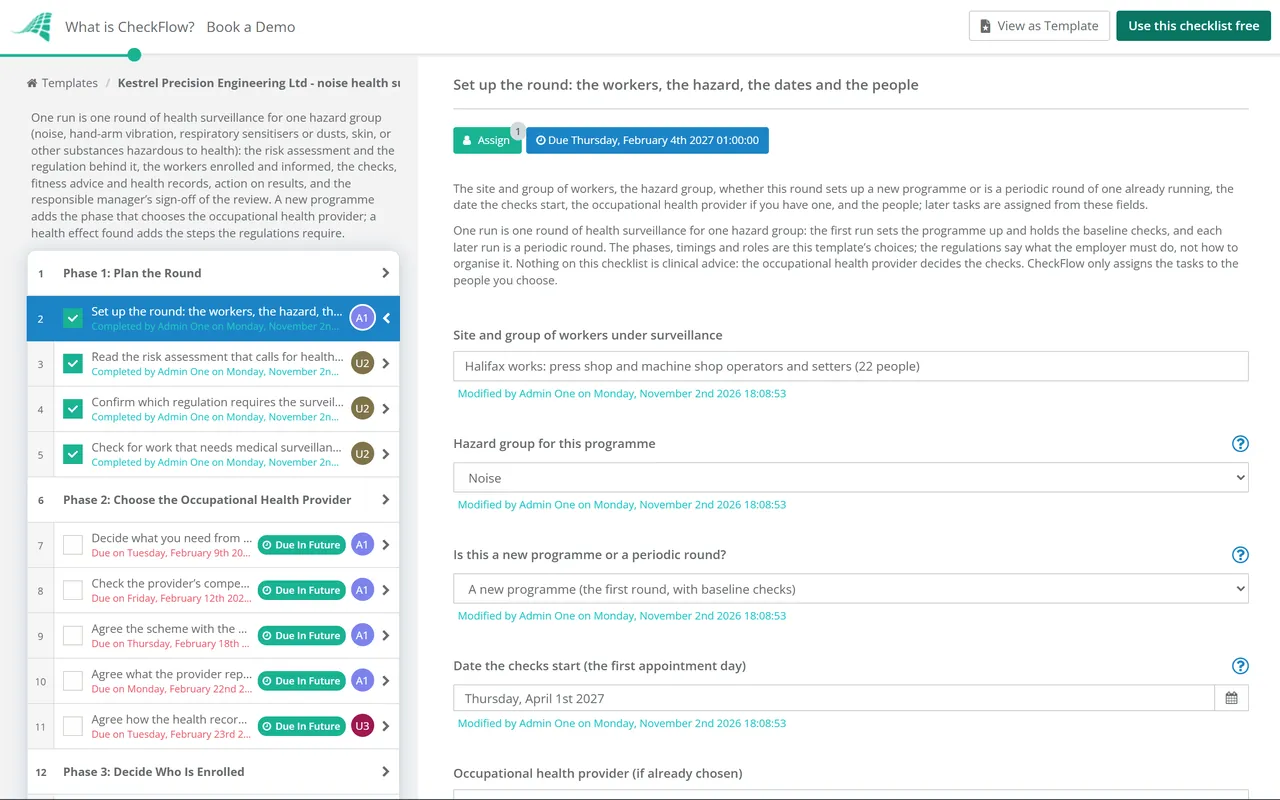
    Owned by the programme lead. Enter the date the checks start on the first task: every due date counts from it in working days. Choose the hazard group and whether this round sets up a new programme or is a periodic round, and the tasks for each answer appear.

    • Set up the round: the workers, the hazard, the dates and the people — the site and group of workers, the hazard group, whether this round sets up a new programme or is a periodic round of one already running, the date the checks start, the occupational health provider if you have one, and the people; later tasks are assigned from these fields
    • Read the risk assessment that calls for health surveillance — the assessment of this work, its date, the controls in place and the risk to health that remains after them; health surveillance follows from the assessment and does not replace the controls
    • Confirm which regulation requires the surveillance — the regulation for this hazard and its test, and why the test is met for this group; the note below shows the regulation for the hazard on the first task
    • Check for work that needs medical surveillance by an appointed doctor — asbestos, lead, ionising radiation, work in compressed air and the substances and processes in Schedule 6 of COSHH need medical surveillance under their own regulations, by a doctor appointed by HSE; this checklist does not cover them
    • Read the last round’s review and its open actions — shown only for a periodic round: the last round’s signed-off review and any conditions, actions still open, workers due a check, and any change to the work, the controls or the risk assessment since
    • Check the provider and the scheme still fit — shown only for a periodic round: the provider’s contract and staff, the checks and intervals the provider advised, and whether a change in the work means the scheme should change
    • Arrange the medical surveillance outside this checklist — shown only when some of the work needs medical surveillance: book it with an appointed doctor under the regulation that requires it, and keep its records under that regulation; it runs alongside this programme
  2. Phase 2 — New Programme

    Phase 2: Choose the Occupational Health Provider

    5 tasks

    Applies only when this round sets up a new programme. HSE says a scheme should usually be set up with input from a competent occupational health professional: choose one, agree the scheme, and agree what you will see and what stays confidential.

    • Decide what you need from an occupational health provider — in-house or an external provider, every health hazard the group is exposed to, the number of workers, their shifts and sites, and who will lead and manage the scheme
    • Check the provider’s competence for this hazard — training and experience in health surveillance for this hazard, suitably qualified staff for the checks, and reports on each worker’s fitness to continue the work; if a GP offers the service, check they are competent in occupational medicine
    • Agree the scheme with the provider — the checks for this hazard and how often, the baseline for new starters, who leads the scheme, roles and how you communicate, and how results reach you; the provider advises the checks, and this template prescribes none
    • Agree what the provider reports to you and what stays confidential — each worker’s fitness for the task with the exposure and when their next check is due, for the health record; clinical notes and test results stay in the medical record the provider keeps, and you see them only with the worker’s written consent
    • Agree how the health records are held — who in your organisation sees the health records, where they are kept, how they are kept secure and for how long; information about workers’ health is covered by data protection law
  3. Phase 3

    Phase 3: Decide Who Is Enrolled

    11 tasks

    Everyone the assessment shows is exposed or liable to be exposed goes on the list, including new starters and people changing jobs. The hazard on the first task adds a task to agree its checks with the provider, and a trained employee doing some checks adds their training.

    • List the workers who need health surveillance — everyone in the group the risk assessment shows is, or is liable to be, exposed, with their job, the work that exposes them, when they were last checked and whether they are due this round
    • Include new starters and people changing jobs — a baseline check before, or as soon as possible after, exposure starts, so later checks have something to compare with; agree how HR tells the programme lead when someone joins or moves into the work
    • Plan for shift, part-time, agency and remote workers — when and where each of them can be checked in working time, and for agency workers, who arranges their checks and who keeps their record, agreed with the agency
    • Tell the provider about workers who may be at particular risk — anyone the provider should see first, such as someone who already has hearing loss before noise work or a circulatory condition before vibration work, as HSE describes; record only who was referred, never why
    • Agree this round’s checks and who does them — the checks the provider advised for this round, who carries out each one, and whether a trained employee (a responsible person) does some of them, such as questionnaires or skin inspections, passing what they find to the provider
    • Noise: agree the hearing checks — shown for noise: hearing checks in controlled conditions by someone with the appropriate training, the programme under the control of an occupational health professional, workers told their results, and a doctor’s examination where hearing damage is found, as HSE describes
    • Hand-arm vibration: agree the questionnaires and referrals — shown for hand-arm vibration: the screening questionnaires HSE publishes, who gives them, how positive answers are referred to the provider, and the higher-level checks the provider’s qualified staff carry out
    • Respiratory: agree the questionnaires and any examinations — shown for respiratory sensitisers or dusts: the questionnaires the provider uses, who gives them, how answers reach the provider, and any examination by a doctor or trained nurse the provider advises
    • Skin: agree the skin checks and who does them — shown for substances that harm the skin: a baseline skin assessment, then regular skin inspections by a trained responsible person or an annual questionnaire, depending on the level of risk HSE describes, and how findings reach the provider
    • Other substances: ask the provider about the checks and biological monitoring — shown for other substances hazardous to health: the checks the provider advises for the substance, and whether biological monitoring (measuring a substance or its breakdown products in a sample such as urine or blood) has a role
    • Train or refresh the responsible person — shown when a trained employee does some checks: training and ongoing support from the provider, what they look for, how they record findings and pass them on, and that they do not interpret them
  4. Phase 4

    Phase 4: Inform and Consult the Workers

    5 tasks

    HSE says health surveillance only works with workers’ co-operation. Consult before the checks start, tell every worker what the scheme is for and what happens to the results, and record consent wherever clinical information is to be shared.

    • Consult the safety representatives and the workers — the health hazards, the controls, the scheme and how the results will be used, with the trade union safety representative or employee representative and the workers concerned, before the checks start
    • Tell each worker what the scheme is for and what happens to the results — why surveillance is needed, what the checks involve as the provider describes them, who sees which results, what will happen if ill health is found, and that they can see their own health record
    • Explain the duty to attend, in working time and at the employer’s cost — each worker must attend when required, during working hours and at the employer’s cost; tell them what action you may take if someone refuses, as HSE advises
    • Tell workers how to report symptoms between checks — the symptoms to watch for that the provider and HSE describe for this hazard, and whom to tell straight away, without waiting for the next check
    • Record written consent where clinical information is to be shared — the health record holds fitness advice, not clinical information; where a worker agrees to share anything more with you, or you need to see their medical record, get their written consent first and keep it
  5. Phase 5

    Phase 5: Hold the Checks

    5 tasks

    The checks start on the date on the first task. Book everyone in working time, hold the checks, follow up anyone who misses one, and wait for the provider’s report: until it arrives, the round is not complete.

    • Book every worker’s appointment — a time in working hours for each worker due this round, with cover for their work, and the provider’s visit or clinic confirmed
    • Hold the checks — the provider’s staff carry out the checks agreed for this round; record who attended and who did not
    • Hold the responsible person’s checks — shown when a trained employee does some checks: the questionnaires or inspections done as trained, with what they found recorded and passed to the provider without interpretation
    • Follow up anyone who missed a check — a new appointment for each worker who was absent or refused, with the reason recorded and the action the scheme sets out if someone refuses
    • Receive the provider’s report on the round — fitness for the task for each worker and when their next check is due; HSE says the surveillance is not complete until you have this feedback
  6. Phase 6

    Phase 6: Fitness Advice, Health Records & Action on Results

    10 tasks

    The provider’s fitness advice goes into each worker’s health record; clinical results stay with the provider. Where a check finds a health effect linked to the work, the tasks the regulations require appear.

    • Record each worker’s fitness advice — fit, fit with restrictions or not fit for the task with the exposure, as the provider advises, any restriction advised and when the next check is due; no clinical details
    • Noise: make sure a worker with hearing damage is examined by a doctor — shown for noise: where a check finds identifiable hearing damage, the worker is examined by a doctor, who may refer them to a specialist; the steps that follow apply if the doctor or specialist considers the damage likely to be the result of noise
    • Make sure the worker is told by a suitably qualified person — shown when a check found a health effect: a suitably qualified person tells the worker and, under COSHH and the vibration regulations, gives information and advice on further health surveillance; for noise, record the doctor’s examination first, in the task before this one
    • Check whether a diagnosis must be reported under RIDDOR — shown when a check found a health effect: occupational asthma, occupational dermatitis, hand-arm vibration syndrome and carpal tunnel syndrome are among the diseases reportable when linked to the work RIDDOR lists, once the employer receives a doctor’s diagnosis
    • Consider alternative work for the worker — shown when a check found a health effect: work with no risk of further exposure, taking into account the advice of the doctor or occupational health professional
    • Keep a health record for each worker — the worker’s details, where they work, the hazards they are exposed to and their fitness to continue, kept for at least the period the regulation sets; no confidential medical information without the worker’s written consent
    • Review the risk assessment — shown when a check found a health effect: the assessment reviewed in the light of the result, with the date and what changed
    • Give workers access to their own health record — on reasonable notice, and copies to the enforcing authority when it asks; offer a worker a copy of their record when they leave, as HSE suggests
    • Review the controls, taking the provider’s advice into account — shown when a check found a health effect: the measures that control the exposure reviewed, with any advice from the doctor, the occupational health professional or HSE, and the changes made
    • Review the health of others similarly exposed — shown when a check found a health effect: a review of the health of the other employees who have been similarly exposed, including a medical examination where one is recommended
  7. Phase 7

    Phase 7: Review the Round

    5 tasks

    Look at the round as a whole: grouped results, what they say about the controls, the collective results shared with the workers and the next round booked. Then the responsible manager signs off the review. Nothing after the sign-off can be completed until it is done.

    • Review grouped results with the provider — results for groups of workers doing similar work, in groups large enough to protect each worker’s anonymity, to see how well the controls work
    • Record what the round shows about the controls — whether the results show the controls working, and any change to the risk assessment or the controls they point to; where a health effect was found, the reviews in Phase 6 come first
    • Share the collective results with the workers — the results for the group in a form that cannot be linked to any one person, given to the workers and their representatives
    • Book the next round — the date of each worker’s next check at the interval the provider advised, and the date the next round’s checklist starts
    • Responsible manager signs off the round’s review — the checks held, the health records kept, any action on the results done, the collective results shared and the next round booked; nothing after this task can be completed until it is signed off
  8. Phase 8

    Phase 8: Close the Round

    4 tasks

    After the sign-off: complete what was missing or meet the conditions, send the summary to the provider and the safety representatives, and close the round.

    • Not approved: complete what is missing and bring it back — shown when the review is not approved: finish the tasks or records the manager named, then change the decision on the sign-off, or un-complete it and complete it again
    • Send the round’s summary to the provider and the safety representatives — the grouped results, the actions taken and the next round’s dates, with nothing that links a clinical result to a worker
    • Meet the conditions of the sign-off — shown when the review is approved with conditions: each condition met and recorded, and the responsible manager told
    • Close the round and file the records — the provider’s report, the health records updated, the reviews and the sign-off filed, and the next round’s checklist started from its date

Health Surveillance Law, Hazard by Hazard

Which regulation covers which hazard

Phase 1 records the hazard group and shows the note for its regulation. The record periods come from the regulations themselves.

Hazard Regulation (Great Britain) When surveillance applies Health record kept
NoiseControl of Noise at Work Regulations 2005, regulation 9The risk assessment indicates a risk to health; it includes testing of hearing. HSE: employees likely to be regularly exposed above the upper exposure action values (85 dB(A) daily or weekly, or a 137 dB(C) peak), or at risk for any reason.Kept available in a suitable form; no period set (regulation 9(2))
Hand-arm vibrationControl of Vibration at Work Regulations 2005, regulation 7The risk assessment indicates a risk to health, or exposure is likely at or above the exposure action value (2.5 m/s² A(8)), and the regulation 7(2) tests are met.Kept available in a suitable form; no period set (regulation 7(3))
Respiratory sensitisers and dustsCOSHH 2002, regulation 11Where appropriate: a disease or adverse health effect may be related to the exposure, is reasonably likely under the conditions of the work, and valid, low-risk techniques can detect it. HSE: everyone exposed or likely to be exposed to an asthmagen.At least 40 years from the last entry (regulation 11(3))
Substances that harm the skinCOSHH 2002, regulation 11The same tests. HSE examples: skin sensitisers, previous cases of work-related skin disease, reliance on gloves.At least 40 years from the last entry (regulation 11(3))
Other substances hazardous to healthCOSHH 2002, regulation 11The same tests. The substances and processes in Schedule 6 also need medical surveillance under a relevant doctor at least every 12 months (outside this checklist).At least 40 years from the last entry (regulation 11(3))
Any other health riskManagement of Health and Safety at Work Regulations 1999, regulation 6Such health surveillance as is appropriate, having regard to the risks the assessment identifies.No period set; HSE says at least while you employ the worker

What the employer keeps, and what stays confidential

The employer sees fitness advice, not clinical results. Phases 2, 4 and 6 set this up and keep to it.

Record Who keeps it What it holds Who sees it
Health recordThe employerThe worker’s details, where they work, the hazards they are exposed to and their fitness to continueThe employer; the worker on reasonable notice; the enforcing authority on request
Medical recordThe occupational health professionalClinical notes, test results and other information about the worker’s healthThe provider; the employer only with the worker’s written consent
Fitness adviceThe provider sends it to the employerFitness for the task with the exposure, and when the next check is dueEntered in the health record
Collective resultsThe employerResults for the group in a form that cannot identify anyoneGiven to the workers as part of their information

Where this comes from. The regulations as published on legislation.gov.uk: COSHH regulation 11, Noise regulation 9, Vibration regulation 7 and Management Regulations regulation 6, and HSE’s guidance on health surveillance and record keeping. They apply in England, Wales and Scotland. Northern Ireland has its own regulations, enforced by HSENI; in Ireland, see the Health and Safety Authority. In the US, OSHA sets its own medical surveillance requirements, such as the hearing conservation program in 29 CFR 1910.95; this checklist does not cover them.

Not on this checklist. Medical surveillance by a doctor appointed by HSE for asbestos, lead, ionising radiation, work in compressed air and the COSHH Schedule 6 substances and processes runs under its own regulations. Phase 1 asks whether any of the group’s work needs it.

Why Run Health Surveillance in CheckFlow?

1

Nothing missed when a check finds a problem

Record that a check found a health effect linked to the work, and the steps the regulations require appear, each with an owner and a date: the worker told by a suitably qualified person, a RIDDOR check, alternative work considered, the risk assessment and the controls reviewed, and others similarly exposed reviewed. All of them come before the responsible manager’s sign-off.

2

Only the tasks this round needs

The hazard group adds its regulation and a task to agree its checks. A new programme adds the phase that chooses the provider; a periodic round adds a look back at the last one. Work that needs an appointed doctor, and a trained employee doing some checks, each add their own task.

3

Every round on record

Name the programme lead, the responsible manager, the health and safety adviser, HR and the supervisor on the first task, and every task is assigned from those fields. Due dates count from the date the checks start. The worker list, attendance and fitness advice stay on the tasks they came from, and the Reports Grid lists every round with its answers, while Analytics shows where tasks are waiting.

CheckFlow does not hold medical records or decide whether a worker is fit for work: the occupational health provider does that, and keeps the clinical results. Keep only fitness advice on the checklist. CheckFlow makes sure every round gets the same steps in the same order, with an owner and a due date for each, a sign-off at the end, and a record of who did what and when. See CheckFlow’s compliance checklist software.

Assess substances with the COSHH Assessment Checklist and other hazards with the Health & Safety Risk Assessment Checklist or the Job Hazard Analysis (JHA) Checklist. Investigate a case of work-related ill health with the Workplace Accident Investigation Checklist, and bring a worker back after time off with the Return-to-Work Checklist.

AI generator

Didn’t find what you need? Describe it.

Describe the process in a sentence and the AI checklist generator drafts the phases and tasks for you.

Frequently Asked Questions

What is health surveillance at work?

HSE describes it as a scheme of repeated health checks used to identify ill health caused by work. HSE says the law requires it when workers remain exposed to health risks after controls are in place, because controls may not always be reliable. It is not the same as health screening or health promotion. Examples are hearing checks for noise, questionnaires for hand-arm vibration, and skin or breathing checks for substances. This template runs one round for one hazard group.

Who needs health surveillance for noise or vibration?

For noise, HSE says employees likely to be regularly exposed above the upper exposure action values (85 dB(A) daily or weekly, or a 137 dB(C) peak), or at risk for any reason. For hand-arm vibration, employees likely to be regularly exposed above the exposure action value of 2.5 m/s² A(8), or at risk for any other reason. The duties are in regulation 9 of the Noise Regulations and regulation 7 of the Vibration Regulations.

Who can carry out health surveillance?

HSE says schemes should usually be set up with input from a competent occupational health professional, and if a GP offers the service, you need to be sure they are competent in occupational medicine. For some hazards, such as skin inspections or basic vibration questionnaires, a trained employee (a responsible person) can do part of the work and pass findings to the provider without interpreting them. Phase 2 of this template checks the provider’s competence.

What can an employer see from health surveillance results?

Fitness advice: whether each worker is fit for the task with the exposure, any restriction, and when their next check is due. That goes into the health record. Clinical notes and test results stay in the medical record the occupational health professional keeps, and the employer sees them only with the worker’s written consent. Workers are also given the collective results, in a form that cannot identify anyone.

How long must health surveillance records be kept?

Under COSHH, a health record is kept for at least 40 years from the date of the last entry (regulation 11(3)). The noise and vibration regulations require a health record kept available in a suitable form but set no period; HSE says to keep it at least while you employ the worker. Medical surveillance regimes such as asbestos and lead have their own rules. This template’s health record task lists the rule for each hazard.

Can an employee refuse health surveillance?

The COSHH, noise and vibration regulations each say an employee must attend the health surveillance procedures required, when their employer requires it, during working hours and at the employer’s cost. HSE advises telling workers what action you may take if they refuse, and explaining why surveillance matters and what happens to the results. This template explains the duty in Phase 4 and follows up missed checks in Phase 5.

What must an employer do when health surveillance finds a problem?

Where a check finds a health effect linked to the exposure, the regulations require the employer to make sure a suitably qualified person tells the worker, to review the risk assessment and the controls, to consider alternative work with no further exposure, and to review the health of others similarly exposed. For noise, the worker is first examined by a doctor. Some diagnosed diseases must also be reported under RIDDOR.

Is health surveillance the same as medical surveillance?

Not quite. Medical surveillance is a stricter form of health surveillance, done by a doctor appointed by HSE, that the law requires for work with asbestos, lead, ionising radiation and compressed air (each under its own regulations) and for the substances and processes in Schedule 6 of COSHH (regulation 11(5)). This template does not cover it: Phase 1 asks whether any of the group’s work needs it, and adds a task to arrange it separately.

How often should health surveillance be done?

The occupational health provider advises the interval for each hazard and worker. HSE describes hearing checks usually every year for a worker’s first two years and then every three years, and for skin it says a brief monthly inspection routine is often appropriate where the risk is higher. This template runs one round per checklist and books the next round before the review is signed off.

Is CheckFlow free for this template?

14-day free trial, no card required. The Business plan is $10 per user per month after the trial. Full details at checkflow.io/pricing.

Run Every Round of Health Surveillance the Same Way

Free trial — no credit card required.

14-day free trial, no credit cardFull refund in your first 30 daysUS hosting, EU on request