COSHH Assessment Checklist Template

Most COSHH assessments are a folder of safety data sheets. The dust and fume the work makes are never listed, the extraction has not been examined for years, and nobody has decided whether the people breathing it need health surveillance.

Last reviewed: October 2026

Every employer in Great Britain whose work could expose employees to a substance hazardous to health must assess the risk first, under the Control of Substances Hazardous to Health Regulations 2002. This free COSHH assessment checklist is for health and safety leads, site and workshop managers and supervisors who assess a workplace, area or task and then have to show the controls work. One run is one assessment. It plans the assessment, builds an inventory of the substances, including the dusts and fumes the work produces, and assesses who is exposed, by which route, how much and how often. It then prevents exposure where it can and adequately controls the rest, sets the maintenance, monitoring and health surveillance the regulations require, and covers training and emergencies before the findings are recorded, signed off and reviewed. A local exhaust ventilation phase appears when LEV is used, and tasks for carcinogens, mutagens and asthmagens and for health surveillance appear when they apply.

A COSHH Assessment Goes Substance by Substance

Regulation 6 of the Control of Substances Hazardous to Health Regulations 2002 (COSHH) says an employer shall not carry out work that is liable to expose employees to a substance hazardous to health until they have made a suitable and sufficient assessment of the risk to those employees, and of the steps needed to meet the regulations, and have put those steps in place. Substances hazardous to health include those that meet the criteria for a health hazard classification, anything with a workplace exposure limit, biological agents, and dust of any kind at or above set concentrations in air. The HSE adds that some are produced by the work itself, such as wood dust from sanding and fumes from welding.

A COSHH assessment is narrower and deeper than a general health and safety risk assessment. It goes substance by substance: who is exposed, by which route, how much and how often, whether exposure can be prevented, whether the controls are adequate, and what the regulations then require on maintenance, local exhaust ventilation, monitoring, health surveillance, training and emergencies. Fire and explosion risks from flammable substances belong in the fire risk assessment. Draining and isolating lines that hold hazardous substances before maintenance is part of a lockout procedure, and an ISO 45001 management system runs all of them as a yearly cycle.

COSHH assessment

Covers substances hazardous to health

Asks: which substances are present or produced, who is exposed and how, and is exposure prevented or adequately controlled?

When: before the work starts, reviewed regularly, and straight away after a significant change or when monitoring shows it is needed.

Output: the significant findings, the steps taken to prevent or control exposure, and the decisions on LEV, monitoring and health surveillance.
General risk assessment

Covers every other hazard at work

Asks: what else could cause harm here, from machinery and manual handling to work at height and stress?

When: for each workplace or activity, under the Management of Health and Safety at Work Regulations 1999.

Output: an action plan for all hazards, which points to the COSHH assessment for substances.

Fire risk assessment

Covers flammable substances as a fire risk

Asks: what could start a fire, what would burn, and would everyone get out?

When: reviewed regularly and after a significant change, by the responsible person for the premises.

Output: fire precautions and an emergency plan. COSHH does not apply where a substance is hazardous only because it is flammable.

What the COSHH Assessment Checklist Covers

Eight phases take one COSHH assessment from planning to review: prevention first, then adequate control, then the checks the regulations require. Phase 5 appears only when local exhaust ventilation is used, the tasks for carcinogens, mutagens and asthmagens and for health surveillance appear only when they apply, and Phase 8 shows the recording rule that fits the employer’s headcount.

  1. Phase 1

    Phase 1: Plan the Assessment

    5 tasks

    Decide what the assessment covers and gather the information before you look at the work. Lead and asbestos have their own regulations and are not assessed here.

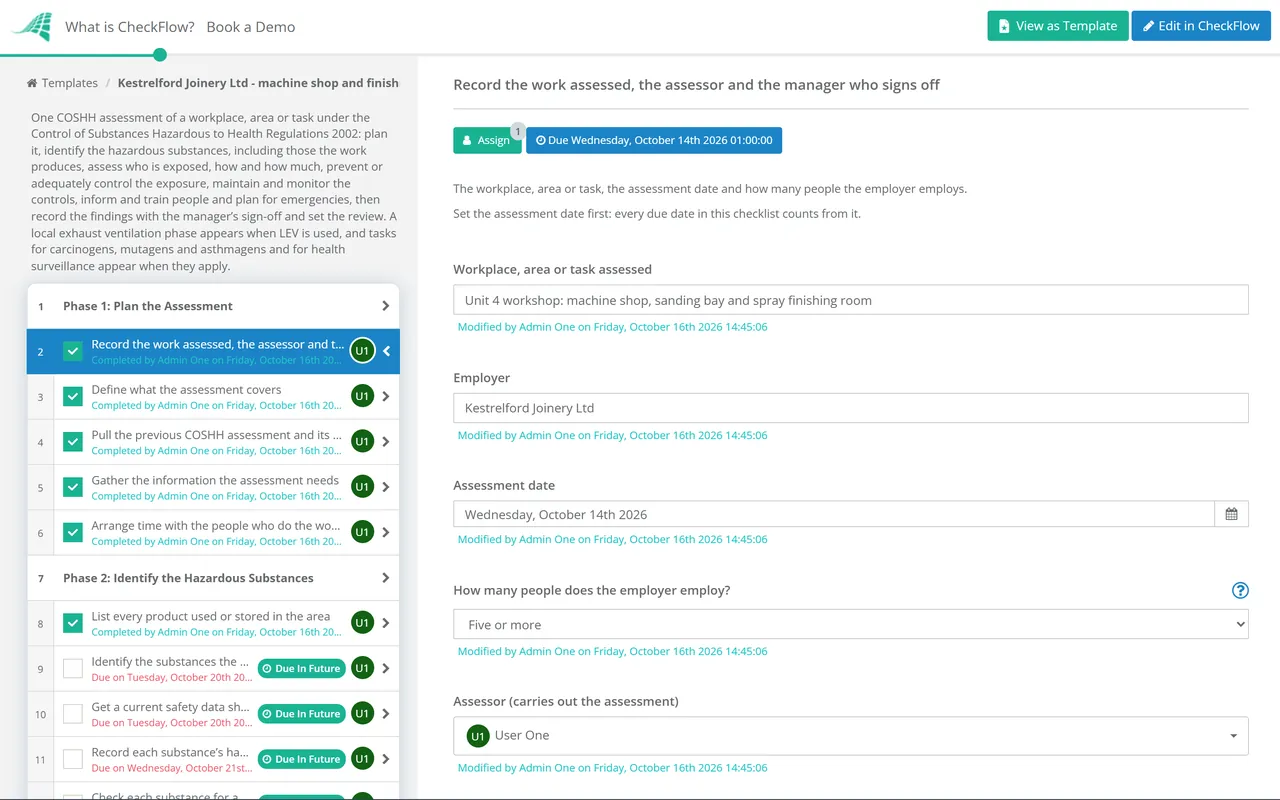
    • Record the work assessed, the assessor and the manager who signs off — the workplace, area or task, the assessment date and how many people the employer employs
    • Define what the assessment covers — the processes, tasks, areas and shifts in scope, including cleaning and maintenance, and whether local exhaust ventilation is used
    • Pull the previous COSHH assessment and its open actions — which actions were completed, which slipped and which were never started
    • Gather the information the assessment needs — safety data sheets, LEV examination reports, exposure monitoring results, the collective results of health surveillance, and ill-health and accident records
    • Arrange time with the people who do the work and their safety representatives — operators, supervisors, cleaners and maintenance staff, who know how the substances are really used
  2. Phase 2

    Phase 2: Identify the Hazardous Substances

    6 tasks
    • List every product used or stored in the area — walk the stores and work areas, and record each product, its supplier, where it is used and how much is kept
    • Identify the substances the work produces — dusts, fumes, vapours, mists and gases from cutting, sanding, grinding, welding, mixing, heating, spraying or cleaning
    • Get a current safety data sheet for each product — ask the supplier for any that are missing, out of date or incomplete
    • Record each substance’s hazard classification — the hazard pictograms and hazard statements on the label and safety data sheet, and the health effects they warn of
    • Check each substance for a workplace exposure limit — in EH40/2005 Workplace exposure limits, noting the limit and its reference period
    • Build the substance inventory — one line per substance, so the next phases can work through them in order
  3. Phase 3

    Phase 3: Assess Who Is Exposed, How and How Much

    6 tasks

    Regulation 6(2) lists what the assessment must consider, including the level, type and duration of exposure, the circumstances of the work and activities such as maintenance where exposure can be high.

    • Identify who could be exposed — employees by task and shift, and maintenance workers, cleaners, contractors, visitors or members of the public
    • Work out how each substance could get into the body — breathed in, onto or through the skin, swallowed, or into the eyes, and the effect of each route
    • Estimate how much, how often and for how long — the quantity used, how long each task lasts and how many times a day, week or month it is done
    • Look at the tasks where exposure can be highest — maintenance, cleaning, filter changes, emptying dust collectors, breakdowns and spills
    • Record what is already done to control exposure — the controls seen in use on the day, not only the ones written in procedures
    • Rate the risk for each substance and task — how likely harm is and how serious it could be with the existing controls, including any combined risk from more than one substance
  4. Phase 4

    Phase 4: Prevent Exposure, Then Control It

    8 tasks

    Regulation 7 puts prevention first: exposure must be prevented or, where that is not reasonably practicable, adequately controlled. Substitution is the preferred way to prevent it, and PPE comes last.

    • Ask whether each substance or process is needed at all — can the job be done another way, or the process changed so the substance is not used or produced
    • Substitute a safer substance or process — one that removes or reduces the risk under the conditions of use, such as a water-based product for a solvent-based one, brushing rather than spraying, or pellets instead of powder
    • Check the controls against the principles of good practice — the eight principles in Schedule 2A, which must be applied before control can be treated as adequate
    • Control exposure at source — work processes, enclosure, closed transfer, on-tool extraction and local exhaust ventilation, before measures that rely on people
    • Set the working practices that reduce exposure — fewer people exposed, shorter tasks, less substance kept, safe storage, handling and waste, general ventilation, cleaning, and washing facilities
    • Apply the extra measures for carcinogens, mutagens and asthmagens — shown only when Phase 2 flags one; reduce exposure to as low a level as is reasonably practicable and, for carcinogens and mutagens, apply the regulation 7(5) measures
    • Provide PPE where exposure cannot be adequately controlled by other means — gloves, eye protection and protective clothing chosen for the substance and the job, worn in addition to the other controls
    • Select RPE and have each wearer face-fit tested — a tight-fitting facepiece must fit its wearer: test at selection, by a competent person, for each type of facepiece worn
  5. Phase 5 — If LEV Used

    Phase 5: Local Exhaust Ventilation

    5 tasks

    Shown only when Phase 1 records that LEV is used or planned. Regulation 9 requires a thorough examination and test of LEV at least once every 14 months, or at the shorter interval Schedule 4 sets for certain processes.

    • List every LEV system and hood the controls rely on — where each one is, the process it serves and the substances it extracts
    • Check the user checks and airflow indicators — operators can see whether each hood is drawing properly, and the log book records the checks, faults and repairs
    • Confirm the thorough examination and test is in date — at least once every 14 months, or at the Schedule 4 interval; if one is due, book a competent examiner and give them the system’s intended performance
    • Act on the examination report — repair any hood or system that failed and have a competent person confirm it controls exposure before relying on it again
    • Keep the examination and repair records — a suitable record or summary of each examination, test and resulting repair, kept for at least 5 years
  6. Phase 6

    Phase 6: Maintenance, Monitoring & Health Surveillance

    8 tasks

    Controls stop working unless someone looks after them. The health surveillance tasks appear only when the answer to “Is health surveillance required?” is Yes.

    • Set the maintenance and checks for every control — plant and equipment kept in efficient working order, in good repair and clean, and systems of work and supervision reviewed at suitable intervals
    • Check how PPE and RPE are stored, checked and examined — a defined place to store PPE, checks at suitable intervals, thorough examination of RPE that is not disposable, and contaminated PPE kept apart and cleaned or destroyed
    • Decide whether exposure monitoring is needed — where the assessment shows it is needed to keep control adequate or to protect health, for example to show exposure stays below a WEL
    • Arrange the monitoring and record the results — at regular intervals and after any change that may affect exposure; keep records of identifiable employees’ personal exposures for 40 years and other records for 5
    • Decide whether health surveillance is required — where a disease or health effect may be related to the exposure, is reasonably likely under the conditions of the work, and can be detected by valid, low-risk techniques
    • Set up health surveillance with an occupational health professional — shown only when health surveillance is required: who is included, the checks and how often, and a baseline before or soon after exposure starts
    • Keep a health record for each employee under surveillance — kept for at least 40 years from the last entry, and separate from the confidential medical records the occupational health professional holds
    • Act on the health surveillance results — review the assessment and the controls, consider alternative work for anyone affected, and review the health of others similarly exposed
  7. Phase 7

    Phase 7: Information, Training & Emergencies

    5 tasks

    Regulation 12 sets what employees must be told and trained in. Regulation 13 requires plans for accidents, incidents and emergencies involving the substances, unless the assessment shows only a slight risk because of the quantities present and the controls are sufficient.

    • Inform and train everyone who works with the substances — the substances’ names and risks, any WEL, access to the safety data sheets, the precautions to take and how to use the controls and PPE, including for cleaning and maintenance staff
    • Make sure containers and pipes are labelled — the contents, their nature and any hazards clearly identifiable, including products decanted into other containers
    • Brief contractors and find out what they bring on site — the risks and how they are controlled, and the hazardous substances contractors bring and how they will protect your workers
    • Prepare the procedures for spills, accidents and emergencies — spill kits and decontamination products, first-aid arrangements, the people trained to act, the waste from a clean-up, and the warning and communication systems
    • Test the procedures and share them with the emergency services — run the safety drills at regular intervals, give the emergency services the information they need, and display it at the workplace where appropriate
  8. Phase 8

    Phase 8: Record, Sign Off & Review

    6 tasks

    With five or more employees, regulation 6(4) requires the significant findings, and the steps taken to meet regulation 7, to be recorded as soon as is practicable. Regulation 6(3) requires a review regularly and straight away when a trigger occurs.

    • Record the significant findings and the steps taken — the substances, who is exposed and how, the controls in place, and the decisions on LEV, monitoring and health surveillance
    • Write the action plan — each further action with who carries it out and when it is needed by, the highest risks first
    • Manager signs off the assessment and action plan — before the findings are shared, with the decision and any conditions recorded
    • Share the findings with employees and their representatives — the significant findings, the results of any monitoring and the collective results of health surveillance, in a form that identifies nobody
    • Track each action and close it with evidence — a photo, an examination report or a training record on this task, and a new date for any action that slips
    • Set the review date and the triggers for an earlier review — a regular review date, and straight away if the assessment may no longer be valid, the work changes significantly or monitoring shows a review is needed

What Each COSHH Regulation Requires

Regulation 6 asks for an assessment of the steps needed to meet the regulations, so a COSHH assessment is only finished when it has an answer for each of regulations 7 to 13. The HSE’s own summary of the job is the same: gather information about the substances, the work and the working practices, evaluate the risks to health, decide on the measures needed to comply with regulations 7 to 13, record the assessment if you have five or more employees, and decide when it needs to be reviewed. Use the table to check nothing was left out.

Regulation What it requires Where the checklist covers it
6. AssessmentA suitable and sufficient assessment before the work starts, considering among other things the hazardous properties, the supplier’s safety data sheet, the level, type and duration of exposure, high-exposure activities such as maintenance, any WEL, and monitoring and health surveillance results. Reviewed regularly and straight away when a trigger occurs. With five or more employees, the significant findings and the steps taken to meet regulation 7 are recorded.Phases 1 to 3 and 8
7. Prevention or controlPrevent exposure, by substitution by preference, or where that is not reasonably practicable control it adequately: work processes and engineering controls first, then control at source including ventilation, then suitable PPE where adequate control cannot be achieved by other means.Phase 4
7(7) and Schedule 2A. Adequate controlControl is adequate only if the eight principles of good practice are applied, any WEL is not exceeded, and exposure to carcinogens, mutagens and asthmagens is reduced to as low a level as is reasonably practicable.Phases 2 and 4
8. Use of controlsThe employer takes all reasonable steps to make sure controls are used. Employees use them and report any defect straight away.Phase 3
9. Maintenance, examination and testingPlant and equipment kept in efficient working order and clean. LEV thoroughly examined and tested at least once every 14 months, or at the Schedule 4 interval. Non-disposable RPE examined at suitable intervals. Records kept for at least 5 years.Phases 5 and 6
10. Monitoring exposureMonitoring where the assessment shows it is needed, at regular intervals and after any change. Records of identifiable employees’ personal exposures kept for at least 40 years, others for at least 5.Phase 6
11. Health surveillanceSuitable health surveillance where it is appropriate, with a health record for each employee kept for at least 40 years. Medical surveillance for the Schedule 6 substances and processes.Phase 6
12. Information, instruction and trainingThe substances and their risks, any WEL, access to safety data sheets, the significant findings, the precautions to take, monitoring results and the collective results of health surveillance. Containers and pipes identifiable.Phases 7 and 8
13. Accidents, incidents and emergenciesProcedures, first-aid facilities and safety drills tested at regular intervals, emergency information and warning systems, shared with the emergency services. Not required where the assessment shows only a slight risk because of the quantities present and the controls are sufficient.Phase 7

What COSHH does not cover. Lead and asbestos have their own regulations. COSHH also does not apply where a substance is hazardous only because it is radioactive, explosive or flammable, or only because it is at a high or low temperature or a high pressure (regulation 5). A solvent that is both flammable and harmful to health is assessed here for its health effects.

Where it applies. The 2002 Regulations extend to England, Wales and Scotland. Northern Ireland has its own Control of Substances Hazardous to Health Regulations (Northern Ireland) 2003, with the same five-employee recording rule and the same 14-month LEV examination interval. Workplace exposure limits for Great Britain are listed in the HSE’s EH40/2005, which COSHH makes legally binding.

Why Run COSHH Assessments in CheckFlow?

1

Reviews and examinations start on time

A recurring schedule starts the review of each area’s COSHH assessment on the date you set, assigned to the assessor. The LEV phase records the date the next thorough examination and test is due, and a change in the work starts its own run from the same template the same day.

2

The manager signs off before the findings go out

The manager is chosen on the first task. The sign-off is assigned to them alone, and nothing after the sign-off step can be completed until they record a decision and any conditions.

3

One template for every area

A print room with solvent wash and an office with cleaning products run the same checklist. The LEV phase appears only where extraction is used, and the carcinogen and health surveillance tasks appear only where the answers say they apply. The Reports Grid shows every assessment in progress and the tasks that are overdue.

CheckFlow does not decide whether exposure is adequately controlled. That judgement is yours, recorded in the tables on each task, with the data sheets, examination reports and fit test certificates attached where they were produced. It runs the assessment around it: who does what, by when, and who signed it off. CheckFlow’s compliance checklist software shows how the same approach handles recurring inspections and reviews.

Assess the other hazards in the same workplace with the Health & Safety Risk Assessment Checklist, and fire with the Fire Risk Assessment Checklist. Isolate and drain plant before maintenance with the Lockout/Tagout Checklist, and run the management system around all of them with the ISO 45001 Checklist.

AI generator

Didn’t find what you need? Describe it.

Describe the process in a sentence and the AI checklist generator drafts the phases and tasks for you.

Frequently Asked Questions

What is a COSHH assessment?

It is the risk assessment that regulation 6 of the Control of Substances Hazardous to Health Regulations 2002 requires before any work that is liable to expose employees to a substance hazardous to health. It identifies the substances, including dusts and fumes the work produces, decides who could be harmed and how, and sets out the steps needed to prevent or adequately control exposure. The HSE says the person doing it needs no particular qualification but must be competent: they must understand hazard and risk, know how the work exposes people, and be able to collect the information and decide on the controls.

Do I have to write a COSHH assessment down?

If you employ five or more people, yes. Regulation 6(4) requires you to record the significant findings as soon as is practicable after the assessment is made, and the steps you have taken to prevent or control exposure under regulation 7. The HSE says that even with fewer than five employees it makes sense to write down what you did. There is no set form: the HSE asks that the record covers the dangers, to whom and doing what task, the controls that could prevent harm, and how they are used and checked.

How often should a COSHH assessment be reviewed?

Regulation 6(3) requires a review regularly, and straight away if there is reason to suspect the assessment is no longer valid, the work has changed significantly, or monitoring results show a review is needed. It sets no fixed interval: the HSE says that depends on the risk, the work and how likely things are to change. A review does not mean repeating the whole assessment. The first question is whether it is still suitable and sufficient, and only the parts that no longer reflect the work need changing.

What does adequate control mean under COSHH?

Regulation 7(7) sets three tests. The eight principles of good practice in Schedule 2A must be applied, any workplace exposure limit for the substance must not be exceeded, and for carcinogens, mutagens and asthmagens exposure must be reduced to as low a level as is reasonably practicable. Control comes after prevention: regulation 7 says to prevent exposure where reasonably practicable, preferably by substitution, and lists the order of controls after that, with PPE last, provided only where adequate control cannot be achieved by other means.

How often does LEV need a thorough examination and test?

At least once every 14 months under regulation 9(2), or more often for the four processes in Schedule 4: every month for blasting to clean metal castings and for jute cloth manufacture, and every six months for certain dry grinding and polishing of metal and for processes that produce non-ferrous metal castings. Keep a record of each examination, test and resulting repair for at least 5 years. The HSE says the examiner must be competent and needs the system’s intended performance, usually from the commissioning report.

When is health surveillance required under COSHH?

Regulation 11 requires it where it is appropriate to protect employees’ health. That is the case where an identifiable disease or adverse health effect may be related to the exposure, is reasonably likely under the conditions of the work, and can be detected by valid techniques that are low risk to the employee. It is also required for the substances and processes in Schedule 6, with medical surveillance under a relevant doctor at least every 12 months. Keep a health record for each employee under surveillance for at least 40 years.

Is a safety data sheet the same as a COSHH assessment?

No. The HSE says a safety data sheet is not a risk assessment, and that collecting data sheets is only the first stage. The sheet describes the hazards of the product and how to handle, store and deal with it in an emergency, but it is not specific to your workplace. The assessment has to look at how the substance is actually used, who is exposed and how much. Substances produced by the work, such as wood dust, have no data sheet at all and still need assessing.

Is CheckFlow free for this template?

14-day free trial, no card required. The Business plan is $10 per user per month after the trial. Full details at checkflow.io/pricing.

Assess Every Hazardous Substance, Then Keep the Controls Working

Free trial — no credit card required.

14-day free trial, no credit cardFull refund in your first 30 daysUS or EU hosting