Client Trust Account Reconciliation Checklist Template

A client account can agree to the bank and still be wrong. A client ledger in debit means another client’s money has paid for it, and a small difference carried forward for three months is a problem nobody has resolved.

Last reviewed: October 2026

This free client trust account reconciliation checklist runs one three-way reconciliation of a law firm’s client account: the bank statement balance, the client cash book balance and the total of the individual client ledgers, agreed at the same date. It is for cashiers, bookkeepers, COFAs and managing partners. The cashier brings the books up to date, lists uncleared items and prepares the statement. Then the checklist works through the checks a client account needs: ledgers in debit, credit balances on the business side, residual and dormant balances, transfers to the office account against bills, withdrawals, interest and any breach found. The COFA, a manager or the responsible lawyer signs it off before the records are filed and the next reconciliation is set. Choose England and Wales (SRA Accounts Rules) or the United States on the first task, and the matching notes appear; US readers are pointed to their own state’s rules. When a matter ends, the Legal Matter Closing Checklist brings its ledger to nil.

A Three-Way Reconciliation, Not Just a Bank Reconciliation

A bank reconciliation proves that the cash book agrees with the bank. A law firm’s client account needs one more step, because the money in it belongs to many clients. The three-way reconciliation also proves that the total of the individual client ledgers equals the cash book and the bank, so every client’s money is accounted for and no client is overdrawn on another client’s money.

This checklist runs one reconciliation for every client account the firm holds, at one date. In England and Wales it follows the SRA Accounts Rules 2019. In the United States the rules come from each state’s rules of professional conduct and state bar, so the US notes tell you what to check rather than giving one state’s answer. It is a working checklist, not legal advice: your regulator’s rules and your own advisers decide what applies to your firm.

This checklist

The client account three-way reconciliation

Covers: the bank statement, the client cash book and the client ledger total agreed at one date, plus debit, residual and dormant balances, transfers for costs, interest, breaches and the sign-off.

Cadence: at least every five weeks in England and Wales; as your state requires in the US.

Output: a signed reconciliation and a list of open items.

Office and business accounts

The Bank Reconciliation Checklist

Covers: matching the firm’s own bank accounts to its ledger, investigating reconciling items and an independent review.

Use it: for the office (business) account and any other account that holds the firm’s own money. Bank Reconciliation Checklist.

One matter ending

The Legal Matter Closing Checklist

Covers: the final bill, taking costs, returning the balance and bringing one client’s ledger to nil when a matter closes.

Use it: for each file you close; the reconciliation then shows no balance left behind. Legal Matter Closing Checklist.

What the Client Trust Account Reconciliation Checklist Covers

Nine phases take one reconciliation from the bank statements to a signed record. The rules you choose on the first task (England and Wales, a US state or elsewhere) show the matching notes. An unexplained difference, a ledger in debit, a balance with no reason to hold it and a breach each add their own tasks. The sign-off is the gate: the records and the next reconciliation wait until it is done.

  1. Phase 1

    Phase 1: Set Up the Reconciliation

    4 tasks

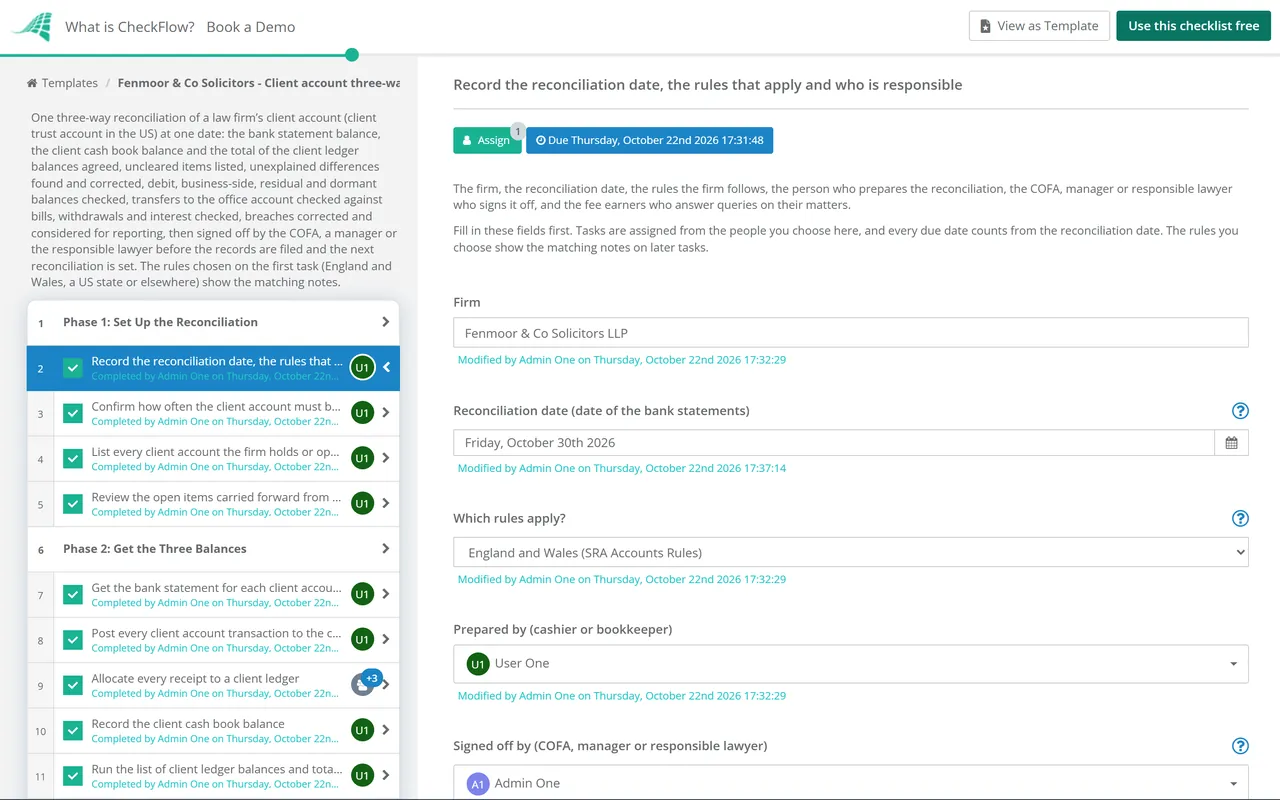
    The cashier starts the run once the bank statements to the reconciliation date are in. Choose the rules that apply on the first task: it shows the matching notes on the tasks where the rules differ. Every due date counts in business days from the reconciliation date.

    • Record the reconciliation date, the rules that apply and who is responsible — the firm, the reconciliation date, the rules the firm follows, the person who prepares the reconciliation, the COFA, manager or responsible lawyer who signs it off, and the fee earners who answer queries on their matters
    • Confirm how often the client account must be reconciled and the deadline for this one — the date of the last reconciliation, the longest gap your rules allow between reconciliations, and the date this one must be finished and signed off
    • List every client account the firm holds or operates — general client accounts, designated deposit accounts for single clients, and any client’s own account the firm operates as signatory, with any account opened or closed since last time
    • Review the open items carried forward from the last reconciliation — every uncleared item, difference and query from last time, whether it has now cleared, and anything still open with its owner
  2. Phase 2

    Phase 2: Get the Three Balances

    5 tasks

    A three-way reconciliation compares three figures at the same date: the balance on the bank statement, the balance in the client cash book and the total of the individual client ledger balances. Bring the books up to date before you take the figures.

    • Get the bank statement for each client account to the reconciliation date — a statement or bank download for every account on the list, ending on the reconciliation date, with the closing balance recorded
    • Post every client account transaction to the cash book — every receipt, payment and transfer to the reconciliation date, in date order, with a narrative that identifies the client and the matter, and a running total
    • Allocate every receipt to a client ledger — no unidentified or suspense receipts left, and mixed payments of client and office money split promptly between the client account and the business account
    • Record the client cash book balance — the cash book balance for each client account at the reconciliation date, after every posting
    • Run the list of client ledger balances and total it — every client ledger balance at the reconciliation date with a running total, and any debit balance listed separately, never netted off against credit balances
  3. Phase 3

    Phase 3: Reconcile the Bank to the Cash Book

    4 tasks

    Adjust the bank balance for timing differences until it should equal the cash book. Every adjustment is a listed item with a date and an amount, never a single balancing figure.

    • List money paid in that the bank has not yet credited — outstanding lodgements and deposits in transit, each with the date, amount and client, and when it is expected to clear
    • List payments made that have not yet left the bank — unpresented cheques and payments in the cash book that the statement does not show yet, each with the date, amount and payee
    • Find items on the statement that are not in the cash book — bank charges, interest credited, returned cheques, reversed payments and receipts nobody has posted; post each one that is correct and query each one that is not
    • Agree the adjusted bank balance to the cash book balance — the statement balance plus outstanding lodgements less unpresented payments, compared with the cash book, and any difference recorded rather than written off
  4. Phase 4

    Phase 4: Complete the Three-Way Reconciliation

    4 tasks

    The cash book balance must equal the total of the client ledger balances, and both must agree to the adjusted bank balance. An unexplained difference adds two tasks: find the cause, then correct the records or replace any money missing.

    • Compare the cash book balance with the total of the client ledgers — the two figures side by side; a difference means a posting is missing, duplicated or on the wrong ledger, or a ledger total is wrong
    • Prepare the three-way reconciliation statement — the bank, cash book and client ledger figures on one statement for each client account, with every adjusting item listed and the result recorded
    • Unexplained difference: find the cause — postings checked against the statement line by line, transposed figures, entries posted to the wrong ledger or account, missing transfers and bank errors, until the whole difference is explained
    • Unexplained difference: correct the records or replace the money — correcting entries posted with the reason recorded, a bank error raised with the bank in writing, and any shortfall in the client account replaced from the firm’s own money at once
  5. Phase 5

    Phase 5: Check the Client Ledger Balances

    7 tasks

    A reconciliation that agrees can still hide a problem in the ledgers. A debit balance adds a task to replace the shortfall, and a balance held with no reason to keep it adds the tasks to return or deal with it.

    • Check for client ledgers in debit — any client ledger that shows more paid out than was held for that client, which means other clients’ money paid for it
    • Debit balance: replace the shortfall and find the cause — the amount paid into the client account from the firm’s own money straight away, the cause found, such as a payment made before funds cleared or a posting to the wrong ledger, and the fee earner told
    • Review credit balances on the business side of client ledgers — office-side credit balances on client matters, such as costs paid twice or an overpayment, investigated to see whether money is due back to the client
    • Check for residual and dormant balances — money left on finished matters and balances with no movement for months, each with the reason it is still held; money goes back promptly once there is no proper reason to hold it
    • Residual balance: return the money or trace the client — each balance paid back to the client or the third party it is held for, or, where you cannot reach them, every attempt to trace them recorded with its date
    • Residual balance you cannot return: follow your rules for unclaimed money — the route your rules allow for money whose owner cannot be found, with the approval, the payment and the records kept
    • Check money is held only for the legal work — no payments in or out that have nothing to do with the legal work on a matter, and clients told regularly why any money held at the end of a matter is being kept
  6. Phase 6

    Phase 6: Transfers, Withdrawals & Interest

    5 tasks

    Check the movements behind the balances: every transfer to the office account against a bill, every withdrawal against an authority and enough money for that client, and interest worked out under the firm’s policy.

    • Check each transfer to the office account against a bill — a bill or written notice of costs sent before the money moved, the transfer for that exact sum, and enough money held for that client to cover it
    • Check every withdrawal was authorised and supported — each payment approved by someone allowed to approve it, with evidence of the reason, made for the purpose the money was held for or on the client’s instructions, and from a ledger with enough money in it
    • Check client money was paid in promptly — receipts, including cash and money handed to fee earners, banked into a client account without delay, and the firm’s own money kept out of the client account
    • Check transfers between clients’ ledgers — each transfer from one client’s ledger to another recorded separately, with the written authority of both clients where one is lending to the other
    • Work out and account for interest due to clients — interest earned on the client accounts this period, the amount due to each client under the firm’s interest policy or written agreement, and the postings made
  7. Phase 7

    Phase 7: Breaches & Corrections

    4 tasks

    Record every breach the reconciliation found, even one already put right. A breach adds tasks to correct it promptly, decide whether it must be reported, and tell any client who has lost out.

    • Log every breach the reconciliation found — debit balances, shortfalls, transfers without a bill, late banking, unauthorised withdrawals and anything else that broke the rules, with the date found and the person told
    • Breach: correct it promptly and replace any money — each breach put right as soon as it is found, any money improperly withdrawn or withheld paid back into the client account straight away, and the date of each correction recorded
    • Breach: decide whether it must be reported — whether the breach is serious or material enough to report to your regulator, whether your insurer must be told, and the decision recorded with the reasons
    • Breach: tell any client who has lost out and put it right — the client told openly what happened, any lost interest or other loss made good, and the conversation recorded on the matter file
  8. Phase 8

    Phase 8: Review & Sign-Off

    3 tasks

    Someone who did not prepare the reconciliation checks it against the source documents and signs it off. The sign-off is the gate: nothing after it can be completed until it is done.

    • Preparer signs and dates the reconciliation pack — the statement, the bank statements, the list of ledger balances, the lists of uncleared items and the breach log in one pack, signed and dated by the preparer
    • Reviewer checks the pack against the source documents — the three figures traced to the statement, the cash book and the ledger list, unusual or old items questioned, and the corrective action already taken checked
    • COFA or manager signs off the reconciliation — the record of the reconciliation signed and dated by the person your rules require; if it is not ready, record what must change and leave this task open, because nothing after it can be completed until it is done
  9. Phase 9

    Phase 9: Records & the Next Reconciliation

    4 tasks

    File the signed reconciliation with the records it relies on, carry the open items forward and set the date of the next one.

    • File the signed reconciliation with its supporting records — the signed statement, bank statements, ledger list and breach log stored securely where the firm’s reporting accountant or auditor can find them, for the period your rules require
    • Carry open items forward with an owner and a date — every uncleared lodgement, unpresented payment and open query listed for the next reconciliation, each with the person chasing it and the date it should clear
    • Set the date of the next reconciliation — a reconciliation date within the longest gap your rules allow, so the next run starts on time
    • Note any change needed to the firm’s client account controls — who can authorise payments, how receipts are allocated, how quickly bills are sent and files closed, and anything this month showed could be done better

The Three Balances, and the Rules at a Glance

The three balances and what moves them

All three figures are taken at the same date. The bank figure is adjusted for timing items; the cash book and the ledger total should already be equal.

Balance Where it comes from Adjust for Common causes of a difference
Bank statement balanceThe statement for each client account at the reconciliation dateMoney paid in but not yet credited; payments made but not yet presentedBank charges, interest or returned cheques not posted; receipts nobody has recorded
Client cash book balanceThe running total of every transaction through the client accountsNothing: post every transaction firstMissing or duplicated postings; a business account entry posted to the client cash book
Total of client ledger balancesThe list of every client ledger balance with a running totalNothing: list debit balances separately, never net them offA posting to the wrong ledger; an unallocated receipt; a ledger in debit

England and Wales and the United States

Where the rules differ, the notes on each task follow the answer on the first task. The US column says what to check in your state, because each state sets its own rules.

Point England and Wales (SRA Accounts Rules 2019) United States
How oftenAt least every five weeks, for every client account (rule 8.3)As your state’s rules require; frequency varies by state
Bank statementsFor all client and business accounts at least every five weeks (rule 8.2)Check your state’s record-keeping rule
Who signs offThe COFA or a manager of the firm (rule 8.3)Check whether your state names who must review and sign
DifferencesInvestigate and resolve promptly (rule 8.3); correct breaches promptly on discovery (rule 6.1)Check your state’s rules on correcting and reporting problems
Costs from client moneyA bill or written notice of costs first, then the exact sum, covered by that client’s money (rule 4.3)Check your state’s rule on withdrawing earned fees
InterestA fair sum of interest for clients, unless agreed otherwise in writing (rule 7)Check your state’s rules on interest and IOLTA accounts
Money you cannot return£500 or less per client matter to charity under the SRA’s prescribed circumstances; over £500 needs SRA authorityYour state’s unclaimed property law and trust account rules
Keeping recordsAt least six years (rule 13.1)The period your state sets

Sources. The SRA Accounts Rules (version in effect from 25 November 2019), the SRA’s guidance on keeping accurate client accounting records, its prescribed circumstances for residual balances and its warning notice on money missing from client account. In the United States, start with your state bar’s client trust account rules and your state’s version of the rule on safekeeping property.

Why Run Client Account Reconciliations in CheckFlow?

1

Never past the deadline

Enter the reconciliation date and every task gets a due date counted in business days from it. Schedule the checklist to start itself each month, so the next run never depends on someone remembering. Open reconciliations show on the Reports Grid, and overdue alerts go to the people assigned.

2

Every problem gets its own task

An unexplained difference, a ledger in debit, a balance with no reason to hold it and a breach each add the tasks that deal with them, assigned to the cashier, the fee earner or the person who signs off. In a clean month they stay hidden.

3

Signed off, with the evidence attached

The sign-off is a gate: the records and the next reconciliation cannot be ticked off until the COFA, manager or responsible lawyer has signed. Statements, ledger lists and the signed pack are uploaded to the tasks they belong to, and the activity log shows who did what and when. See how approval steps work.

CheckFlow does not hold client money, match bank transactions or calculate ledger balances; your practice management or accounts system does that. CheckFlow runs the process around it: who reconciles by when, what evidence is attached, which items are still open and who signed the result. See how recurring checklists start each reconciliation on time.

Close each file properly with the Legal Matter Closing Checklist, so no balance is left behind, and open new matters with the Legal Case Intake Checklist. Reconcile the firm’s own accounts with the Bank Reconciliation Checklist as part of the Month-End Close Checklist, and review the wider controls once a year with the Legal Department Compliance Audit Checklist.

AI generator

Didn’t find what you need? Describe it.

Describe the process in a sentence and the AI checklist generator drafts the phases and tasks for you.

Frequently Asked Questions

What is a three-way reconciliation?

It compares three figures for a client account at the same date: the balance on the bank statement, the balance in the client cash book and the total of the individual client ledger balances. The bank figure is adjusted for money paid in but not yet credited and payments not yet presented. When all three agree, the money in the account matches what the firm owes each client. A difference has to be found and corrected, not carried forward.

How often must a client account be reconciled?

In England and Wales, rule 8.3 of the SRA Accounts Rules requires a reconciliation at least every five weeks for every client account a firm holds or operates. In the United States the frequency is set by each state’s rules of professional conduct and state bar, and it varies, so check your own state’s client trust account rules.

Who signs off a client account reconciliation?

In England and Wales the record of each reconciliation must be signed off by the firm’s Compliance Officer for Finance and Administration (COFA) or a manager of the firm. The SRA’s guidance suggests they check the statement, question unusual or old items and record the date they signed. In the US, check whether your state names who must review and sign it.

What is a debit balance on a client ledger?

It is a client ledger that shows more paid out than was ever held for that client, so other clients’ money has paid for it. It breaks the rule that money is withdrawn for a client only when enough is held for that client (rule 5.3 in England and Wales), so put it right at once: replace the shortfall from the firm’s own money and find the cause. The SRA’s guidance asks firms to list debit balances separately, never to net them off against credit balances, and to investigate them fully.

What should a firm do with residual client balances?

Return money promptly once there is no longer a proper reason to hold it (rule 2.5 in England and Wales). If the client cannot be traced, the SRA allows a balance of £500 or less on any one client matter to be paid to a charity, after reasonable steps to return it, with the steps and payments recorded. Over £500 needs the SRA’s authority first. In the US, your state’s unclaimed property law and trust account rules apply.

How is this different from a bank reconciliation?

A bank reconciliation agrees the cash book to the bank. The three-way reconciliation adds the client ledgers, so it also proves the money is held for the right clients in the right amounts, and it adds the checks a client account needs: debit balances, residual balances, transfers for costs and interest. Use the Bank Reconciliation Checklist for the firm’s own accounts.

Can costs be moved to the office account before the bill is sent?

Not in England and Wales. Rule 4.3 of the SRA Accounts Rules requires a bill of costs or other written notification of the costs before client money is transferred to pay them, and the transfer must be for the specific sum in it and covered by the money held for that client. In the US, check your state’s rule on when earned fees may be withdrawn from a client trust account.

How long must client account records be kept?

In England and Wales, at least six years, stored securely (rule 13.1 of the SRA Accounts Rules). Keep each signed reconciliation with the bank statements, ledger lists and notes it relies on, so your reporting accountant can follow it. In the US, your state sets the retention period for client trust account records.

Is CheckFlow free for this template?

14-day free trial, no card required. The Business plan is $10 per user per month after the trial. Full details at checkflow.io/pricing.

Reconcile Every Client Account on Time

Free trial — no credit card required.

14-day free trial, no credit cardFull refund in your first 30 daysUS hosting, EU on request