Law Firm AML Client Due Diligence Checklist Template

Taking on a new client or matter? Confirm the work is in scope, assess the client and matter risk, verify identity and beneficial owners, screen for PEPs and sanctions, establish the source of funds, and sign off that CDD is complete before the firm acts.

Last reviewed: November 2026

Printed from checkflow.io/templates/legal-contract-management/law-firm-aml-client-due-diligence-checklist

This free law firm AML checklist is for fee earners, MLROs and compliance teams at UK law firms doing client due diligence under the Money Laundering Regulations 2017 and the Legal Sector Affinity Group (LSAG) guidance. It is written for England and Wales first, and the same regulations apply in Scotland and Northern Ireland. One run covers one new client or matter, from the date the instructions arrive to the sign-off that CDD is complete before the firm acts, then ongoing monitoring and records.

It reflects the amendments in force from 30 June 2026, and the UK Sanctions List, which became the only source of UK designations on 28 January 2026. It does not replace your firm’s policy, its MLRO or legal advice.

What the Law Firm AML Client Due Diligence Checklist Covers

Nine phases take one client or matter from the instructions to the sign-off that CDD is complete, then through ongoing monitoring to the records. The first task records the date the instructions were received, which sets every due date up to the sign-off, the expected end of the matter, which sets the checks before completion, and the type of client, which adds the right identity and ownership checks. A PEP, a sanctions match, a high or low risk rating, a suspicion or CDD that cannot be completed add the steps each one needs.

  1. Phase 1

    Phase 1: Instructions & Scope

    5 tasks

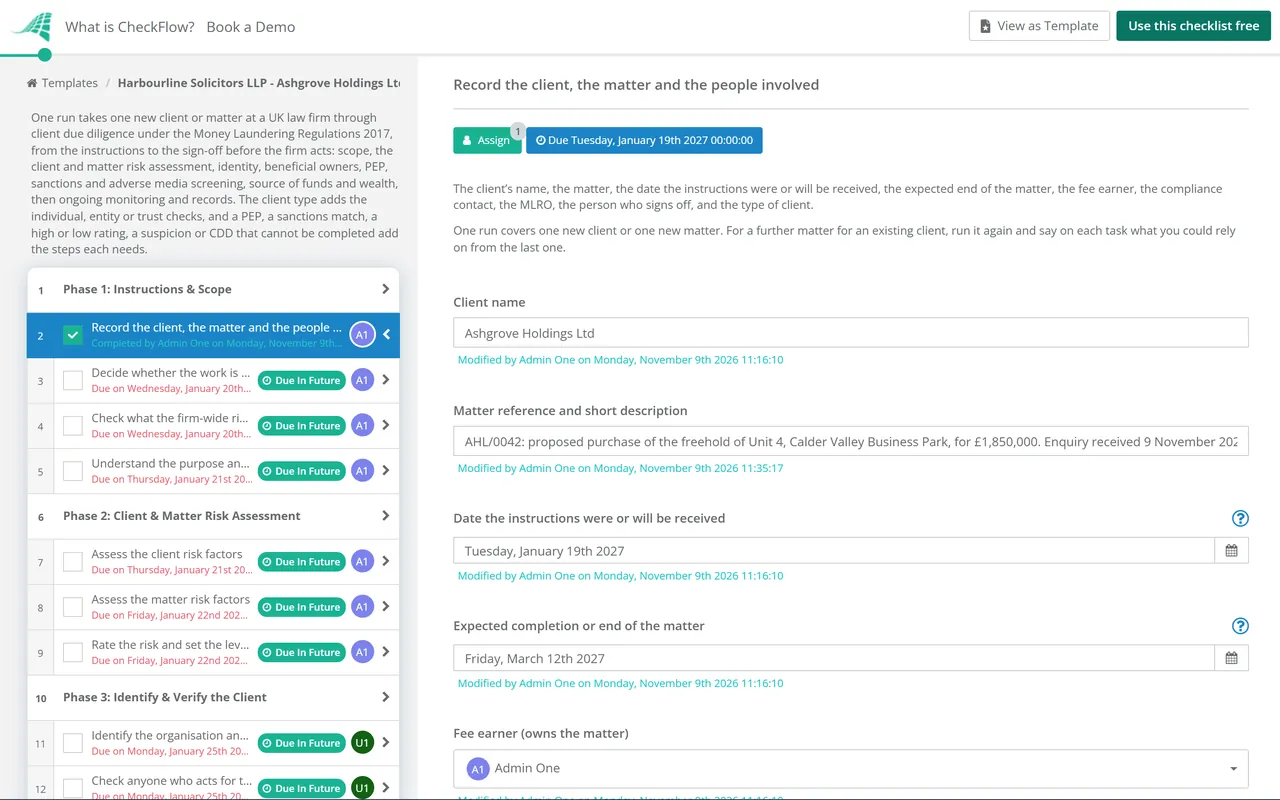
    Record the client, the matter and who does what, then decide whether the work is in scope of the Money Laundering Regulations 2017. The date the instructions were received sets every due date up to the sign-off.

    • Record the client, the matter and the people involved — the client’s name, the matter, the date the instructions were or will be received, the expected end of the matter, the fee earner, the compliance contact, the MLRO, the person who signs off, and the type of client
    • Decide whether the work is in scope of the regulations — whether the firm is acting as an independent legal professional in a financial or real property transaction, as a trust or company service provider, or as a tax adviser, with the reasons recorded
    • Record why the work is out of scope and close this run — after ‘Not in scope: this checklist is not needed’ only: the reasons, who agreed them, and a note to run this checklist if the matter later comes into scope
    • Check what the firm-wide risk assessment and policy say about this kind of work — the rating the firm-wide risk assessment gives this type of client and matter, and any steps the policy requires for it
    • Understand the purpose and intended nature of the matter — what the client wants done and why, how the instructions reached the firm, whether you met the client, and whether the work makes sense for this client
  2. Phase 2

    Phase 2: Client & Matter Risk Assessment

    3 tasks

    Assess the client and the matter against the firm-wide risk assessment, record the reasons, and set the level of due diligence. The SRA expects a client risk assessment at the start of every client relationship.

    • Assess the client risk factors — who the client is, where they and their owners are based, how they are structured, whether anyone is hiding behind them, and how they came to the firm
    • Assess the matter risk factors — the size, complexity, timescale and purpose of the matter, who pays, and whether it fits what you know of the client
    • Rate the risk and set the level of due diligence — an overall rating with the reasons written down, and the level of due diligence it calls for: simplified, standard or enhanced
  3. Phase 3

    Phase 3: Identify & Verify the Client

    4 tasks

    Identify the client and verify who they are from documents or information from a reliable source that is independent of them, along with anyone who acts for them. Only the check for your type of client appears.

    • Identify the client and verify their identity — full name, date of birth and address, verified from documents or information from a reliable and independent source, or a secure electronic identification process
    • Identify the organisation and verify its details — name, registration number and registered office, and for a company the law it is under, its constitution, its directors and the senior people running it
    • Identify the trust and verify the trustees — the trust’s name and type, the trust deed, the trustees who instruct the firm, and the settlor, beneficiaries or class of beneficiaries and anyone with control
    • Check anyone who acts for the client — whether anyone gives instructions on the client’s behalf, that they are authorised to, and their own identity verified from an independent source
  4. Phase 4

    Phase 4: Beneficial Owners & Structure

    4 tasks

    Applies only when the client is not an individual. Identify who ultimately owns or controls the client, verify them, understand the ownership and control structure and, where it applies, check the official register.

    • Identify the beneficial owners — the individuals who own or control more than 25%, who otherwise control the client, or the trust’s settlor, trustees, beneficiaries and controllers
    • Verify the beneficial owners — reasonable measures, matched to the risk, so you are satisfied you know who each one is, without relying only on the public register
    • Understand the ownership and control structure — how the client is owned and controlled through each layer, why it is structured that way, and whether that makes sense for its business
    • Collect the register excerpt and report any material discrepancy — an excerpt from Companies House, the trust register or the register of overseas entities before the relationship starts, and any material discrepancy reported
  5. Phase 5

    Phase 5: PEP, Sanctions & Adverse Media Screening

    8 tasks

    Screen the client, the beneficial owners and the people acting for them for politically exposed persons and sanctions, search for adverse media, and check for links to high-risk countries. A match adds the steps it needs.

    • Screen for politically exposed persons, family members and close associates — the client and each beneficial owner checked, and the result recorded with the source used
    • Check the client, owners and counterparties against the UK Sanctions List — the client, anyone who controls or owns more than 50% of it, the people acting for it and the other parties to the matter, with the date and result
    • Resolve the possible sanctions match — after a possible match only: compare dates of birth, addresses and other identifiers, record the outcome, and take no money until it is resolved
    • Stop, freeze any funds and report the designated person — after a confirmed match only: no funds taken or paid, any funds or assets held frozen, a report to OFSI (or OTSI for trade sanctions), a suspicious activity report considered, and the SRA told where its rules require
    • Search for adverse media on the client and its owners — searches on the client and beneficial owners at a depth that suits the risk, with the results judged for source, relevance, timing and seriousness
    • Check for links to FATF call for action countries and other high-risk places — where the client, its owners and the other parties are established, and whether any is in a country on FATF’s list of high-risk jurisdictions subject to a call for action
    • Apply enhanced due diligence for the PEP — after a PEP result only: the level of risk and the extent of enhanced measures assessed, and adequate measures taken to establish source of wealth and source of funds
    • Apply the measures for a FATF call for action country — after a Yes only: more information on the client and beneficial owner and on the relationship, source of funds and wealth, the reasons for the transactions, and enhanced monitoring planned
  6. Phase 6

    Phase 6: Source of Funds & Source of Wealth

    3 tasks

    Find out where the money for this matter comes from and how the client came to have it, to a depth that suits the risk. Take no money other than for fees and disbursements until it is done.

    • Establish the source of funds for the matter — the amount, currency and remitting account, and how and from where the client got the money, with evidence that matches the risk
    • Check any third party paying into the matter — who else is contributing, their relationship to the client, why they are paying, and their own source of funds where the risk calls for it
    • Understand the client’s source of wealth — how the client built up their overall wealth, recorded from what they tell you for low or standard risk, and evidenced for high risk
  7. Phase 7

    Phase 7: Simplified or Enhanced Due Diligence

    3 tasks

    Record what the level of due diligence means for this matter, then look again at the risk rating now that screening and source of funds are done. Simplified due diligence is a reduced form of the checks, not no checks.

    • Record why simplified due diligence applies and what is adjusted — after a low-risk rating only: why the risk is low with reference to the firm-wide assessment, which measures are adjusted in extent, timing or type, and the monitoring that stays in place
    • Apply enhanced due diligence and plan enhanced monitoring — after a high-risk rating only: the extra measures taken, such as further independent sources, more on the client’s background and finances, and closer monitoring of the matter
    • Review the risk rating now the checks are done — whether screening, the source of funds or anything else changes the rating, and if it does, the answer on Phase 2 changed so the right tasks appear
  8. Phase 8

    Phase 8: Suspicion, Sign-Off & What If CDD Cannot Be Completed

    7 tasks

    Consider whether anything gives grounds for suspicion, then the person named on the first task signs off that CDD is complete before the firm acts. Nothing after the sign-off can be completed until it is done. If CDD cannot be completed, the firm stops.

    • Consider whether anything gives grounds to know or suspect money laundering — everything found so far weighed by the fee earner, with any knowledge or suspicion reported internally to the MLRO and nothing said to the client about it
    • Make an internal report to the MLRO — after a Yes only: the client, the matter, what was found and why it is suspicious, given to the MLRO and recorded, with the matter paused
    • Decide whether to report to the NCA and whether consent is needed — after a Yes only: the MLRO’s decision on a suspicious activity report, whether privilege applies, and whether a defence against money laundering is needed before the firm does anything more
    • Finish the missing due diligence and come back to the sign-off — after ‘Not yet’ only: what was missing, the checks completed, and the decision on the sign-off changed to Approved before it is completed
    • Stop: do not act, take or pay money, and consider a disclosure — after ‘CDD cannot be completed’ only: no transaction carried out, the relationship not started or ended, and the MLRO deciding whether a disclosure is required
    • Close the matter with the client without tipping them off — after ‘CDD cannot be completed’ only: the client told the firm cannot act, any money returned only to where it came from and only as the MLRO allows, and the file kept
    • Sign off that CDD is complete before the firm acts — identity, beneficial owners, screening, source of funds and the right level of due diligence all done, any internal report dealt with, and the decision recorded
  9. Phase 9

    Phase 9: Ongoing Monitoring & Records

    5 tasks

    Keep the checks up to date while the matter runs, check the money that arrives against what you were told, screen again before completion, and keep the records for five years after the relationship ends.

    • Set how the matter will be monitored — who watches the matter, how often the client and matter risk assessment is looked at, and what would trigger fresh checks
    • Check the money received against the source of funds — each payment into client account matched to the expected funds by amount, sender and account, with anything unexpected reported to the MLRO
    • Review the risk assessment if anything has changed — new parties, a change in ownership or control, new sources of funds or a change in the matter, with the assessment updated and fresh checks done
    • Screen again before completion or before money is paid out — the client, owners and other parties checked again against the UK Sanctions List and for PEPs before completion or before funds are released
    • Keep the CDD records for five years after the relationship ends — the CDD documents, risk assessments and transaction records filed, the date the five years end recorded, and personal data deleted after that unless an exception applies

What the Money Laundering Regulations Require of Law Firms, and What Changed in 2026

What the regulations require, step by step

The Money Laundering Regulations 2017 apply across the UK. England and Wales come first here; Scottish firms are supervised by the Law Society of Scotland and firms in Northern Ireland by the Law Society of Northern Ireland.

Step Where it comes from What it requires In this checklist
Is the work in scope?MLR 2017 regulations 11(d) and 12Independent legal professionals in financial or real property transactions, trust or company service providers, and tax advisers.Phase 1
Client and matter riskRegulations 18 and 28(12) and (13); the SRA warning noticeThe extent of CDD must reflect the firm-wide risk assessment and the risk in the case; a client risk assessment at the start of every relationship.Phase 2
IdentityRegulation 28(2), (10), (18) and (19)Identify and verify the client, and anyone acting for them, from a reliable source independent of them.Phase 3
Beneficial ownersRegulations 5, 6, 28(3A), (4) and (9), and 30AIdentify them, take reasonable measures to verify them, understand the structure, collect the register excerpt and report material discrepancies.Phase 4
PEPsRegulation 35Enhanced due diligence, senior management approval, source of wealth and funds, and enhanced monitoring; a lower starting point for a domestic PEP.Phase 5
SanctionsThe UK Sanctions List; the SRA’s sanctions guidanceCheck clients, owners and controllers and counterparties; report a designated person to OFSI.Phase 5
High-risk countriesRegulation 33(1)(b) and (3A)Six set measures for a party established in a FATF call for action country.Phase 5
Source of funds and wealthRegulations 28(11), 33(3A) and 35(5); the LSAG guidanceWhere the money comes from and how the client came to have it, to a depth that suits the risk.Phase 6
Simplified or enhancedRegulations 33 and 37Enhanced measures where the risk is high; simplified measures only where it is low, adjusting the checks rather than dropping them.Phases 2 and 7
Timing and sign-offRegulation 30Verify before the relationship is established or the transaction carried out, with a narrow exception. Senior management must approve a PEP or a FATF call for action party; a sign-off on every matter is this template’s choice.Phase 8
Suspicion, or CDD that cannot be completedRegulation 31; POCA sections 330, 333A and 335Do not act; consider a disclosure; report suspicion to the MLRO; do not tip off.Phase 8
Ongoing monitoring and recordsRegulations 28(11) and 40Scrutinise transactions and keep CDD up to date; keep records for five years after the relationship ends.Phase 9

What changed in 2026

Two sources moved this year, and the legal sector guidance has not caught up with both of them yet.

Change What it does From
Money Laundering and Terrorist Financing (Amendment) Regulations 2026 (SI 2026/621)The occasional transaction threshold in regulation 27(2) became £12,000 (it was 15,000 euros).30 June 2026
The same regulationsEnhanced due diligence under regulation 33(1)(b) now applies to FATF call for action countries, a narrower list than before.30 June 2026
The UK Sanctions ListThe only source for all UK sanctions designations; OFSI’s Consolidated List closed.28 January 2026
LSAG guidance (2025)Approved by HM Treasury and in effect from 23 April 2025, so it predates the 2026 amendments and still refers to 15,000 euros.23 April 2025
The FCA as AML supervisor for the legal sectorAnnounced in October 2025. It needs legislation, and the SRA, the Law Society of Scotland and the other legal supervisors carry on meanwhile.Not yet in force

Where this comes from. The Money Laundering Regulations 2017 and SI 2026/621 on legislation.gov.uk, shown there as up to date to 6 to 9 November 2026 and read on 9 November 2026; the Proceeds of Crime Act 2002; the LSAG anti-money laundering guidance for the legal sector; the SRA’s AML obligations page (updated 9 November 2026), client and matter risk assessment warning notice and sanctions guidance (both updated 19 June 2026); the FCDO’s UK Sanctions List page; HM Treasury’s supervision reform response; and the Law Society of Scotland. Where the guidance and the regulations differ, the regulations as amended apply.

Why Run Law Firm AML Checks in CheckFlow?

1

A sign-off before the firm acts

The sign-off is assigned to one person alone, and the checklist halts there: the monitoring and records tasks cannot be completed until CDD is signed off. The regulations require senior management approval only for a PEP or a FATF call for action party; a sign-off on every matter is this template’s choice. If something is missing, the sign-off stays open and a task above it says what to finish. If CDD cannot be completed, the tasks to stop and close the matter appear instead.

2

Only the checks this client needs

An individual gets the identity check for a person; a company, trust or other body gets its own checks, the beneficial owners and, where it applies, the register excerpt. A PEP, a sanctions match, a FATF call for action country, a high or low rating or a suspicion each adds the steps the regulations set for it.

3

The reasons are written down

Every risk rating, source of funds conclusion and screening result has a field for the reasons; the SRA’s warning notice says the rationale for the risk level and level of due diligence should be clearly recorded. Name the fee earner, the compliance contact, the MLRO and the approver once, and every task is assigned. Track every open matter in the Reports Grid.

CheckFlow does not verify identities, screen names against sanctions or PEP lists, or give legal advice: those stay with your firm, its MLRO and the tools and sources it chooses. CheckFlow makes sure every check is done in order, by the right person, with the reasons kept.

Use this template free
AI generator

Didn’t find what you need? Describe it.

Describe the process in a sentence and the AI checklist generator drafts the phases and tasks for you.

Frequently Asked Questions

What should a law firm AML checklist include?

For each new client or matter: whether the work is in scope of the Money Laundering Regulations 2017, a client and matter risk assessment that reflects the firm-wide one, identity checks on the client and anyone acting for them, the beneficial owners and ownership structure, PEP, sanctions and adverse media screening, source of funds and wealth, simplified or enhanced measures, a sign-off before the firm acts, ongoing monitoring and records kept for five years. This template follows that order.

Which legal work is in scope of the Money Laundering Regulations?

Acting as an independent legal professional in financial or real property transactions, such as buying and selling property or businesses, managing client money or assets, opening or managing accounts, and creating or managing trusts and companies (regulation 12(1)). Trust or company services and tax advice are also in scope (regulations 12(2) and 11(d)). The SRA notes that work outside these, such as ancillary relief, can move into scope later, so check again when a matter changes.

When must client due diligence be completed before a law firm acts?

Regulation 30 requires the identity of the client, anyone acting for them and any beneficial owner to be verified before the business relationship is established or the transaction carried out. It may be finished during the establishment of the relationship only where that is necessary not to interrupt the normal conduct of business, there is little risk, and it is completed as soon as practicable. The LSAG guidance says CDD must be complete before substantive work, or before funds other than for fees and disbursements reach client account.

Does a law firm need a risk assessment for every client and matter?

For every client, yes. The SRA’s warning notice says a client risk assessment must always be carried out at the beginning of a client relationship and recorded as part of CDD. A matter risk assessment should be carried out and recorded at the earliest opportunity, though one may not be needed where a client’s matters are highly repetitive and the client assessment covers the risk. Either way, the SRA expects the reasons for the rating to be written down.

What is the difference between source of funds and source of wealth?

Source of funds is where the money for this matter comes from, and how the client came to have it: the LSAG guidance says it is not enough to know it came from a UK bank account. Source of wealth is the origin of the client’s entire body of wealth, such as a career, a business or an inheritance. Both must be established for a politically exposed person, and source of wealth checks deepen as the risk rises.

When can a law firm use simplified due diligence?

Only where it finds the relationship or transaction presents a low degree of risk, in the light of its firm-wide risk assessment and regulation 37(3). It is not an exemption: the firm must still comply with regulations 28, 29 and 30A, adjusting only the extent, timing or type of its regulation 28 measures, and must monitor enough to spot anything unusual. It must stop if it doubts the documents, the risk is no longer low, it suspects money laundering, or a regulation 33(1) case such as a PEP applies.

What happens if client due diligence cannot be completed?

Under regulation 31 the firm must not carry out the transaction, must not start the business relationship, must end any existing one, and must consider whether a disclosure is required under the Proceeds of Crime Act 2002 or the Terrorism Act 2000. The LSAG guidance says a suspicious activity report should not be used to get permission to carry on without CDD. Telling the client about a report can be the tipping off offence in section 333A.

What changed in the Money Laundering Regulations in 2026?

SI 2026/621 came into force on 30 June 2026. Among other changes, the occasional transaction threshold became £12,000, and enhanced due diligence for high-risk countries now applies to FATF call for action countries. The LSAG guidance dates from April 2025 and still refers to 15,000 euros, so follow the regulations where they differ. Separately, the UK Sanctions List replaced OFSI’s Consolidated List on 28 January 2026.

Does this checklist work for law firms in Scotland, Northern Ireland or outside the UK?

The Money Laundering Regulations 2017 apply across the UK, so it works in Scotland and Northern Ireland, where the Law Society of Scotland and the Law Society of Northern Ireland are the supervisors. Outside the UK, follow local law: AUSTRAC says Australian lawyers providing certain services came under its regime on 1 July 2026, and in the US FinCEN says its residential real estate reporting rule was vacated by a court in March 2026 and is under appeal.

Is CheckFlow free for this template?

14-day free trial, no card required. The Business plan is $10 per user per month after the trial. Full details at checkflow.io/pricing.

Sign Off Every New Matter’s CDD Before the Firm Acts

Free trial — no credit card required.

14-day free trial, no credit cardFull refund in your first 30 daysUS hosting, EU on request