The legal matter that begins without a structured intake — without a conflict check, without a clear scope, without assigned responsibility — is the matter that produces the conflict dispute, the missed deadline, and the “who was supposed to handle that?” conversation.
For in-house legal departments, the matter request arrives by email, Slack message, phone call, or corridor conversation — and whether it becomes a properly opened, tracked, and resourced matter or remains an informal obligation in someone’s inbox depends entirely on whether there is a structured intake process. For law firms, the new client intake — including the conflict check that is a professional responsibility obligation, the engagement letter that defines scope and fees, and the AML/KYC check that is a regulatory requirement — must be completed before any substantive work begins. In both contexts, the intake process is where the quality of the matter management is determined: the right information gathered upfront, the right resources assigned, the right scope documented, and the right oversight in place from day one. This free legal case intake checklist gives in-house legal departments and law firms a structured framework for a consistent, compliant, and thorough matter intake process.
This checklist describes a process framework. It does not constitute legal advice. Law firm professional responsibility obligations vary by jurisdiction. Consult qualified counsel and relevant professional rules.
Intake for In-House Legal Departments vs Law Firms — the Key Differences
In-House Legal Departments
The requestor is an internal business unit, not an external client
The conflict check is less formal but still needed — particularly for matters where the company is potentially adverse to another party
Scope documentation is critical — internal clients often have unclear briefs and unlimited expectations of legal’s time
Matter triage determines whether legal resource is needed or whether the business unit can handle the matter with standard guidance
Internal billing or time tracking enables the legal function to demonstrate value and manage capacity
Law Firms
The conflict check is a professional responsibility obligation — accepting a matter that conflicts with an existing client’s interests is an ethical violation that can result in disqualification, disciplinary action, and fee forfeiture
AML/KYC checks are a regulatory requirement in the UK (Proceeds of Crime Act, Money Laundering Regulations) and in many other jurisdictions
The engagement letter defining scope, fees, and billing terms is a commercial and professional requirement
Client care letters (UK SRA requirements) must be provided
Both the conflict check and AML/KYC must be completed before any substantive work begins
The Legal Case Intake Process Checklist
Six phases covering the full matter intake process — from request receipt and conflict check through classification, engagement terms, file opening, and matter kickoff.
Phase 1
Matter Request Receipt & Initial Information Gathering
The intake form is the quality control step that prevents ambiguous or incomplete instructions from entering the legal process. A legal team that accepts verbal instructions from a hallway conversation is a legal team that will have scope disputes, missed deadlines, and no record of what it was asked to do.
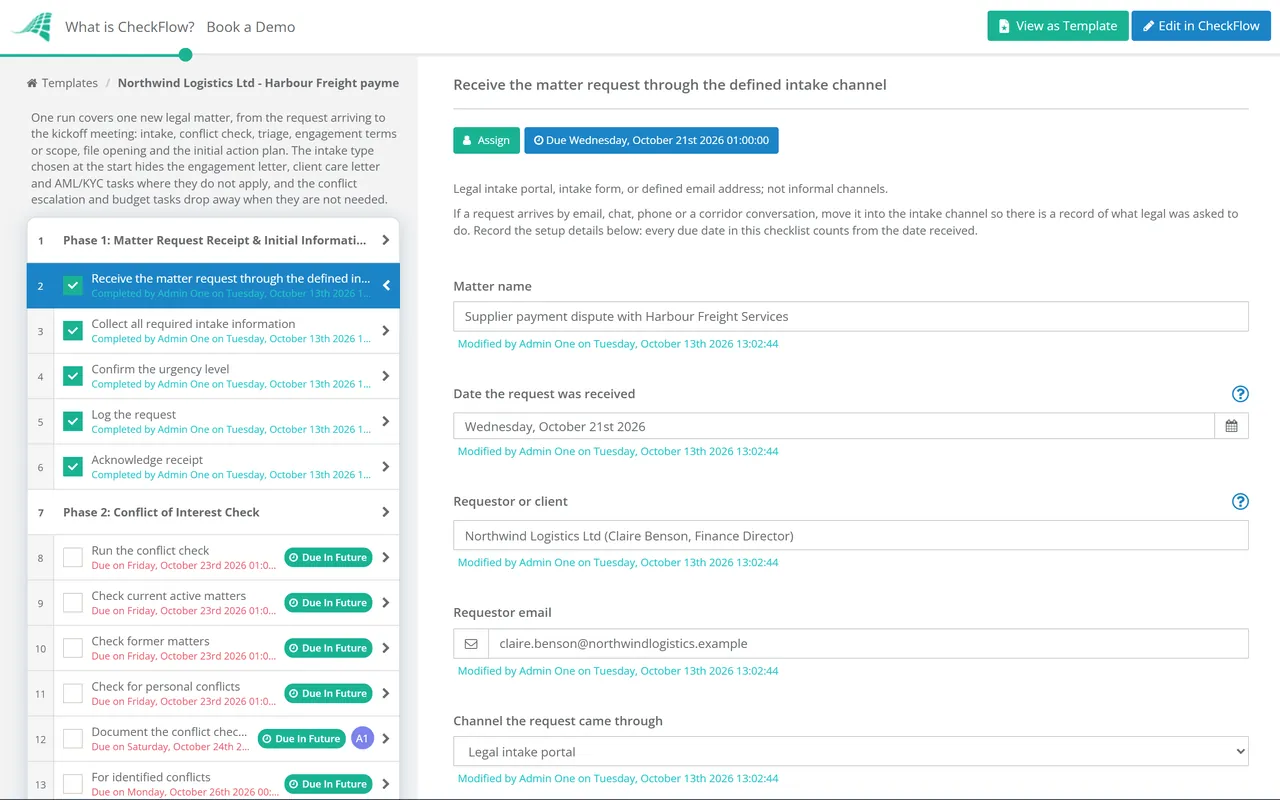
Receive the matter request through the defined intake channel — legal intake portal, intake form, or defined email address; not informal channels
Collect all required intake information — matter type, instructing party or client, counterparties (all parties to the matter), a clear description of the legal issue or objective, key facts, any relevant documents, and any deadline or urgency
Confirm the urgency level — is there an imminent deadline (court filing, contract expiry, regulatory response)? Affects triage priority
Log the request — date received, requestor, matter description, and preliminary classification
Acknowledge receipt — to the requestor; with an expected timeline for initial response
Phase 2
Conflict of Interest Check
The conflict check is the most critical compliance step in legal matter intake. For law firms it is a professional responsibility requirement. For in-house teams it identifies situations where the company’s interests may conflict with each other or with a related party. DO NOT begin substantive work before the conflict check is complete.
Run the conflict check — search the matter management system for all parties to the matter (client/requestor, counterparties, related entities, key individuals)
Check current active matters — is any party to this matter an adverse party on any current active matter?
Check former matters — has the firm or department previously represented or advised any party in a matter that could create a conflict?
Check for personal conflicts — does any attorney proposed to work on the matter have a personal interest, relationship, or prior engagement that creates a conflict?
Document the conflict check result — no conflict found; potential conflict identified and reviewed; or conflict confirmed requiring escalation or declination
For identified conflicts — consult qualified professional responsibility counsel; consider whether informed written consent can cure the conflict; do not proceed without resolution
Phase 3
Matter Classification & Triage
Classify the matter type — corporate, commercial, employment, litigation, IP, regulatory, real estate, M&A, or other; determines routing and resource assignment
Assign a matter priority — urgent (deadline within days), high (deadline within weeks), standard (no immediate deadline), or strategic (requires partner/GC level involvement)
Assess whether legal resource is required — for in-house departments: can this be handled with standard guidance or does it require active legal support?
Assess whether external counsel is required — specialist expertise, capacity constraint, or jurisdiction requirement; confirm budget authority before engaging
Estimate the scope and resource required — preliminary estimate of attorney time, budget, and timeline; communicated to the requestor at this stage
Phase 4
Engagement Terms or Scope Confirmation
Law Firm Track
Prepare and issue the engagement letter — scope, fee structure (hourly, fixed fee, contingency), billing frequency, payment terms, and billing guidelines
Issue the client care letter (UK) — SRA-required information including who will handle the matter, how to complain, and cost estimates
Complete AML/KYC checks (UK/EU) — verify client identity; source of funds; PEP and sanctions screening; required before accepting instructions under Money Laundering Regulations
Obtain signed engagement letter — before beginning substantive work
In-House Track
Document the approved scope — what legal has agreed to do; timeline; any dependencies on the business unit; confirm in writing to the requestor
Confirm the budget — for matters requiring external counsel; budget authority confirmed before engagement
Phase 5
Matter File Opening & Administration
Open the matter in the matter management system — matter number allocated; all intake information entered; matter type, status, and key dates recorded
Create the matter file — physical or electronic; all intake documents and correspondence filed; directory structure established
Assign a matter lead — the attorney or legal officer with primary responsibility; confirmed and communicated to the requestor
Assign any supporting team members — based on matter type, complexity, and capacity; roles defined
Set key dates and deadlines — limitation periods, court filing deadlines, regulatory response deadlines, and internal milestones; diarised with appropriate lead times
Confirm supervision arrangements — for matters worked on by junior attorneys; supervising partner or GC confirmed
Phase 6
Matter Kickoff & Initial Action Plan
Conduct the kickoff meeting — with the requestor and legal team; confirm facts, objectives, constraints, and key contacts
Identify immediate actions — any urgent steps required before the next review point; preservation of documents or evidence if litigation is anticipated
Define the initial work plan — what needs to happen, in what sequence, by whom, by when; documented and shared with the requestor
Issue a legal hold if required — for matters where litigation is anticipated; immediately on identification
Set the first update cadence — how often the requestor will receive matter status updates
This checklist is available as a free, runnable template in CheckFlow — with the conflict check gated before file opening, all intake information captured in a structured record, and a complete matter history from first request to kickoff.
How to Run a Conflict of Interest Check — and What to Do When You Find One
A conflict of interest in legal practice arises when a lawyer’s duty to one client or party is incompatible with their duty to another — either a current client or a former client. Law firm professional rules (Model Rules of Professional Conduct in the US, SRA Code of Conduct in the UK) prohibit representing adverse parties without informed written consent, and in many cases even with consent. An incomplete conflict check is not a minor administrative failure — it can result in disqualification from a matter, disciplinary action, fee forfeiture, and malpractice liability.
For in-house legal departments, the conflict exposure is different but real: a situation where the company’s interests in one matter may be adverse to its interests in another (common in group company structures, joint ventures, and transactions involving related parties). The conflict check identifies these situations before work begins, when they can be managed — rather than after, when disclosure obligations may have been triggered.
Why Run Legal Intake in CheckFlow?
1
A structured intake that captures everything needed before work begins
An intake that relies on memory and informal conversation produces incomplete matters — the key fact that wasn’t captured, the deadline that wasn’t diarised, the party that wasn’t checked in the conflict system. CheckFlow’s intake checklist makes every required field a task — conflict check, scope confirmation, deadline diary, and matter file opening — that cannot be bypassed before the matter is active.
Conflict check as a gated step before substantive work
The conflict check is the step most commonly skipped under time pressure — when the client is urgent, the deadline is real, and the matter seems straightforward. CheckFlow makes the conflict check a required step before the matter file opening task can begin. Substantive work cannot start on a matter that has not been through the conflict check.
Every matter opened through CheckFlow has a complete intake record — who requested it, the parties, the scope, the conflict check outcome, the assigned attorney, and the key dates. When a matter produces a dispute about scope, timeline, or instructions, the record is there. When a regulatory body asks for evidence of a firm’s conflict check procedures, the documented record exists.
Many legal matter intakes involve contract review. CheckFlow’s Contract Review & Approval Checklist provides the structured review process that connects to legal case intake for contract-related matters. See the Contract Review & Approval Checklist →
Legal operations depends on structured processes across the full legal function. CheckFlow’s Legal Department Compliance Audit Checklist covers the annual review of the legal function including matter management processes. See the Legal Department Compliance Audit →
What should a legal matter intake process include?
+
A legal matter intake process covers six phases: matter request receipt (structured intake through a defined channel, collecting all required context), conflict of interest check (searching all parties against the current and former matter register before any substantive work begins), matter classification and triage (matter type, priority, resource requirements, and external counsel assessment), engagement terms or scope confirmation (engagement letter and AML/KYC for law firms; documented scope confirmation for in-house), matter file opening (matter number, file creation, lead assignment, deadline diary), and matter kickoff (kickoff meeting, immediate action plan, legal hold if required, and update cadence).
What is a conflict of interest check and when must it be done?
+
A conflict of interest check is a systematic search of the firm’s or department’s matter register against all parties to a new matter — client, counterparties, related entities, and key individuals — to identify any existing or prior relationship that could create a conflict. For law firms, it is a professional responsibility obligation that must be completed before accepting instructions or beginning substantive work. Model Rule 1.7 (US) prohibits concurrent representation of clients with adverse interests without informed written consent; Model Rule 1.9 extends protection to former clients. The SRA Code of Conduct (UK) imposes equivalent obligations. Failure to conduct a proper conflict check can result in disqualification, disciplinary proceedings, fee forfeiture, and professional indemnity claims.
What AML/KYC requirements apply to law firms?
+
In the UK, law firms are subject to the Money Laundering, Terrorist Financing and Transfer of Funds Regulations 2017 (and subsequent amendments). Before acting for a client in specified activities (including many property transactions, company formations, and trust or company services), firms must verify the client’s identity through Customer Due Diligence (CDD), identify beneficial owners, screen for politically exposed persons (PEPs) and sanctions, and assess the source of funds. Failure to comply with AML obligations creates criminal liability for the firm and individual fee-earners. Equivalent requirements apply in most EU and many international jurisdictions. US law firms are not currently subject to comprehensive federal AML requirements for client funds, though proposed FinCEN rules may change this.
What information should be captured at legal matter intake?
+
A thorough matter intake should capture: the instructing party (business unit or client name), all counterparties and related entities (required for the conflict check), a clear description of the legal issue and objective, key facts and background, all known deadlines and limitation periods, any documents or prior correspondence, the requestor’s expected timeline and desired outcome, budget authority for any external counsel, and the urgency level. For law firms, additional information includes: client identity documents, source of funds, and engagement letter execution. Incomplete intake information is the most common cause of scope disputes and missed deadlines.
Is CheckFlow free for this template?
+
You can start a free 14-day trial with no credit card required, giving you full access to all features including this template. The Business plan is $10 per user per month after the trial. Full details at checkflow.io/pricing.
Open Every Legal Matter With the Right Information, the Right Check, and the Right Owner
Free trial — no credit card required.
Do you like cookies? 🍪 We use cookies to ensure you get the best experience on our website. Learn more