Compliance Audit Checklist for a Legal Department

The legal department exists to manage the organisation’s legal risk — but who audits the legal department? An annual compliance audit of the legal function is how General Counsel ensures the function is managing its own obligations as rigorously as it manages everyone else’s.

Legal departments are typically the function that conducts or oversees compliance audits across the organisation. They review other departments’ processes, identify regulatory gaps, and ensure the business is managing its legal obligations. But the legal function itself is subject to its own compliance obligations — professional responsibility rules, data protection requirements for privileged information, matter management standards, contract management obligations, and internal governance requirements — all of which require the same systematic assessment applied elsewhere. An annual legal department compliance audit asks: Are all policies current and accessible? Are matter management processes consistent? Is the contract register complete and renewals managed proactively? Is IP being tracked and protected? Are privilege obligations being maintained? Are the regulatory areas the department covers current and staffed? This free compliance audit checklist gives General Counsel, Legal Operations Managers, and Chief Legal Officers a structured framework for the annual audit of the legal function.

This checklist describes a process framework. It does not constitute legal advice. Consult qualified legal counsel for advice specific to your jurisdiction and circumstances.
Use This Template Free See Live Example
No Credit Card Required

Nine Domains the Legal Department Compliance Audit Must Address

1

Legal Governance & Policies

Are legal department policies current, accessible, and followed consistently?

2

Matter Management

Is every legal matter formally opened, assigned, tracked, and closed?

3

Contract Management

Is the contract register complete? Are renewals, obligations, and expiry dates tracked?

4

Intellectual Property Protection

Is the IP portfolio inventoried, registered, and monitored for infringement?

5

Data Protection & Privilege

Is privileged and confidential information managed with appropriate security and access controls?

6

Employment Law Compliance

Are employment policies current and consistent with applicable law in all jurisdictions?

7

Litigation & Dispute Management

Is ongoing litigation tracked, provisioned for, and properly managed?

8

Regulatory Tracking

Are all regulatory obligations that fall within the legal function’s remit current and assigned?

9

Legal Department Metrics & Performance

Is the legal function measuring and reporting its output and value?

The Legal Department Compliance Audit Checklist

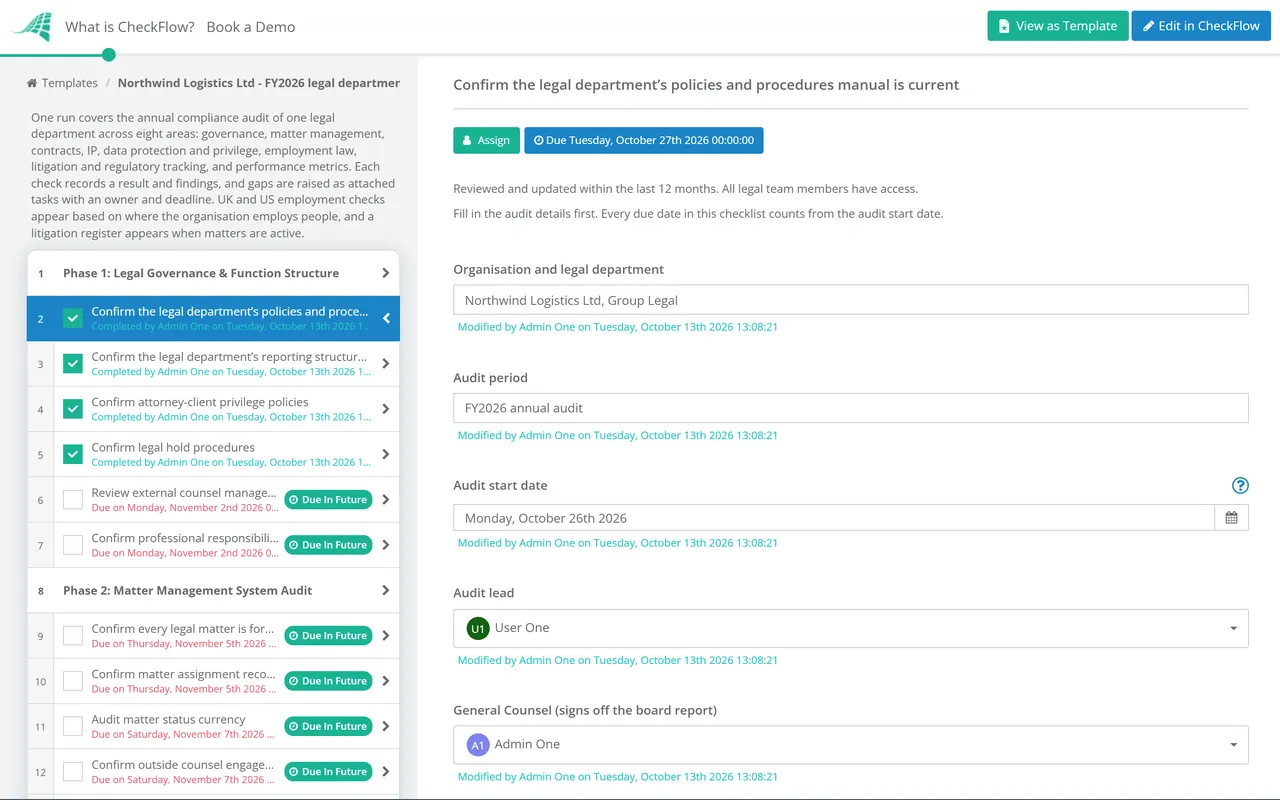
Eight phases covering the full scope of an annual legal function compliance audit — from governance and matter management through to performance metrics and gap assessment.

Phase 1

Legal Governance & Function Structure

A legal department without documented policies is a department whose practices vary with who is working on a matter. Documented policies are the baseline for consistent legal service delivery.

  • Confirm the legal department’s policies and procedures manual is current — reviewed and updated within the last 12 months; all legal team members have access
  • Confirm the legal department’s reporting structure is documented — who the GC reports to; escalation paths for significant legal risks to the board or audit committee
  • Confirm attorney-client privilege policies — staff understand which communications are privileged; who may claim privilege; how privilege is maintained in written communications
  • Confirm legal hold procedures — documented process for issuing and managing litigation holds; tested in the past year
  • Review external counsel management policies — panel firms, outside counsel guidelines, billing guidelines, conflict-of-interest procedures, and matter supervision standards
  • Confirm professional responsibility compliance — bar admission currency for all admitted attorneys; continuing legal education (CLE) obligations tracked
Phase 2

Matter Management System Audit

  • Confirm every legal matter is formally opened — in the matter management system; no matters managed through informal channels without a matter record
  • Confirm matter assignment records — every open matter has a named internal lead; no unassigned open matters
  • Audit matter status currency — all open matters have been updated within the required timeframe; no stale matters without recent activity
  • Confirm outside counsel engagement letters are on file — for every active external matter; billing guidelines acknowledged
  • Review matter closure process — matters that have concluded are formally closed; file retention and destruction applied per the document retention policy
  • Analyse matter volume and type trends — are there significant changes in matter type or volume that indicate emerging risk areas or under-resourcing?
Phase 3

Contract Management & Register Audit

  • Confirm a central contract register exists — all material contracts logged; party names, effective dates, expiry/renewal dates, obligations, and value
  • Audit contract register completeness — compare against accounts payable/receivable records, known major relationships, and department inputs; identify any contracts not yet in the register
  • Confirm renewal tracking is active — all contracts with upcoming renewal or expiry dates have reminders set; no contracts approaching auto-renewal without a review decision
  • Confirm contract templates are current — standard agreement templates (NDA, MSA, SOW, vendor agreements) reviewed in the last 12 months; reflect current law and policy
  • Confirm signatory authority matrix — who can sign contracts of what value and type; current, documented, and consistently applied
  • Review contract compliance obligations — key contractual obligations (reporting, insurance, exclusivity, audit rights) are tracked and monitored
Phase 4

Intellectual Property Protection Audit

  • Confirm the IP portfolio register is complete — all registered trademarks, patents, copyrights, and domain names inventoried; status current
  • Confirm IP renewal deadlines are tracked — trademark renewals, patent maintenance fees, and other renewal obligations flagged well in advance
  • Confirm trade secret protection measures — confidential information is identified; access is controlled; NDAs are in place with all parties who access trade secrets
  • Confirm IP ownership for employee-created works — employment agreements include IP assignment provisions; contractor agreements include work-for-hire provisions
  • Conduct an IP monitoring review — is the organisation actively monitoring for trademark infringement and patent challenge? Any current infringement matters in progress?
Phase 5

Data Protection, Confidentiality & Privilege

  • Confirm legal department data classification policy — privileged communications, confidential client information, and regulated personal data are separately identified and appropriately secured
  • Confirm access controls for privileged materials — who has access to privileged matter files; access limited to authorised personnel on a need-to-know basis
  • Confirm GDPR/CCPA compliance for personal data held by the legal department — retention periods, data subject rights, and data processing agreements where the legal department acts as controller
  • Confirm document retention and destruction policy — current and applied; legal hold process overrides standard retention for relevant materials
  • Review vendor and tool security — legal technology tools (matter management, contract management, e-signature) reviewed for security compliance; data processing agreements in place
Phase 6

Employment Law & HR Compliance Review

  • Confirm employment policy currency — employee handbook, disciplinary procedures, grievance procedures, equality and diversity policy, and all other employment policies reviewed within the last 12 months
  • Confirm compliance with wage and hour requirements — minimum wage, overtime classification, and pay statement compliance in all jurisdictions
  • Confirm right-to-work compliance — documentation on file for all employees; re-verification schedule for time-limited permissions
  • Confirm restrictive covenant compliance — non-compete and non-solicitation agreements reviewed for enforceability under current law in relevant jurisdictions; note recent FTC/state law developments
  • Review workforce classification — employee vs contractor classification reviewed for all independent contractors; IR35 (UK) or ABC test (California) compliance as applicable
Phase 7

Litigation Management & Regulatory Tracking

  • Audit all active litigation matters — current status; provision adequacy reviewed with finance; external counsel performance assessed
  • Confirm regulatory enquiries and investigations are logged — all regulatory contact documented; response strategy defined
  • Confirm regulatory change tracking is in place — a defined process for identifying and assessing new and changed regulations affecting the business
  • Confirm insurance programme is current — directors and officers liability, employment practices liability, professional indemnity, and cyber; coverage levels reviewed with a specialist broker
  • Review anti-bribery and corruption compliance — policy current; training completed; due diligence process for third parties in higher-risk jurisdictions
Phase 8

Legal Department Performance & Value Metrics

  • Confirm legal department budget vs actual is tracked — internal cost and external legal spend analysed; trends reviewed
  • Track matter cycle times — average time from matter opening to resolution by matter type; identifies bottlenecks
  • Measure business client satisfaction — a structured survey or feedback mechanism to assess how the business perceives legal’s service quality and responsiveness
  • Report legal value to the board — at least annually; a summary of legal risks managed, value protected, and notable matters resolved
  • Conduct an annual gap assessment — areas of legal risk not currently covered by the team’s skills or capacity; inform the resourcing plan

This checklist is available as a free, runnable template in CheckFlow — with each phase assigned to the appropriate legal team member, findings tracked through to remediation, and a complete audit record produced every year.

Use This Template Free

Why 80% of Legal Departments Are Planning to Shift from Reactive to Strategic — and What That Requires

Research from 2025 shows that 80% of legal departments plan to shift from reactive to strategic support over the next two years. The reactive legal department responds to requests; the strategic legal department anticipates risk, manages it proactively, and demonstrates its value to the business. The compliance audit is the mechanism that enables this shift — by systematically identifying gaps in the department’s own processes before they produce problems, and by generating the data that demonstrates the function’s coverage and value.

But only 12% of legal teams had achieved end-to-end process automation as of 2025. The gap between the aspiration (strategic, proactive, data-driven) and the reality (reactive, manual, under-resourced) is largely a process and systems gap. A legal department that runs structured processes — for contract management, matter management, IP tracking, and compliance monitoring — creates the operational foundation that strategic legal practice requires.

Why Run the Legal Department Audit in CheckFlow?

1

A structured, recurring annual audit that actually happens

Legal department audits that exist as intentions — “we should review our processes this year” — rarely materialise into structured assessments. CheckFlow schedules the annual legal department audit automatically, assigns each phase to the appropriate team member, and produces a documented audit record. The audit is an operational discipline, not a reactive response to a problem.

Recurring Checklists


2

Remediation tracking through to completion

An audit that identifies gaps but does not track their remediation produces a documented record of known vulnerabilities. CheckFlow assigns each audit finding to a named owner with a deadline, tracks completion, and escalates overdue items. The legal function’s compliance gaps close rather than accumulate.

Audit Trail
3

A documented audit record for board and regulatory purposes

Legal department compliance — privilege policies, data protection, regulatory tracking — requires evidence of systematic management when challenged. Every task completed in CheckFlow is timestamped and attributed to a named team member. The annual audit record demonstrates structured governance of the legal function.

SOP Software

The contract management audit phase connects to CheckFlow’s dedicated Contract Review & Approval and Contract Renewal Reminder templates for the operational processes that underpin contract compliance. See the Contract Review & Approval Checklist →

The IP protection audit phase connects to CheckFlow’s dedicated Intellectual Property Registration template for the full IP registration process. See the IP Registration Checklist →

Legal & Contract Management Templates

Also relevant: Human Resources Audit Checklist — for the HR function audit that sits alongside the employment law compliance phase of this checklist. And HIPAA Compliance Audit Checklist — for healthcare legal teams managing HIPAA obligations.

Frequently Asked Questions

What should a legal department compliance audit cover?

+

A legal department compliance audit covers eight domains: legal governance and function structure (policies, privilege procedures, outside counsel management, CLE compliance), matter management (matter opening, assignment, status currency, and closure), contract management (register completeness, renewal tracking, template currency, signatory authority), IP protection (portfolio register, renewal tracking, trade secret management, IP ownership), data protection and privilege (access controls for privileged materials, GDPR/CCPA compliance, document retention), employment law compliance (policy currency, wage and hour, right-to-work, workforce classification), litigation and regulatory tracking (active matter status, regulatory tracking, insurance programme), and legal department metrics (budget tracking, cycle times, business client feedback).

How often should a legal department compliance audit be conducted?

+

Annual is the minimum recommended frequency for a comprehensive legal department compliance audit. Higher-risk areas — employment law, data protection, and regulatory compliance — may warrant quarterly review given the pace of regulatory change. Trigger-based reviews should also be conducted when significant legal developments occur: a major regulatory change in a jurisdiction where the business operates, a significant litigation outcome that reveals a process gap, a data breach with legal and privilege implications, or a material change in the business’s risk profile.

Who should conduct a legal department compliance audit?

+

The audit should typically be led by the General Counsel or Chief Legal Officer, with input from senior members of the legal team responsible for each practice area. Legal Operations — where it exists — is often the most effective function to coordinate the audit. For completeness and objectivity, organisations with larger legal departments should consider periodic use of external legal management consultants or specialist firms to audit specific domains. The audit should be presented to the audit committee or board with findings, remediation actions, and progress update.

What is a legal hold and why must the process be tested?

+

A legal hold (or litigation hold) is a process that suspends the normal document retention and destruction schedule for information potentially relevant to pending or reasonably anticipated litigation. Failure to preserve relevant documents after receiving notice of litigation — or after circumstances that would lead a reasonable person to anticipate litigation — can result in sanctions for spoliation of evidence, including adverse inference instructions to juries. The legal hold process must be documented, consistently applied, and tested periodically to confirm it reaches all relevant custodians and systems — including cloud storage, email archives, collaboration tools, and messaging platforms.

Is CheckFlow free for this template?

+

You can start a free 14-day trial with no credit card required, giving you full access to all features including this template. The Business plan is $10 per user per month after the trial. Full details at checkflow.io/pricing.

Run the Annual Legal Department Audit That Closes Gaps Before They Close You

Free trial — no credit card required.