60% of managers say that reduced visibility makes performance reviews harder for remote employees. But “harder to see” is not the same as “harder to measure.” The answer to remote performance management is not more visibility — it is better measurement.
Remote and hybrid work have exposed a fundamental weakness in how many organisations assess performance: they measure it by presence rather than by output. In an office, the manager sees who arrives early, who stays late, who attends the most meetings, and who appears most engaged in the open plan — and these signals, consciously or not, shape the performance narrative. Remote work removes these signals entirely, which creates two problems: proximity bias (in-office and more-visible team members receive systematically higher ratings than equivalent remote performers), and management anxiety about employees whose work is less visible. The answer to both is the same: output-based performance management. Specific, measurable goals. Agreed in advance. Assessed against evidence. Supplemented by structured feedback from the colleagues who work most closely with the employee. And reviewed in a virtual conversation that is prepared well enough to be substantive rather than awkward. This free checklist gives managers of remote and hybrid teams a structured framework for the full remote performance review process.
Proximity Bias — Why “Out of Sight” Should Not Mean “Lower Rated”
Proximity bias is the tendency to favour people who are more physically present or more visible. In hybrid teams, it manifests as a systematic rating advantage for in-office workers over equivalent remote workers — not because the in-office workers perform better, but because they are more visible to the manager and therefore more easily recalled when performance assessments are made. Research consistently shows that in-office workers receive higher performance ratings, are more likely to be considered for promotion, and receive more informal development investment than remote workers of equivalent output.
The structural antidote to proximity bias is output-based performance management: goals defined by what will be delivered, not how many hours are logged or which meetings are attended; data collected on what was actually produced; and multi-source feedback gathered from the colleagues who worked most directly with the employee regardless of their location.
What the Remote Performance Review Checklist Covers
This checklist covers the full remote performance review process in five phases — from output-based goal setting through to documentation. Designed specifically for the proximity bias and measurement challenges of remote and hybrid work.
Phase 1
Phase 1: Output-Based Goal Setting
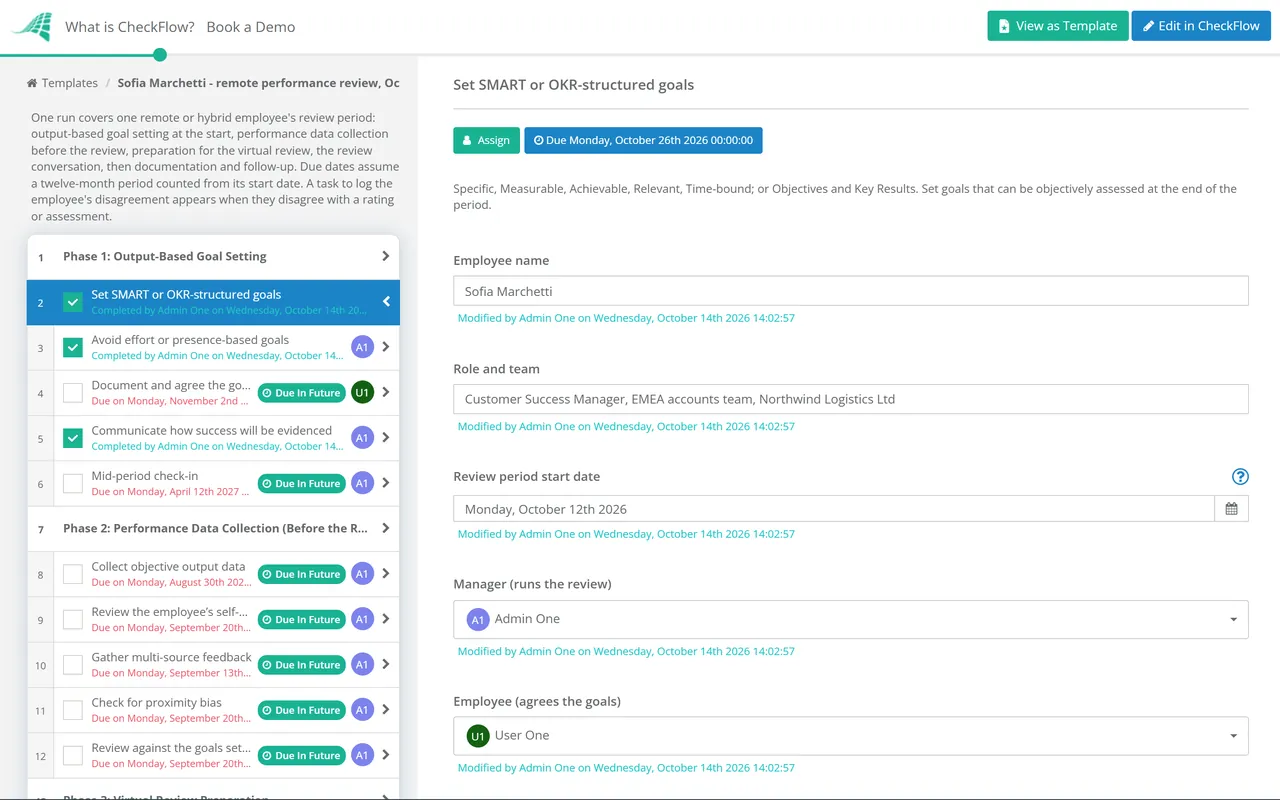
Set SMART or OKR-structured goals — Specific, Measurable, Achievable, Relevant, Time-bound; or Objectives and Key Results; goals that can be objectively assessed at the end of the period
Avoid effort or presence-based goals — “be responsive on Slack” is not a goal; “resolve 95% of support tickets within 24 hours” is a goal; the distinction is measurability without surveillance
Document and agree the goals — in writing; both manager and employee have the same record; not subject to “I thought we agreed…” disputes
Communicate how success will be evidenced — what data will be used? What qualitative evidence matters? Both parties agree before the period starts
Mid-period check-in — quarterly or midpoint review of progress against goals; course-correct if off-track; remote employees need more frequent goal check-ins than in-person because there is less ambient feedback
Phase 2
Phase 2: Performance Data Collection (Before the Review)
Collect objective output data — what was delivered against goals? Specific, evidenced, quantitative where possible; not impressionistic
Review the employee’s self-assessment — invite a structured written self-assessment at least 1 week before the review; what they believe they achieved; what they found challenging; what development they want
Gather multi-source feedback — from colleagues who worked most closely with the employee; cross-functional partners; internal customers; done early enough to be reflected in the review
Check for proximity bias — in your own assessment; is the rating based on output evidence or on recall of visible presence? Would you rate this person differently if they had been in the office every day?
Review against the goals set at the start — not against what the employee happened to work on; the agreed goals are the standard
Phase 3
Phase 3: Virtual Review Preparation
Prepare the review document — structured assessment of each goal, evidence cited, multi-source feedback themes synthesised, development observations
Share the review document with the employee — at least 48 hours before the conversation; no surprises in a performance review conversation; the employee should have time to read and consider
Book a dedicated uninterrupted slot — at least 60 minutes; not a squeezed time between other meetings; both parties confirm they will be in a quiet location
Technology check — video call confirmed working; screen share available for reviewing the document together; backup plan if technology fails
Phase 4
Phase 4: The Virtual Performance Review Conversation
The virtual review conversation requires more deliberate structure than in-person because the absence of physical presence makes it easier for one person to dominate, harder to read emotional cues, and tempting to rush. Build in more pauses, ask more checking questions, and confirm understanding more explicitly.
Open with context — briefly: the purpose of the conversation; the structure; confirmation that the document has been read
Employee shares their perspective first — on their own performance before the manager offers their assessment; this reduces the power dynamic and provides insight into the employee’s self-awareness
Work through each goal together — what was achieved; what the evidence shows; agreed rating or assessment
Discuss development — strengths to build on; specific areas for growth; not a deficit list but a genuine conversation about what the employee wants to become
Allow adequate time for employee questions and responses — do not rush the employee’s reactions; disagreement is legitimate and should be heard; the employee’s perspective on a rating they disagree with should be documented
Close with agreement on next period goals — the review does not close without clarity on what the next period’s goals are
Phase 5
Phase 5: Documentation & Follow-Up
Document the review — final ratings, key feedback themes, agreed development actions; signed by both parties (digitally)
Log any employee disagreement — if the employee disagrees with a rating or assessment, this should be noted; the review record is a legal document in some jurisdictions
Set goals for the next period — documented; agreed; both parties have a copy; the next review starts now
Schedule development actions — specific training, coaching, or project opportunities agreed in the review are calendared before the conversation ends
Output-based goal tracking visible to both manager and employee
The remote performance review that relies on the manager’s recall of what the employee did over twelve months is the review most prone to proximity bias. CheckFlow makes the agreed goals, the documented progress, and the evidence collected visible to both parties throughout the year — so the annual review summarises a documented record rather than a recalled impression.
2
Multi-source feedback collected and structured before the review
The 360 feedback process for remote employees that is initiated two days before the review produces rushed, low-quality input. CheckFlow triggers the multi-source feedback collection four weeks before the review date — giving respondents adequate time and giving the manager enough synthesis time for the feedback to genuinely inform the conversation.
3
A legally defensible review record
Performance reviews are regularly produced as evidence in employment disputes — particularly in cases involving underperformance management and dismissal. CheckFlow produces a dated, attributed, structured review record with the agreed goals, evidence references, assessments, and any employee commentary — the documentation that HR and legal teams rely on.
Remote performance management requires the full employee performance review framework. CheckFlow’s Employee Performance Review Checklist in the HR series covers the complete annual review process. See the Employee Performance Review Checklist →
Team engagement supports performance. CheckFlow’s Remote Team Engagement Activities Checklist covers the structured programme for keeping remote teams connected and motivated. See the Remote Team Engagement Activities →
What should a remote performance review checklist include?
+
A remote performance review checklist covers five phases: goal setting (SMART or OKR-structured output-based goals, agreed in writing at the period start, with mid-period check-ins), performance data collection (objective output data, employee self-assessment, multi-source feedback, proximity bias check, goals review), review preparation (structured review document, employee pre-read 48 hours before, dedicated quiet slot, technology confirmed), virtual review conversation (context, employee shares first, goal-by-goal review, development discussion, employee questions, next period goals), and documentation and follow-up (signed review record, any disagreement noted, next period goals documented, development actions calendared).
What is proximity bias and how does it affect remote workers?
+
Proximity bias is the tendency to evaluate people more favourably based on physical proximity or visibility rather than on the quality or quantity of their work. In hybrid teams, it typically manifests as in-office employees receiving higher performance ratings, more mentoring attention, and better promotion prospects than remote employees of equivalent output — not because they perform better, but because they are more visible to their manager. The antidote is output-based performance management: defining what will be delivered at the start of the period, measuring what was delivered at the end, and supplementing manager assessment with structured multi-source feedback from the colleagues who worked most directly with the employee.
How should goals be set for remote employees?
+
Goals for remote employees should be output-based and measurable without requiring surveillance of working hours or online presence. The most effective framework is SMART goals (Specific, Measurable, Achievable, Relevant, Time-bound) or Objectives and Key Results (OKRs). A goal like “be more responsive” is not a SMART goal; “respond to all client emails within 4 hours during working hours” is measurable and objective. Goals should be agreed in writing at the start of the review period, with mid-period check-ins to assess progress and adjust if the context has changed.
How do you run an effective performance review on video?
+
An effective virtual performance review requires: sharing the review document with the employee at least 48 hours before the conversation (so there are no surprises and they can prepare); booking a dedicated, uninterrupted slot of at least 60 minutes; having both parties in a quiet location; inviting the employee to share their own assessment first (this reduces power imbalance and provides insight into self-awareness); building in explicit pauses for the employee to respond (physical cues that indicate when someone wants to speak are harder to read on video); and not rushing through the development section to get to the rating.
Is CheckFlow free for this template?
+
14-day free trial, no card required. The Business plan is $10 per user per month after the trial. Full details at checkflow.io/pricing.
Review Every Remote Employee on What They Delivered — Not How Visible They Were
Free trial — no credit card required.
Do you like cookies? 🍪 We use cookies to ensure you get the best experience on our website. Learn more