
Financial Promotion Approval Checklist Template

Every financial promotion has to comply with the FCA’s rules before it is used and for as long as it runs, checked by people with the right competence and recorded. This template adds a named approver as the gate, and approving another firm’s promotion under section 21 adds duties of its own.

Last reviewed: November 2026

Printed from checkflow.io/templates/financial-services/financial-promotion-approval-checklist

This free financial promotion checklist is for compliance teams, marketing teams and approvers at FCA-authorised firms in the UK. One run is one promotion, or a set of pieces that go out together, such as an email and its landing page, from the brief to approval and while it runs. The first phase logs the promotion, its audience and every piece. The reviewer then decides whether it is a financial promotion and which rules govern it, the owner lists every claim with its evidence, and the review checks the promotion is fair, clear and not misleading, balanced by the relevant risks, prominent where it must be and likely to be understood by the people it reaches. The approver signs off the final version as the gate, the approval is recorded with its retention period, and the promotion goes live exactly as approved. The last phase watches responses, reviews the promotion at three months and withdraws it if it stops complying. Approving a third party’s promotion under section 21 of the Financial Services and Markets Act 2000 adds the client checks, the terms of the approval, any FCA notification and the quarterly attestation, and restricted mass market investments, non-mass market investments and consumer credit each add their own checks. UK only: the rules are the FCA Handbook’s as read in November 2026.

The Approval Gate for One Promotion

The Compliance Monitoring & Testing Checklist tests a sample of promotions after they have been used, for example a quarter’s financial promotions, as part of the monitoring plan. The FCA Consumer Duty Annual Review Checklist looks at outcomes across the firm’s products once a year. The Campaign Launch Checklist and the Design Review & Approval Checklist each have one step that names financial promotions disclaimers, inside a wider marketing process.

This checklist is the approval gate for one promotion before it is used, and its review while it runs: the rules that apply, every claim and its evidence, the checks against COBS 4 or CONC 3, the approver’s sign-off and the record. Use it for every promotion your firm communicates or approves, and use monitoring and testing to check, after the fact, that the gate works.

This checklist

One promotion, before it is used and while it runs

Covers: the rules that apply, claims and evidence, fair, clear and not misleading checks, risk information and prominence, consumer understanding, the review comments, the approver’s sign-off, the record, the in-life review and withdrawal.

When: for every promotion, before go-live.

Output: an approved final version, a record with its retention period, and a review date.
After the fact

The Compliance Monitoring & Testing Checklist

Covers: a planned test of one obligation area for one period, from the population and sample to findings and actions.

Use it: to test a sample of approved promotions against this checklist’s records. Compliance Monitoring & Testing Checklist.

Once a year

The FCA Consumer Duty Annual Review Checklist

Covers: the outcomes evidence, the board report and the actions that follow, across the firm’s products.

Use it: for the yearly review; this checklist’s testing and complaints notes feed it. FCA Consumer Duty Annual Review Checklist.

What the Financial Promotion Approval Checklist Covers

Nine phases take one promotion from the brief to its review while it runs. The first task sets the go-live date and the people, and every due date counts in business days back from go-live, starting five weeks before it. Later answers add only what this promotion needs: the third-party approval steps, the checks for restricted mass market investments, non-mass market investments or consumer credit, and the withdrawal steps if it stops complying. The approver’s sign-off is the gate: nothing after it can be completed until it is done.

  1. Phase 1

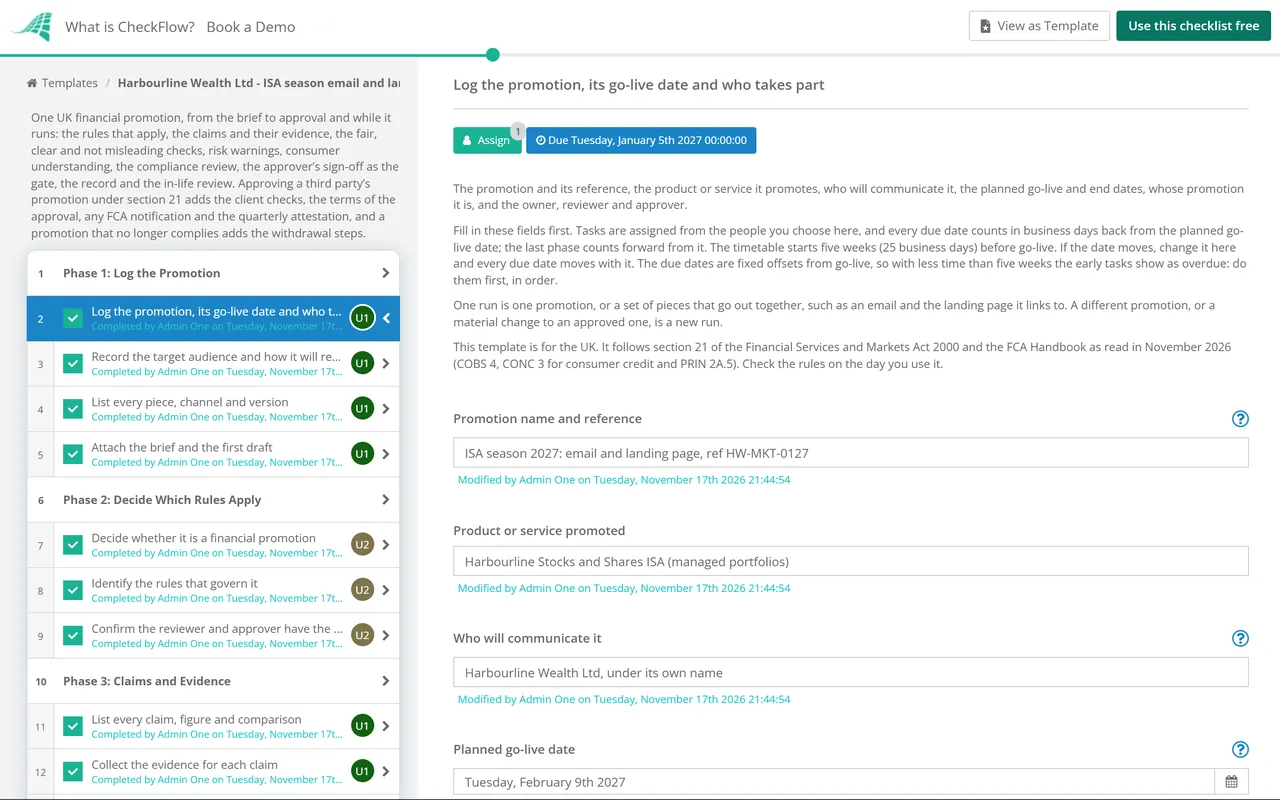
    Phase 1: Log the Promotion

    4 tasks

    The promotion owner opens one run for one promotion: one campaign piece, or a set of pieces that go out together. The answers on the first task assign every task, count every due date in business days back from the planned go-live date and add the third-party approval steps when someone else will communicate it.

    • Log the promotion, its go-live date and who takes part — the promotion and its reference, the product or service it promotes, who will communicate it, the planned go-live and end dates, whose promotion it is, and the owner, reviewer and approver
    • Record the target audience and how it will reach them — who the promotion is for, whether it is addressed to or likely to be received by retail clients, and the target market from the product’s governance
    • List every piece, channel and version — each email, web page, social post, advert or print piece, its channel and size limits, and whether any part is spoken in real time
    • Attach the brief and the first draft — the brief, the draft copy and design of every piece, and the version number the review starts from
  2. Phase 2

    Phase 2: Decide Which Rules Apply

    4 tasks

    The compliance reviewer decides whether the piece is a financial promotion, which part of the FCA Handbook governs it and whether the people checking it have the right competence. For a third party’s promotion, the client and the approval route are checked here, before any work is done on the copy.

    • Decide whether it is a financial promotion — whether it invites or induces someone to engage in investment activity in the course of business, or is image advertising, an excluded communication or exempt
    • Check the client and the approval route — for a third party’s promotion: who the client is, that they are not authorised, whether your firm has the FCA’s approver permission or an exemption covers this approval, and any conflict of interest
    • Identify the rules that govern it — whether COBS 4 applies to a mainstream investment, the stricter rules for a restricted mass market or non-mass market investment, or CONC 3 for consumer credit
    • Confirm the reviewer and approver have the right competence — competence and expertise in the product or service promoted, and what you will do if you lack it
  3. Phase 3

    Phase 3: Claims and Evidence

    6 tasks

    The owner lists every claim the promotion makes and gathers the evidence for each one, so the review that follows checks facts rather than chasing them. Performance figures, comparisons and tax statements each have their own rules.

    • List every claim, figure and comparison — each statement of fact, number, rate, fee, award or comparison, where it appears and the evidence that supports it
    • Collect the evidence for each claim — the source document for each claim, its date, and a check that each figure will still be current on the go-live date
    • Check any past, simulated or future performance figures — five years of complete 12-month periods where available, the reference period and source, the prominent warning, and nothing more prominent than it should be
    • Check comparisons are meaningful, fair and balanced — every comparison with another product, provider, cash or an index, its sources and its key facts and assumptions
    • Check any tax statement — that any reference to a tax treatment says prominently that it depends on individual circumstances and may change, and that allowances and tax years are right
    • Check any sustainability claim — that any reference to environmental or social characteristics is fair, clear, not misleading and backed by evidence
  4. Phase 4

    Phase 4: Fair, Clear and Not Misleading

    7 tasks

    The compliance reviewer checks the draft against the core rule: COBS 4.2.1R for investments and CONC 3.3.1R for consumer credit. Each piece is checked on its own, because a reader may see only one of them.

    • Check it is clearly identifiable as a promotion — that a reader can tell it is marketing, including in social posts, partner content and anything that looks like editorial
    • Check the firm’s name and, if approved for others, the approver’s name and date — the name of the firm, and for a promotion approved for an unauthorised person the approving firm’s name and the approval date, or an Approver FRN link
    • Check benefits are balanced by the relevant risks — that every potential benefit is accompanied by a fair and prominent indication of the relevant risks, and that it makes clear if capital is at risk
    • Check words such as “guaranteed”, “protected” and “secure” — that any such word, or one like it, is a fair description and comes with all the information needed to make it fair, clear and not misleading
    • Check nothing important is disguised, diminished or obscured — small print, footnotes, pop-ups, links and design choices that hide or play down important items, statements or warnings
    • Check it matches the product documents and is up to date — that fees, features, rates and terms match the product documents and what clients are told elsewhere, as at the go-live date
    • Check each piece and channel stands alone — each email subject line and body, landing page, social post and advert on its own, within its character limits, including how it looks on a phone
  5. Phase 5

    Phase 5: Risk Warnings and Prominence

    5 tasks

    The reviewer checks the risk information is right for the product and prominent enough. For mainstream investments the FCA prescribes no wording; restricted mass market and non-mass market investments and consumer credit have their own rules, which the answer in Phase 2 adds.

    • Check the risk statements for this product — that the relevant risks of this product are explained where the benefits are, in words the audience will read
    • Check the font size and layout of the risk information — a font size at least equal to the main text, and a layout that makes the risk information prominent on every screen size
    • Check the restricted mass market investment rules — the prescribed risk warning, the risk summary or its link, no incentives to invest, and the conditions for any direct offer
    • Check the non-mass market investment restriction — the exemption relied on to promote it to retail clients, the investor certification and warnings it needs, and the compliance oversight record
    • Check the consumer credit rules — the representative example or representative APR where a rate, cost or trigger requires it, no suggestion that credit is available regardless of status, and any required warning
  6. Phase 6

    Phase 6: Consumer Understanding

    3 tasks

    PRIN 2A.5 applies to firms under the Consumer Duty that produce, approve or distribute communications to retail customers. The reviewer checks the promotion will be understood by the people it reaches and gives them what they need to decide well.

    • Check it is likely to be understood by its audience — plain language, jargon explained, key information easy to find, no unnecessary disclaimers, and the right amount of detail for the target audience
    • Test the communication where appropriate — whether to test the promotion with people like its audience before it is used, the results, and why if it was not tested
    • Check the journey after the click — that the landing page and next steps give the information people need in good time, through a channel that lets them review it
  7. Phase 7

    Phase 7: Compliance Review and Approval

    6 tasks

    The reviewer sends one set of comments, the owner makes the changes, and the approver signs off the final version. The approval is the gate: nothing after it can be completed until it is done.

    • Send the compliance review comments — every change the review asks for, by piece, with the rule behind it, in one marked-up copy
    • Make the changes and confirm the final version — every comment answered, the final version of every piece attached, and nothing changed that the reviewer did not see
    • Set the terms of the approval for others — who may communicate it, to which audience, through which channels and until when, written into the approval you give
    • Rework or drop the promotion — the owner fixes what the approver rejected and sends it back for approval, or records that the promotion will not be used
    • Approve the promotion for use — the approver checks the final version and the review, then approves it, approves it with conditions or does not approve it
    • Check the approval conditions are met — each condition the approver set, met and checked by the reviewer before the promotion goes live
  8. Phase 8

    Phase 8: Record and Go Live

    4 tasks

    The approval is recorded with the version it covers, any approval for others is sent with its terms, and the promotion goes live exactly as approved.

    • Record the approval and how long to keep it — the version approved, who approved it and when, why they were satisfied it complies, and the retention period that applies
    • Send the approval and its terms to those who will communicate it — the approved version, the approver’s name and date or Approver FRN link, the limits of the approval, and what they must tell you if anything changes
    • Notify the FCA of the approval where the rules require it — for a firm with approver permission: an approval of a promotion for a non-mass market investment, or for a qualifying cryptoasset where SUP 16.31.5R requires it, notified within 7 days
    • Confirm it went live exactly as approved — the live version of every piece matches the approved version, links work, and any approver name, date or FRN link shows
  9. Phase 9

    Phase 9: In-Life Review and Withdrawal

    7 tasks

    While the promotion runs, the owner watches how it lands and the reviewer checks it still complies at three months, and sooner if something changes. A promotion that no longer complies is withdrawn and everyone relying on it is told.

    • Watch responses and complaints in the first weeks — complaints, questions and signs that people misunderstood it, passed to the reviewer as they come in
    • Review whether it still complies — figures, rates, the product, the rules and the audience checked again, with the client’s written attestation for a third party’s promotion
    • Withdraw it from every channel — the promotion taken down everywhere it runs, scheduled sends cancelled, and the date and time recorded
    • Tell everyone relying on the approval — every person you know to be relying on your approval told that it is withdrawn, as soon as reasonably practicable
    • Notify the FCA of the withdrawal if it is a notifiable concern — for a firm with approver permission, a withdrawal because of a notifiable concern notified within 7 days
    • Take the change through approval — a new run of this checklist for the changed version, with the current version left live only while it still complies
    • Retire it and keep the record — the end date reached or the next review set, the record complete, and what to do differently next time

Which FCA Rules Apply, and How Long to Keep the Record

Which rules apply

The answer on the Phase 2 task decides which extra checks the run adds.

What is promoted Rules (FCA Handbook) What they add In this checklist
A mainstream investmentCOBS 4, with COBS 4.5A for MiFID business or COBS 4.5 and 4.6 for other businessFair, clear and not misleading; balanced risks in a font at least as large as the main text; performance, comparison and tax rules; no prescribed risk wordingPhases 3 to 6 for every promotion
A restricted mass market investment, including qualifying cryptoassetsCOBS 4 and COBS 4.12AA prescribed risk warning and risk summary, no incentives to invest, and conditions for a direct offer, including a 24-hour cooling-off period, with some exceptionsAn extra task in Phase 5
A non-mass market investmentCOBS 4, COBS 4.12B and COBS 4.11.4RPromotion to retail clients only under an exemption, with a record certified by the compliance oversight functionAn extra task in Phase 5
Consumer creditCONC 3 (COBS 4 does not apply)Clear, fair and not misleading; a representative example or APR when the rules require it; no “regardless of status” claimsAn extra task in Phase 5
A third party’s promotion, approved under section 21FSMA 2000 s21 and s55NA, COBS 4.10, SUP 16.31Approver permission or an exemption, confirmation before approval, limited terms, monitoring, quarterly attestations and FCA notifications (for consumer credit, CONC 3.11 rather than COBS 4.10)Extra tasks in Phases 2, 7 and 8, and the attestation on the Phase 9 review

How long to keep the record

The record task in Phase 8 asks which of these applies. COBS 4.11 does not apply to consumer credit promotions (COBS 4.1.1R(2)(d)), so the record task has a fifth answer for them: keep the record under your own policy.

The promotion relates to Keep the record for (COBS 4.11.1R(3))
A pension transfer, pension conversion, pension opt-out or FSAVCIndefinitely
A life policy, occupational pension scheme, SSAS, personal pension scheme or stakeholder pension schemeSix years
MiFID or equivalent third country businessFive years
Any other caseThree years

Read on 17 November 2026: COBS 4 was last updated on 6 April 2026 and has a future version dated 25 October 2027, the day the FCA expects its new cryptoasset regime to come into force; SUP 16.31 was last updated on 1 October 2026. Insurance, mortgages and other products outside COBS 4 have their own rules, which this template does not check. Section 21 applies to communications capable of having an effect in the UK, whatever their origin. This template does not give legal advice: take advice where a case is not clear.

Why Run Financial Promotion Approval in CheckFlow?

1

Signed off before it is used

The approver’s sign-off is a gate: nothing after it can be completed until it is done, and only the named approver can open it. See how approval steps work.

2

A record that answers the questions

Each run keeps the version approved, the evidence for every claim, the review comments, who approved it and when, and the retention period. Every promotion sits on the Reports Grid with its answers, so a sample for testing takes minutes to pull.

3

Still compliant while it runs

The in-life review falls due three months after go-live, with the client’s attestation for a third party’s promotion, and a promotion that stops complying adds the withdrawal steps. Analytics shows completion rates and overdue and late work by person and by step.

CheckFlow does not decide whether a promotion complies; your reviewer and approver do. CheckFlow runs the process around them: who checked what, which evidence supports each claim, what changed after the review, who approved which version and when it was withdrawn.

Test approved promotions after the fact with the Compliance Monitoring & Testing Checklist, and take what you learn into the FCA Consumer Duty Annual Review Checklist. Check emails before they send with the Email Campaign QA Checklist, brief creators with the Influencer Campaign Checklist, and handle complaints about a promotion with the Customer Complaints Handling Checklist.

AI generator

Didn’t find what you need? Describe it.

Describe the process in a sentence and the AI checklist generator drafts the phases and tasks for you.

Frequently Asked Questions

What is a financial promotion?

Under section 21 of the Financial Services and Markets Act 2000, a financial promotion is an invitation or inducement to engage in investment activity (or claims management activity) communicated in the course of business. It can be an advert, an email, a web page, a brochure or a social media post. Only an authorised person may communicate one, unless an authorised person with the right permission has approved its content or an exemption applies. Breaching the restriction is a criminal offence.

What should a financial promotion checklist include?

Whether the piece is a financial promotion and which rules govern it; the audience and every channel; each claim with its evidence; performance, comparison and tax statements; fair, clear and not misleading checks; risk information and its prominence; whether the audience will understand it; the review comments and final version; the approver’s sign-off; the record and retention period; and a review while it runs. This checklist covers each one, with extra steps for third-party approvals.

What does fair, clear and not misleading mean for a promotion?

It is the core rule: COBS 4.2.1R for investments and CONC 3.3.1R for consumer credit. In practice the FCA’s rules ask that a promotion is accurate, gives a fair and prominent indication of the relevant risks wherever it mentions benefits, does not disguise, diminish or obscure important information, is likely to be understood by the people who receive it, and takes the nature of the client into account.

What is the s21 gateway for approving financial promotions?

Since 7 February 2024, an authorised firm can approve a promotion for an unauthorised person under section 21 only with the FCA’s permission to do so (section 55NA), unless an exemption applies: for its appointed representatives, unauthorised members of its group, or its own promotions passed on by others. Approvers must confirm compliance before approving, monitor the promotion while it runs, get a written attestation from the client every three months and, where they hold the permission, report to the FCA.

Do investment promotions need a “capital at risk” warning?

For mainstream investments, the FCA says it does not prescribe risk wording and that a separate risk warning is not required, but a promotion must make clear if capital is at risk and give a balanced view of benefits and risks (COBS 4.2.4G and the FCA’s page on risk warnings for mainstream investments). Restricted mass market investments, including qualifying cryptoassets, must use the risk warning prescribed in COBS 4.12A.11R.

What must an approved financial promotion show?

A promotion approved for an unauthorised person that is likely to reach retail clients must include the name of the firm that approved it and the date it was approved (COBS 4.10.7AG and COBS 4.5.2R). On a website, app or other digital medium where these cannot reasonably fit, it may instead carry a clear link in the form “Approver FRN” followed by the approving firm’s reference number, leading to a page that shows them (COBS 4.5.2AR).

How long must financial promotion records be kept?

COBS 4.11.1R requires an adequate record of each investment promotion a firm communicates or approves, with some exceptions, such as image advertising, non-retail communications and promotions in a personal visit, telephone call or other interactive dialogue. It is kept indefinitely for a pension transfer, conversion, opt-out or FSAVC; six years for a life policy or pension scheme; five years for MiFID or equivalent third country business; and three years in any other case. COBS 4.11 does not apply to consumer credit promotions.

What happens if an approved promotion stops complying?

The approving firm must withdraw its approval and tell anyone it knows is relying on it as soon as reasonably practicable (COBS 4.10.2R(2)). A firm with approver permission must tell the FCA within 7 days if it withdraws because of a notifiable concern (SUP 16.31.5R). A firm that keeps communicating a promotion that no longer complies breaches the rules, and the FCA can direct that a misleading promotion is withdrawn (section 137S).

Do the rules apply to social media and finfluencer posts?

Yes. The FCA’s guidance on financial promotions on social media (FG24/1, March 2024) says its rules are technology neutral and apply on every channel. Each post must comply on its own, within the platform’s limits. An influencer or affiliate who is not authorised and promotes a regulated product without approval from an appropriate authorised firm may be committing a criminal offence, so a firm working with one should check who approves what before anything is posted.

Is CheckFlow free for this template?

14-day free trial, no card required. The Business plan is $10 per user per month after the trial. Full details at checkflow.io/pricing.

Approve Every Financial Promotion With the Evidence Behind It

Free trial — no credit card required.

14-day free trial, no credit cardFull refund in your first 30 daysUS hosting, EU on request