
All year, PRIN 2A.9
Who: product, operations and compliance teams.
Work: outcome metrics by product and customer group, acted on as issues appear.
Output: MI and fixes made during the year.
Last reviewed: October 2026
No Credit Card Required
Printed from checkflow.io/templates/financial-services/consumer-duty-annual-review-checklist
This free checklist runs the annual Consumer Duty review at a UK firm, from setting the timetable to the board’s approval. It is for compliance, risk and Consumer Duty leads at banks, lenders, insurers, investment firms, advisers and payment firms. It gathers the evidence on the four outcomes, tests outcomes for vulnerable customers and other groups, and turns it into a report the board can challenge and approve. Two answers at the start add phases only where they apply: closed products, and other firms in your distribution chain. The board’s approval is a recorded task, and the agreed actions carry into next year’s review.
The Consumer Duty, Principle 12 and PRIN 2A in the FCA Handbook, has applied to open products since 31 July 2023 and to closed products since 31 July 2024. It asks firms to deliver good outcomes for retail customers under four headings: products and services, price and value, consumer understanding and consumer support. Three cross-cutting rules sit over them: act in good faith, avoid causing foreseeable harm, and enable and support customers to pursue their financial objectives.
PRIN 2A.8 requires the firm’s board, or equivalent governing body, to review and approve an assessment of the outcomes customers receive at least once a year. When it does, the board confirms whether it is satisfied the firm is meeting the Duty, considers whether future strategy is consistent with it, and agrees any actions. The annual review is where the year’s monitoring and product work come together, and it does not replace either. A board that only sees the annual report has missed eleven months of chances to act, so many firms also send outcome MI to the board or a committee during the year and use the annual assessment to step back and look at the whole picture.
Who: product, operations and compliance teams.
Work: outcome metrics by product and customer group, acted on as issues appear.
Output: MI and fixes made during the year.
Who: product owners, with insurers also under PROD 4.
Work: target market, product testing and fair value assessments.
Output: a product kept, changed or withdrawn.
Who: the board or governing body.
Work: challenge the evidence across all four outcomes and the strategy.
Output: an approved report and agreed actions.
Five phases run every year. Closed products and the distribution chain switch on only when the scoping answers in Phase 1 call for them.
Owned by the Consumer Duty lead. The answers recorded here decide whether Phases 5 and 6 appear.
Outcomes 1 and 2. Product owners supply the evidence; the Consumer Duty lead checks it.
Outcomes 3 and 4. Marketing, servicing and complaints teams supply the evidence.
Shown only when the firm has closed products with existing customers.
Shown only when other firms manufacture or distribute your products.
The approval task is assigned to the board chair or company secretary, who records the board’s decision. A Not approved returns the report to the Consumer Duty lead.
Each phase maps to a part of PRIN 2A or the FCA’s guidance. Which parts apply, and how deep the review goes, depends on your retail business and your role in the chain, so treat the table as a starting point, not legal advice.
| Requirement | Source | What the review evidences | Phase |
|---|---|---|---|
| Products and services | PRIN 2A.3; PROD for insurers and investment firms | Products meet the target market’s needs and reach it | 2 |
| Price and value | PRIN 2A.4 | Fair value assessments, by product and group | 2, 5 |
| Consumer understanding | PRIN 2A.5 | Communications tested and understood | 3 |
| Consumer support | PRIN 2A.6 | Support that works and no unreasonable barriers | 3 |
| Cross-cutting rules | PRIN 2A.2 | Good faith, harm avoided, objectives supported | 4 |
| Outcomes for different groups, including vulnerable customers | PRIN 2A.9; FG21/1 vulnerability guidance | Group-level outcome data | 4 |
| Distribution chain | PRIN 2A, applied to each firm’s role in the chain | Information shared and acted on | 6 |
| Annual board assessment | PRIN 2A.8 | Approval, strategy check and agreed actions | 7 |
The Duty is being simplified, but most of the changes are still proposals. The timeline shows what has happened and what is pending.
The FCA said it no longer expects firms to have a board-level champion, though firms may keep the role.
In a letter to the Chancellor on wholesale firms, the FCA committed to clarify its supervisory approach, consult on how the Duty applies through distribution chains, and propose removing business with non-UK customers from scope.
The FCA added insight for smaller firms, then published observations on the first two years of board reports, pointing to gaps in data analysis, oversight of third-party distribution and evidence of board challenge.
Proposals to limit the Duty mainly to customers usually resident in the UK, replace co-manufacturing with a principal and secondary manufacturer model, confirm proportionate due diligence on partner firms, and say a stand-alone board report is not required if proportionate reporting reaches the board at least annually. Consultation closed on 18 September 2026.
Until the FCA publishes a policy statement, the current PRIN 2A rules apply, including the annual board assessment.
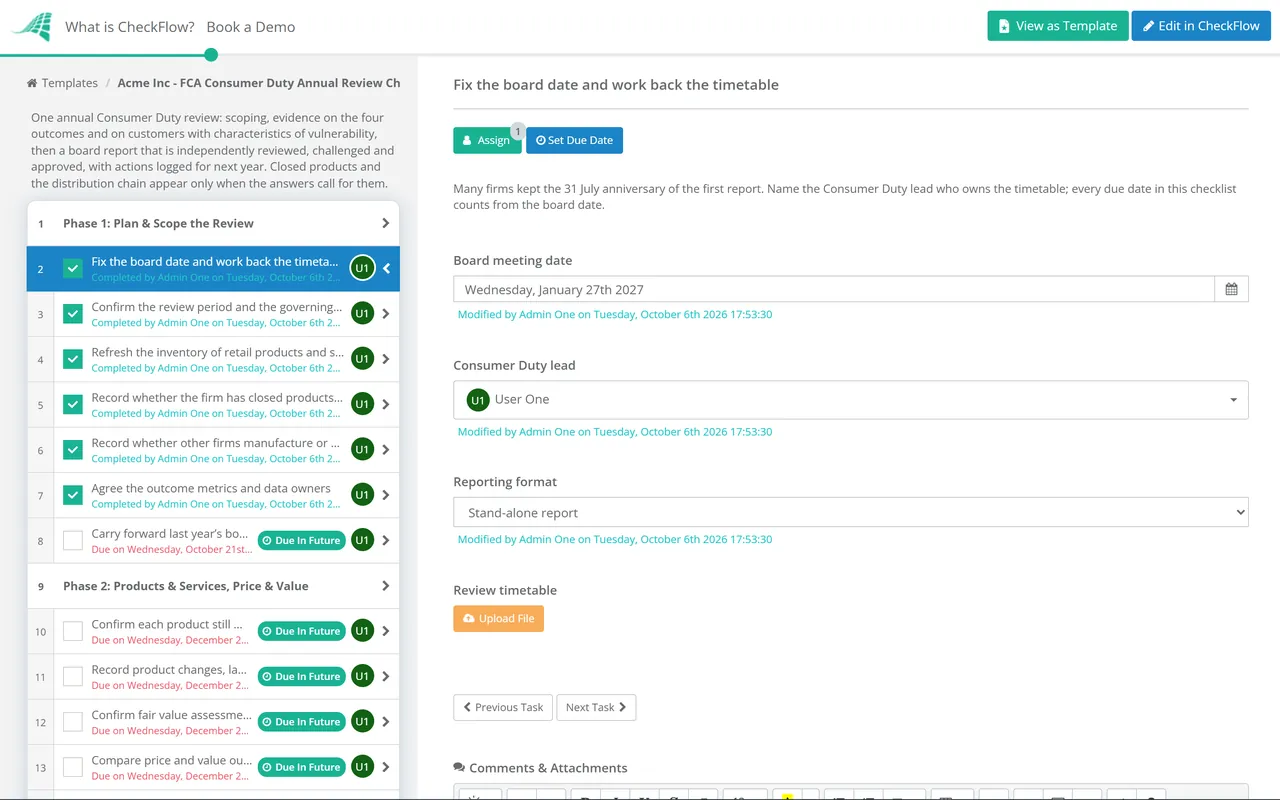
A recurring annual schedule opens the review months before the board date, and due-date offsets give each product owner a deadline for their evidence. The Tasks grid shows who has not yet delivered.
Fair value assessments, testing results and complaints MI attach to the task they support, and a data set of your products feeds the dropdowns. When the board asks where a conclusion came from, the evidence is one click away.
The board’s decision is an approval task assigned to a named person, and the checklist cannot close until it is answered. The agreed actions and the timestamped activity trail export for the FCA if it asks.
CheckFlow is not a board portal, data warehouse or MI dashboard, and it does not write the report for you. It runs the workflow around them: who supplies each piece of evidence, by when, who reviewed it and what the board approved. Our guide to financial services workflow automation covers other recurring reviews, and the financial services overview shows how regulated firms use CheckFlow.
Complaints MI is one of the strongest outcome signals, and the Complaints Handling Checklist records a root cause for every complaint. Accountability for the Duty runs through your Senior Managers’ responsibilities, which the SM&CR Annual Certification Checklist keeps current, and CheckFlow’s compliance checklist software covers the rest of the compliance calendar.

Regulatory Examination Preparation Checklist

Monthly Management Reporting Pack Checklist

Financial Planner Client Onboarding Checklist

KYC Periodic Review Checklist

Employee Compliance Certification Tracking Checklist
Describe the process in a sentence and the AI checklist generator drafts the phases and tasks for you.
The rules require an assessment of whether the firm is delivering good outcomes for retail customers, based on its monitoring, and the actions needed where it is not. The board must review and approve it, confirm whether it is satisfied the firm is complying with the Duty, consider whether future strategy is consistent with it, and agree any actions. The FCA sets no format, but its reviews favour reports built on outcome data, split by customer group, with clear owners for each action.
At least once a year. The first report was due by 31 July 2024, and many firms have kept that anniversary, but the rule sets a frequency rather than a calendar date. Choose a date that fits your board cycle and your data, and keep it consistent so each report covers a full year.
No. It is an internal governance document, not a submission or an attestation. The FCA can ask to see it, often during supervisory work, so keep the approved version, the minutes showing the board’s challenge and the evidence behind it.
Not the annual assessment. CP26/23, published in June 2026, proposes that firms need not produce a stand-alone Consumer Duty report and can fold proportionate reporting into existing governance, as long as the board still considers it at least annually. The consultation closed on 18 September 2026 and final rules are expected in early 2027. Until then the current rules apply.
Yes. The Duty has applied to closed products and services since 31 July 2024, so long-standing customers on legacy products need the same outcome evidence as customers on open products. Value is often the weak point, because closed books can drift from what new customers are offered.
By comparing outcomes, not by describing policies. The monitoring rules ask firms to check whether different groups of customers, including those with characteristics of vulnerability, get worse outcomes than others. Run the same metrics for customers flagged as vulnerable as for everyone else: complaints, arrears, cancellations, time to resolve and value. Where the numbers differ, the report should explain why and what the firm is doing about it. The FCA’s FG21/1 guidance covers how to identify vulnerability and adapt service.
14-day free trial, no card required. The Business plan is $10 per user per month after the trial. Full details at checkflow.io/pricing.
14-day free trial, no credit cardFull refund in your first 30 daysUS hosting, EU on request