
Design Review & Approval Checklist Template

A structured review process that catches what informal feedback misses — before the work goes live.

Informal design review — sending a file, waiting for comments, making changes, repeating — is how most teams operate. It produces inconsistent results because what gets reviewed depends on who happens to look at it and what catches their eye. Brand errors get through because nobody explicitly checked. Accessibility issues are missed because nobody was asked to look. Legal requirements are overlooked because the legal team was not in the loop. Technical specifications are wrong because the reviewer was evaluating the concept, not the delivery format. A structured design review checklist changes this — by defining what needs to be reviewed at each stage, who is responsible for each review discipline, and what constitutes acceptable quality before work advances to the next stage or goes live. This free design review and approval checklist covers every review discipline from brief compliance through brand standards, copy accuracy, technical specifications, accessibility, legal compliance, stakeholder approval, and final file delivery.

Use This Template Free See Live Example
No Credit Card Required

Why a Structured Review Process Produces Better Work Than Informal Feedback

The problem with informal review is not that reviewers are careless — it is that reviewers are human. They notice what is salient and miss what is habitual. They check what they were implicitly asked to check (the concept, the layout, the copy) and skip what nobody mentioned (the accessibility contrast ratio, the print bleed, the copyright status of the stock image). The result is design work that passes review because nobody looked at the specific things that make it fail in production, in print, or in a regulatory audit.

A structured review checklist does not make reviewers work harder — it makes their attention systematic. Each review discipline has its own criteria. Each criterion is a specific, answerable question. Reviewers check what the checklist asks them to check, not what happens to catch their eye. The work that passes a structured review is not just approved — it is correct.

What the Design Review & Approval Checklist Covers

This checklist covers eight review disciplines — from brief compliance through to final file delivery. Depending on the project and organisation, some disciplines may be combined or assigned to the same reviewer; others require independent specialists. The order reflects a logical review sequence, with internal quality checks preceding external or stakeholder review.

Phase 1

Brief Compliance Review

Brief compliance review is the first and most fundamental check. If the work does not answer the brief, everything that follows is reviewing the wrong thing.

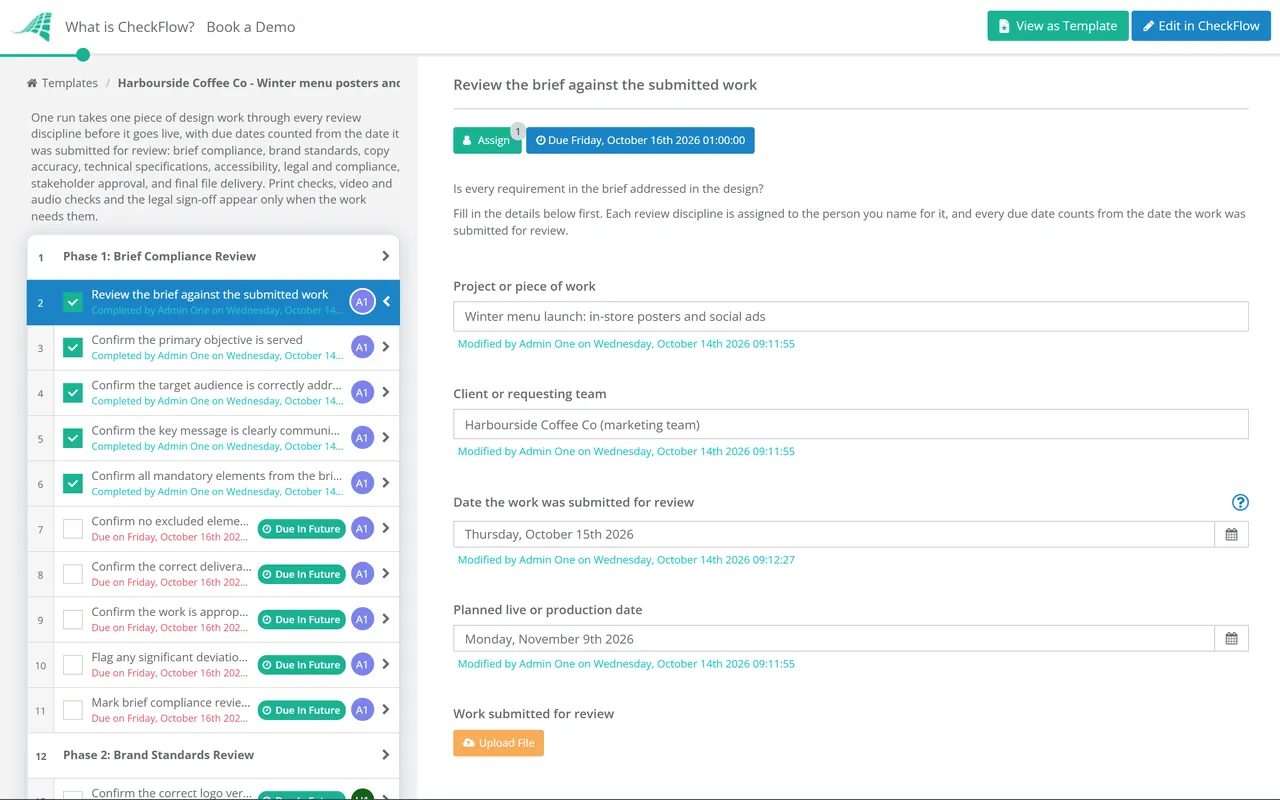
  • Review the brief against the submitted work — is every requirement in the brief addressed in the design?
  • Confirm the primary objective is served — does the design achieve what the brief set out to achieve? Review against the success criteria defined in the brief
  • Confirm the target audience is correctly addressed — does the design speak to the defined audience with appropriate tone, style, and messaging?
  • Confirm the key message is clearly communicated — is the single-minded proposition visible and prominent?
  • Confirm all mandatory elements from the brief are present — logo, tagline, specific copy, CTA, URL, QR code, product imagery, or other required inclusions
  • Confirm no excluded elements are present — review the brief’s list of exclusions and confirm none appear in the work
  • Confirm the correct deliverables have been produced — format, dimensions, quantity, and variations as specified
  • Confirm the work is appropriate for the confirmed distribution channels — does the design work in context?
  • Flag any significant deviations from the brief — document them and confirm whether they represent a creative improvement (flagged to the requester) or a gap (to be corrected before proceeding)
  • Mark brief compliance review as complete before proceeding to brand standards review
Phase 2

Brand Standards Review

  • Confirm the correct logo version is used — primary, secondary, or monogram as appropriate to the context; confirm it is the current approved version
  • Confirm logo clearspace requirements are met — no other elements within the defined exclusion zone
  • Confirm logo is not distorted, recoloured, or modified in any way not sanctioned by the brand guidelines
  • Confirm colour usage is correct — all colours match the approved brand palette values (HEX, RGB, or CMYK as appropriate to the format); no off-brand or approximate colours
  • Confirm typography is correct — approved typefaces, weights, and sizes as defined in the brand guidelines; no substituted or unlicensed fonts
  • Confirm imagery style is consistent with brand guidelines — photography style, illustration style, or icon library as applicable
  • Confirm tone of voice is on-brand — the copy reads like the brand, at the right register for the audience and channel
  • Confirm layout and visual hierarchy are consistent with brand conventions
  • Confirm any co-branding or partner logo usage meets the guidelines for both brands
  • Flag any brand guideline exceptions or new applications not covered by existing guidelines — these require brand manager sign-off rather than automatic rejection
Phase 3

Copy & Content Accuracy Review

  • Proofread all copy thoroughly — spelling, grammar, punctuation, and capitalisation; do not rely solely on spell-check
  • Verify all factual claims — product names, specifications, pricing, dates, statistics, and any other verifiable information is accurate and current
  • Confirm all contact details and URLs are correct and working — email addresses, phone numbers, website URLs, and landing page links
  • Confirm product or service names are spelled correctly and consistently — including capitalisation, spacing, and any trademark symbols required
  • Confirm any prices, offers, or promotional terms are current and authorised — check against the relevant pricing documentation or campaign brief
  • Confirm all required copy elements are present — headline, body, CTA, tagline, and any other copy components specified in the brief
  • Confirm no placeholder text remains — search for lorem ipsum, [INSERT COPY HERE], TBC, or similar markers
  • Check copy for consistency across all executions — if multiple versions or formats exist, confirm shared copy is identical where it should be
  • Confirm any social media copy meets platform character limits and format requirements
  • Confirm copy is appropriate for all markets and regions where the work will be distributed — flag any language, cultural references, or terminology that may not translate correctly
Phase 4

Technical Specifications Review

Technical review is the most commonly skipped discipline — and the one most likely to cause expensive rework at the point of production or delivery. A design that looks perfect at A3 may be unusable at web resolution.

  • Confirm file format is correct for the intended use — print (PDF, EPS, TIFF), web (PNG, SVG, JPEG, WebP), video (MP4, MOV), or other as required
  • Confirm dimensions are correct — pixel dimensions for digital, physical dimensions for print; verify against the spec in the brief
  • Confirm image resolution is appropriate — 300 DPI minimum for print; 72 DPI sufficient for screen; confirm raster images are not upscaled from a lower resolution
  • Confirm colour mode is correct — CMYK for print, RGB or sRGB for digital; colour modes should not be mixed within a print-destined file
  • Confirm bleeds, safe areas, and crop marks are correctly set for print deliverables — typically 3–5mm bleed; all critical content within the safe area
  • Confirm fonts are either embedded or outlined in print-ready files — avoid missing font errors at the print stage
  • Confirm file size is appropriate for the intended use — web assets are optimised for fast loading; email assets are within platform size limits
  • Confirm video files meet platform requirements — frame rate, bitrate, codec, aspect ratio, maximum file size, and caption file format where required
  • Confirm all linked or embedded assets in the source file are included in the delivery — no missing links
  • Confirm file naming conventions are correct — consistent with the organisation’s naming standards and clearly identifying version, format, and dimension
Phase 5

Accessibility Review

Accessibility review is not optional for digital content — it is a legal requirement in many jurisdictions and increasingly a procurement requirement. Run it before sign-off, not as a post-launch fix.

  • Check colour contrast ratios for all text elements — confirm normal text meets WCAG AA minimum ratio of 4.5:1; large text (18pt+ or 14pt bold+) meets 3:1 minimum
  • Confirm text is not conveyed by colour alone — any information communicated through colour must also be communicated through text, shape, or pattern
  • Confirm minimum text size — body text should not fall below 12px for digital; confirm legibility at intended viewing size and distance
  • Confirm image alt text is present and descriptive for all informational images — decorative images should use empty alt attribute (alt=“”)
  • Confirm video content has accurate captions or subtitles — auto-generated captions should be reviewed and corrected before publication
  • Confirm audio-only content has a transcript where required
  • Confirm interactive elements are keyboard-navigable — buttons, links, and form fields can be reached and activated without a mouse
  • Confirm any flashing or animated content does not exceed 3 flashes per second — to reduce seizure risk
  • Check for sufficient contrast between interactive elements and their background — WCAG AA minimum 3:1 for UI components
  • Document the accessibility review outcome — note any issues found and resolved, and confirm the final version meets the required WCAG standard for the project
Phase 6

Legal & Compliance Review

  • Confirm all claims in the design are accurate and substantiated — no superlatives, comparative claims, or statistics that cannot be evidenced
  • Confirm all required legal disclaimers are present, legible, and correctly positioned — terms and conditions links, financial promotions disclaimers, healthcare claims qualifications, or other sector-specific disclosures
  • Confirm copyright clearance for all imagery, video, music, and third-party content — all licences are current and appropriate for the intended use and markets
  • Confirm trademark symbols are correctly applied — ® and ™ symbols where required by brand or legal guidelines
  • Confirm any talent or model release requirements are met for photography or video featuring identifiable individuals
  • Confirm music or audio licences cover the intended distribution — social media, broadcast, and digital use may require different licences
  • Confirm the design complies with relevant advertising standards — ASA (UK), FTC (US), or other applicable regulatory body guidance
  • Confirm platform-specific advertising policies are met — Google, Meta, LinkedIn, and other platforms have specific content policies that must be checked before ad submission
  • Confirm GDPR, CCPA, or other data privacy requirements are met for any data collection elements — opt-in copy, privacy policy links, and cookie consent where applicable
  • Obtain legal or compliance sign-off where required — document the approval before advancing to stakeholder review
Phase 7

Stakeholder & Client Approval

  • Confirm all internal quality reviews are complete before the work goes to stakeholder review — do not present work for approval that has not passed internal quality checks
  • Identify the correct approver — confirm the person reviewing has the authority to give final sign-off
  • Present the work with context — brief summary, objective, and any specific aspects you want the reviewer to focus on
  • Confirm the review criteria for this stage — the stakeholder is reviewing for strategic and objective alignment, not repeating the technical or brand checks already completed
  • Set a clear review deadline — confirm when feedback is needed by to meet the production or live schedule
  • Collect consolidated feedback — all stakeholder feedback in a single submission; not multiple emails or verbal comments
  • Action feedback and confirm revisions meet the brief — re-run quality checks on revised work before returning for re-review
  • Obtain written approval — a documented confirmation that the work is approved; not a verbal “looks good”
  • Log the approval — record approver name, date, and version approved in the project record
  • Confirm no further changes will be made after sign-off — communicate clearly that post-approval changes are out of scope and will require a new authorisation
Phase 8

Final File Delivery & Archiving

  • Prepare final production-ready files — apply all approved changes and export in all required formats and dimensions
  • Conduct a final technical check on delivery files — confirm format, dimensions, file size, colour mode, and naming conventions are all correct on the final exported files
  • Confirm final files match the approved version — nothing has changed between the approved version and the production files
  • Deliver files through the agreed method — shared drive, FTP, file transfer service, or direct upload
  • Confirm receipt from the recipient — obtain acknowledgement that all files have been received and are accessible
  • Archive source files in the brand asset library — original editable files retained alongside exported formats for future use
  • Archive the complete project record — brief, review checklists, feedback logs, approval documentation, and final files
  • Update the brand asset library index — if new brand assets have been created, ensure they are catalogued and accessible
  • Conduct a project retrospective where appropriate — what did the review process catch that would have been missed without it? What could be improved for the next project?
  • Mark the project as complete — confirm all tasks closed, all files delivered, and all records archived

This checklist is available as a free, runnable template in CheckFlow — with each review discipline assigned to the right specialist, review stages enforced in sequence, and a complete approval record built automatically for every project.

Use This Template Free

The Eight Review Disciplines — and Who Should Own Each One

Not every reviewer checks everything. The most effective review processes assign each discipline to the person or team best qualified to evaluate it — and run checks in parallel where possible to reduce total review time.

Brief Compliance

Owner

Account manager, producer, or creative director

Notes

The person who accepted the brief is usually best placed to review against it — they know what was agreed and what flexibility exists.

Brand Standards

Owner

Brand manager or senior designer

Notes

Brand review requires access to current brand guidelines and authority to flag exceptions. It should not be delegated to the designer who produced the work.

Copy Accuracy

Owner

Editor, copywriter, or dedicated proofreader

Notes

Copy review benefits significantly from fresh eyes — someone who was not involved in writing the copy will catch errors that the author overlooks through familiarity.

Technical Specifications

Owner

Production manager, technical designer, or print buyer

Notes

Technical review requires knowledge of production requirements — print specifications, digital platform requirements, and file delivery standards vary significantly and are easy to miss without specialist knowledge.

Accessibility

Owner

UX designer, accessibility specialist, or dedicated reviewer

Notes

Accessibility review should use automated tools (browser extensions, contrast checkers) alongside manual checks. Many accessibility issues are invisible to casual review.

Legal & Compliance

Owner

Legal team, compliance officer, or qualified external reviewer

Notes

Legal review timelines should be built into the project schedule — legal teams are often a bottleneck when engaged too late. Brief the legal team at the start of the project for complex or regulated content.

Stakeholder Approval

Owner

Named approver with confirmed sign-off authority

Notes

Stakeholder approval is a strategic check — does the work achieve the objective — not a repeat of the quality checks already completed. Brief the approver on this distinction to reduce misdirected feedback.

Final File Delivery

Owner

Production manager or account manager

Notes

Final delivery check is often the least glamorous and most overlooked. The wrong file format delivered to a printer costs more to fix than any other review failure.

Why Run Design Review & Approval in CheckFlow?

1

Assign each discipline to the right specialist automatically

CheckFlow assigns each review discipline to the right named reviewer automatically when the review process begins — the brand manager receives the brand review tasks, the legal team receives the compliance tasks, and the account manager receives the brief compliance review. Each reviewer sees only their tasks. Everyone is notified immediately. No coordinator required.

2

Enforce the review sequence that protects quality

Internal quality reviews must complete before work goes to stakeholders. Legal review must complete before client presentation in regulated sectors. Technical review must complete before files are delivered. CheckFlow’s enforced task order means these sequences are maintained even under deadline pressure. For teams producing regular creative output, CheckFlow’s recurring checklist feature can trigger the full review process automatically for each new project cycle.

3

A complete approval record for every project

Every review task completed, every approval given, and every revision made is logged in CheckFlow with a timestamp and the name of the responsible reviewer. When a regulatory audit, a client dispute, or a brand review asks for evidence of the approval process, the complete record is already there — not reconstructed from email history.

Design review is the quality gate within the broader revision process. CheckFlow’s Client Feedback & Revision Process checklist covers the business process around revision rounds, scope management, and documented sign-off — the complement to the quality review criteria on this page. See the Client Feedback & Revision Process Checklist →

The brand standards check in Phase 2 is only as reliable as the brand guidelines it references. CheckFlow’s Brand Asset Management checklist covers how to audit, document, and maintain the brand standards that every design review depends on. See the Brand Asset Management Checklist →

Frequently Asked Questions

What is a design review checklist?

+

A design review checklist is a structured quality assurance tool used to evaluate creative work against defined criteria before it advances to the next stage or receives final approval. It covers multiple review disciplines — brief compliance, brand standards, copy accuracy, technical specifications, accessibility, legal compliance, and stakeholder approval — each with specific, answerable criteria that make review systematic rather than impressionistic. A design review checklist ensures that what gets reviewed is determined by the criteria required for quality, not by what happens to catch a reviewer’s eye.

What is the difference between design review and design approval?

+

Design review is the process of evaluating work against defined quality criteria — checking that it meets brief requirements, brand standards, technical specifications, accessibility requirements, and legal compliance. Design approval is the formal decision that the work is acceptable and may proceed — given by a named person with the authority to make that decision. Review is a quality check; approval is an authorisation. In practice, multiple review disciplines may be conducted simultaneously by different specialists, feeding into a single approval decision by the relevant stakeholder or sign-off authority.

Who should be involved in a design review?

+

The review disciplines and their owners are: brief compliance (account manager or creative director), brand standards (brand manager or senior designer), copy accuracy (editor or proofreader), technical specifications (production manager or technical designer), accessibility (UX designer or accessibility specialist), legal and compliance (legal team or compliance officer), stakeholder approval (the named person with final sign-off authority), and final file delivery (production manager or account manager). Not all projects require all eight disciplines — adapt the review team to the project scope and sector. The key principle is that each discipline is owned by the person best qualified to evaluate it, not delegated to whoever is available.

What accessibility standards should a design review check against?

+

Digital design should be reviewed against the Web Content Accessibility Guidelines (WCAG) — the internationally recognised standard for web accessibility. WCAG 2.1 AA is the most commonly required level for commercial digital content, covering colour contrast ratios (4.5:1 for normal text, 3:1 for large text), text alternatives for images, captions for video, keyboard navigation, and other criteria. WCAG 2.2 introduced additional criteria in 2023. EN 301 549 is the European standard for public sector digital content and is closely aligned with WCAG 2.1 AA. Print and physical design has less formally codified accessibility standards, but minimum font sizes, contrast ratios, and clear visual hierarchy all apply.

How should legal and compliance review be integrated into the design approval process?

+

Legal and compliance review should be built into the project timeline from the outset — not added at the end when an issue is discovered. For complex, regulated, or claim-heavy content (financial promotions, healthcare advertising, comparative claims), the legal team should be briefed at the start of the project and given adequate review time before the work reaches stakeholder approval. For standard commercial content, a structured compliance checklist reviewed by the account manager or marketing manager — covering claims substantiation, required disclaimers, copyright clearances, and platform policies — is sufficient before escalating to the legal team only when a specific issue is flagged.

Is CheckFlow free to use for this template?

+

You can start a free 14-day trial with no credit card required, giving you full access to all features including this template. The Business plan is $10 per user per month after the trial. Full details at checkflow.io/pricing.

Ship Work That Is Right, Not Just Approved

Free trial — no credit card required.