
Most regulated firms
Clock starts: on receipt, through any channel.
Deadline: 8 weeks for most complaints; 15 business days for payment services and e-money.
Output: a final response with ombudsman referral rights.
Last reviewed: October 2026
No Credit Card Required
Printed from checkflow.io/templates/financial-services/complaints-handling-checklist
This free complaints handling checklist takes one customer complaint at a regulated firm from receipt to closure. It is for complaints teams and compliance officers at banks, lenders, payment firms, insurers, brokers and wealth managers. Two answers at the start shape the rest: whether the complaint falls under UK or US rules, and whether it is also a billing or transfer error dispute with its own statutory deadline. Only the phases that apply appear. Outcomes and redress go to a named approver before the customer hears the decision, and every complaint closes with a root cause.
In the UK the FCA’s Dispute Resolution: Complaints sourcebook, known as DISP, defines a complaint broadly: any oral or written expression of dissatisfaction, justified or not, that alleges the customer has suffered, or may suffer, financial loss, material distress or material inconvenience. It is a complaint even if the customer never uses the word, and the rules then set the acknowledgement, the response deadline and the route to the Financial Ombudsman Service.
The US has no single equivalent. Complaints sent through the Consumer Financial Protection Bureau come with a response deadline, and examiners review complaint handling as part of a firm’s compliance management system. A complaint about a disputed card charge or electronic transfer can also be a formal error notice under Regulation Z or Regulation E, with a statutory deadline that no complaint policy can extend.
Clock starts: on receipt, through any channel.
Deadline: 8 weeks for most complaints; 15 business days for payment services and e-money.
Output: a final response with ombudsman referral rights.
Clock starts: on receipt, or when a regulator forwards it.
Deadline: your own policy; 15 days in the CFPB portal, final response within 60.
Output: a written response and a UDAAP risk check.
Clock starts: on the consumer’s error notice.
Deadline: 10 business days or provisional credit for transfers; two billing cycles for card billing errors.
Output: a corrected account or a written explanation.
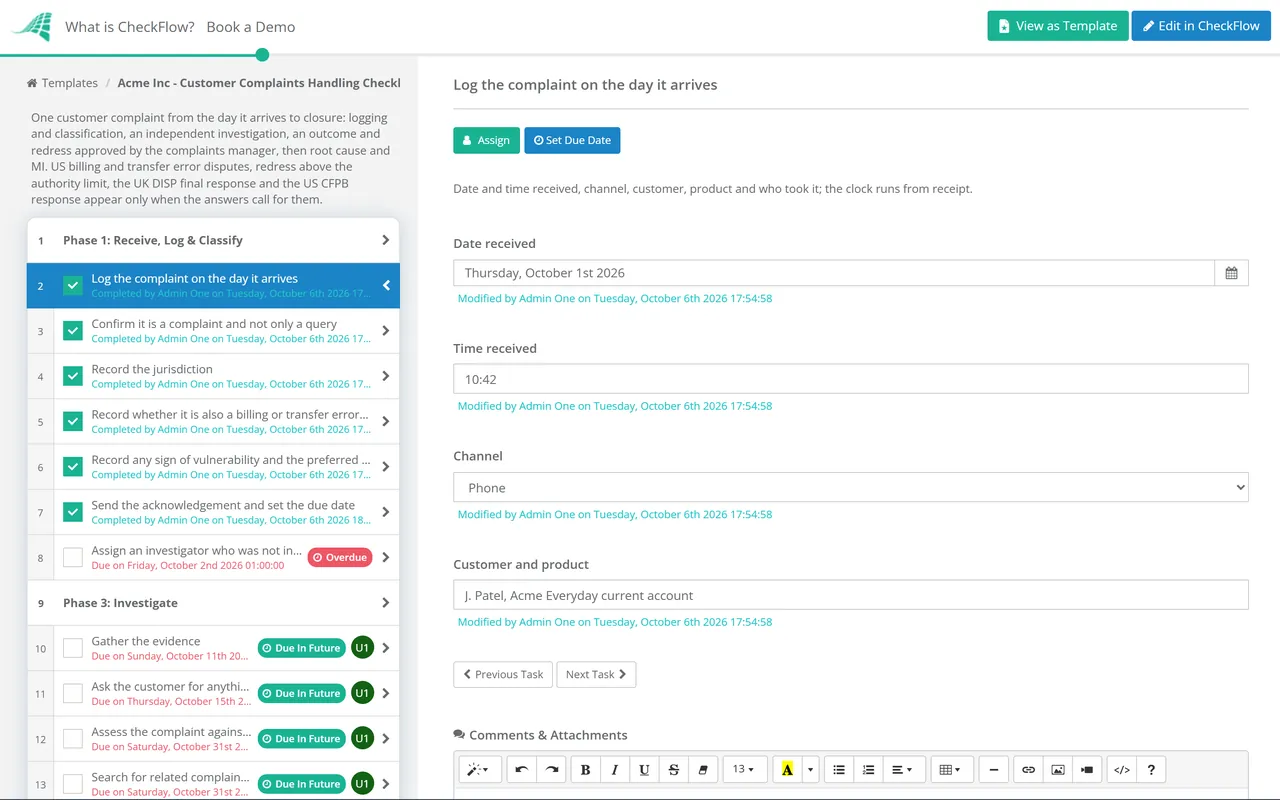
Four phases run on every complaint. Three switch on from the Phase 1 answers: the error dispute, UK response and US response phases.
Assigned to whoever receives the complaint. The answers recorded here decide which later phases appear.
Shown only when the complaint is also a US billing or transfer error notice. It runs alongside the investigation.
The outcome goes to the complaints manager as an approval task. Redress above the handler’s authority limit goes to the named approver.
Shown only when the jurisdiction is UK. Deadlines follow DISP 1.5 and DISP 1.6.
Shown only when the jurisdiction is US. Your complaint policy and any state or regulator deadlines apply alongside.
The table maps each part of the checklist to its main UK and US source. Obligations depend on your firm type, products and regulators, so treat it as a starting point, not legal advice.
| Requirement | United Kingdom | United States | Phase |
|---|---|---|---|
| Acknowledge the complaint | Prompt written acknowledgement and progress updates, DISP 1.6.1R | No general federal rule; set by firm policy | 1 |
| Quick resolution | Resolved by close of the third business day: summary resolution communication, DISP 1.5 | No equivalent | 5 |
| Final response deadline | 8 weeks, DISP 1.6.2R; payment services and e-money 15 business days, or 35 in exceptional circumstances, DISP 1.6.2AR | CFPB portal: respond within 15 days, final response within 60 | 5, 6 |
| Transfer error | Not applicable | Regulation E, 12 CFR 1005.11: 10 business days, or 45 days with provisional credit | 2 |
| Card billing error | Not applicable | Regulation Z, 12 CFR 1026.13: acknowledge within 30 days, resolve within two billing cycles and 90 days | 2 |
| External escalation | Financial Ombudsman Service, within six months of the final response, DISP 2.8.2R | CFPB, prudential and state regulators | 5, 6 |
| Root cause | Identify and remedy recurring or systemic problems, DISP 1.3.3R | Complaint management is part of the compliance management system examiners review; UDAAP under the Dodd-Frank Act | 7 |
| Records | At least three years; five for MiFID business, DISP 1.9 | Firm retention schedule | 7 |
| Reporting | Half-yearly complaints return to the FCA | CFPB publishes complaint data from its portal | 5, 7 |
Several things are moving. The Financial Ombudsman Service has wider grounds to dismiss complaints referred from 1 October 2026, and is piloting a registration stage for new cases, with rule changes not expected before April 2027. Separately, HM Treasury proposed in March 2026 an absolute 10-year longstop on complaints to the ombudsman; when this page was last reviewed it was a proposal, not law. Under the FCA’s PS25/19, a single consolidated complaints return replaces five existing returns, with data collected from 1 January 2027 and the first period running from January to June 2027. In the US, the CFPB stopped publishing consumer complaint narratives in August 2026, though complaints still flow to companies through its portal.
Due-date offsets run from the received date, so the acknowledgement, the response and any dispute deadline land on the right people. The Tasks grid shows every open complaint, and analytics show what is overdue.
Conditional logic reads the jurisdiction and the dispute answer. A UK complaint gets the DISP steps; a US card dispute gets the Regulation Z timeline and the CFPB steps.
The outcome and any redress above the limit go to named people as approval tasks. Evidence and letters attach to the task they support, and the timestamped activity trail exports when the ombudsman or an examiner asks what happened and when.
CheckFlow is not a CRM, complaints case system or letter generator, and it does not submit responses to the CFPB portal. It runs the workflow around those tools: who does each step, by when, and who approved the outcome. Your CRM can start a checklist through the API, and the financial services overview shows other workflows regulated firms run the same way.
UK firms feed complaints MI into the board’s annual Consumer Duty assessment, which the Consumer Duty Annual Review Checklist covers. Complaint files are an early request in a supervisory visit, so pair this template with the Regulatory Examination Preparation Checklist, and see CheckFlow’s compliance checklist software for the wider compliance calendar.

Regulatory Examination Preparation Checklist
Support Ticket Response Checklist
Defect Reporting & Resolution Checklist

KYC Periodic Review Checklist

Customer Escalation Checklist
Describe the process in a sentence and the AI checklist generator drafts the phases and tasks for you.
For most complaints, eight weeks from receipt under DISP 1.6.2R. By then the firm must send a final response, or explain in writing why it cannot yet, when it expects to, and that the customer can now go to the Financial Ombudsman Service. Payment services and e-money complaints need a final response within 15 business days, or 35 in exceptional circumstances with a holding reply.
It is the written message a UK firm sends when it resolves a complaint by close of business on the third business day after receipt. It confirms the complaint is treated as resolved and tells the customer they can still refer it to the Financial Ombudsman Service. These complaints are exempt from the normal time limits but still count in complaints reporting.
After the final response, or once the deadline passes without one. The customer normally has six months from the final response to refer it, and the complaint must also be brought within six years of the event or, if later, three years of when the customer knew or should have known they had cause to complain. The final response has to explain these rights and say whether the firm consents to the ombudsman looking at a complaint referred late.
The CFPB asks companies to respond through its portal within 15 days. If more work is needed, the company can mark the response in progress and give a final response within 60 days, describing the steps taken and any remedy. The portal process runs alongside any statutory error resolution deadline, not instead of it.
In the US it can be both. An unauthorised or incorrect electronic transfer reported within 60 days of the statement triggers Regulation E error resolution, and a credit card billing error notice triggers Regulation Z, each with its own deadlines. Log it as a complaint and run the dispute timeline in parallel, as Phase 2 does.
A root cause category for every complaint, a check of whether the same issue affects customers who have not complained, and corrective actions with owners and dates. UK rules require firms to identify and remedy recurring or systemic problems. Review the categories monthly so a rising trend reaches management before it reaches the regulator.
14-day free trial, no card required. The Business plan is $10 per user per month after the trial. Full details at checkflow.io/pricing.
14-day free trial, no credit cardFull refund in your first 30 daysUS hosting, EU on request