A structured, repeatable enrolment process for every intake cycle — from initial inquiry through records setup, placement, and first-day welcome.
Student enrolment is one of the highest-volume, highest-stakes administrative processes any educational institution or training provider runs. A student whose application is lost, whose documents are not verified on time, whose fees are not correctly processed, or who arrives on day one without system access is a student whose first impression of your institution is a failure of basic operational competence. Delivered consistently, a structured enrolment process is the difference between a confident, well-supported start and an anxious scramble that sets the wrong tone before teaching has even begun. This free student enrolment process checklist gives admissions teams, registrars, training coordinators, and education administrators a structured, repeatable framework for every enrolment cycle — from inquiry management and application processing through document verification, financial processing, student records setup, programme placement, and first-day welcome.
Why a Structured Enrolment Process Is the Foundation of Student Experience
Research on student retention consistently identifies enrolment experience as a significant predictor of early dropout. Students who have a smooth, well-supported enrolment — where communications are timely, requirements are clearly explained, and support is proactively offered — begin their studies with confidence. Students who navigate a confusing, disorganised, or incomplete process begin with frustration and doubt, and are more likely to disengage before the first assessment. The enrolment process is not administrative overhead — it is the institution’s first significant quality signal to every new student.
For institutions managing hundreds or thousands of enrolments per cycle, consistency is the primary challenge. A well-managed enrolment for one student in September and a poorly-managed one for another in the same cohort represents not just operational inconsistency but a failure of equity. A structured checklist run for every student in every intake cycle — with each task assigned, each deadline tracked, and every data protection obligation embedded — transforms an ad hoc administrative exercise into a reliable, scalable, and auditable process.
What the Student Enrolment Process Checklist Covers
This checklist covers eight phases of the student enrolment cycle — from initial inquiry and application through to document verification, financial processing, records setup, placement, orientation, and first-period monitoring. It applies to both academic and training enrolment contexts.
Phase 1
Enquiry Management & Pre-Application
Enquiry management is the first impression. How promptly and helpfully an institution responds to initial enquiries significantly affects both conversion and the student’s initial confidence in the institution’s quality.
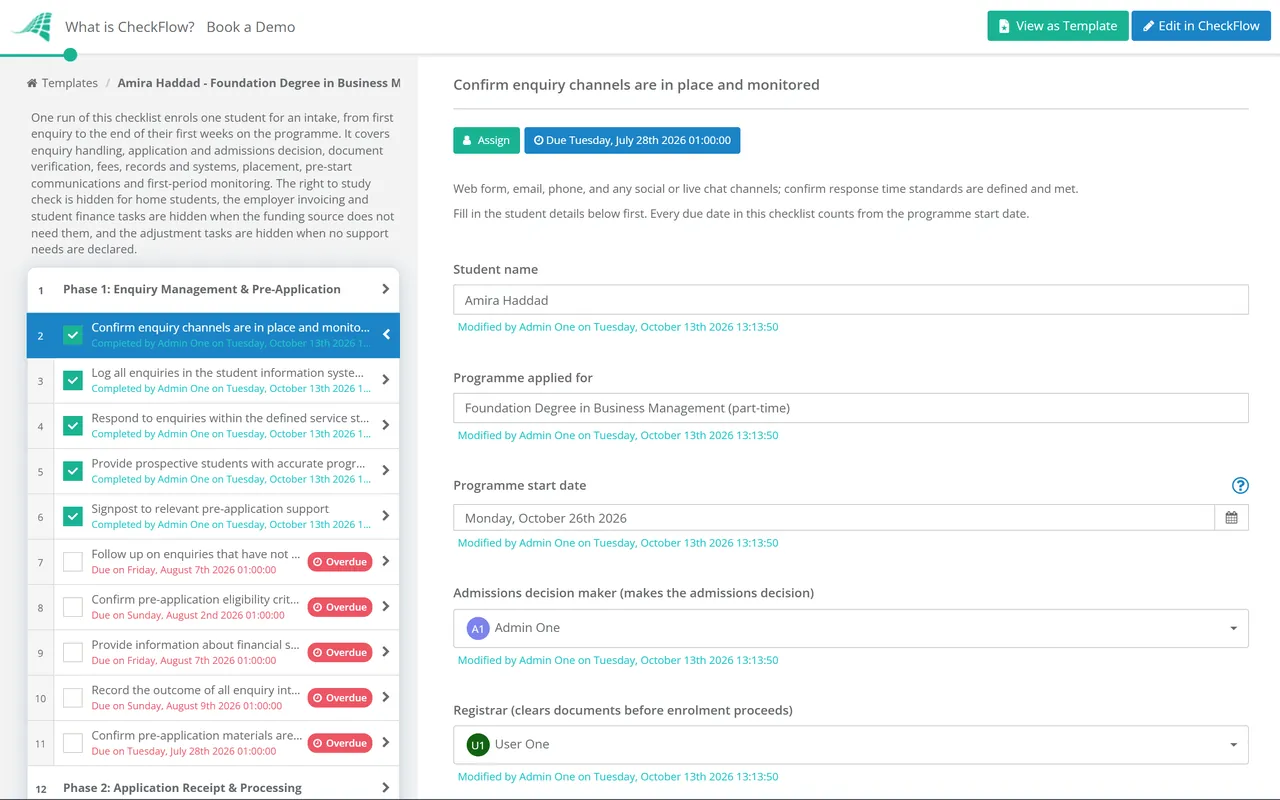
Confirm enquiry channels are in place and monitored — web form, email, phone, and any social or live chat channels; confirm response time standards are defined and met
Log all enquiries in the student information system (SIS) or CRM — confirm each enquiry is recorded with contact details, programme interest, and enquiry date
Respond to enquiries within the defined service standard — confirm the response includes programme information, entry requirements, application instructions, and key dates
Provide prospective students with accurate programme and entry information — confirm all information provided is current and consistent with published materials
Signpost to relevant pre-application support — open days, information sessions, taster courses, or guidance interviews as applicable
Follow up on enquiries that have not progressed to application — a structured follow-up process improves conversion without being intrusive
Confirm pre-application eligibility criteria are communicated clearly — entry requirements, age restrictions, residency requirements, and any prior qualification requirements
Provide information about financial support and funding options — student finance, employer funding, bursaries, scholarships, or payment plans available
Record the outcome of all enquiry interactions — applied, declined to apply, deferred enquiry, or no response
Confirm all pre-application marketing and information materials are accurate and meet any regulatory or accreditation information requirements
Phase 2
Application Receipt & Processing
Confirm application received and logged in the SIS — date, programme, and reference number assigned; acknowledgement sent to the applicant promptly
Confirm the application is complete — all required sections completed and all required supporting documents submitted; request missing information with a clear deadline
Assess eligibility against entry requirements — academic qualifications, age, residency status, English language proficiency, or other applicable entry criteria
Conduct any required prior learning assessment or recognition of prior experience (RPL/APEL) — where the applicant is seeking exemptions or credit transfer
Assess any additional support needs declared by the applicant — disabilities, learning difficulties, or mental health conditions that require reasonable adjustments; confirm a referral to the relevant support team
Conduct any required safeguarding checks — particularly for courses involving work with children or vulnerable adults; DBS or equivalent background check requirements
Make and communicate the admissions decision — unconditional offer, conditional offer, waitlist, or rejection; communicate clearly and promptly with appropriate reasons where required
Process any conditions of offer — confirm conditions are clearly communicated and track their satisfaction before the enrolment deadline
Record the admissions decision and outcome in the SIS
Confirm equal opportunities and non-discrimination obligations are met throughout the application process
Phase 3
Document Collection & Verification
Document verification is a compliance requirement — not just an administrative step. Accepting fraudulent or unverified documents exposes the institution to regulatory, reputational, and legal risk.
Identify all required documents for this student and programme — identity, qualifications, residency, visa status, employer funding authorisation, or other programme-specific requirements
Request outstanding documents with clear instructions and a deadline — specify accepted document types, format requirements (original, certified copy, or digital), and submission method
Verify identity documents — passport, national ID, or birth certificate; confirm verification method (in-person or electronic) and document the outcome
Verify proof of address where required — particularly for student finance and residency-based funding
Verify academic qualifications — certificates, transcripts, or official statements of results; confirm authenticity checking process for qualifications from international institutions
Verify right to study status — for international students or where visa requirements apply; confirm visa type and conditions are recorded correctly
Confirm any professional body or regulatory body registration requirements — for professional programmes requiring registration before enrolment (nursing, teaching, social work, etc.)
Store all documents securely in compliance with data protection requirements — FERPA (US), GDPR (UK/EU), or applicable local data protection law; confirm retention periods are documented
Confirm document status is updated in the SIS — received, verified, or outstanding; enrolment should not proceed with outstanding mandatory documents
Confirm all document verification records are retained in accordance with regulatory requirements
Phase 4
Financial Processing & Fee Management
Confirm the fee applicable to this student and programme — home or international fee rate, part-time or full-time, any fee waivers or discounts applicable
Confirm any financial aid, bursary, or scholarship entitlement — process any institutional awards; confirm any external funding sources (student finance, employer sponsorship, government funding) are confirmed and documented
Issue a fee statement or invoice — clearly showing the total fee, any funding applied, and the amount payable by the student
Confirm payment terms and methods — instalment plan options, payment methods accepted, and any deposit requirements
Process the enrolment deposit or first payment where required — confirm receipt and update the financial record
Confirm employer or sponsor invoicing arrangements where applicable — purchase order received, invoice address confirmed, and payment terms agreed
For student finance-funded students — confirm loan application status, attendance confirmation obligations, and any institutional reporting requirements
Confirm the student understands the tuition fee debt policy and any implications of non-payment
Issue a fee receipt or payment confirmation
Update financial records in the SIS and confirm any financial holds that would prevent enrolment are resolved
Phase 5
Student Records & Systems Setup
Create the student record in the SIS — confirm all personal data, programme details, enrolment status, and reference number are correctly entered
Assign a unique student ID — confirm it is communicated to the student with instructions for use
Set up student system access — institutional email account, LMS or VLE access, library system, student portal, and any other systems required for the programme
Confirm access credentials are communicated to the student — login instructions, password setup, and any multi-factor authentication requirements
Set up any required reasonable adjustments in systems — extended time for assessments, accessible formats, or other adjustments flagged during the application process
Enrol the student on the correct modules, units, or courses in the LMS — confirm all content they need is accessible from their account
Confirm the student record is correctly classified for reporting purposes — home/international, mode of attendance, funding source, and any statutory reporting requirements
Register with any professional or accreditation bodies where required — professional registration for regulated programmes
Confirm data protection consent and privacy notice — student has been informed of how their data will be used; consent recorded where required
Confirm the student record is accurate and complete — final review before the enrolment is confirmed as complete
Phase 6
Programme Placement & Scheduling
Confirm the student’s programme and year or level of entry — including any advanced standing or credit transfer from prior learning
Confirm module or unit choices where applicable — optional pathways, elective choices, or any personalisation options are selected and confirmed
Issue a timetable or schedule — teaching sessions, assessment dates, key deadlines, and any mandatory attendance requirements
Confirm practical or placement arrangements where required — work-based learning, clinical placements, or internship arrangements that need to be in place before the programme begins
Allocate to tutor group, personal tutor, or learning coach — confirm the student knows who their primary contact is and how to reach them
Confirm any progression or attendance requirements — what is required of the student to progress to the next level or qualify for their award
Allocate any specialist facilities or resources — studio space, equipment loans, specialist software licences, or laboratory access as required by the programme
Confirm induction or orientation session registration — the student is confirmed on any required induction activities
Communicate the programme schedule and key dates clearly — term dates, assessment periods, and any early withdrawal or deferral deadlines
Update the SIS to reflect confirmed placement and scheduling
Phase 7
Orientation, Welcome & Pre-Start Communications
Send a formal welcome communication — before the programme starts; confirm key dates, what to bring, what to expect, and who to contact with questions
Confirm induction programme is planned and communicated — dates, format, and attendance expectations for induction activities
Communicate all system access details before the start date — do not wait until day one to provide login instructions; allow time for technical issues
Introduce the personal tutor, module leader, or learning coach — provide contact details and information on how to access support
Communicate student support services — wellbeing, disability support, financial support, academic skills, careers, and any other services available to the student
Share key policies and procedures — attendance policy, assessment regulations, academic integrity policy, complaints procedure, and any safeguarding policies
Provide campus or facility information — maps, parking, building access, catering, and library access for on-site programmes
Confirm student ID card or access arrangements — physical or digital student ID issued before or on arrival
Send a pre-start readiness checklist to the student — confirm everything they need to do before day one
Confirm any special arrangements for students with disabilities or additional support needs are in place before the programme starts
Phase 8
First Period Monitoring, Records Management & Compliance
The first two to four weeks are the highest-risk period for early withdrawal. Proactive monitoring and a structured first check-in catch disengagement before it becomes dropout.
Monitor attendance or engagement in the first two weeks — flag non-attending students for proactive outreach by the personal tutor or support team
Conduct a first enrolment check-in — confirm the student is settled, has system access, understands their schedule, and knows how to access support
Confirm all documents and financial requirements are completed — chase any outstanding items and confirm enrolment conditions are met
Finalise the enrolment record — confirm the student is fully enrolled and the record is accurate and complete in the SIS
Complete any statutory or funding body registration requirements — Higher Education Statistics Agency (HESA) returns, ESFA data submissions, or other regulatory reporting as applicable
Confirm attendance for student finance or funding purposes where required — attendance confirmation obligations met and documented
Archive enrolment documentation — all documents, correspondence, and decision records retained in accordance with the data retention policy and regulatory requirements
Conduct a process review for this intake cycle — what worked well, what caused delays, and what should be improved for the next intake?
Update the enrolment process documentation — reflect any changes to requirements or procedures for the next cycle
Confirm all enrolment data is correctly stored and protected in accordance with FERPA, GDPR, or applicable data protection law
This checklist is available as a free, runnable template in CheckFlow — with tasks assigned across admissions, the registrar, finance, IT, and academic teams, each student tracked through the enrolment process individually, and the complete intake cycle schedulable as a recurring checklist.
The Enrolment Process Across Different Educational Contexts
The eight-phase enrolment framework applies across all educational contexts — adapted in scope and regulatory requirements, but identical in structure.
Schools (K-12)
Identity and age verification, proof of address for catchment or district requirements, immunisation records, previous school records, safeguarding checks, SEND (special educational needs and disabilities) assessment referrals, and parent/guardian consent. Statutory enrolment and reporting requirements vary by jurisdiction.
Further Education & Sixth Form Colleges
Entry qualification verification, guidance interview or initial assessment, Learning Difficulties and Disabilities (LDD) assessment, bursary and fee remission eligibility, EFA/ESFA funding data requirements, and timetable and option group placement.
Higher Education
UCAS or direct application processing, qualification verification, international student visa and right to study checks, student finance processing, accommodation allocation, module registration, HESA data requirements, and induction programme coordination.
Corporate Training & L&D
Employee eligibility confirmation, line manager authorisation, cost centre or budget code allocation, LMS account creation and course enrolment, pre-course materials distribution, and compliance training completion tracking.
Private Training Providers & Professional Development
Programme eligibility, fee agreement and payment, CPD portfolio or professional body requirements, pre-course preparation, and certificate or accreditation registration where applicable.
Online & Distance Learning
Digital identity verification, platform access and technical readiness, time zone and scheduling considerations, digital accessibility setup, and asynchronous communication channel setup.

Why Run Student Enrolment in CheckFlow?
1
Track every student through the process simultaneously
During a busy intake period, an admissions team may be managing hundreds of individual enrolments at different stages — some awaiting documents, some pending financial clearance, some ready for systems setup, some with outstanding visa checks. CheckFlow’s grid dashboard shows every student’s current stage and outstanding tasks in a single view. The question “where are we with this student?” is always one click away.
2
Coordinate across admissions, finance, IT, and academic teams
A complete enrolment touches admissions (application), the registrar (records), finance (fees), IT (system access), and the academic team (placement and orientation) — often in parallel. CheckFlow assigns each phase to the right team, notifies them when their actions are due, and prevents students from being marked as fully enrolled until every required phase is complete.
3
Run each intake as a recurring, self-starting process
Enrolment cycles repeat — September intakes, January intakes, rolling monthly starts. CheckFlow’s recurring checklist feature schedules each new cycle automatically, initialising the full enrolment checklist for each new cohort without manual setup. The process starts itself; the team focuses on the students, not on kicking off the system.
Student enrolment is the beginning of a student’s journey — and the quality of their early experience significantly affects retention. CheckFlow’s IT Onboarding Checklist covers the systems and access setup side of new starter onboarding in detail — directly applicable to the student systems phase of any enrolment process. See the IT Onboarding Checklist →
For L&D and training teams managing recurring employee training enrolments, CheckFlow’s recurring checklist feature schedules each cohort enrolment automatically — so every new group of learners gets the same structured, complete enrolment process without manual coordination overhead. Learn more about recurring checklists in CheckFlow →
What does a student enrolment process checklist cover?
+
A student enrolment process checklist covers the institution’s internal workflow for processing and onboarding new students — not the student’s own to-do list. It spans eight phases: enquiry management and pre-application support, application processing and eligibility assessment, document collection and verification, financial processing and fee management, student records and systems setup, programme placement and scheduling, orientation and pre-start communications, and first-period monitoring and records management. The checklist coordinates multiple departments — admissions, the registrar, finance, IT, and academic teams — ensuring every required step is completed for every student in every intake cycle, consistently and in compliance with relevant regulatory requirements.
What data protection obligations apply to student enrolment?
+
Student enrolment involves collecting and processing significant volumes of personal data — identity documents, financial information, health and disability data, and academic records. In the United States, the Family Educational Rights and Privacy Act (FERPA) regulates the collection, storage, disclosure, and retention of student education records. In the UK and EU, the General Data Protection Regulation (GDPR) and UK GDPR impose obligations on all processing of student personal data, including the requirement for a lawful basis for processing, data minimisation, clear retention periods, and appropriate security measures. Students must be informed of how their data will be used through a privacy notice. Special category data — including health and disability information collected for reasonable adjustments — requires explicit consent or another specific lawful basis. All enrolment documentation must be retained in accordance with the applicable statutory retention schedule.
How should institutions handle students with disabilities or additional support needs during enrolment?
+
Best practice is to invite students to disclose any disabilities or additional support needs as part of the application process — not waiting until enrolment or beyond. Once disclosed, the enrolment process should include a referral to the relevant support team (disability services, SEND team, or equivalent) before the programme starts, so that reasonable adjustments can be agreed, documented, and implemented from day one. Reasonable adjustments may include extended time for assessments, alternative assessment formats, adapted physical access, assistive technology, or additional academic support. The enrolment checklist should include a specific task for reviewing and acting on any disclosed support needs — not as an afterthought but as a standard part of the process for every student.
What is student finance and how does it affect the enrolment process?
+
Student finance refers to government-backed loan and grant systems that fund tuition fees and living costs for eligible students — student loans in the US and UK, HECS-HELP in Australia, and equivalent systems in other jurisdictions. For institutions enroling students using these funding mechanisms, the enrolment process must include confirming the student’s loan application status before the programme starts, attending to attendance confirmation obligations that trigger loan disbursement, and meeting any regulatory reporting requirements associated with the funding. Late or incorrect processing can delay funding for students and create compliance exposure for the institution. For corporate training, the equivalent is employer-funded enrolment — confirming purchase orders, invoicing arrangements, and cost centre authorisation before the programme begins.
How do you manage high-volume enrolment periods efficiently?
+
High-volume enrolment periods — September intakes in UK further and higher education, fall semester starts in the US, or monthly cohort starts in online learning — require both process consistency and operational visibility. The most effective approach is to run a structured enrolment checklist for every student simultaneously, with each phase tracked in a system that shows the whole cohort’s status at once. Teams need to see immediately who is fully enrolled, who is awaiting documents, who has outstanding financial clearance, and who has not yet received system access — without manually chasing status from each department. CheckFlow’s grid dashboard gives admissions teams and registrars exactly this view across every student in a cohort simultaneously.
Is CheckFlow free to use for this template?
+
You can start a free 14-day trial with no credit card required, giving you full access to all features including this template. The Business plan is $10 per user per month after the trial. Full details at checkflow.io/pricing.
Run a Consistent, Compliant Enrolment Process for Every Student
Free trial — no credit card required.
Do you like cookies? 🍪 We use cookies to ensure you get the best experience on our website. Learn more