Customer Renewal Checklist Template

The renewal shows up in the forecast three weeks before the date. The champion left in the summer, a third of the licences have sat unused all year, and a quote with a discount nobody approved is already in the customer’s inbox.

Last reviewed: October 2026

This free customer renewal checklist is for customer success managers, account managers and the CS and sales leads who approve renewals, in B2B and SaaS companies. One run manages one subscription renewal with one customer, starting 120 days before the renewal date. It confirms the notice terms in the contract and the customer’s decision-makers, compares what the customer bought with what they use, and checks open issues, goals, billing, the health score, the sponsor and champion, and any competitor or budget signals. You then choose the renewal strategy, flat, expansion, downsell or a price change, and the renewal approver signs off the pricing and terms before any proposal goes out. The renewal conversation, negotiation, signature, billing, licences, the CRM and the next renewal follow. An at-risk renewal gets a save plan with executive outreach, and a customer who will not renew gets the steps to record why and hand the account to offboarding.

A Renewal Is Won Before the Proposal Goes Out

A customer renewal is the point at which a subscription customer decides whether to sign up for another term, on what terms and at what price. In B2B and SaaS companies the customer success manager usually owns the relationship and the account owner, an account executive or account manager, owns the commercial side. Renewals that go wrong rarely go wrong on the day. The sponsor left months ago, half the licences were never used, nobody read the notice clause, or a discount went out that nobody approved.

This checklist runs one renewal with one customer, from 120 days before the renewal date to the next renewal booked. It is the supplier’s side of the renewal. If you are the customer, deciding whether to renew a supplier’s contract, use the contract renewal reminder checklist instead. The quarterly business review checklist covers the meetings during the term that make the renewal conversation shorter, and managed service providers renewing a managed services agreement can use the MSP agreement renewal checklist.

Quarterly business review

Show the value during the term

When: every quarter, while the contract runs.

Covers: the customer’s goals and results, adoption, risks and next quarter’s plan.

Output: agreed goals and actions. A run of good QBRs is the evidence the renewal conversation rests on.

Customer renewal

Keep the customer for another term

When: from 120 days before the renewal date.

Covers: notice terms, licences against use, health and risk, the renewal strategy, an approved quote, negotiation, signature and billing.

Output: a signed renewal, or a recorded loss handed to offboarding. This checklist.

Contract renewal reminder

Decide whether to renew a supplier

When: ahead of the renewal or notice date of a contract you buy.

Covers: the contract register, the supplier’s performance, value for money and whether to renew, renegotiate, terminate or rebid.

Output: a decision and any notice sent in time. The buyer’s side, in the Contract Renewal Reminder Checklist.

What the Customer Renewal Checklist Covers

Nine phases take one subscription renewal from 120 days before the renewal date to the next renewal booked. Phase 4, the save plan, appears only when the renewal is rated at risk. When the customer says they will not renew, Phase 9 replaces Phases 5 to 8. The contract’s auto-renewal terms, the renewal strategy and any change to the contract terms add their own tasks, and nothing after the approval of the renewal pricing and terms can be completed until it is given.

  1. Phase 1

    Phase 1: Set Up the Renewal

    6 tasks

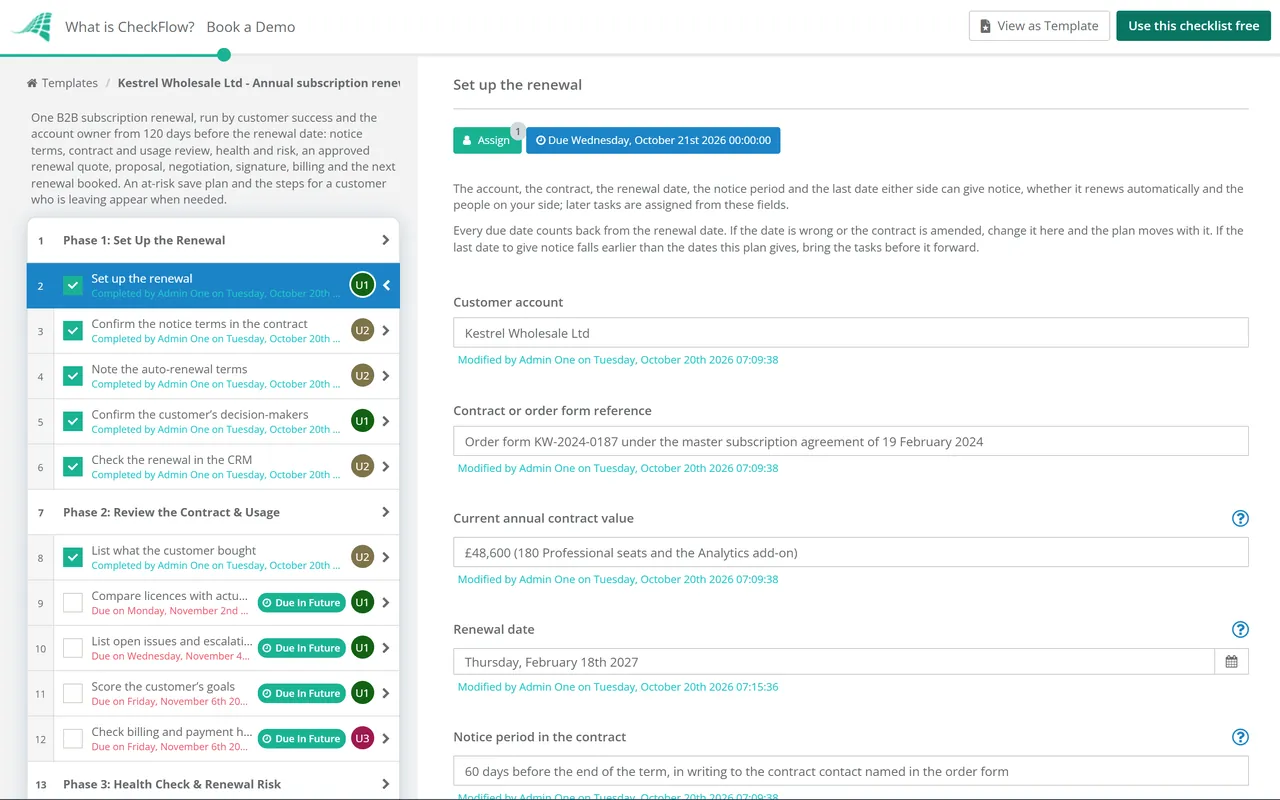
    Start 120 days before the renewal date. The date that matters most is often the last day either side can give notice, not the renewal date itself, so find it in the contract first.

    • Set up the renewal — the account, the contract, the renewal date, the notice period and the last date either side can give notice, whether it renews automatically and the people on your side; later tasks are assigned from these fields
    • Confirm the notice terms in the contract — the renewal and termination clauses, the notice period, how notice must be given and the last date either side can give it
    • Note the auto-renewal terms — shown only when the contract renews automatically; the length of the renewal term, any price change the contract allows and how either side stops it
    • Ask legal to confirm the renewal terms — shown only when nobody is sure whether the contract renews automatically; legal reads the signed contract and any amendments and confirms the renewal and notice terms
    • Confirm the customer’s decision-makers — the executive sponsor who owns the budget, the champion who uses the product, procurement and whoever signs the renewal
    • Check the renewal in the CRM — a renewal opportunity with the renewal date, the current value, the owner and the forecast stage
  2. Phase 2

    Phase 2: Review the Contract & Usage

    5 tasks

    Compare what the customer bought with what they use and what they set out to achieve. Most renewal surprises are already visible here.

    • List what the customer bought — products, plan, licences or seats, add-ons and services, the price of each and any discount and when it ends
    • Compare licences with actual use — active users against seats bought, use of each product and add-on, and the trend over the term
    • List open issues and escalations — support tickets still open, escalations during the term, defects and feature requests the customer is waiting on
    • Score the customer’s goals — the goals from the handoff, the success plan or the last QBR, each met, partly met or missed, with the evidence
    • Check billing and payment history — overdue invoices, disputes, credit notes, payment terms and the purchase order the customer needs on the renewal invoice
  3. Phase 3

    Phase 3: Health Check & Renewal Risk

    5 tasks

    Decide early whether this renewal is on track. The answer on the last task here adds the save plan or the steps for a customer who is leaving.

    • Update the health score — the current rating, the last one and the signals behind any change
    • Check the sponsor and champion are still in place — the executive sponsor who owns the budget and the champion who uses the product; any change of role, departure or reorganisation
    • Look for competitor and budget signals — a competitor evaluation, procurement asking for a tender, a budget freeze, a merger or acquisition, or a new leader with other plans
    • Ask the customer about next year — a call with the champion about priorities, growth or cuts, new teams and what they need to see before they renew
    • Rate the renewal risk — on track, at risk or the customer has said they will not renew, with the reasons; this answer adds the save plan or the steps for a customer who is leaving
  4. Phase 4 — At-risk account

    Phase 4: At-Risk Save Plan

    4 tasks

    Applies only when the renewal is rated at risk. Agree the plan, and have someone senior speak to the customer, before any renewal proposal goes out.

    • Name the causes of the risk — low use, missed goals, a lost sponsor or champion, open escalations, budget pressure or a competitor, with the evidence for each
    • Agree the save plan — actions, owners and dates for each cause, and what help, services or commercial terms you could offer
    • Arrange executive outreach — an executive on your side speaks to the customer’s sponsor about the risk and the plan before the renewal proposal
    • Review progress on the save plan — whether each action is done and whether the risk rating can change before the renewal strategy is set
  5. Phase 5

    Phase 5: Renewal Strategy & Approval

    6 tasks

    Decide what you will propose and get the price and terms approved before the customer sees a number. Nothing after the approval can be completed until it is given.

    • Choose the renewal strategy — a flat renewal, an expansion, a downsell or a price change, based on use, health and the customer’s plans
    • Build the expansion case — shown only for an expansion; the extra seats or products, tied to the customer’s goals and use, and who on their side would agree them
    • Plan the downsell — shown only for a downsell; what is removed, the new value and how you will keep the account healthy at the smaller size
    • Prepare the renewal quote — products, quantities, price per unit, term, payment terms and any discount, with the reason for each change from the current contract
    • Check the quote against the contract — any cap on price increases, the notice a price change needs, the minimum term, payment terms and the discount policy
    • Approve the renewal pricing and terms — the CS or sales lead, with finance where a discount is outside policy, approves the quote, any discount and any change of terms; nothing goes to the customer until it is approved
  6. Phase 6

    Phase 6: Proposal & Negotiation

    7 tasks

    Talk about the value delivered before you talk about price, and aim to have the terms agreed well before the notice deadline. Legal joins only when the customer wants to change the contract.

    • Hold the renewal conversation — with the sponsor and champion: the value delivered over the term, their plans for next year and what you will propose
    • Send the renewal proposal — the approved quote, the term, what is included and the date you need a decision by, before the notice deadline
    • Record the customer’s response — accepted, wants changes to the price or scope, or wants changes to the contract terms
    • Answer procurement and security questions — supplier forms, security questionnaires and updated company details the customer’s procurement team asks for
    • Review the redlines with legal — shown only when the terms change; each change the customer asks for, with legal’s view: accept, counter or reject
    • Agree the final terms — price, term, scope and any contract changes, within what was approved; anything outside it goes back to the approver first
    • Legal approves the final version — shown only when the terms change; the agreed redlines are in the final document and nothing else has changed
  7. Phase 7

    Phase 7: Signature, Order & Billing

    6 tasks

    Get the renewal signed, then make sure the order, the invoice and the customer’s licences all match what was signed by the renewal date.

    • Send the renewal for signature — the order form or amendment, to the signer the customer named, through your usual signature process
    • Plan for a late signature — shown only when the contract does not renew automatically; agree what happens if it is not signed by the renewal date, such as a short extension, and who decides
    • File the signed renewal — signed by both sides, filed with the contract, and the signature date and new term recorded
    • Raise the renewal order — the order in the billing system with the new products, quantities, prices, term and any discount end date
    • Update billing and check the first invoice — the invoice schedule, purchase order number and billing contact, and the first renewal invoice checked before it is sent
    • Update licences and access — seats added or removed and add-ons switched on or off in the product, so the customer has what they bought from the renewal date
  8. Phase 8

    Phase 8: Close & Book the Next Renewal

    5 tasks

    Record the outcome while it is fresh and start the next renewal now, so it never again begins three weeks before the date.

    • Update the CRM — the renewal closed as won with the new value, term and renewal date, and the health and risk notes
    • Confirm the new term with the customer — thank the sponsor and champion, and confirm the new term, any change to seats or products and who to contact
    • Update the success plan — the goals for the new term agreed in the renewal conversation, with measures, targets and owners
    • Book the next renewal — a renewal opportunity in the CRM and the next renewal checklist due to start 120 days before the next renewal date
    • Review the renewal with the CS lead — what worked, what was conceded, how long each step took and what to change for the next one
  9. Phase 9 — Customer leaving

    Phase 9: If the Customer Does Not Renew

    6 tasks

    Applies only when the customer has said they will not renew, and replaces Phases 5 to 8. Due dates count from the day they told you. Record why, leave the door open and hand the account to offboarding.

    • Confirm the decision in writing — the notice received, its date, whether it was given in time and in the form the contract requires, and the date the service ends
    • Update the CRM and the forecast — the renewal closed as lost with the reason and the end date, and the forecast updated
    • Hold an exit conversation — with the sponsor: hear the reasons, ask what would have changed the outcome and leave the door open
    • Record the churn reason — the main reason, any other reasons, the product or approach they are moving to and whether it could have been prevented
    • Review the lost renewal with the CS lead — the reasons, the warning signs and when they appeared, and any lessons for other accounts
    • Hand the account to offboarding — start the customer offboarding and cancellation checklist with the end date, data export, final invoice and access removal

Renewal Risk Signals and What to Do About Them

Most lost renewals show warning signs months before the renewal date. The table lists the usual ones, where to look for them and what to do. Phase 3 checks each of them, and the answers decide whether the renewal is on track, at risk or already lost.

Signal Where to look What it can mean What to do
Licences bought but not usedProduct admin reportsThe customer may cut seats or question the valueFind out why; offer adoption help or plan a smaller renewal before they ask
Use above what was boughtProduct admin reportsThe customer has grown into the productTalk about an expansion tied to their goals
Executive sponsor has left or changed roleCall notes, the champion, bounced emailsNobody on their side owns the budget for youMeet the new leader early; arrange executive outreach
Champion has leftThe admin, user listsUse often drops and nobody argues for the renewalFind and train a new champion
Open escalations or repeated ticketsThe help deskFrustration that surfaces at renewalClose them, or agree a plan and dates with the customer
Goals missed or never agreedThe success plan, the last QBRThe customer cannot say what they got for the moneyScore the goals honestly and agree new ones for the next term
Tender, competitor pricing or a security reviewProcurement emails, the championAnother supplier is being consideredRaise it openly and agree the save plan
Budget freeze, merger or acquisitionThe customer’s news, the championThe decision may move to new peopleConfirm who decides and when
Late payment or disputed invoicesBillingUnhappiness, or a budget problemResolve the dispute before the renewal proposal goes out

Flat, expansion, downsell or price change. A flat renewal keeps the same products, quantities and price. An expansion adds seats or products, and works best when it follows the customer’s own growth or goals. A downsell removes what is not used: it keeps the customer, and is usually better than a renewal they resent or a cancellation. A price change on the same products needs a reason the customer can follow, and must respect any cap or notice period in the contract. Phase 5 records the choice and shows the matching task.

The notice date comes first. If the contract renews automatically unless notice is given, the last date to give notice is when the customer can still walk away without paying for another term. Aim to have the renewal conversation and the proposal done before then, so the customer is deciding on your proposal rather than on a reminder in their diary. If the contract ends unless a renewal is signed, plan what happens if the signature is late. Read the contract itself for both: the template asks for the clause references on its second task.

Why Run Customer Renewals in CheckFlow?

1

Every renewal starts 120 days out

Enter the renewal date and every due date follows it, from the notice terms 120 days out to the review two weeks after. Set a recurring schedule for each account and next year’s renewal checklist is created for you, so the work never starts three weeks before the date.

2

No quote goes out unapproved

The renewal approver’s decision on the pricing and terms halts the checklist: the proposal cannot be sent, nor the renewal signed, until the quote, any discount and any change of terms are approved. See how approvals that halt a checklist work.

3

Every renewal visible to CS leadership

The Reports Grid shows each renewal and how far it has got, and the Tasks Grid shows each CSM and account owner what is due this week. The licence table, the save plan, the quote and the signed renewal sit on the tasks they belong to. See analytics and reporting.

CheckFlow does not replace your CRM, billing system or e-signature tool, and it does not calculate health scores or forecast renewals. It runs the renewal steps in the same order for every account, with a record of who did what and when.

This template runs one customer renewal. Record the customer’s goals at signature with the Sales to Customer Success Handoff Checklist, review them each quarter with the Quarterly Business Review (QBR) Checklist, and decide how renewals are owned and forecast across the book with the Customer Success Strategy Checklist. A customer who does not renew can be closed with the Customer Offboarding & Cancellation Checklist.

AI generator

Didn’t find what you need? Describe it.

Describe the process in a sentence and the AI checklist generator drafts the phases and tasks for you.

Frequently Asked Questions

What is a customer renewal process?

It is the set of steps a supplier follows to keep a subscription customer for another term. A typical B2B process confirms the renewal and notice dates in the contract, compares what the customer bought with what they use, checks the account’s health and risk, chooses a renewal strategy, gets the price and terms approved internally, then holds the renewal conversation, negotiates, gets the renewal signed and updates billing, licences and the CRM. When the customer will not renew, the process records why and hands the account to offboarding.

When should you start preparing for a customer renewal?

This template starts 120 days before the renewal date, which leaves about two months to review the account and fix problems before the proposal goes out, and about two months for the conversation, negotiation and signature. Start earlier for large accounts, contracts that need procurement or legal review, or contracts whose notice deadline falls well before the renewal date. In an auto-renewing contract, aim to finish the renewal conversation before the customer’s last date to give notice.

What should you review before a renewal?

What the customer bought and what they pay; how many licences they use and the trend; open support issues and escalations; how they did against the goals they set; billing and payment history; the health score; whether the sponsor and champion are still in place; and any sign of a competitor, a tender or budget pressure. Ask the customer about their plans for next year too. Together these decide whether the renewal is on track or at risk, and whether to propose a flat renewal, an expansion, a downsell or a price change.

Who owns the renewal, customer success or sales?

It varies. In many B2B and SaaS companies the customer success manager owns the relationship and the health of the account, and an account executive or account manager owns the commercial terms and the paperwork. Some companies give the whole renewal to one of them. This template has both roles, plus a renewal approver (usually the CS or sales lead), finance and a legal reviewer. Assign the same person to two roles if that is how your team works.

How do you save an at-risk renewal?

Act before the proposal, not in it. Name the causes of the risk with evidence, agree a save plan with actions, owners and dates for each cause, and have an executive on your side speak to the customer’s sponsor. Review progress before you set the renewal strategy: a smaller renewal the customer wants may be better than a full one they resent. In this template, rating the renewal at risk adds those steps in Phase 4.

What should you do when a customer decides not to renew?

Confirm the decision in writing and check that notice was given in time and in the form the contract requires; if it was late or informal, take legal advice before you reply. Close the renewal as lost in the CRM, hold an exit conversation with the sponsor, record the main reason and whether it could have been prevented, and review it with the CS lead. Then hand the account to offboarding for the data export, the final invoice and access removal. In this template, answering that the customer has said they will not renew adds those steps in place of the renewal tasks.

How is this different from the contract renewal reminder checklist?

They are the two sides of the same date. This customer renewal checklist is for the supplier: customer success and the account owner keeping a customer for another term. The Contract Renewal Reminder Checklist is for the buyer: legal, procurement and operations deciding whether to renew, renegotiate or end a contract with one of their own suppliers, and giving notice in time if they want out.

Is CheckFlow free for this template?

14-day free trial, no card required. The Business plan is $10 per user per month after the trial. Full details at checkflow.io/pricing.

Run Every Renewal the Same Way, 120 Days Out

Free trial — no credit card required.

14-day free trial, no credit cardFull refund in your first 30 daysUS hosting, EU on request