Customer Success Strategy Checklist Template

Most CS teams are reactive. This checklist helps you build a CS function that is systematically, reliably proactive.

The difference between a CS team that grows NRR and one that spends all its time firefighting is rarely about headcount or talent — it is about structure. Proactive CS teams operate from defined playbooks, health score frameworks, segmentation models, and renewal processes that surface risk before it becomes churn. Reactive teams wait for a customer to go quiet and hope the renewal comes through. This free customer success strategy checklist gives CS leaders, VP of CS, and SaaS founders a structured framework for building — or systematising — every component of a high-performing CS function, from customer segmentation and health scoring through to QBR cadence, expansion playbooks, and voice of the customer programmes.

Use This Template Free See Live Example
No Credit Card Required

What an Unstructured CS Function Actually Costs

A CS team without a defined strategy does not fail dramatically — it leaks. NRR sits at 95% instead of 115%. Expansion conversations happen too late, or not at all. At-risk accounts are identified by the customer going quiet rather than by a health score dropping three weeks earlier. QBRs happen for the accounts that ask for them, not the ones that need them. The result is a CS team that is perpetually busy but not reliably driving the outcomes the business needs.

The structural problems are predictable and fixable. Customers are not segmented by value or risk, so every account gets the same reactive treatment. There are no defined playbooks, so onboarding quality depends on which CSM runs the account. Health scores either do not exist or are not actioned. Renewal conversations start thirty days before the contract end date instead of ninety. Expansion is an afterthought, not a systematic motion. A customer success strategy checklist does not solve all of these at once — but it ensures none of them are ignored.

What the Customer Success Strategy Checklist Covers

This checklist covers the eight core components of a structured customer success function — from customer segmentation and health scoring through to team structure and continuous improvement.

Phase 1

Customer Segmentation & Ideal Customer Profile

Segmentation is the foundation of everything else in CS. Without it, every customer gets the same treatment regardless of value, risk, or need — and your CSMs cannot prioritise their time effectively.

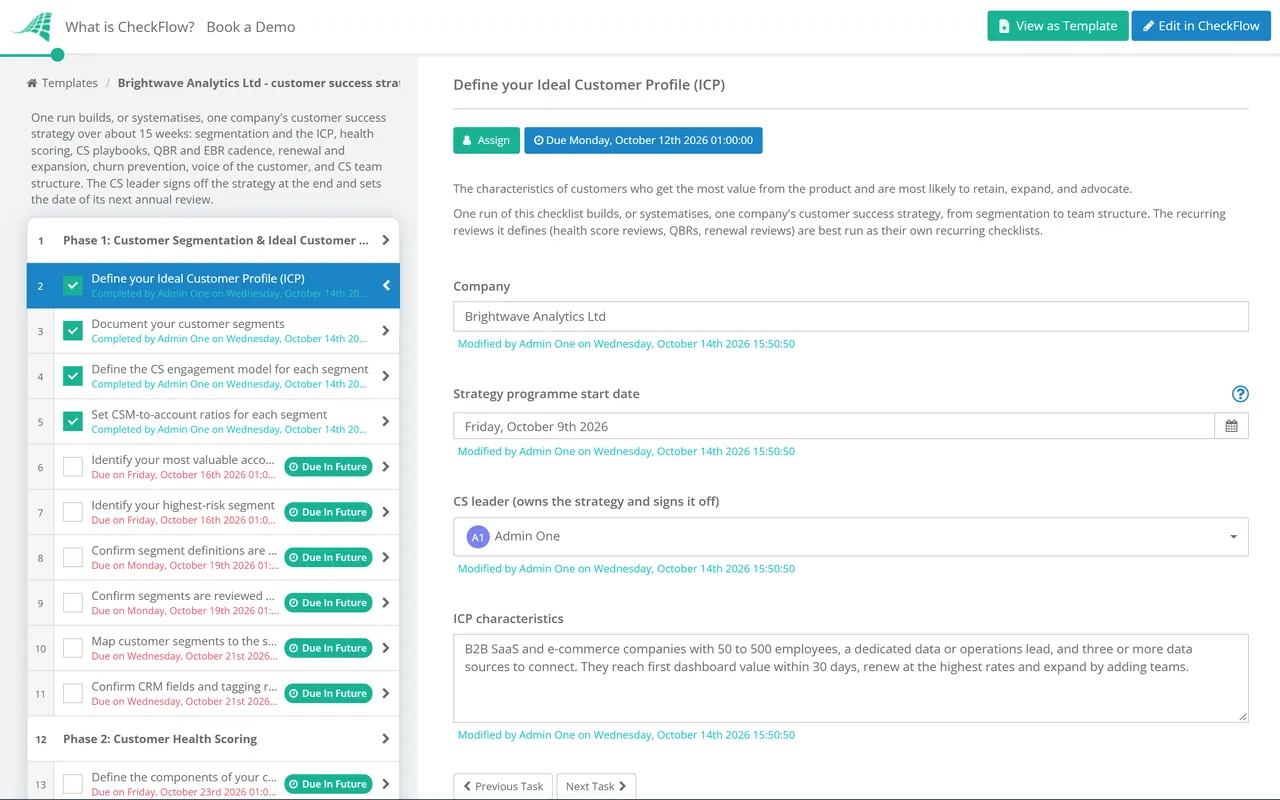
  • Define your Ideal Customer Profile (ICP) — the characteristics of customers who get the most value from the product and are most likely to retain, expand, and advocate
  • Document your customer segments — typically by ARR tier, company size, use case, or product plan
  • Define the CS engagement model for each segment — High Touch (dedicated CSM, regular calls), Mid Touch (pooled CSM, structured cadence), Low Touch (automated, minimal human intervention)
  • Set CSM-to-account ratios for each segment — confirm ratios are achievable with current headcount and planned growth
  • Identify your most valuable accounts — define what qualifies as a strategic account and what additional attention those accounts receive
  • Identify your highest-risk segment — small accounts with low engagement typically churn at the highest rates and require different strategies to retain
  • Confirm segment definitions are documented and shared with the full CS team
  • Confirm segments are reviewed at least annually — customer mix changes as the business grows and segments should evolve accordingly
  • Map customer segments to the sales handoff process — confirm the CS engagement model for each segment is communicated to sales before close
  • Confirm CRM fields and tagging reflect customer segments accurately
Phase 2

Customer Health Scoring

  • Define the components of your customer health score — typically a weighted combination of product usage, engagement, support ticket volume, NPS/CSAT, and financial signals
  • Confirm health score inputs are measurable and automatically tracked — avoid inputs that require manual CSM judgement to be reliable at scale
  • Assign weights to each health score component — confirm the weighting reflects what actually predicts retention in your customer base
  • Define health score thresholds — green (healthy), yellow (at risk), red (critical) — and document what action each threshold triggers
  • Confirm health scores are visible to all CSMs and CS leadership in the CS platform or CRM
  • Define the response playbook for each health score threshold — what happens when a customer moves from green to yellow? From yellow to red?
  • Confirm health scores are reviewed in team meetings at a defined frequency — a health score that nobody looks at is not a health score
  • Validate health score accuracy against churn data — do customers who churned show health score deterioration before they left?
  • Refine health score weighting based on validation findings — health scoring is a model that should improve over time
  • Confirm health scores are incorporated into CSM performance reviews and team OKRs
Phase 3

CS Playbooks

A playbook is a documented, repeatable sequence of actions for a defined situation. Without playbooks, every CSM handles every situation differently — and your best CSM’s expertise stays with them when they leave.

  • Document the onboarding playbook — the structured process for taking a new customer from signed to live and achieving first value
  • Document the adoption playbook — the actions CSMs take at 30, 60, and 90 days to drive product adoption and habit formation
  • Document the at-risk playbook — the specific sequence of actions triggered when a customer moves to yellow or red health score
  • Document the renewal playbook — when renewal conversations start, who leads them, what is reviewed, and how risk is handled
  • Document the expansion playbook — how CSMs identify, qualify, and develop expansion opportunities within their book of business
  • Document the escalation playbook — what triggers an executive escalation, who is involved, and what the resolution process looks like
  • Document the churn save playbook — the specific actions and incentives available when a customer notifies you of intent to cancel
  • Document the advocacy playbook — how CSMs identify happy customers and convert them to case studies, references, and testimonials
  • Confirm all playbooks are accessible to the full CS team in a shared, searchable location
  • Confirm playbooks are reviewed and updated at least quarterly — a playbook that does not evolve becomes outdated faster than expected
Phase 4

QBR & Executive Business Review Cadence

  • Define which accounts receive formal Quarterly Business Reviews (QBRs) — typically high-touch accounts above a defined ARR threshold
  • Define the QBR format — agenda template, success metrics reviewed, data sources, and required attendees on both sides
  • Confirm QBRs are scheduled proactively — not reactively when the customer requests one
  • Define the preparation checklist for each QBR — what the CSM reviews before the call and what materials are prepared
  • Confirm QBR outputs are documented — action items, risks identified, expansion opportunities, and follow-up commitments
  • Define the Executive Business Review (EBR) format for strategic accounts — a more senior, strategic conversation typically held annually or bi-annually
  • Confirm executive sponsor engagement for strategic accounts — is there a regular executive-to-executive relationship beyond the CSM level?
  • Confirm check-in cadence for mid-touch and low-touch accounts — automated health check emails, product newsletters, and periodic human touchpoints
  • Track QBR completion rates by CSM and segment — confirm QBRs are actually happening on schedule
  • Gather and act on QBR feedback — what are customers consistently raising that requires a product or process response?
Phase 5

Renewal & Expansion Process

  • Confirm renewal conversations begin at least 90 days before contract end — not 30 days
  • Build a renewal tracking dashboard — every renewal due in the next 180 days should be visible to CS leadership with current health score and risk level
  • Define renewal risk categories — confirmed renewal, at risk, churn likely — and the action plan for each
  • Confirm the renewal process involves finance and legal where required — confirm ownership of commercial negotiations is clear
  • Document the expansion trigger framework — what signals indicate a customer is ready for an expansion conversation (usage thresholds, team growth, new use case identification)
  • Confirm expansion opportunities are tracked in the CRM with a defined pipeline stage and owner
  • Define the hand-off process between CS and Sales for expansion deals above a defined ARR threshold
  • Set NRR and GRR targets by segment — confirm CS team OKRs reflect revenue retention and expansion goals
  • Track and report NRR, GRR, and expansion ARR monthly — confirm these metrics are visible to CS leadership and the wider business
  • Conduct a quarterly renewal retrospective — which renewals were lost, what were the signals, and what earlier intervention could have changed the outcome?
Phase 6

Churn Prevention & At-Risk Account Management

  • Confirm at-risk accounts are formally identified and tracked — not just known informally by individual CSMs
  • Confirm the at-risk playbook is being executed consistently — review a sample of red health score accounts to confirm the playbook is being followed
  • Define the escalation threshold — at what point does an at-risk account require CS leadership or executive involvement?
  • Conduct regular at-risk account reviews in CS team meetings — confirm every at-risk account has an active owner and a documented recovery plan
  • Track churn by segment, cohort, and reason — confirm churn data is captured at the account level and rolled up for analysis
  • Conduct exit interviews or churn surveys for every churned account above a defined ARR threshold
  • Classify churn as regrettable or non-regrettable — and confirm the distinction is reflected in reporting
  • Identify the most common regrettable churn reasons — prioritise product, process, or support improvements based on churn root causes
  • Confirm win-back sequences exist for churned accounts that may be re-engaged — not all churn is permanent
  • Report churn root cause analysis to product and leadership quarterly — CS is the voice of the customer inside the business
Phase 7

Voice of the Customer Programme

  • Implement a regular NPS or CSAT programme — confirm the survey cadence, distribution method, and response rate targets
  • Define the response process for detractors and passives — who follows up, within what timeframe, and with what objective?
  • Implement a close-the-loop process for all survey responses — confirm no feedback goes unacknowledged
  • Track NPS and CSAT trends over time by segment and cohort — not just the overall score
  • Create a formal channel for CSMs to submit product feedback from customer conversations — confirm it reaches the product team
  • Hold regular CS-to-Product feedback sessions — ensure customer insight is systematically incorporated into the product roadmap
  • Identify and develop customer advocates — customers with high NPS and strong results who are willing to provide references, case studies, or testimonials
  • Build a formal reference programme — confirm there is a process for managing reference requests from the sales team
  • Track customer health score alongside NPS — confirm the two metrics are consistent and investigate any divergence
  • Report voice of the customer insights to the full leadership team quarterly — not just to CS
Phase 8

CS Team Structure & Operations

  • Define CS team roles and levels — CSM, Senior CSM, CS Manager, VP CS, CS Operations — confirm responsibilities and promotion criteria for each level
  • Confirm CSM book of business sizes are sustainable — too many accounts per CSM results in reactive firefighting regardless of strategy
  • Define CSM performance metrics — NRR, GRR, health score improvement, QBR completion, expansion pipeline — and confirm they are tracked and used in performance reviews
  • Build a CS onboarding programme for new CSMs — confirm new hires understand the product, the playbooks, the tools, and the customer base before taking on accounts
  • Confirm CS tooling is adequate — CS platform or CRM, health scoring, email automation, and project tracking
  • Define the CS team meeting cadence — weekly team standups, at-risk reviews, pipeline reviews, and retrospectives
  • Confirm the escalation path from CSM to CS leadership is clear and used consistently
  • Build a CS operations function or assign CS Ops responsibilities — data quality, tooling, reporting, and playbook maintenance should not fall on CSMs
  • Conduct quarterly CS team retrospectives — what is working, what is not, and what the team needs to improve
  • Review and update the CS strategy annually — confirm the strategy reflects the current product, customer mix, and business goals

This checklist is available as a free, runnable template in CheckFlow — with tasks assigned across CS leadership, CSMs, and cross-functional stakeholders, recurring strategy reviews scheduled automatically, and a complete record of strategy build-out progress.

Use This Template Free

The Customer Success Metrics That Actually Drive Decisions

A CS strategy is only as good as its metrics. These are the numbers that CS leaders and boards track to understand whether the CS function is working.

Net Revenue Retention (NRR)

The percentage of recurring revenue retained from existing customers including expansion, contraction, and churn. NRR above 100% means the existing customer base is growing — the gold standard of CS performance. Best-in-class SaaS NRR is 120%+.

Gross Revenue Retention (GRR)

The percentage of recurring revenue retained from existing customers excluding expansion — churn and contraction only. GRR measures how well the CS team retains what it has. Best-in-class GRR is 90%+.

Customer Health Score

A composite metric combining product usage, engagement, support volume, and other signals into a single indicator of account health. A leading indicator of churn risk — the goal is to act on health score decline before the customer voices dissatisfaction.

Time to First Value (TTV)

How long it takes a new customer to achieve their first meaningful outcome with the product. The single strongest predictor of long-term retention — customers who reach first value quickly retain at significantly higher rates.

Net Promoter Score (NPS)

A measure of customer loyalty and satisfaction — how likely customers are to recommend the product. Useful as a directional trend metric and for identifying advocates and detractors, but should be tracked alongside usage and retention data for full context.

Expansion ARR

New recurring revenue generated from existing customers through upgrades, seat expansion, or additional products. Tracked alongside NRR — a CS team that drives expansion is contributing directly to revenue growth, not just retention.

CheckFlow does not replace your CS platform or CRM — it manages the structured processes your CS team follows: the playbooks, review cadences, and recurring activities that generate the outcomes these metrics reflect.

Why Run Your CS Strategy in CheckFlow?

1

Turn strategy into executed process

A CS strategy that lives in a document is not a strategy — it is a plan. CheckFlow turns each component of the strategy into a structured, assigned, trackable checklist. Playbooks become runnable checklists. QBR preparation becomes an assigned task with a deadline. Health score reviews become a recurring weekly action. The gap between a documented strategy and an executed one closes when the tasks are assigned to people with due dates.

2

Recurring activities that run themselves

CS is full of recurring obligations — weekly health score reviews, monthly at-risk account reviews, quarterly QBRs, annual strategy reviews. CheckFlow’s recurring checklist feature schedules these activities automatically at their required frequency, assigns them to the right CSM or CS leader, and confirms completion with a timestamped log. Nothing gets skipped because someone was busy that week.

3

Visibility across every account and every CSM

CS leaders need to know — at any given moment — which accounts are at risk, which QBRs are overdue, and which renewal conversations have not started. CheckFlow’s grid-based dashboard gives CS leadership a live view of every active process across every CSM’s book of business simultaneously. The answer to “where are we with Account X?” is always one click away.

A customer success strategy is only as strong as the onboarding it feeds into. CheckFlow’s SaaS customer onboarding checklist gives your CS team a structured, repeatable framework for taking every new customer from signed to live — the foundation of time to first value and long-term retention. See the SaaS Customer Onboarding Checklist →

QBRs, renewal reviews, and health score check-ins are recurring activities that happen on a defined schedule — or should. CheckFlow’s recurring checklist feature automates these cadences so they run on time, every time, with a structured agenda and a completion record for every account. Learn more about recurring checklists →

Frequently Asked Questions

What is a customer success strategy and why does it matter?

+

A customer success strategy is a documented framework that defines how a business proactively manages customer relationships to drive retention, expansion, and advocacy. It covers customer segmentation, engagement models, health scoring, playbooks, review cadences, and team structure. Without a defined strategy, CS teams default to reactive account management — responding to problems when customers raise them rather than identifying and addressing risk before it becomes churn. Companies with a structured CS strategy consistently outperform those without on NRR, customer lifetime value, and overall revenue growth.

What is the difference between a customer success strategy and a customer success plan?

+

A customer success strategy defines how the CS function operates as a whole — segmentation models, engagement frameworks, health scoring, playbooks, and team structure. It is the operating system for the entire CS organisation. A customer success plan is account-specific — the documented goals, milestones, and actions for a particular customer relationship. The strategy defines how all plans are built; the plan applies the strategy to a specific account.

What should a customer success health score include?

+

A well-designed health score typically combines four to six signals into a weighted composite metric. Common inputs include product usage frequency and depth (the strongest predictor of retention), login activity, feature adoption breadth, support ticket volume and sentiment, NPS or CSAT score, and financial signals (payment history, contract value trend). The exact weighting should be calibrated against your own churn data — the inputs that best predict churn in your customer base should receive the highest weights. A health score that is not validated against actual outcomes is an opinion, not a metric.

When should renewal conversations start?

+

Best practice is to begin renewal conversations 90 days before contract end — not 30. Starting at 90 days gives sufficient time to surface and address concerns, negotiate terms without pressure, and involve stakeholders on both sides. Accounts identified as at-risk should begin renewal conversations even earlier — as soon as the risk signal is identified, regardless of how far from renewal the account is. Waiting until 30 days before renewal to discover a problem that has been developing for three months is one of the most common and avoidable causes of preventable churn.

How do you build customer success playbooks?

+

Start with the situations your team faces most frequently — onboarding, adoption, at-risk, renewal, and expansion are the core five. For each, document the trigger (what situation activates the playbook), the actions (the specific sequence of steps the CSM takes), the owner of each step, the timeline, and the success criteria. The first version does not need to be perfect — it needs to exist. Review and refine each playbook quarterly based on outcomes. A playbook that your best CSM follows instinctively but has never written down is a single point of failure, not an asset.

Is CheckFlow free to use for this template?

+

You can start a free 14-day trial with no credit card required, giving you full access to all features including this template. The Business plan is $10 per user per month after the trial. Full details at checkflow.io/pricing.

Start Building a Proactive CS Function Today

Free trial — no credit card required.