The tenant placed without a structured screening process is the tenant whose non-payment, property damage, or lease violation you will be managing for the next twelve months. Thorough screening is not bureaucracy — it is asset protection.
The decision to place a tenant is one of the highest-stakes decisions in property management. A good tenant protects the asset, pays on time, and renews. A bad tenant produces arrears, disrepair claims, neighbour complaints, and an eviction process that takes months and costs thousands. The difference between these outcomes is almost entirely determined before the tenancy begins — in the screening process. A structured tenant screening checklist serves two equally important purposes: it protects the landlord by identifying high-risk applicants before commitment, and it protects the landlord legally by ensuring every applicant is evaluated against the same written criteria. Inconsistent screening — applying different standards to different applicants — is a discrimination liability regardless of whether discrimination was intended. Written criteria, applied identically to every applicant, is the mechanism that ensures consistency, supports legally defensible decisions, and complies with the Fair Housing Act (US) and Equality Act 2010 (UK). This free checklist gives landlords and property managers a structured framework for the full tenant screening process.
Process framework, not legal advice. Fair Housing/Equality Act requirements are complex. Laws on screening criteria, application fees, and permissible checks vary by jurisdiction. Consult a qualified property lawyer or housing law specialist for advice on compliant screening practices in your jurisdiction.
The Screening Criteria Document — Why It Must Exist Before the First Application Arrives
The screening criteria document is the written record of the standards against which every applicant will be evaluated. It must exist — in writing — before any application is received. A landlord who decides criteria after reviewing applications is a landlord who is consciously or unconsciously adjusting criteria to favour or exclude particular applicants — and that is the definition of discriminatory screening, regardless of intent.
At a minimum, screening criteria should specify: the minimum income requirement (gross monthly income of at least 2.5–3× the monthly rent is the standard in both the US and UK), the credit score minimum (if applicable), the acceptable rental history standard (no evictions, no rent arrears in the past X years), the acceptable reference standard, and any legitimate property-specific requirements (such as no-smoking terms). These criteria are then applied identically to every single applicant.
The Tenant Screening Checklist
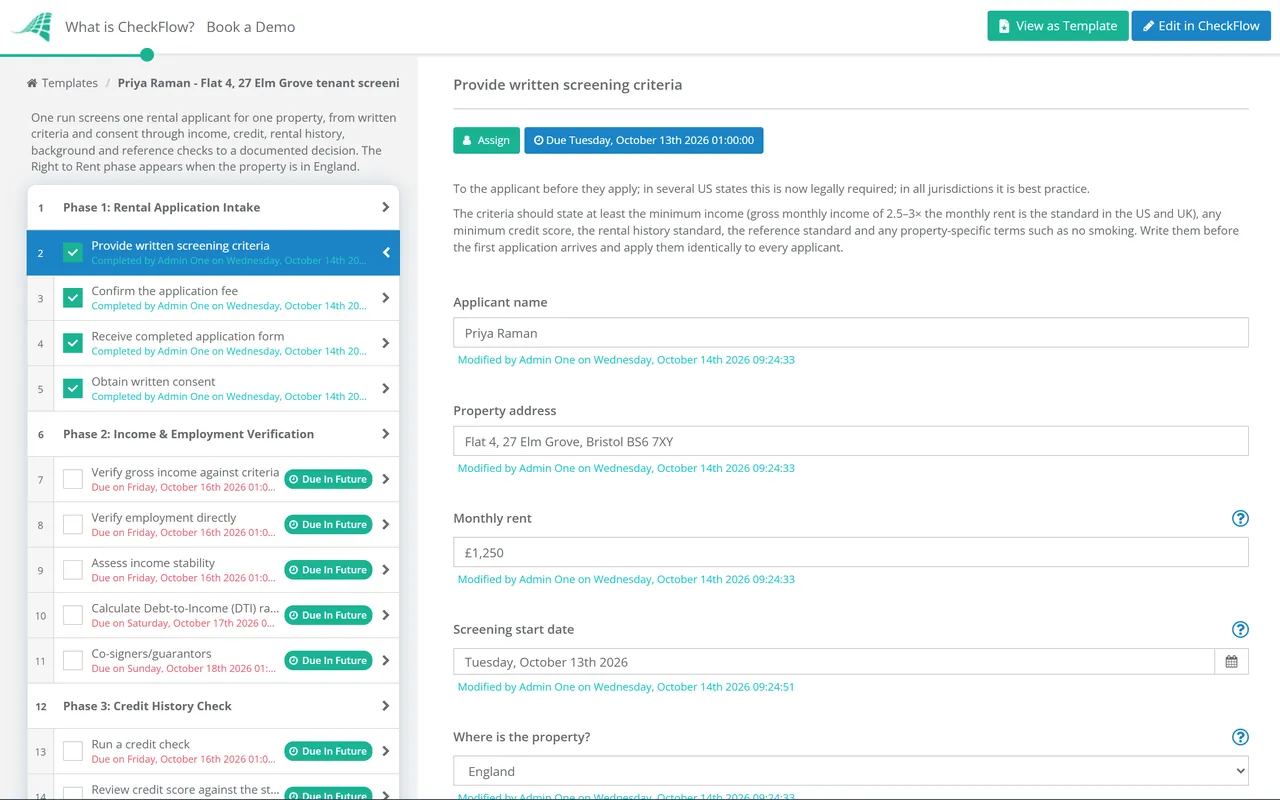
Eight phases covering the full tenant screening process — from application intake and income verification through credit check, rental history, Right to Rent, background check, references, and the documented screening decision.
Phase 1
Rental Application Intake
Provide written screening criteria — to the applicant before they apply; in several US states this is now legally required; in all jurisdictions it is best practice
Confirm the application fee — where applicable; within local legal limits (California: $59.67 cap in 2025); fee disclosed and explained to applicant
Receive completed application form — full name, date of birth, current address, employment details, gross income, rental history, and emergency contact
Obtain written consent — for credit check, background check, and reference checks; before proceeding with any checks
Phase 2
Income & Employment Verification
Verify gross income against criteria — minimum 2.5–3× monthly rent required; collect payslips (typically last 3 months), employer letter, or equivalent; for self-employed: last 2 years tax returns or accountant’s letter
Verify employment directly — contact the HR department of the employer (not the applicant’s supervisor); confirm employment status and start date
Assess income stability — is the income consistent? On a probation period? Fixed-term contract with expiry before the lease term ends?
Calculate Debt-to-Income (DTI) ratio — total monthly debt obligations / gross monthly income; aim for below 40%; above this increases payment risk
Co-signers/guarantors — for borderline income cases; guarantor income and creditworthiness verified to same standard; guarantor agreement signed separately
Phase 3
Credit History Check
Run a credit check — using an authorised credit reference agency (UK: Experian, Equifax, TransUnion; US: same); with the applicant’s written consent
Review credit score against the stated minimum criterion
Review credit history — any CCJs (UK) or court judgments (US); bankruptcy or insolvency history; late payment patterns; outstanding debt levels
Assess the overall credit picture — a single CCJ from 5 years ago is different from a recent pattern of missed payments; context matters; apply criteria consistently
Adverse credit decision procedure — if the credit check results in a decline, in the US the Fair Credit Reporting Act requires an adverse action notice to the applicant
Phase 4
Rental History Verification
Obtain 2–3 years rental history — previous landlord(s) or letting agent contacts; provided by the applicant
Contact previous landlords — directly; not via the applicant; confirm: duration of tenancy, rent level and payment record, property condition on departure, any notices served, and whether they would let to them again
Check for prior evictions — ask directly; some screening services include eviction records; a prior eviction does not automatically disqualify but requires careful consideration
Flag gaps in rental history — where was the applicant living? Unexplained gaps may indicate an undisclosed eviction or living situation worth clarifying
Phase 5
Right to Rent Check (England)
The Right to Rent check is a legal requirement for landlords in England. Letting a property to someone without the right to rent in the UK can result in a civil penalty of up to £20,000 per occupier (unlimited for repeat breaches since 2024). This check is not optional.
Verify the prospective tenant’s right to rent in the UK — for every adult who will occupy the property
Check acceptable documents — UK/EEA passport or biometric residence permit; or via the Home Office online checking service for those with digital immigration status
Copy and date-stamp documents — or record the online check reference; retained in the tenancy file
Repeat checks for time-limited right to rent — where the right to rent is time-limited, a repeat check must be conducted before expiry
Note: Right to Rent does not apply in Scotland, Wales, or Northern Ireland

Phase 6
Background Check
Conduct a background check — using an authorised screening service; with the applicant’s written consent; per the applicable legal requirements for the jurisdiction
Review results against the stated criteria — consistently; any criminal history is assessed in context of the criteria; blanket exclusion of all criminal records may constitute discrimination in some US jurisdictions
Adverse action notice (US) — if rejecting based on a background report, FCRA requires an adverse action notice with the screening agency’s details
Phase 7
Reference Checks
Employer reference — current employer confirms employment status and character
Character reference — a person who has known the applicant for an appropriate period; not a family member
Follow up directly — contact all references by telephone; not just written responses
Phase 8
Screening Decision
Assess all information against the written criteria — documented; consistent with how all other applications are assessed
Document the decision — approved, approved with conditions (guarantor, higher deposit), or declined; with the reason based on the screening criteria
Notify the applicant — promptly; accepted or declined; adverse action notice where required (US)
Retain screening records — for a minimum period per local law; in case of discrimination complaints
Written criteria applied consistently to every applicant
The screening decision that cannot be traced to written, consistently-applied criteria is the screening decision most vulnerable to a discrimination complaint. CheckFlow’s screening checklist records the criteria, the verification steps, and the outcome for every application — creating the documentation that demonstrates consistent application.
2
Every check logged with evidence
The landlord who cannot evidence that a Right to Rent check was conducted, that income was verified, and that credit was checked for a particular tenancy has a documentation gap that becomes a compliance exposure. CheckFlow logs every check as it is completed, with the result and the verifying document reference.
3
A screening record that supports renewal, dispute resolution, and compliance audit
Screening decisions made today become the evidence base for discrimination complaints that may arrive months later. CheckFlow archives the complete screening record for every applicant considered — accepted or declined — providing the documented history that demonstrates fair and consistent practice.
Screening is the first step of the property management lifecycle. CheckFlow’s Property Management Checklist covers the complete property lifecycle from setup to annual review. See the Property Management Checklist →
Successful screening leads to move-in. CheckFlow’s Tenant Onboarding Checklist covers the structured move-in process. See the Tenant Onboarding Checklist →
A tenant screening checklist covers eight phases: application intake (written screening criteria provided to applicant, fee disclosure and consent), income and employment verification (minimum 2.5–3× rent income, direct employer confirmation, DTI assessment, guarantor option), credit check (with consent, credit history and score against criteria, adverse action procedure), rental history verification (previous landlord contact, eviction check, gap investigation), Right to Rent check (England: legally required for all adult occupants), background check (with consent, against stated criteria, consistent application), references (employer and character, direct phone contact), and decision documentation (all criteria assessed, decision documented, applicant notified, records retained).
What income requirements are standard for tenant screening?
+
The standard income requirement in both the UK and US is gross monthly income of at least 2.5 to 3 times the monthly rent. For example, for a property renting at £1,200/month, the landlord would typically require gross monthly income of £3,000–£3,600/month. Debt-to-Income (DTI) ratio — total monthly debt obligations divided by gross monthly income — is also assessed, with a target of below 40%. For self-employed applicants, income is typically verified through the last two years’ tax returns or an accountant’s letter. For borderline income cases, a guarantor with adequate income and good credit is often an acceptable solution.
What is a Right to Rent check and when is it required?
+
The Right to Rent check is a legal requirement for private landlords in England, introduced by the Immigration Act 2014. Before a new tenancy begins, landlords must verify that every adult who will occupy the property has the legal right to rent in the UK. This is done by checking original documents (such as a British passport or biometric residence permit) or using the Home Office online checking service for those with digital immigration status. Copies or records of the check must be retained. Failure to conduct Right to Rent checks can result in a civil penalty of up to £20,000 per occupier. Right to Rent checks are not required in Scotland, Wales, or Northern Ireland.
How should a landlord handle a declined screening decision?
+
A declined screening decision should be documented against the specific criterion or criteria not met — not as a general impression. The applicant should be notified promptly. In the US, if the decline is based on information from a consumer reporting agency (credit check or background check), the Fair Credit Reporting Act requires the landlord to provide an adverse action notice stating the name and contact details of the agency used and explaining the applicant’s right to a free copy of their report. Screening records for all applicants — accepted and declined — should be retained for a minimum period per local law.
Is CheckFlow free for this template?
+
You can start a free 14-day trial with no credit card required, giving you full access to all features including this template. The Business plan is $10 per user per month after the trial. Full details at checkflow.io/pricing.
Screen Every Tenant Consistently, Thoroughly, and With a Record That Protects You
Free trial — no credit card required.
Do you like cookies? 🍪 We use cookies to ensure you get the best experience on our website. Learn more