
Eviction is the last resort in a landlord’s toolbox, not the first. A negotiated departure takes days. A court-ordered possession takes months. And an illegal eviction — changing the locks, removing belongings, cutting off utilities — is a criminal offence with severe consequences.
Evicting a tenant is one of the most stressful and expensive experiences a landlord can face. It is also one of the most legally complex — and the consequences of getting the process wrong are severe. An eviction notice with an error in the prescribed form is an invalid notice. A notice served at the wrong address is an invalid notice. A landlord who changes the locks without a court possession order has committed the criminal offence of unlawful eviction. And in England, a landlord who has not protected the deposit, not provided the prescribed information, or not provided the current “How to Rent” guide may be unable to serve a valid notice at all. The Renters’ Rights Act 2025, which came into force in England on 1 May 2026, has made significant changes to the eviction landscape — abolishing Section 21 no-fault evictions and requiring all possession proceedings to be based on specific statutory grounds. The process described here is a general framework. It is not a substitute for legal advice. Before taking any steps to end a tenancy, consult a qualified solicitor or property lawyer. This free checklist gives landlords and property managers a structured overview of the eviction process — from early resolution through to property recovery.
This checklist is a general process guide only. Eviction law is complex and jurisdiction-specific. Errors in procedure can invalidate a notice, delay proceedings by months, and expose the landlord to significant legal liability. Always consult a qualified solicitor (UK) or attorney (US) before taking any steps to end a tenancy through eviction proceedings.
Important — UK: Section 21 no-fault evictions were abolished in England on 1 May 2026 under the Renters’ Rights Act 2025. All residential evictions in England are now via Section 8 only. Different rules apply in Scotland, Wales, and Northern Ireland.
UK and US Eviction Frameworks — Both Require Court Process; Neither Allows Self-Help
UK (England, post-Renters’ Rights Act 2025)
Primary route: Section 8 notice (fault-based); served on specific grounds under the Housing Act 1988 (as amended).
Section 21 abolished: As of 1 May 2026, no-fault evictions by Section 21 are no longer available in England.
Typical timeline: 2–6 months from notice to possession (longer if defended or if court lists are delayed).
Process: Notice → Possession claim → Hearing → Possession order → Bailiff warrant if needed.
Self-help eviction (changing locks, removing belongings, cutting utilities) is a criminal offence in the UK. A court order is required before a tenant can be physically removed.
US (varies by state)
Common notices: Pay or Quit (non-payment), Cure or Quit (lease breach), Unconditional Quit (serious violations or no-cause in no-fault-permitted states).
No-fault eviction: Permitted in many states; requirements vary significantly by state.
Typical process: Notice → Unlawful Detainer (UD) action → Hearing → Judgment → Writ of Possession if needed.
Typical timeline: 1–4 months depending on state and grounds.
Self-help eviction is illegal in every US state. The law requires a court order before a tenant can be physically removed.
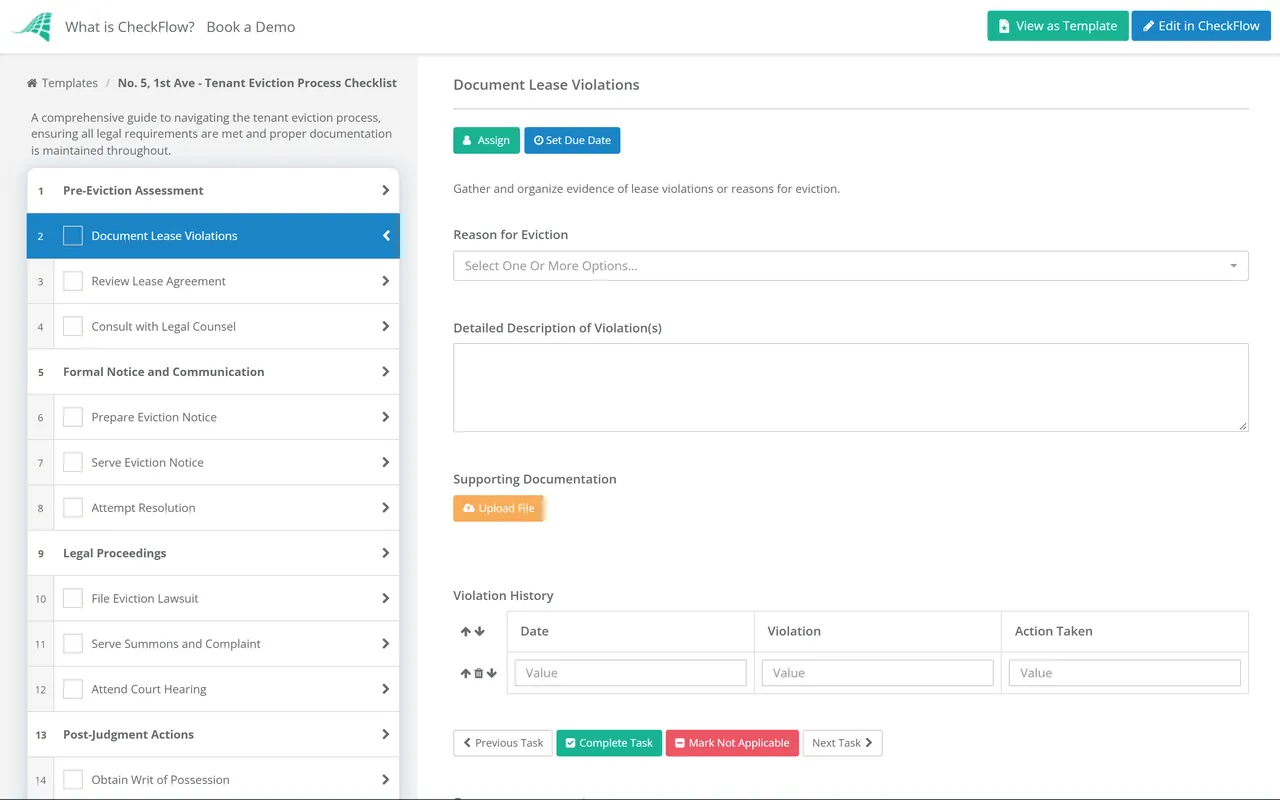
The Tenant Eviction Process Checklist
Seven phases covering the full eviction process — from early resolution attempt through legal prerequisites, notice, court claim, enforcement, and post-eviction property recovery.
Phase 1
Early Resolution — Before Any Formal Step
A negotiated departure is faster, cheaper, and less adversarial than court proceedings. Before serving any notice, attempt direct dialogue. Document all communication.
Contact the tenant in writing — outlining the issue (arrears amount, breach details); what is needed to resolve it; and a reasonable deadline for response
Offer a payment plan (for arrears) — a structured repayment plan may be more recoverable than contested court proceedings; any plan agreed in writing
Offer a negotiated departure date — a cash for keys arrangement or a simple agreement to leave by a specified date may avoid the need for court proceedings
Document all communications — every contact, every response, every agreement; in writing where possible; the record will be needed if proceedings are required
Phase 2
Confirm Legal Prerequisites Before Serving Notice (England)
In England, a notice may be invalid — and unenforceable — if the landlord has not met their legal obligations. Check every item below before serving any notice.
Deposit is protected — in an approved TDS scheme; prescribed information was served within 30 days; if not, seek legal advice before proceeding
Gas Safety Certificate provided to tenant — before they moved in; if not, seek legal advice
EICR provided to tenant — if not, seek legal advice
“How to Rent” guide — current version provided to tenant at the start of the tenancy; if not, a valid guide may need to be served now (seek legal advice)
No illegal retaliatory eviction — the landlord is not serving notice because the tenant has complained about disrepair or exercised a legal right; this would make the eviction unlawful
Phase 3
Serving Notice
Every detail of the notice must be correct. Wrong form, wrong dates, wrong grounds, or incorrect service method can invalidate the notice and require starting the process again.
Obtain qualified legal advice — before drafting the notice; the grounds and notice period must be correct for the specific circumstances
Select the correct notice form — England: Section 8 notice on Form 3 (prescribed form); specific ground(s) must be stated; notice period depends on the ground
Confirm the notice period — Ground 8 (mandatory arrears): 4 weeks; Grounds 10/11 (discretionary arrears): 4 weeks; other grounds: varies; check with solicitor
Serve the notice correctly — in writing; to the correct address; by first class post (add 2 days to notice period for service), hand delivery, or other permitted method; retain proof of service (witness, postage certificate)
Keep a copy — of the served notice with the proof of service; this will be filed with the court if proceedings follow
Phase 4
During the Notice Period
Monitor the situation — has the tenant responded? Vacated voluntarily? Paid arrears? Remediated the breach?
Continue to document — rent payments, communications, and any changes in the situation
Prepare for court claim — if the tenant has not vacated and not remediated; gather all evidence (rent account, correspondence, inventory, certificates); instruct solicitor
Phase 5
Making a Possession Claim
A possession claim can only be made after the notice period has expired and the tenant has not vacated. The landlord must apply to the court — they cannot remove the tenant themselves.
File the possession claim — through the court (England: N5 claim form; or online via Possession Claim Online for rent arrears cases); with all supporting evidence
Attend the court hearing — or instruct a solicitor to attend; with all evidence; prepared to answer the judge’s questions
Obtain the possession order — the court may grant an outright possession order (if the ground is mandatory) or a suspended order (conditional on the tenant meeting conditions)
Outright possession order — specifies the date by which the tenant must leave; if they do not leave by that date, apply for a bailiff warrant
Phase 6
Enforcing the Possession Order
Apply for a warrant of possession — if the tenant has not vacated by the possession order date; filed with the court on Form N325 (England)
Bailiff appointment confirmed — the court bailiff (or High Court Enforcement Officer if the case is transferred) will set an eviction date
Attend the eviction — with a locksmith; the bailiff executes the warrant; the landlord may change the locks only when the bailiff hands over possession
Handle any tenant belongings — per applicable tort of interference with goods legislation; seek legal advice; cannot simply dispose of belongings left at the property
Phase 7
Post-Eviction Property Recovery
Change all locks immediately — after bailiff handover; tenant may have copies of keys
Inspect and document the property — thoroughly; compared to the move-in inventory; photographs of all damage; maintenance costs estimated
Apply for debt judgment (if applicable) — for rent arrears and damage costs above the deposit; court judgment can be enforced against the tenant’s assets
Deposit claim through the scheme — if deposit deductions are required; evidenced against the move-in inventory; via the scheme’s dispute resolution process
Re-market the property — once in lettable condition; after any required repairs or cleaning
A documented record of every pre-eviction communication
The landlord who cannot evidence that they attempted to resolve the issue before serving notice, that they served the notice correctly, or that they continued to receive rent after a specific date is the landlord with a weakened court case. Every communication, every notice, and every event logged through CheckFlow creates the timestamped record that courts and adjudicators rely on.

2
Legal prerequisite checks that prevent invalid notices
The most common cause of eviction failure is a procedural error at the notice stage — an unprotected deposit, a missing document provision, a wrong form. CheckFlow’s legal prerequisites phase requires each item to be verified before the notice process can begin — preventing the procedural failures that send landlords back to square one.
3
A process that forces the right sequence
Eviction proceeds through a strict legal sequence — notice, court claim, hearing, possession order, warrant. Skipping steps or taking self-help action has severe consequences. CheckFlow’s eviction process checklist enforces the correct sequence and includes the legal warnings at every phase where the temptation to shortcut is highest.
Many evictions result from issues that could have been prevented by thorough tenant screening. CheckFlow’s Tenant Screening Checklist covers the pre-tenancy process. See the Tenant Screening Checklist →
The legal prerequisites that must be in place before serving notice — deposit protection, compliance documents, How to Rent guide — are all established at move-in. CheckFlow’s Tenant Onboarding Checklist covers the move-in process. See the Tenant Onboarding Checklist →
The eviction process covers seven phases: early resolution attempt (written communication, payment plans, negotiated departure — always the first step), legal prerequisites check (England: deposit protection, compliance documents, How to Rent guide must all be in order), serving notice (correct form, correct grounds, correct service method and notice period), monitoring during the notice period, making a possession claim if the tenant does not vacate, enforcement (warrant of possession and bailiff attendance if the possession order is not complied with), and post-eviction property recovery (locks changed, property documented, deposit claim, property re-marketed).
What happened to Section 21 evictions in England?
+
Section 21 of the Housing Act 1988, which permitted “no-fault” evictions (evictions without the landlord needing to state a reason), was abolished in England by the Renters’ Rights Act 2025. This took effect on 1 May 2026. From that date, all residential possession proceedings in England must be based on specific statutory grounds under Section 8 of the Housing Act 1988. Different eviction rules apply in Scotland, Wales, and Northern Ireland.
What are the grounds for Section 8 eviction in England?
+
Section 8 grounds are divided into mandatory grounds (where the court must grant possession if the ground is proven) and discretionary grounds (where the court may grant possession if it is reasonable to do so). Key grounds include: Ground 8 (mandatory) — the tenant is at least two months in arrears both at the time of notice and at the hearing; Grounds 10–11 (discretionary) — some rent arrears or persistent late payment; Ground 12 (discretionary) — breach of the tenancy agreement; Ground 14 (discretionary) — nuisance, annoyance, or criminal conviction relating to the property. Additional grounds were added by the Renters’ Rights Act 2025. Legal advice is essential to select and plead the correct grounds for each case.
What is an illegal eviction and what are the consequences?
+
An illegal eviction occurs when a landlord removes or attempts to remove a tenant from a property without following the correct legal process. This includes: changing the locks without a court possession order, removing the tenant’s belongings from the property, cutting off utilities to make the property uninhabitable, harassment designed to make the tenant leave, and physically forcing the tenant out. In the UK, illegal eviction is a criminal offence under the Protection from Eviction Act 1977, punishable by imprisonment and an unlimited fine. Tenants can also pursue civil claims for damages. The correct procedure is to obtain a court possession order and, if the tenant does not comply, a bailiff warrant.
Is CheckFlow free for this template?
+
You can start a free 14-day trial with no credit card required, giving you full access to all features including this template. The Business plan is $10 per user per month after the trial. Full details at checkflow.io/pricing.
Document Every Step of the Eviction Process — and Keep the Evidence That Courts Require
Free trial — no credit card required.
Do you like cookies? 🍪 We use cookies to ensure you get the best experience on our website. Learn more