
One template, two countries
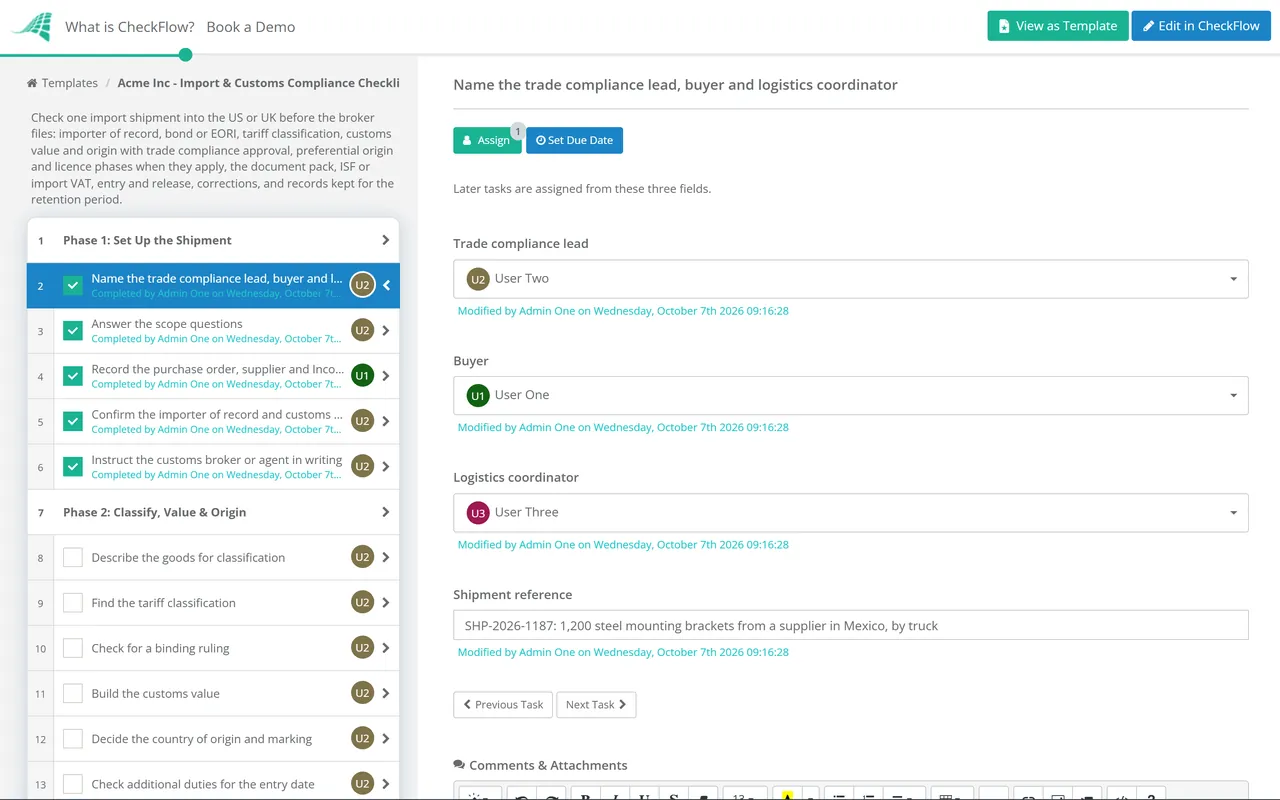
The importing country answer shows the ISF, bond and entry deadlines for a US shipment, or the EORI, deferment and postponed VAT tasks for a UK one. The preference and licence phases appear only when the goods need them.
Last reviewed: October 2026
No Credit Card Required
Printed from checkflow.io/templates/procurement-supply-chain/customs-import-compliance-checklist
This free import compliance checklist is for importers bringing goods into the United States or the United Kingdom: buyers, logistics coordinators and the person who signs off trade compliance. It runs one shipment from the purchase order and the Incoterms® rule to the filed record, covering classification, customs value, origin and preference, licences, pre-arrival filings, the broker’s draft entry, release, corrections and record retention. Three questions at the start show the US or UK tasks, the preference claim and the licence checks only when this shipment needs them.
In the US, the importer of record must use “reasonable care” to make entry, under 19 USC 1484. In the UK, HMRC says you remain responsible for due diligence on your declarations even when an agent makes them for you. A broker moves the typing, not the accountability. It works from what you give it, and most errors start there.
The checks are the same in both countries, but the details differ in ways that catch people out. The customs value is a good example: US transaction value excludes international freight and insurance, while the UK value includes transport and insurance up to the UK border.
| Check | United States (CBP) | United Kingdom (HMRC) |
|---|---|---|
| Who answers for the entry | The importer of record, using reasonable care (19 USC 1484) | The importer, who keeps the due diligence duty when an agent declares |
| Importer identifier | Importer of record number on the entry | An EORI number starting with GB |
| Classification | 10-digit HTSUS number | Commodity code from the UK Trade Tariff |
| Customs value | Transaction value under 19 USC 1401a, excluding international freight and insurance | Method 1 transaction value, including transport and insurance to the UK border |
| Advance data | Importer Security Filing for ocean cargo, 24 hours before loading at the foreign port (19 CFR 149.2) | Entry summary declaration in the S&S GB service; the carrier is legally responsible, so confirm it was made |
| Declaration | Entry within 15 calendar days of arrival (19 CFR 142.2); entry summary within 10 working days of entry (19 CFR 142.12) | Import declaration on the Customs Declaration Service (CDS) |
| Paying | A customs bond, single transaction or continuous (19 CFR Part 113) | Pay per import, or monthly through a duty deferment account; import VAT by postponed VAT accounting if VAT registered |
| Keeping records | 5 years from the date of entry (19 CFR 163.4) | 4 years for customs records; 6 years for VAT records |
Tariffs are the part that moves fastest. US additional duties under Section 232, Section 301 and other authorities changed repeatedly through 2025 and 2026, and so did the legal basis for some of them. This page states no rates. The checklist instead makes someone check HTSUS chapter 99 and CBP’s CSMS messages, or the UK Trade Tariff, for the entry date, every time. CheckFlow does not file entries or calculate duty: your broker or agent files, and CheckFlow runs the importer’s checks around the filing.
Seven phases run from the purchase order to the retention date. The country answer shows US or UK tasks in every phase, the origin phase appears only for a preference claim, and the licence phase only for controlled goods. Classification and value need the trade compliance lead’s approval before anything is filed.
Owned by the trade compliance lead. Scope questions: importing into (US / UK), claiming preferential origin or a trade programme (Yes/No), goods controlled by another agency or needing a licence (Yes/No). Tasks marked US or UK appear only for that answer.
The approval is assigned from the trade compliance lead field. The checklist halts until it is Approved, so nothing reaches the broker unchecked.
Shown only when “Claiming preferential origin or a trade programme?” is Yes. Owned by the trade compliance lead.
Shown only when “Goods controlled by another agency or need a licence?” is Yes. Assigned to the trade compliance lead, due before the goods ship.
Assigned to the logistics coordinator. Due dates run from the departure date field.
Assigned to the logistics coordinator, with the review task assigned to the trade compliance lead. The entry task is due 15 days after the arrival date field.
Owned by the trade compliance lead. The retention task carries a date field for the destruction date.
Most delays at the border are a missing or inconsistent document. Agree with the supplier at the purchase order who sends what and when, and check each item against the others before the broker sees it.
| Document | Provided by | Check before filing |
|---|---|---|
| Commercial invoice | Seller | Price, currency, Incoterms® rule, full description, quantity, origin, buyer and seller names |
| Packing list | Seller | Packages, weights and marks match the invoice and transport document |
| Bill of lading or air waybill | Carrier or freight forwarder | Consignee, notify party, container numbers and arrival port |
| Proof of origin | Exporter or producer, or the importer’s own knowledge | Wording and validity required by the agreement or programme |
| Licences, permits and certificates | Importer applies; supplier provides health or conformity certificates | In date, covering these goods and quantities, obtained before shipping |
| Value evidence | Importer and seller | Royalty, assist, commission and freight figures used in the value |
| ISF (US ocean) or import declaration (UK) | Importer, filed through the broker or agent | Data matches the approved classification, value and origin |
| Broker or agent authority | Importer | Signed, current, and for the UK stating direct or indirect representation |
Keep the set together. A US entry record stays for 5 years from the date of entry under 19 CFR 163.4, and HMRC asks for 4 years of customs records, longer for VAT. When a query arrives years later, the person who handled the shipment may have left. Check the current text of the regulations, and take advice from a licensed broker or customs adviser on any specific entry.
The importing country answer shows the ISF, bond and entry deadlines for a US shipment, or the EORI, deferment and postponed VAT tasks for a UK one. The preference and licence phases appear only when the goods need them.
Classification, value, origin and additional duties wait for the trade compliance lead. The approval halts the checklist, so the broker never receives a code someone guessed the night before the ship docked.
Invoices, origin statements, rulings and the broker’s draft sit on the task that checked them, and the audit trail shows who approved the classification and when. That is the reasonable care record, built as you go.
CheckFlow is not a customs filing system, a broker platform or a duty calculator. It runs the importer’s human process around them. Pair this checklist with the Shipment Tracking Checklist to follow the goods in transit, and set up new suppliers with the Supplier Onboarding Checklist, so invoice content and origin evidence are agreed before the first order.
The Incoterms® rule is decided long before the goods ship. The Supplier Sourcing & Tender Checklist fixes it at award, along with who acts as importer.

Shipment Tracking Workflow

Procurement Compliance Review

Supplier Onboarding Checklist

Purchase Order Approval

Supplier Sourcing & Tender Checklist
Describe the process in a sentence and the AI checklist generator drafts the phases and tasks for you.
The importer’s identity and the broker’s authority, the Incoterms® rule, a reasoned classification, a customs value with every addition accounted for, the country of origin and marking, any preference claim and its proof, licences and agency filings, pre-arrival filings such as the US ISF, a review of the broker’s draft entry, a reconciliation of what was paid, corrections, and a filed record with a retention date.
Usually the importer. In the US, 19 USC 1484 puts the duty of reasonable care on the importer of record, and relying on a broker does not remove it. In the UK, HMRC says you remain responsible for due diligence when an agent declares for you, and a direct representative is not jointly liable.
No, not at the time of review. Duty-free de minimis treatment was suspended for all countries from 29 August 2025 under Executive Order 14324, the suspension was continued by Executive Order 14388 on 20 February 2026, and CBP wrote it into its regulations with an interim final rule effective 24 June 2026. Separately, legislation enacted on 4 July 2025 repeals the statutory exemption from 1 July 2027. Low-value shipments now need a formal or informal entry. Check CBP’s current guidance, because this area has moved quickly.
In the US, 5 years from the date of entry, under 19 CFR 163.4, which implements 19 USC 1508. In the UK, HMRC asks importers to keep records of goods declared for 4 years, and VAT-registered businesses keep VAT records for 6 years, so many UK importers keep the whole file for 6. A UK importer claiming preference under the UK–EU agreement keeps the exporter’s statement on origin for 4 years from importation.
Only DDP (Delivered Duty Paid). Under the other ten Incoterms® 2020 rules the buyer clears the goods for import and pays the duty. DDP can be hard for a foreign seller, and even under it you should know how the goods were classified and valued. Incoterms® 2020 remains the current edition published by the ICC.
14-day free trial, no card required. The Business plan is $10 per user per month after the trial. Full details at checkflow.io/pricing.
14-day free trial, no credit cardFull refund in your first 30 daysUS hosting, EU on request