Board Member Onboarding Checklist Template

Appointing a trustee can take one vote. Making sure they can legally serve, that the regulator knows, and that they understand the charity well enough to govern it takes a plan.

Last reviewed: October 2026

This free board member onboarding checklist brings one new trustee or nonprofit board member from nomination to a review after the first year. The governance lead checks the governing document, the chair confirms the role and meets the nominee, and references are collected. The eligibility checks follow: the minimum age, a signed disqualification declaration, the official registers, any criminal record check and the nominee’s interests. The board or the members then decide, the regulator and Companies House are told, and the new board member gets an induction pack, meetings with the chair, chief executive and treasurer, a visit to the work and support at the first board meeting. Pick where the charity is registered on the first task to see the notes for England and Wales, Scotland, Northern Ireland or the United States.

One New Board Member, From Nomination to the First Year

A trustee or nonprofit board member shares legal responsibility for the organisation from the day they are appointed. The law sets who can serve, the governing document sets how they are appointed, and the regulator expects to hear about the change. A good induction then turns a new name on the register into someone who can read the accounts and ask the right questions.

This checklist runs one new board member, from nomination to a review after the first year. It covers England and Wales, Scotland, Northern Ireland and the United States, with short notes for each. Two other checklists sit close to it.

This checklist

One new board member

Covers: one trustee or board member, from the role and references to the eligibility checks, the declaration, the appointment decision, registrations, the induction pack and meetings, the first board meeting and a first-year review.

Where: charities regulated by the Charity Commission, OSCR or the Charity Commission for Northern Ireland, and US nonprofits.

Output: a valid appointment with signed declarations, the regulator told, and a board member who knows the charity.


Every meeting

The Board Meeting Preparation Checklist for Nonprofits & Charities

Covers: one board meeting: the agenda, the board pack, financial reporting, the meeting itself, the minutes and the actions.

Use it: for every meeting, including the one that decides this appointment and the new board member’s first. Board Meeting Preparation Checklist for Nonprofits & Charities.

Volunteers

The Volunteer Onboarding Checklist

Covers: recruiting, screening, orienting, training and supervising volunteers who help deliver the work.

Use it: for volunteers in services and events. Trustees are usually unpaid too, but they govern the charity and carry legal duties, so they need this checklist instead. Volunteer Onboarding Checklist.

What the Board Member Onboarding Checklist Covers

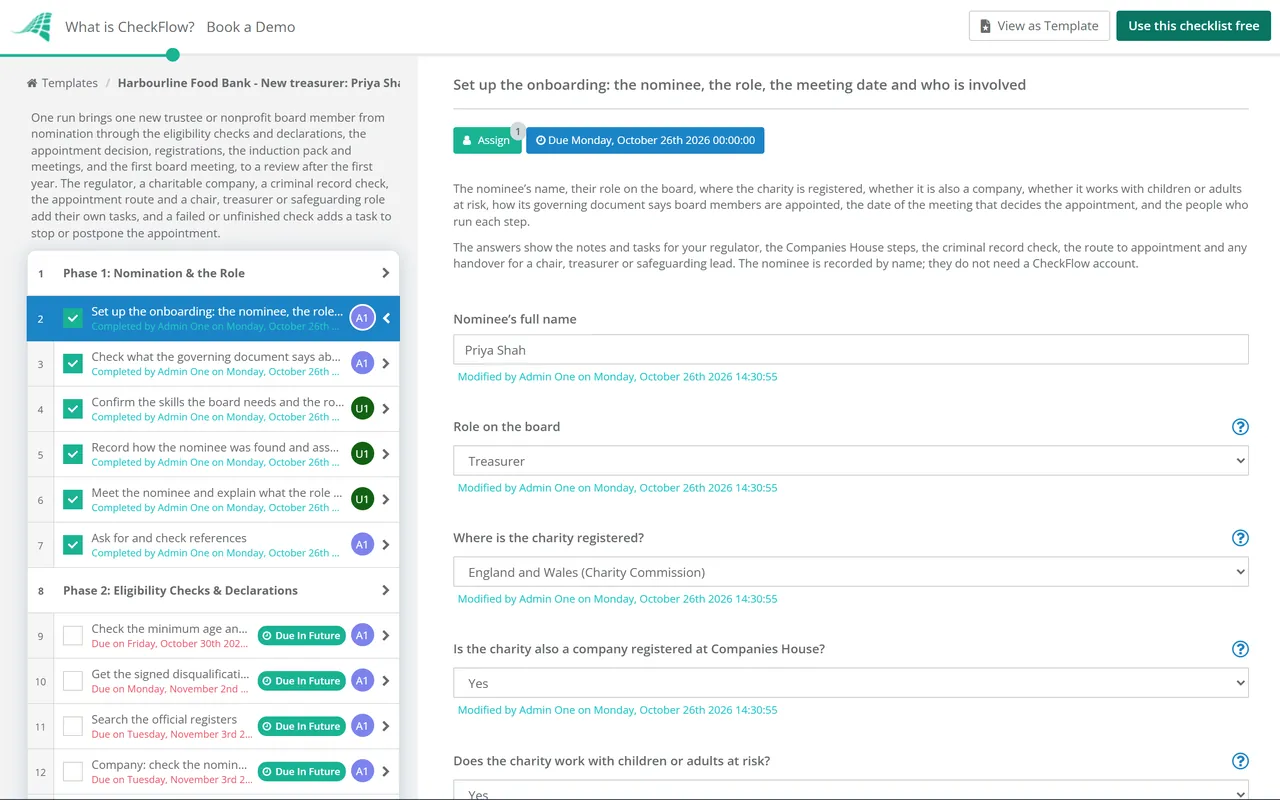
Eight phases follow one new trustee or board member from nomination to a review after the first year. The first task records where the charity is registered, which shows the notes and tasks for that regulator, and whether it is a company, works with children or adults at risk, and how appointments are made. A chair, treasurer or safeguarding lead gets a handover, a declared conflict is assessed before the decision, a failed check stops the appointment and unfinished checks move it to a later meeting. The appointment decision is the gate: nothing after it can be completed until it is recorded.

  1. Phase 1

    Phase 1: Nomination & the Role

    7 tasks

    Start this checklist when someone is nominated or shortlisted for the board. Enter the date of the meeting that will decide the appointment on the first task: every task before the decision counts back from it in business days, the decision is due on it, and every later due date counts forward from it.

    • Set up the onboarding: the nominee, the role, the meeting date and who is involved — the nominee’s name, their role on the board, where the charity is registered, whether it is also a company, whether it works with children or adults at risk, how its governing document says board members are appointed, the date of the meeting that decides the appointment, and the people who run each step
    • Check what the governing document says about appointing board members — who appoints, how, any conditions on who can serve, the lowest and highest number of trustees, the quorum, how long a term lasts and whether a trustee can be re-appointed; an appointment that breaks these rules is not valid
    • US: check the bylaws and state law on electing directors — the number of directors, how they are elected or appointed, terms of office, the quorum and any officer roles, as the bylaws and the nonprofit law of the state of incorporation set them; take advice if you are unsure
    • Confirm the skills the board needs and the role description — the skills, experience and knowledge the board is missing, what the role involves and the time it takes, and which requirements are needed from the start and which can be learnt in the role
    • Record how the nominee was found and assessed — how they were found (an advert, a trustee finder service, a nomination by members or an outside body, or a personal contact), how they were shortlisted and interviewed, and who took part, so the board can see a fair process
    • Meet the nominee and explain what the role involves — the charity’s purposes and work, a trustee’s legal duties, how many meetings there are and when, the time the role takes, that trustees are usually unpaid but can claim reasonable expenses, and any other expectations such as helping with fundraising; offer them the chance to observe a board meeting first
    • Ask for and check references — personal or employer references, which the Charity Commission says you should usually collect and check, with who gave each one and when it came back
  2. Phase 2

    Phase 2: Eligibility Checks & Declarations

    10 tasks

    The law disqualifies some people from being a trustee, and acting while disqualified is usually an offence. Finish these checks and get the signed declaration before the decision, so the charity never appoints someone who cannot serve.

    • Check the minimum age and the capacity to act — that the nominee meets the minimum age for this type of charity and any other condition in the governing document, and is able to manage their own affairs
    • Get the signed disqualification declaration — a written declaration from the nominee that they are not disqualified from acting as a trustee, signed before the appointment is made and kept with the charity’s records
    • Search the official registers — the insolvency register for each nation where the nominee has lived, the register of disqualified company directors and the register of removed trustees, with the date of each search and what it showed
    • Company: check the nominee has verified their identity with Companies House — a new director needs a Companies House personal code, which they get by verifying their identity through GOV.UK One Login or an authorised agent, and the code is given in the appointment filing; they only need to verify once
    • Get the criminal record check the role is eligible for — the level of check the trustee role is eligible for, done before the appointment, with the date the result was seen and whether it is acceptable for the role
    • Ask about conflicts of interest and record the nominee’s interests — their job, other boards and charities, business interests, and links to the charity’s staff, suppliers, funders or the people it serves, so the board knows of any conflict before it decides
    • UK: ask for a fit and proper persons declaration — a charity that claims UK tax reliefs such as Gift Aid needs its managers, including trustees, to be fit and proper persons; HMRC suggests asking each new manager to read its helpsheet and sign a declaration based on its model, kept while they serve and for 4 years after
    • Assess the declared conflict and how it would be managed — how serious and how frequent the conflict would be, whether the appointment adds to the number of conflicted trustees, whether enough unconflicted trustees would remain to form a quorum, and how it would be managed; sometimes it is right not to appoint
    • Record the result of the eligibility checks — whether every check is complete and nothing stops the appointment, so the chair can put the nomination to the decision; note any advice taken
    • Stop or postpone the appointment and tell the nominee — do not put the nomination to the decision; if the nominee is disqualified or not eligible, tell them, record why, and mark the later tasks not applicable, or keep the checklist open while a waiver application is decided; if the checks could not be finished in time, move the meeting date on the first task to a later meeting and record what is still outstanding
  3. Phase 3

    Phase 3: The Appointment Decision

    6 tasks

    The board appoints, or the members or an outside body where the governing document says so. Take the nomination to the meeting with every check complete. The appointment decision is the gate: nothing after it can be completed until it is recorded.

    • Members: give notice of the general meeting and the candidate’s details — notice of the meeting as the governing document requires, with the candidate’s profile and the skills the board is looking for, so the members can vote on the facts
    • Outside body: get the written nomination from the appointing body — a letter or email from the body with the right to nominate or appoint, naming the nominee; tell it the skills the board needs, and that its nominee must act only in the charity’s interests
    • Send the nomination papers to the decision makers — the role description, why this nominee was chosen, confirmation that the checks and declarations are complete (without the personal details), and any declared conflict with how it would be managed
    • Board or members approve the appointment — the decision taken as the governing document says, at a quorate meeting or by the members, with the minute reference and, if it is approved, the date the appointment takes effect; nothing after this task can be completed until it is done
    • Confirm the appointment in writing — a welcome letter or email to the new board member with the date the appointment took effect, the term, their role and what happens next in their induction
    • Not approved: tell the nominee and close this checklist — tell the nominee the decision promptly and kindly, record the reason, and mark the remaining tasks not applicable or archive the checklist
  4. Phase 4

    Phase 4: Registrations & Records

    7 tasks

    Tell the regulator, Companies House if the charity is a company, and everyone else who needs to know, as soon as possible after the appointment.

    • Add the new trustee to the charity’s entry with the regulator — the details the regulator asks for, entered online as soon as possible after the appointment, then a check that the public register shows the right name
    • US: record the election and update any state filings — the board or member resolution in the minutes, the list of directors in your records, and any state filing that names directors, as your bylaws and state law require; take advice if you are unsure
    • Update the charity’s own register of trustees and register of interests — the new board member’s name, role, appointment date and term in your list of trustees, and their declared interests in the register of interests
    • Company: file the director appointment with Companies House — within 14 days of the appointment, with the new director’s personal code, a statement that they have consented to act, and the date they became a director
    • Add them to board communications and the meeting calendar — the board email list or portal, the dates of this year’s board and committee meetings, and how papers are sent
    • Update bank mandates and HMRC details if they will sign or act for the charity — add them as a signatory if they will authorise payments; in the UK, tell HMRC if they become an authorised official, online or with form ChV1; and if the charity holds property in trustees’ names, check whether it needs to be transferred
    • Tell the people who need to know — staff, the auditor or independent examiner, advisers, funders who ask to hear about board changes, and the charity’s insurer if its policy covers trustees
  5. Phase 5

    Phase 5: The Induction Pack

    6 tasks

    The Charity Commission lists what a new trustee should be given. Send the pack in the first two weeks, so there is time to read it before the induction meetings.

    • Send the governing document and the latest annual report and accounts — the current governing document with any amendments, and the most recent trustees’ annual report and accounts; every trustee should have an up to date copy of the governing document
    • Send the latest management accounts, budget and recent board minutes — this year’s budget, the latest management accounts and the minutes of the last few board meetings, so they can see where the charity stands and what the board has decided
    • Send the key policies — safeguarding, expenses, conflicts of interest, social media and internal financial controls, and any others the board relies on, such as reserves, risk and complaints
    • Send the strategy, plans and risk register — the charity’s plans, priorities and values, this year’s operating plan and the current risk register
    • Send the regulator’s guidance for trustees — the regulator’s main guidance on a trustee’s duties, with a note of which parts to read first
    • Agree what information and learning they need in the first year — a conversation about what they already know, what they need to learn and how the charity will help, written down so it can be reviewed after the first year
  6. Phase 6

    Phase 6: Induction Meetings & a Visit to the Work

    9 tasks

    Introduce the new board member to the people and the work. The Charity Commission suggests meeting key people and, over time, visiting services and meeting the people the charity helps.

    • Introduce a mentor trustee — an experienced trustee they can ask about papers, meetings and how the board works during the first year
    • Meet the chair: the board’s priorities and how it works — the board’s current priorities, how meetings run, the committees, how decisions are made and recorded, and that trustees decide together and act only in the charity’s interests
    • Meet the chief executive: the work, the staff and current issues — how the charity delivers its purposes, the staff and volunteer structure, current risks and opportunities, and what the executive needs from the board
    • Meet the treasurer or finance lead: the finances and controls — income and spending, reserves, restricted funds, the budget, the financial controls, and how the accounts are examined or audited
    • Brief them on safeguarding and serious incident reporting — the safeguarding policy, who the safeguarding leads are, how concerns are raised, and how the charity reports serious incidents to its regulator
    • Chair: hand over the chair’s duties — the outgoing chair or vice chair hands over the agenda planning, the working relationship with the chief executive, any delegated authority and the matters still open
    • Treasurer: hand over the treasurer’s duties — the bank access and signatory arrangements, the financial controls, the accounts timetable, the independent examiner or auditor, and any finance committee
    • Safeguarding lead trustee: brief them on the role — the safeguarding policy and when it is next reviewed, the staff safeguarding lead, recent concerns and how they were handled, training, and how serious incidents are reported
    • Visit the charity’s work and meet the people it serves — a visit to a service or project and, where appropriate, a meeting with the people the charity helps, its staff and volunteers, so board decisions are grounded in the work
  7. Phase 7

    Phase 7: The First Board Meeting

    4 tasks

    This template expects the first board meeting about seven weeks after the appointment; change these due dates if your next meeting is sooner or later.

    • Send the first board papers in good time and offer a briefing — the agenda and papers early enough for a new board member to prepare, with a short call to explain any item that needs background
    • Record their attendance and declarations at the first meeting — their attendance, any interests they declare on the agenda items, and anything they asked to follow up
    • Check in after the first meeting — a short conversation about how the meeting went, whether the papers made sense, and what would help them contribute next time
    • Agree any committee or lead role — which committees they will join or lead, if any, and the terms of reference they should read
  8. Phase 8

    Phase 8: Review After the First Year

    4 tasks

    About a year after the appointment, look back with the new board member and refresh the records. These due dates count 12 months from the meeting date.

    • Ask for a fresh disqualification declaration — a new signed declaration, since the Charity Commission says charities should check at reasonable intervals that trustees have not become disqualified
    • Update their interests and check the public records — their entry in the register of interests, and that the regulator’s register and, for a company, Companies House still show their details correctly
    • Review the first year with the chair — how they have settled in, the support they need, progress on the learning plan, and whether the role is working for them and for the board
    • Agree training for the year ahead and improve the induction — the training or development they want next, and what to change in this induction for the next new board member

Trustee Appointment Rules and Timing at a Glance

Appointing a trustee or board member: the rules by jurisdiction

The points that shape an appointment, with the source for each. The answer on the first task shows the matching notes in the checklist.

Point England and Wales Scotland Northern Ireland United States
Minimum age16 for a charitable company or a CIO, 18 for any other charity (CC3)Check the governing document and OSCR’s guidance18 for an unincorporated charity, 16 for a director of a charitable company (CCNI)Set by state law and the bylaws
DisqualificationCharities Act 2011, sections 178 to 184A; acting while disqualified is usually an offence2005 Act as amended by the 2023 Act; wider criteria, including senior management functions, from 31 August 2025Charities Act (Northern Ireland) 2008, section 86; reasons listed in CCNI’s guide 2Set by state law and the bylaws; take advice
Declaration before appointmentYou must ask for a written declaration before appointing (CC30)Confirm with trustees that none of the criteria apply (OSCR)Template declaration in CCNI’s guide 2As your bylaws or policies require
Criminal record checksDBS check when the role is eligible, if the charity works with children or adults at risk (CC30)PVG scheme for regulated roles (Disclosure Scotland)AccessNI checksYour policy and state law
Telling the regulatorUpdate My Charity Commission Account as soon as possible (CC30)Update OSCR Online as soon as possible; names published since 9 March 2026Update the register through CCNI’s online servicesForm 990 Part VI reports the number of voting board members at the end of the tax year
A charitable companyTell Companies House within 14 days, with the director’s personal code (Companies Act 2006, s.167G)The same: Companies House covers the whole UKThe same: Companies House covers the whole UKNot applicable
Conflicts of interestDeclare them, stop them affecting decisions and record them (CC3)Keep a register of interests and a conflict of interest policy (OSCR good practice)Manage conflicts of interest appropriately (CCNI)Form 990 Part VI asks about a written policy (line 12a) and annual disclosure (line 12b)

How the timeline fits together

Every due date counts in business days from the date of the meeting that decides the appointment, entered on the first task.

Stage What happens Due, in business days from the meeting date Where in the checklist
NominationGoverning document, role, references, the nominee met26 to 23 beforePhase 1
ChecksAge, declaration, register searches, any criminal record check, interests22 to 12 beforePhase 2
DecisionAny notice to members, papers sent, then the board or members decide15 before to the meeting dayPhase 3
RegistrationsRegulator, Companies House within 14 days, records, bank and HMRC3 to 8 afterPhase 4
Induction packGoverning document, accounts, minutes, policies, plans, guidance5 to 10 afterPhase 5
Induction meetingsMentor, chair, chief executive, finance, safeguarding, a visit10 to 25 afterPhase 6
First board meetingPapers in good time, attendance, a check-in33 to 40 afterPhase 7
First-year reviewFresh declaration, records, review and training12 months after, then up to 7 morePhase 8

Sources. Charity Commission: The essential trustee (CC3), Finding and appointing new trustees (CC30) and automatic disqualification guidance for charities; Charities Act 2011, section 178; OSCR on the 2023 Act changes and trustee information in OSCR Online; CCNI’s Running your charity guidance and guide to updating the register; Companies Act 2006, section 167G and section 307, Companies House on verifying your identity; Disclosure Scotland’s PVG scheme; gov.uk on insolvency registers in each UK nation; and the IRS Instructions for Form 990 (Part VI). Regulator guidance is not law, US state law varies, and this table is not legal advice.

Why Run Board Member Onboarding in CheckFlow?

1

Every check done before the decision

Enter the date of the meeting that decides the appointment and every task gets a due date in business days: the role, references, declaration, register searches and any criminal record check before it, then the registrations, the induction pack and the meetings after it. Overdue alerts go to the people assigned, so the checks are finished before the board decides and the regulator is told on time.

2

The right steps for each charity

One answer shows the notes and tasks for the Charity Commission, OSCR, the Charity Commission for Northern Ireland or a US nonprofit. A charitable company adds the Companies House identity check and filing, work with children or adults at risk adds the criminal record check, and a chair, treasurer or safeguarding lead gets a handover. A declared conflict is assessed before the decision, a failed check stops the appointment and unfinished checks move it to a later meeting.

3

An appointment on the record

The appointment decision is a gate: the registrations and the induction cannot be ticked off until the board or the members have decided, with the date and the minute reference. The Reports Grid lists every appointment with its answers, so the governance lead can see who is still waiting for checks or registration, and Analytics shows completion rates and overdue work. See how approval steps work.

CheckFlow does not decide whether someone is eligible to be a trustee or whether an appointment is valid. The board, the governing document, the regulator’s guidance and, where needed, legal advice decide that. CheckFlow makes sure each check and step happens on time, every task has an owner and the decision rests on a dated record.

Prepare the meeting that decides the appointment with the Board Meeting Preparation Checklist for Nonprofits & Charities, and collect every board member’s interests each year with the Conflict of Interest Declaration Checklist. The new board member’s first year often includes approving the accounts: the Annual Report Preparation Checklist covers that. Volunteers who help deliver services follow the Volunteer Onboarding Checklist, and a company board can prepare its meetings with the Company Board Meeting Preparation Checklist.

AI generator

Didn’t find what you need? Describe it.

Describe the process in a sentence and the AI checklist generator drafts the phases and tasks for you.

Frequently Asked Questions

What should a board member onboarding checklist include?

Every step for one new trustee or board member: checking the governing document, the role description and references, the age, disqualification and register checks, a signed declaration, any criminal record check, the nominee’s interests, the appointment decision, telling the regulator and Companies House, an induction pack, meetings with the chair, chief executive and treasurer, a visit to the work, the first board meeting and a review after the first year.

What should a trustee induction pack include?

The Charity Commission lists the governing document, the latest annual report and accounts, the latest management accounts and budgets, minutes of recent trustee meetings, key policies such as safeguarding, expenses, conflicts of interest, social media and internal financial controls, the charity’s plans, priorities and values, and its guidance on trustees’ responsibilities. This template sends the pack in Phase 5 and agrees a learning plan for the first year.

Who cannot be a charity trustee?

In England and Wales, reasons for disqualification include an unspent conviction for certain offences such as dishonesty or deception, being an undischarged bankrupt or having an IVA, being disqualified as a company director, having been removed as a trustee for misconduct or mismanagement, and being on the sex offenders’ register. Acting while disqualified is usually an offence. Scotland widened its criteria from 31 August 2025, and Northern Ireland has its own list. A waiver is sometimes possible.

Does a new trustee need a DBS check?

Not always. The Charity Commission says that if your charity works with children or adults at risk, you should always get a standard, enhanced or enhanced with barred list check when the trustee role is eligible for one, and a basic check if your risk assessment says so. Use the DBS eligibility checker. In Scotland the PVG scheme covers regulated roles, and in Northern Ireland AccessNI carries out checks.

How do you tell the Charity Commission about a new trustee?

Update the charity’s register page in My Charity Commission Account as soon as possible after the appointment, with the trustee’s full legal name, home address, email address, phone number, date of birth and the date they started. Only names are shown publicly. In Scotland, charities add trustees in OSCR Online; in Northern Ireland, through CCNI’s online services. This template does it in Phase 4.

Does a charitable company need to tell Companies House about a new trustee?

Yes, if the charity is a company, because its trustees are usually its directors. Section 167G of the Companies Act 2006, in force since 18 November 2025, says the notice must be given within 14 days of the appointment and include a statement that the director’s identity is verified. A new director gets a Companies House personal code by verifying their identity, and gives it in the appointment filing.

How should a new board member’s conflicts of interest be handled?

Ask about them before the appointment. The Charity Commission says a declared conflict does not mean you should not appoint, but you should consider how serious it is, whether it adds to the number of conflicted trustees and whether you can still form a quorum. Record the interests in a register of interests. In the US, Form 990 Part VI asks whether the organisation has a written conflict of interest policy.

What should a US nonprofit board orientation cover?

This template covers the bylaws, the mission and programmes, the budget and latest financial statements, the most recent Form 990, the conflict of interest policy and the board calendar, then meetings with the chair, the chief executive and the treasurer and a visit to the work. State law and the bylaws set how directors are elected, so take advice where you are unsure. Choose United States on the first task to see the US notes.

Is CheckFlow free for this template?

14-day free trial, no card required. The Business plan is $10 per user per month after the trial. Full details at checkflow.io/pricing.

Bring Every New Board Member In Properly

Free trial — no credit card required.

14-day free trial, no credit cardFull refund in your first 30 daysUS hosting, EU on request