Board Meeting Preparation Checklist for Nonprofits & Charities

A nonprofit board meeting where directors receive financials for the first time at the meeting, the agenda is unclear, and no one is sure what decisions are required is a board meeting that fails its governance purpose — every time.

The nonprofit board carries legal and fiduciary responsibility for the organisation’s direction, financial health, and compliance with its charitable purposes. For a board to discharge that responsibility, its meetings must function as genuine oversight events — not reporting sessions where directors absorb information in real time and rubber-stamp decisions that have already been made. That requires a board pack that arrives sufficiently in advance for directors to read it, a clear agenda that distinguishes discussion items from decision items, financial reporting that allows genuine scrutiny of the organisation’s position, and a meeting format that leaves time for strategic discussion rather than operational updates. Good board meeting preparation is the practical foundation of good nonprofit governance — and boards that receive good preparation govern better, regardless of the individual directors’ experience. This free checklist gives executive directors, board chairs, and nonprofit administrators a structured framework for preparing and running effective nonprofit board meetings, from agenda setting through to action item tracking.

Use This Template Free See Live Example
No Credit Card Required

The Five Elements of a Well-Structured Nonprofit Board Agenda

Governance & Legal

Governance & Legal (Mandatory When Applicable)

Approval of previous minutes, conflicts of interest declarations, appointments and resignations, regulatory filing confirmations, constitutional amendments. These items require formal motions and recorded votes.

Financial Oversight

Financial Oversight

Financial statements vs budget (P&L), cash position and runway, significant financial decisions (unbudgeted expenditure above threshold), audit update, investment performance where applicable. Directors must review and understand the financial position at every meeting.

Programme & Impact

Programme & Impact Reporting

Progress against strategic objectives, key programme outcomes, beneficiary numbers, significant partnerships or milestones, and any programme issues requiring board attention or decision.

Strategic Items

Strategic Items

The one or two strategic discussions that require board-level input — not operational updates but directional questions requiring the board’s perspective and guidance.

Any Other Business

Any Other Business & Horizon Scanning

Items raised by directors, upcoming events or milestones, and emerging risks or opportunities the board should be aware of. Kept brief — the substantive work belongs in the structured items.

What the Nonprofit Board Meeting Checklist Covers

This checklist covers five phases of the board meeting cycle — from agenda setting through to post-meeting follow-up and action item tracking. Board minutes are legal documents; every phase matters.

3–4 Weeks Before

Phase 1: Agenda Setting (3–4 Weeks Before the Meeting)

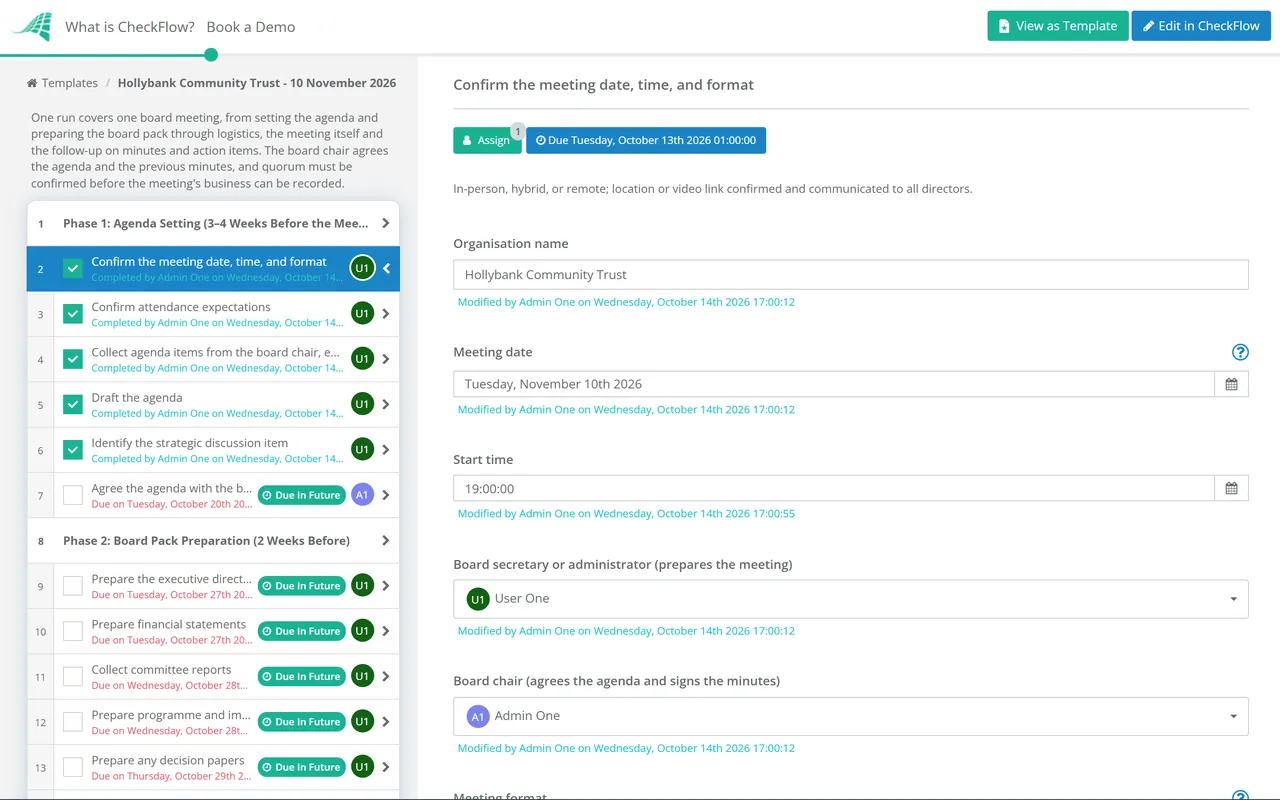
  • Confirm the meeting date, time, and format — in-person, hybrid, or remote; location or video link confirmed and communicated to all directors
  • Confirm attendance expectations — quorum check: how many directors are required for the meeting to be valid per the bylaws or constitution? Confirm quorum is achievable
  • Collect agenda items from the board chair, executive director, and committee chairs — items requiring board decision or discussion; deadline for submissions confirmed
  • Draft the agenda — with clear labels: Information (for noting), Discussion (input sought), or Decision (vote required); time allocated to each item
  • Identify the strategic discussion item — one or two substantive strategic topics for director deliberation; not operational updates
  • Agree the agenda with the board chair — before circulating to all directors
2 Weeks Before

Phase 2: Board Pack Preparation (2 Weeks Before)

The board pack should arrive at least one week before the meeting — ideally 10 days. Directors receiving papers the evening before cannot exercise meaningful oversight. Board packs sent too early lose relevance.

  • Prepare the executive director’s report — narrative summary of the period’s key developments, issues, and opportunities; written to inform and prompt discussion, not to impress
  • Prepare financial statements — P&L vs budget (current month and year-to-date), balance sheet or net assets position, cash flow and runway; with a brief narrative on significant variances
  • Collect committee reports — from audit/finance committee, fundraising committee, HR committee, or any other standing committees; brief, focused on items requiring board awareness or decision
  • Prepare programme and impact update — progress against the organisation’s strategic objectives and programme plan; focused on outcomes, not just activities
  • Prepare any decision papers — for items requiring a board vote; background, options, recommendation, and proposed resolution clearly stated
  • Compile the board pack — agenda, all reports, and supporting documents in a numbered, clearly labelled pack
  • Distribute the board pack — at least 7 days before the meeting; via secure email or board portal
Pre-Meeting

Phase 3: Pre-Meeting Logistics

  • Confirm director attendance — follow up with any director who has not confirmed; note if quorum is at risk and alert the board chair
  • Confirm any conflict of interest declarations — for agenda items; directors with a conflict should be aware of the relevant item in advance
  • Arrange logistics — venue setup, dial-in details, catering if applicable; technology test for hybrid meetings
  • Prepare the minute-taker — the company secretary, administrator, or designated minute-taker briefed on the agenda; what must be formally recorded for each item?
The Meeting

Phase 4: Conducting the Board Meeting

  • Confirm quorum at the start — before any business is transacted; note in the minutes
  • Record conflicts of interest — any director declaring a conflict noted in the minutes; conflicted directors recuse from the relevant vote
  • Approve the minutes of the previous meeting — as a true and accurate record; proposed and seconded; recorded
  • Work through the agenda — information items noted, discussion items debated, decision items formally voted upon and resolution recorded
  • Allow time for the strategic discussion — do not allow operational items to crowd out strategic deliberation
  • Record all resolutions precisely — the exact wording of any motion passed, who proposed, who seconded, and the vote outcome
  • Confirm action items — before close; who is doing what by when; reviewed with all directors
Post-Meeting

Phase 5: Post-Meeting Follow-Up

  • Circulate draft minutes — within 5–7 business days of the meeting; to all directors and the board chair for review
  • Confirm all action items are assigned — in the action log; named person, specific action, and due date
  • Track action items between meetings — progress reported at the next board meeting; overdue items escalated to the board chair
  • File the approved minutes — in the board records; minutes are legal documents and must be retained permanently
  • Circulate minutes to any director who was absent
  • Note items for the next agenda — from this meeting’s discussions and action log; feeds the next cycle

What Nonprofit Board Minutes Must Record — and Why

Minutes Element

Attendance and Quorum

Who was present, who sent apologies, and confirmation that quorum was achieved. Without quorum confirmation, any resolutions passed may be invalid.

Minutes Element

Conflicts of Interest Declared

Any director who declared a conflict and recused themselves from a discussion or vote. Required for good governance and, in many jurisdictions, legal protection of the organisation.

Minutes Element

Resolutions Passed

The exact wording of every resolution, the names of the proposer and seconder, and the vote outcome. Resolutions must be precise — vague minutes do not evidence board approval.

Minutes Element

Action Items

Who agreed to do what, by when. Minutes without action items from decisions are minutes that produce no accountability.

Why Run Board Meeting Preparation in CheckFlow?

1

Consistent board meeting preparation every quarter

Board meeting preparation quality should not depend on how much capacity the executive director has this month. CheckFlow’s recurring checklist generates the full board meeting preparation workflow automatically at the scheduled interval — pack preparation, report collection, logistics confirmation, and post-meeting follow-up — ensuring the same structured process runs for every meeting.


2

Action item tracking between meetings

The board resolution that produces an action item that is never completed or followed up is a resolution that undermines board confidence in the executive team. CheckFlow maintains the action log between board meetings, sends reminders to named action owners, and produces a status report for the next agenda.

3

A complete board governance record for audits and inspections

Charity regulators, auditors, and grant funders may request evidence of board governance — minutes, attendance records, conflict of interest declarations, and resolution logs. Every board meeting managed through CheckFlow produces a complete, dated governance record.

Board financial oversight requires accurate, timely financial reporting. CheckFlow’s Month-End Finance & Accounting Close Checklist covers the financial close process that produces the board’s financial pack. See the Month-End Close Checklist →

Annual report approval is one of the board’s key responsibilities. CheckFlow’s Nonprofit Annual Report Checklist covers the preparation process that the board reviews and approves. See the Annual Report Preparation Checklist →

Frequently Asked Questions

What should be included in a nonprofit board meeting pack?

+

A nonprofit board meeting pack should include: the agenda (with items clearly labelled as information, discussion, or decision), the draft minutes of the previous meeting (for approval), the executive director’s report (key developments and issues), financial statements (P&L vs budget, balance sheet, cash position with narrative), programme and impact update (outcomes against plan), committee reports where applicable, and decision papers for any items requiring a board vote (with background, options, recommendation, and proposed resolution wording). The pack should arrive at least 7 days before the meeting.

What is a quorum for a nonprofit board meeting?

+

A quorum is the minimum number of board members who must be present for a board meeting to transact business legally — typically defined in the organisation’s articles of incorporation, bylaws, or constitution. Common quorum requirements range from a simple majority of current board members to a specified fixed number. If quorum is not achieved, the meeting may proceed informally for discussion but cannot pass binding resolutions. Any resolutions passed without quorum are legally invalid. Quorum should be confirmed at the opening of every meeting and recorded in the minutes.

How long should nonprofit board meeting minutes be?

+

Board minutes should be accurate, clear, and concise — typically 2–5 pages for a standard board meeting. They are a legal record, not a verbatim transcript. They should record who attended, that quorum was confirmed, any conflicts of interest declared, the substance of decisions made (not extensive debate discussion), the precise wording of every resolution passed with proposer, seconder, and vote outcome, and all action items with named owners and deadlines. Minutes should be drafted within one week of the meeting while memories are fresh.

How often should a nonprofit board meet?

+

Most nonprofit and charity governance guidelines recommend a minimum of four board meetings per year (quarterly). Some larger or more complex organisations meet six times per year. Monthly meetings are common in smaller organisations where the board is more operationally involved, though governance best practice typically recommends that boards focus on strategy and oversight rather than operations, which can usually be managed effectively through quarterly meetings supplemented by between-meeting communication and committee work.

Is CheckFlow free for this template?

+

14-day free trial, no card required. The Business plan is $10 per user per month after the trial. Full details at checkflow.io/pricing.

Run Board Meetings That Exercise Genuine Governance — Every Time

Free trial — no credit card required.