
Volunteer Onboarding Checklist Template

Volunteers who feel well-prepared, genuinely welcomed, and meaningfully connected to the mission from their first day return — and eventually give. Volunteers who feel lost, unwelcome, or underutilised do not come back once.

Volunteers are the most valuable relationship a nonprofit has access to — and the most commonly undermanaged. Research from Fidelity Charitable found that 50% of volunteers say volunteering leads them to give more financial support to the causes they serve. Volunteers are twice as likely to donate as other prospects and their donations are on average ten times larger. The volunteer programme is not just operational capacity — it is one of the most cost-effective major donor pipelines in the sector. None of that potential is realised if the volunteer’s first experience is confusion about their role, a lack of training, no introduction to the mission and impact they are contributing to, and no follow-up after their first session. A structured volunteer onboarding process transforms the first volunteer experience into the foundation of a long-term relationship — with the organisation, with the cause, and eventually with the donor community. This free checklist gives volunteer coordinators, executive directors, and programme managers a structured framework for the full volunteer onboarding process.

Use This Template Free See Live Example
No Credit Card Required

Why Every Volunteer is a Future Donor — and How the Onboarding Process Builds That Path

The data on the relationship between volunteering and giving is consistent: volunteers give more, give larger, and give for longer than non-volunteer donors. A volunteer who spends time working alongside programme staff, meeting beneficiaries, and experiencing the organisation’s impact firsthand has a deeper connection to the mission than any direct mail donor — and that connection is the foundation of major gift commitment.

Building the volunteer-to-donor pathway begins at onboarding — not with a fundraising ask, but with a genuine investment in the volunteer’s connection to the mission. When volunteers understand the full impact of the work they are contributing to, feel genuinely valued and welcomed, and are treated as partners in the mission rather than operational resources, the transition from volunteer to donor to major donor is a natural progression — not a solicitation.

What the Volunteer Onboarding Checklist Covers

This checklist covers six phases of the volunteer onboarding cycle — from recruitment through to long-term relationship building. Phase 1 includes the safeguarding and background check obligations that are legal requirements for roles involving vulnerable populations.

Recruitment

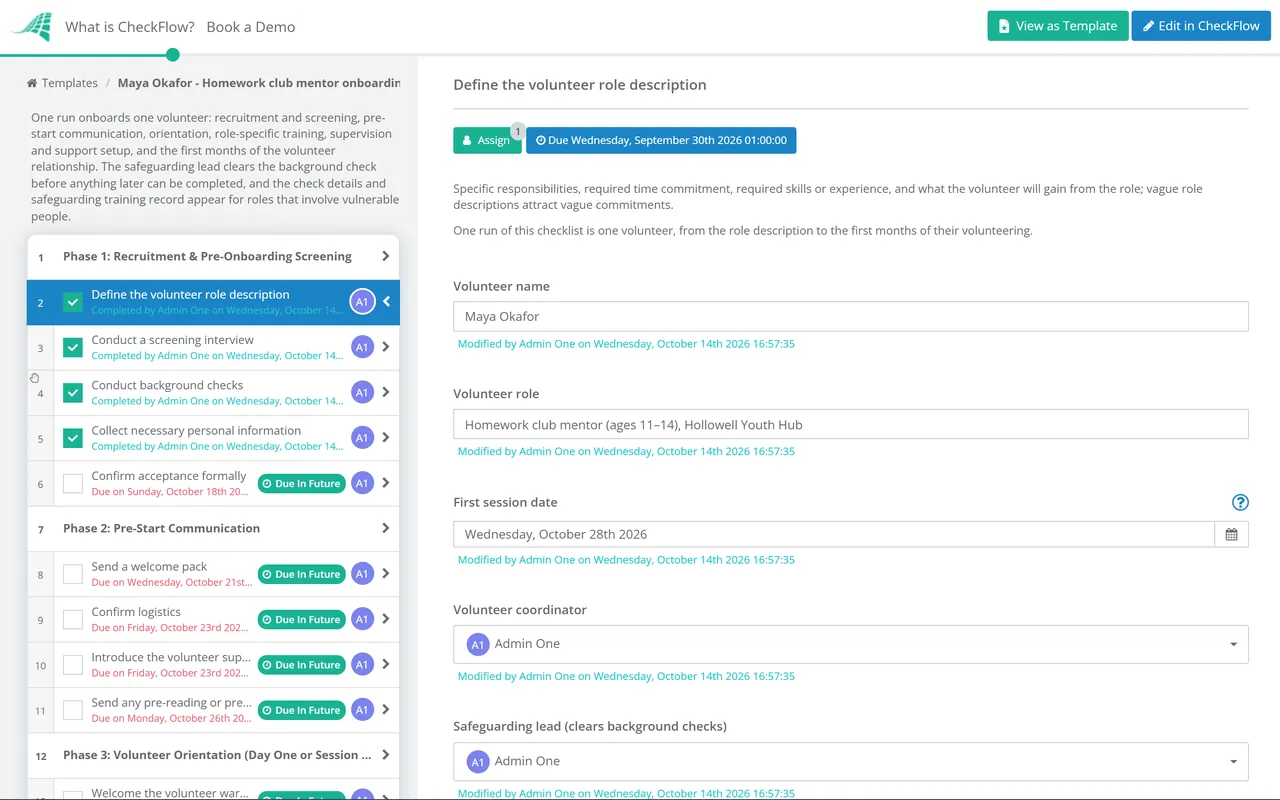
Phase 1: Recruitment & Pre-Onboarding Screening

For organisations working with vulnerable populations — children, vulnerable adults, or people in crisis — background checks and safeguarding screening are not optional process elements. They are legal obligations and the primary protection for the people the organisation serves.

  • Define the volunteer role description — specific responsibilities, required time commitment, required skills or experience, and what the volunteer will gain from the role; vague role descriptions attract vague commitments
  • Conduct a screening interview — for volunteer roles involving any significant responsibility or beneficiary contact; a conversation to assess suitability and confirm the volunteer’s motivation and availability
  • Conduct background checks — DBS check (UK) or equivalent background screening (US) for all roles involving vulnerable populations; required level of check confirmed for the specific role
  • Collect necessary personal information — name, emergency contact, relevant health or accessibility requirements, and signed privacy/GDPR consent for data processing
  • Confirm acceptance formally — welcome communication confirming start date, role, and what to expect; the volunteer should feel chosen, not processed
Pre-Start

Phase 2: Pre-Start Communication

  • Send a welcome pack — before the first session; information about the organisation’s mission and impact, role description, practical logistics, and who the volunteer will meet on their first day
  • Confirm logistics — address or virtual link, start time, dress code if applicable, parking or transport information
  • Introduce the volunteer supervisor — by email before the first session; the volunteer should know who to contact if they have questions
  • Send any pre-reading or pre-completion forms — volunteer agreement, confidentiality agreement, safeguarding policy acknowledgement; completed before or on the first day
Orientation

Phase 3: Volunteer Orientation (Day One or Session One)

The orientation exists to give the volunteer three things: understanding (of the mission, the work, and their role in it), connection (to the people they will work with and the beneficiaries they will serve), and confidence (that they know what they are doing and who to ask for help).

  • Welcome the volunteer warmly — named greeting from the volunteer coordinator or supervisor; their presence is expected and valued
  • Give the organisation tour — physical space or virtual equivalent; where things are, where to go, who is who
  • Introduce the team — programme staff, other volunteers; names and roles; not just a list but genuine introductions
  • Deliver the mission and impact session — not a corporate induction; a genuine account of why the organisation exists, who it serves, and the difference volunteers make; include a real impact story
  • Review the volunteer role — specific tasks, typical session structure, what good looks like; confirm the volunteer feels clear about what they are here to do
  • Cover key policies — health and safety, safeguarding, confidentiality, social media policy; brief, focused on what volunteers need to know, not a full policy reading
  • Confirm emergency procedures — fire evacuation, first aid location, incident reporting process
Training

Phase 4: Role-Specific Training

  • Deliver role-specific training — for the specific tasks the volunteer will be doing; hands-on where possible; not just verbal explanation
  • Mandatory training where required — safeguarding/child protection training for relevant roles; health and safety; food hygiene (for catering roles); documented completion
  • Provide written guidance — step-by-step instructions for key tasks; accessible when the supervisor is not available
  • Confirm the volunteer is confident — before they work independently; a supervised first session followed by observation in their second; not thrown in without support
Support Setup

Phase 5: Supervision & Ongoing Support Setup

  • Assign a named supervisor or buddy — a specific person the volunteer can approach with questions, concerns, or difficulties; not “anyone on the team”
  • Confirm the communication channel — how does the volunteer contact the organisation between sessions? Email, messaging platform, or phone?
  • Set the check-in schedule — a brief check-in conversation after the first, third, and sixth sessions; how is it going? What support do they need?
  • Confirm scheduling arrangements — how are sessions booked? What happens if the volunteer cannot attend? Who do they notify and how?
Relationship

Phase 6: Building the Long-Term Volunteer Relationship

  • Record the volunteer’s interests and motivations — in the volunteer database; what drew them to this cause? What skills are they contributing? What do they hope to get from the experience?
  • Recognise and thank volunteers regularly — at milestones (first session, tenth session, anniversary); verbally and through formal recognition; the volunteer who feels genuinely appreciated stays
  • Include volunteers in the organisation’s community — invite to events, send the annual report, share impact updates; treat them as mission partners, not operational resources
  • Build the donor connection naturally — not a solicitation; through deepening the connection to mission and impact; volunteers who feel fully connected to the organisation’s work give willingly

Volunteer Retention — the Five Factors That Determine Whether They Return

Factor 1

They felt genuinely welcome

A named greeting, an introduction to the team, and a genuine expression that their presence matters makes the difference between a volunteer who returns and one who does not.

Factor 2

They understood what they were doing

A volunteer who is unsure of their role, unclear on expectations, and uncertain who to ask for help is a volunteer who will find a reason not to return.

Factor 3

They felt their time was meaningful

Poor volunteer management (waiting around, unclear tasks, doing nothing useful) is the most common reason volunteers do not return. Useful, structured, impactful time is the most powerful retention driver.

Factor 4

They were thanked sincerely

A genuine, specific thank-you — for what the volunteer did and what difference it made — is a powerful relationship builder. Generic thank-you emails are not.

Factor 5

They were informed of their impact

Volunteers who know what happened as a result of the session they participated in feel connected to the mission. Volunteers who receive no follow-up feel like they disappeared after leaving the building.

Why Run Volunteer Onboarding in CheckFlow?

1

A consistent onboarding experience for every volunteer

Volunteer onboarding quality that depends on which staff member handles the welcome — thorough with one coordinator, patchy with another — produces inconsistent retention rates. CheckFlow runs the same structured onboarding sequence for every volunteer: welcome pack sent before arrival, orientation delivered on day one, role-specific training completed in session two, check-in scheduled at session three. Every volunteer receives the same quality of welcome.


2

Safeguarding and compliance tasks enforced as gated steps

The background check that was meant to happen before the first session but was skipped because the volunteer had already started is a safeguarding failure. CheckFlow makes the background check completion a required step before the first session scheduling task can be completed — ensuring compliance with safeguarding obligations for every volunteer role that requires it.

3

A volunteer database record that builds the donor relationship

The volunteer’s interests, motivations, skills, and session history — recorded through CheckFlow’s onboarding process — create the relationship intelligence that makes the transition from volunteer to donor feel like the natural next step of a genuine relationship, not a cold solicitation.

Volunteer onboarding shares many elements with employee onboarding — the same welcome, orientation, and role-specific training principles apply. CheckFlow’s Employee Onboarding Checklist covers the parallel process for paid staff. See the Employee Onboarding Checklist →

Fundraising events are a major source of volunteer recruitment and the primary context for new volunteer first experiences. CheckFlow’s Fundraising Event Planning Checklist covers the event where many volunteers first connect with the organisation. See the Fundraising Event Planning Checklist →

Frequently Asked Questions

What should a volunteer onboarding checklist include?

+

A volunteer onboarding checklist covers six phases: recruitment and screening (role description, screening interview, background checks where required, and personal information collection), pre-start communication (welcome pack, logistics confirmation, supervisor introduction, and pre-completion forms), orientation (warm welcome, organisation tour, team introductions, mission and impact session, role review, and key policies), role-specific training (hands-on training, mandatory certifications, written guidance, and supervised first session), supervision and support setup (named supervisor, communication channels, check-in schedule), and engagement and relationship building (interest recording, regular recognition, inclusion in the organisation community, and the natural development of the volunteer-donor relationship).

What background checks are required for volunteers?

+

Background check requirements vary by country, role type, and the populations served. In the UK, volunteers in roles involving regulated activity with children or vulnerable adults require an Enhanced DBS (Disclosure and Barring Service) check — a legal requirement under the Safeguarding Vulnerable Groups Act 2006. Other roles may require a Basic or Standard DBS check. In the US, requirements vary by state and sector; many states require background checks for volunteers working with minors, and organisations receiving certain federal funding may have additional requirements. The appropriate level of check should be determined by the role’s responsibilities, the organisation’s legal obligations, and the populations served.

How can nonprofits improve volunteer retention?

+

The five most impactful volunteer retention practices are: making every volunteer’s first experience genuinely welcoming (named greeting, team introductions, clear purpose), ensuring volunteer time is meaningful and well-used (not waiting around or doing unclear tasks), providing specific, sincere thanks at every session and at milestones, keeping volunteers informed of the impact their contributions make, and connecting them to the broader community of the organisation through events, communications, and the annual report. Volunteers who feel genuinely appreciated and meaningfully connected to the mission are retained at dramatically higher rates than those managed primarily as an operational resource.

What is the volunteer-to-donor pathway and how does it work?

+

The volunteer-to-donor pathway is the natural progression of a deepening relationship between a volunteer and the organisation — from giving time, to giving money, to giving significantly. Research from Fidelity Charitable shows 50% of volunteers say their volunteering experience leads them to give more financially; volunteers donate on average ten times more than non-volunteer donors. The pathway is built through excellent stewardship (not solicitation) — treating volunteers as mission partners, keeping them informed of impact, involving them in the organisation’s community, and deepening their understanding of and connection to the cause. The ask, when it comes, should feel like a natural invitation rather than a commercial transaction.

Is CheckFlow free for this template?

+

14-day free trial, no card required. The Business plan is $10 per user per month after the trial. Full details at checkflow.io/pricing.

Welcome Every Volunteer So Well That They Stay — and Eventually Give

Free trial — no credit card required.