
Annual Report Preparation Checklist for Nonprofits & Charities
Your annual report is your most powerful accountability and stewardship document — the one your donors read to decide if they will give again, your funders read to decide if they will grant again, and your community reads to understand what their trust has produced.
An annual report that is assembled in the two weeks before its deadline is an annual report that will omit your most powerful impact story (because the programme manager never sent it), present unaudited financials (because the audit is not quite finished), and miss the donor who gave the largest gift of the year (because the list was not reconciled). The best nonprofit annual reports are built year-round: impact stories captured as they happen, photos taken at events, financial data maintained in real time, and beneficiary testimonials collected as programmes deliver results. The production process at year-end is then an assembly exercise rather than a scavenger hunt. A structured annual report preparation checklist ensures the data collection happens throughout the year, the content is strategically planned with the audience in mind, every required element is covered, and the finished report reaches every stakeholder who needs to see it — on time. This free checklist gives executive directors, development directors, and communications staff a structured framework for the full nonprofit annual report preparation cycle.
The Four Audiences Your Annual Report Must Serve Simultaneously
Audience 1
Current Donors
What they want:
Evidence that their gift made a difference. Specific impact stories, beneficiary outcomes, and financial transparency that shows their money was used as intended.
What the report must do:
Thank them by name, show their gift’s impact with real stories, and give them a reason to give again.
Audience 2
Grantmakers & Foundations
What they want:
Financial accountability, programme outcomes against stated objectives, and evidence of organisational competence and sustainability.
What the report must do:
Present credible financials (audited where possible), quantified programme outcomes, and the leadership and governance that demonstrates a trustworthy grantee.
Audience 3
Prospective Supporters
What they want:
A compelling reason to engage — evidence that the organisation is doing important work effectively and that their support would make a meaningful difference.
What the report must do:
Tell the problem, tell your solution, show the results, and make it easy to take the next step.
Audience 4
Regulators & Compliance
What they need:
For US nonprofits — accurate financial data consistent with Form 990. For UK charities — financial accounts consistent with Charity Commission submission. For any regulated sector — confirmation of legal compliance.
What the report must do:
Present accurate, verifiable financial information consistent with regulatory filings.
What the Nonprofit Annual Report Preparation Checklist Covers
This checklist covers seven phases of the annual report cycle — beginning with year-round data collection and ending with distribution to every stakeholder who needs to see it. The most important phase is the first: data and story collection that happens before production begins.
Ongoing
Phase 1: Year-Round Data & Story Collection
The annual report assembly process cannot produce what the year-round data collection process did not capture. Every impact story, every programme outcome, every donor milestone not captured in the moment is lost or diluted by the time assembly begins.
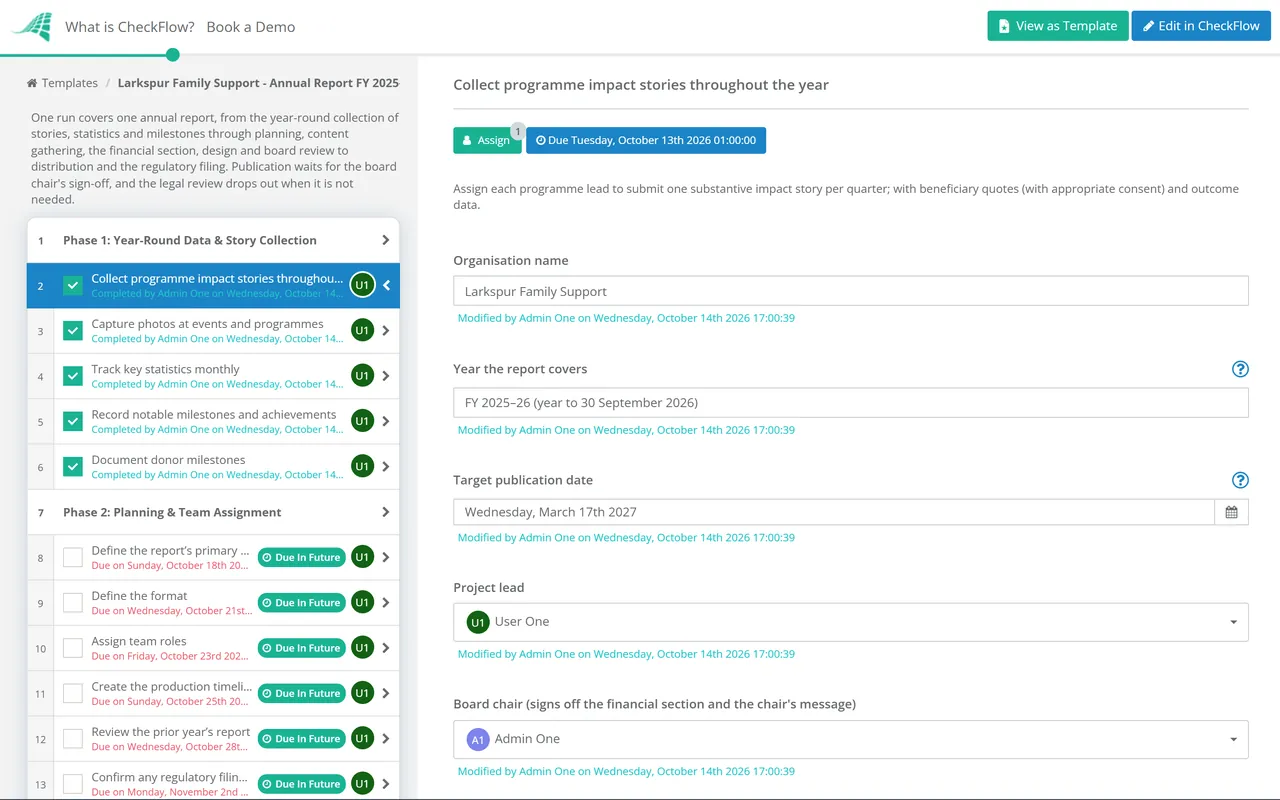
Collect programme impact stories throughout the year — assign each programme lead to submit one substantive impact story per quarter; with beneficiary quotes (with appropriate consent) and outcome data
Capture photos at events and programmes — with signed image consent forms where people are identifiable; stored in a central asset library
Track key statistics monthly — beneficiaries served, programmes delivered, volunteer hours, funds raised, partner organisations; these populate the infographics and impact section
Record notable milestones and achievements — any awards, programme launches, significant partnerships, policy achievements; maintained in a running document throughout the year
Document donor milestones — major gifts, first-time donors reaching multi-year status, legacy gift commitments; feeds the donor recognition and stewardship sections
4–6 Months Before
Phase 2: Planning & Team Assignment
Define the report’s primary purpose and audience — stewardship for existing donors, credibility for grantmakers, or public-facing awareness? This determines tone, format, and emphasis
Define the format — print, digital PDF, interactive web report, or a short-form summary; production budget confirmed
Assign team roles — project lead, financial section owner (finance/treasurer), programme narrative owner, donor recognition owner (development), design lead; all named with deadlines
Create the production timeline — working backwards from the desired publication date; content deadline, design deadline, review deadline, print/publish deadline
Review the prior year’s report — what feedback was received? What sections resonated? What should change?
Confirm any regulatory filing dates — Form 990 deadline (US) or Charity Commission accounts deadline (UK) to ensure the annual report is consistent with regulatory submissions
2–3 Months Before
Phase 3: Content Gathering
Commission the executive director and board chair messages — brief both on the year’s key themes and two or three key messages the report must convey
Compile programme highlights and impact narratives — from the quarterly stories collected throughout the year; select the most powerful two or three for featured stories
Compile key statistics and impact metrics — all headline numbers confirmed and attributed to source
Prepare the financial summary — with the finance team or treasurer; revenue breakdown, expense breakdown, and net position; pie charts or visual formats to make accessible to non-financial readers
Confirm audit status — for larger organisations; include audited statements or note the audit timeline; the annual report and Form 990 should be consistent
Compile the donor and volunteer recognition list — from the donor database; segmented by giving level where appropriate; check accuracy of every name before finalising
Financial Section
Phase 4: Financial Section Preparation
Prepare the revenue summary — total revenue by source (individual donations, grants, earned income, events, government); year-on-year comparison where appropriate
Prepare the expense summary — programme expenses vs administrative vs fundraising; the programme expense ratio (what percentage goes to the mission) is a key donor and funder transparency metric
Prepare the balance sheet summary — total assets, liabilities, and net assets/fund balance; accessible language, not accounting jargon
Confirm consistency with Form 990 (US) or statutory accounts (UK) — all numbers in the annual report financial section must match regulatory filings exactly
Include an explanatory narrative — what drove any significant changes year-on-year? Plain English explanation alongside the numbers
Design
Phase 5: Design & Production
Brief the designer — with brand guidelines, content, photos, statistics, and format; define the key visual elements (infographics, pull quotes, impact statistics)
Review the first draft design — does the layout tell the story in the right order? Is the financial section visually accessible? Is the impact section compelling?
Review and proofread all copy — accuracy of statistics, spelling of donor names, consistency of figures; a misspelled donor name is a stewardship failure
Confirm all image consent — every identifiable person in every photo has signed consent; particularly important for beneficiaries
Board & Legal
Phase 6: Board & Legal Review
Circulate the near-final draft to the board — for review and approval; board members should review financial accuracy and confirm the report fairly represents the organisation’s year
Obtain board chair sign-off — on the financial section and the board chair’s message
Legal review if required — any legal caveats, regulatory language, or sensitive statements reviewed by legal counsel
Final proofreading — by someone who has not been involved in production; fresh eyes catch what the production team no longer see
Distribution
Phase 7: Distribution & Promotion
Publish the annual report on the website — prominently accessible; PDF download; SEO-indexed
Email to all donors and supporters — with a personal note from the executive director; the annual report email is a stewardship touchpoint, not just a file attachment
Send printed copies to major donors — for significant supporters; a physical report with a personal note is a meaningful stewardship gesture
Share on social media and newsletter — key impact statistics and stories as social content; link to full report
Submit to grantmakers and funders — where required by grant reporting obligations; proactively to foundations the organisation is cultivating
File with regulators — Form 990 (US) or Charity Commission annual return (UK) filed by the required deadline; consistent with annual report financials
The Financial Metric Donors and Funders Look For First
The programme expense ratio — the percentage of total expenses spent on programmes and services (as opposed to administration or fundraising) — is the first financial metric most donors and institutional funders examine. A ratio above 75% is generally considered strong; above 80% is excellent. A ratio below 65% raises questions that require explanation.
The ratio is not the only meaningful financial metric — unrestricted reserves, year-on-year trend, and fundraising efficiency all matter. And a very high programme ratio can itself signal under-investment in the organisational infrastructure needed to sustain programmes. But it is the ratio that appears on charity watchdog sites, that funders calculate from your Form 990, and that donors cite when explaining why they trust or do not trust an organisation. Present it clearly, explain it honestly, and contextualise it in the financial narrative.
Why Run Annual Report Preparation in CheckFlow?
1
Year-round data collection built into the process
The annual report that is assembled under pressure at year-end produces the annual report that misses the most powerful stories. CheckFlow’s recurring checklist feature schedules the quarterly impact story and photo collection tasks automatically — assigning them to programme leads throughout the year so the raw material for a compelling report exists before the production process begins.

2
Multi-team production with named owners and deadlines
Annual report production involves the executive director, finance team, programme leads, development team, designer, and board — all working towards the same deadline with different deliverables. CheckFlow assigns every content section, every financial review task, and every approval step to a named person with a deadline and a reminder — preventing the missed deadline that pushes the publication date and delays the stewardship cycle.
3
A documented production history for governance and improvement
The board chair who approved the report, the date of approval, the compliance filing dates, and the distribution record are governance documentation that supports the organisation’s accountability obligations. Every task in CheckFlow is timestamped and attributed — the production record is maintained automatically.
The financial section of the annual report draws directly from the finance team’s year-end accounts. CheckFlow’s Month-End Finance & Accounting Close Checklist covers the financial close process that produces the numbers the annual report presents. See the Month-End Close Checklist →
Annual report preparation is the culmination of the year. Board oversight of the annual report is part of nonprofit board governance — covered in CheckFlow’s Board Meeting Preparation for Nonprofits. See the Board Meeting Preparation Checklist →
A nonprofit annual report typically includes: a cover page with the organisation’s name, year, and branding; a mission statement and organisational overview; messages from the executive director and board chair; a programme highlights section with impact stories, beneficiary outcomes, and key statistics; a financial summary with revenue breakdown, expense breakdown, programme expense ratio, and balance sheet summary; donor and volunteer recognition; a forward-looking section on goals and plans; and a call to action. The financial section should be consistent with regulatory filings (Form 990 in the US; Charity Commission accounts in the UK).
Are nonprofits legally required to produce an annual report?
+
In the US, public-facing annual reports are not legally required, but Form 990 filing with the IRS is required for most 501(c)(3) organisations. Form 990 is publicly available and contains detailed financial information, governance practices, and programme descriptions. Many nonprofits publish an annual report to accompany or summarise their Form 990 in a more accessible format. In the UK, registered charities with income above £10,000 are required to file annual accounts and a Trustees’ Annual Report with the Charity Commission, which is publicly available. Many organisations also produce a separate stakeholder-facing annual report as a communications and stewardship document.
What is the programme expense ratio and why does it matter?
+
The programme expense ratio (also called the programme efficiency ratio or mission ratio) is the percentage of total expenses spent directly on programmes and services, as opposed to administration or fundraising. A ratio above 75% is generally considered acceptable by most charity watchdogs; above 80% is considered strong. Donors and funders use this ratio as a proxy for whether the organisation uses donations efficiently — it is one of the first figures charity evaluators like Charity Navigator and GiveWell examine. It should be presented clearly in the annual report financial section with a brief explanatory narrative.
When should annual report production begin?
+
Production should begin 4–6 months before the intended publication date — which is typically 3–6 months after the fiscal year end. However, the data and story collection that feeds the report should begin at the start of the fiscal year, with programme impact stories collected quarterly and impact statistics tracked monthly. Organisations that begin production without year-round data collection consistently produce less compelling, less accurate annual reports than those that capture impact as it occurs throughout the year.
Is CheckFlow free for this template?
+
14-day free trial, no card required. The Business plan is $10 per user per month after the trial. Full details at checkflow.io/pricing.
Produce an Annual Report That Earns the Next Year of Support
Free trial — no credit card required.
Do you like cookies? 🍪 We use cookies to ensure you get the best experience on our website. Learn more