
This template
Use for: scheduled quarterly or monthly meetings and special meetings with real debate.
Record: pack, declarations, minutes, actions.
Output: decisions taken with the board’s full attention.
Last reviewed: October 2026
No Credit Card Required
Printed from checkflow.io/templates/investor-relations/board-meeting-preparation-checklist
This free checklist runs one board meeting cycle for a company board, from the calendar date to filed minutes and closed actions. It is for company secretaries, general counsel, CFOs, founders and chiefs of staff at startups, scale-ups, private companies and listed companies. It covers the agenda, paper requests, building and circulating the board pack, conflict declarations, quorum, the meeting, minutes, the action log, resolutions and filings. Two answers at the start, the governing law and whether the company is listed, decide which steps appear: listed companies get the inside information and disclosure phase, and decisions that need a filing open the filings phase.
A board acts as a body. In the UK, directors of a company using the model articles decide by majority at a quorate meeting or unanimously without one. In Delaware, the board acts by a majority of directors present at a meeting with a quorum, or by unanimous written consent under section 141(f) of the General Corporation Law. Either way, the record has to show who decided what, on what information, and whether anyone voting had an interest.
Investors, lenders and auditors read that record, and in a dispute so do courts. A good preparation process produces it as a by-product: the pack shows what directors were told, the declarations show who was conflicted, and the minutes show what they weighed.
Use for: scheduled quarterly or monthly meetings and special meetings with real debate.
Record: pack, declarations, minutes, actions.
Output: decisions taken with the board’s full attention.
Use for: option grants, bank mandates, approving a filing.
Needs: every eligible director to agree; UK model articles also need enough of them to form a quorum.
Record: the signed resolution, kept with the minutes.
Different because: charity law, trustee duties and the regulator shape the agenda.
Use: the nonprofit board meeting checklist.
Five phases run on every meeting. Two appear only when needed: inside information and disclosure for listed companies, and filings for decisions that must be registered.
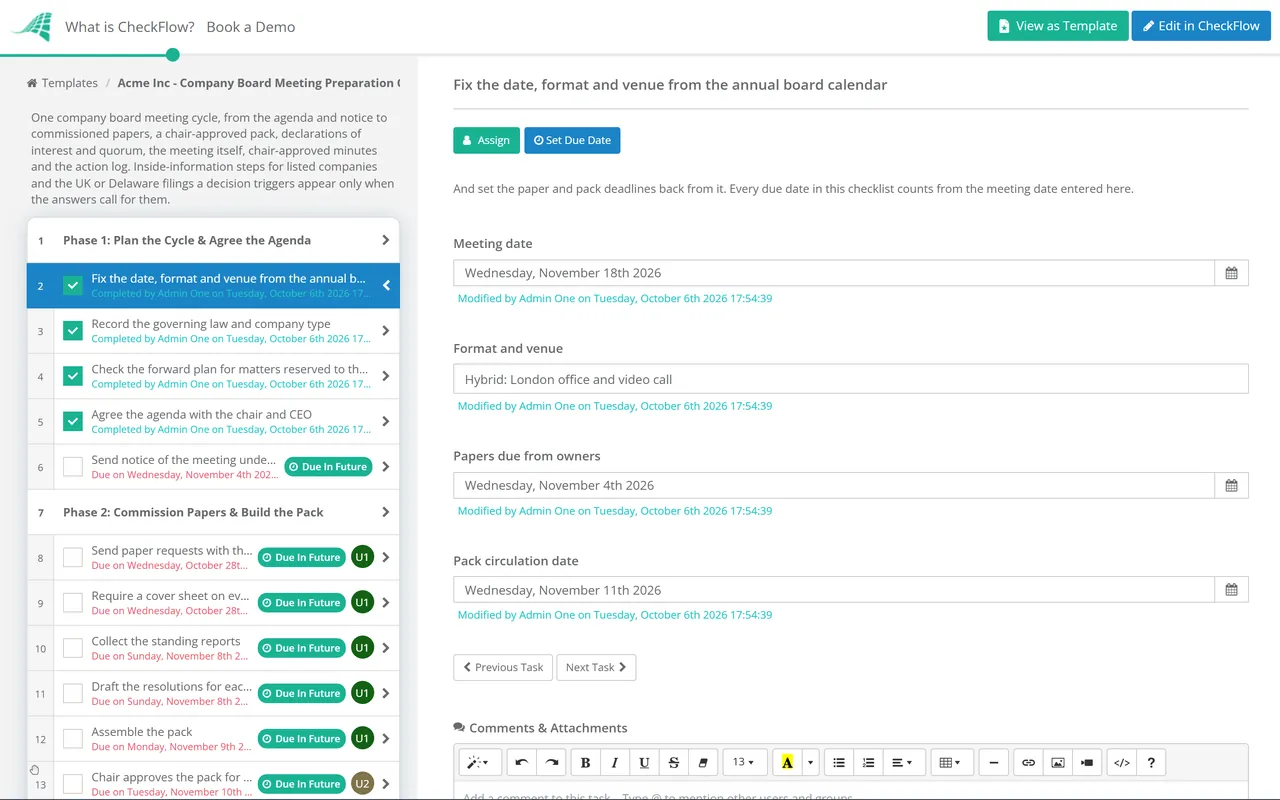
Assigned to the company secretary or whoever runs the board. Due dates are offsets back from the meeting date.
Paper owners are assigned their own tasks. The pack approval is assigned to the chair, and the checklist halts until it is answered.
Shown only when the company type is Listed. Owned by the company secretary with the disclosure committee or general counsel.
The chair runs the meeting; the secretary records it.
The chair’s review of the draft minutes is an approval task.
Shown only when the board took a decision that must be filed or entered in a register. Due dates are offsets from the meeting date.
Most of a board meeting’s mechanics, such as notice, quorum, who chairs and how conflicts are handled, come from the company’s own articles or bylaws. The statutes set the floor. Check your constitution first; the table shows the defaults.
| Requirement | UK: Companies Act 2006 | US: Delaware DGCL | Phase |
|---|---|---|---|
| How the board decides | Majority at a meeting or unanimous decision, model articles 7–8 | Majority of directors present at a quorate meeting, s.141(b); unanimous written consent, s.141(f) | 5, 6 |
| Calling a meeting | Any director may call one, model article 9 | Set by the bylaws | 1 |
| Quorum | Set by the articles; model articles default of two, article 11 | Majority of the whole board unless the charter or bylaws say otherwise, never below one-third, s.141(b) | 3, 5 |
| Remote attendance | Model article 10 | s.141(i) | 5 |
| Directors’ duties | General duties, ss.171–177, including s.172 | Fiduciary duties of care and loyalty, from case law | 5 |
| Conflicts of interest | s.175 authorisation; s.177 proposed transactions; s.182 existing transactions; model article 14 | s.144 safe harbor, amended March 2025 | 3, 5 |
| Minutes | Record all proceedings and keep 10 years, s.248; signed minutes are evidence, s.249 | An officer records proceedings, s.142(a); minutes and board materials are books and records, s.220 | 6 |
| Filings after decisions | ss.30, 167, 555, 859A | Only where the action requires one, such as a charter amendment, s.242 | 7 |
| Listed company information | UK Corporate Governance Code 2024: the chair ensures directors get accurate, timely and clear information; UK MAR | NYSE 303A.03 executive sessions; SEC Form 8-K | 2, 4 |
Recent changes make the record matter more. Delaware’s Senate Bill 21, signed in March 2025, rewrote the section 144 safe harbor for conflicted transactions and defined the books and records a stockholder can demand under section 220, naming board minutes and the materials given to the board. The Delaware Supreme Court upheld the safe harbor amendments in Rutledge v. Clearway Energy Group in February 2026. In practice, the minutes and pack are now the main evidence a stockholder sees, so they should show the disclosure and the disinterested approval the safe harbor depends on.
In the UK, identity verification at Companies House became a legal requirement on 18 November 2025: new directors must be verified to be appointed, and existing directors confirm their verification with the company’s next confirmation statement during a 12-month transition. Companies reporting against the 2024 UK Corporate Governance Code must make the new Provision 29 declaration on material controls for periods starting on or after 1 January 2026, which adds a board review to the annual calendar.
Set the meeting date and the paper requests, pack circulation and minute deadlines follow as due-date offsets. A recurring schedule starts the next quarter’s cycle automatically, so nobody has to remember to.
Each director or executive who owes a paper gets a task with the template attached and a due date. The Tasks grid shows which papers are late before the pack is due, not after.
The chair’s pack and minutes approvals, the circulation date and each declaration of interest are timestamped in the activity trail, which exports for auditors, investors or counsel.
CheckFlow is not a board portal and does not host the board pack, collect e-signatures or replace your minute book. It runs the preparation workflow around them: who owes which paper, when the pack goes out, who declared what and which actions are still open. Conditional logic adds the listed company and filings phases only when they apply, and the professional services and asset management pages show company secretarial teams running other governance work the same way.
Board meetings rarely stand alone. The finance team’s Monthly Management Reporting Pack Checklist feeds the board pack, the Investor Communication & Reporting Framework Checklist covers what goes to shareholders afterwards, and before a fundraise the Investor Data Room Checklist collects the minutes and resolutions investors will ask to see.

Monthly Management Reporting Pack Checklist

Investor Communication & Reporting Framework Checklist
Strategic Investor Relations & Stewardship Checklist
Board Member Onboarding Checklist
AGM Planning Checklist
Describe the process in a sentence and the AI checklist generator drafts the phases and tasks for you.
Neither UK company law nor Delaware law sets a period for board papers; the articles, bylaws or the board’s own terms of reference usually do. Five to seven days before the meeting is common practice, which gives directors a weekend to read. Papers sent the night before undermine the record that directors were properly informed, so log any late paper and whether the chair agreed to take it.
The agenda, draft minutes of the last meeting, the action log, the CEO report, management accounts with cash and KPIs, risk and legal updates, and a paper for each decision with a cover sheet saying what the board is asked to do. Draft resolutions for each decision save time in the meeting and make the minutes easier to write.
In the UK, at least 10 years from the date of the meeting under section 248 of the Companies Act 2006, and failing to keep them is an offence by every officer in default. Delaware sets no period, but section 142 requires an officer to record proceedings and board minutes are among the records stockholders can inspect under section 220. Most companies keep minutes for the life of the company.
Usually, yes. Delaware boards can act by unanimous written consent, given in writing or by electronic transmission, under section 141(f) unless the charter or bylaws prevent it. UK companies on the model articles can take a unanimous decision when every eligible director indicates agreement, provided they would form a quorum at a meeting. Keep the signed resolution or consent with the minutes.
Ask for declarations before the pack goes out and again at the start of the meeting. In the UK, a director must declare an interest in a proposed transaction before the company enters into it under section 177, and directors of a private company can authorise other conflicts under section 175 unless the articles prevent it. In Delaware, full disclosure and approval by disinterested directors is what brings a conflicted transaction within the section 144 safe harbor. Minute who declared, who left the room and who voted.
14-day free trial, no card required. The Business plan is $10 per user per month after the trial. Full details at checkflow.io/pricing.
14-day free trial, no credit cardFull refund in your first 30 daysUS hosting, EU on request