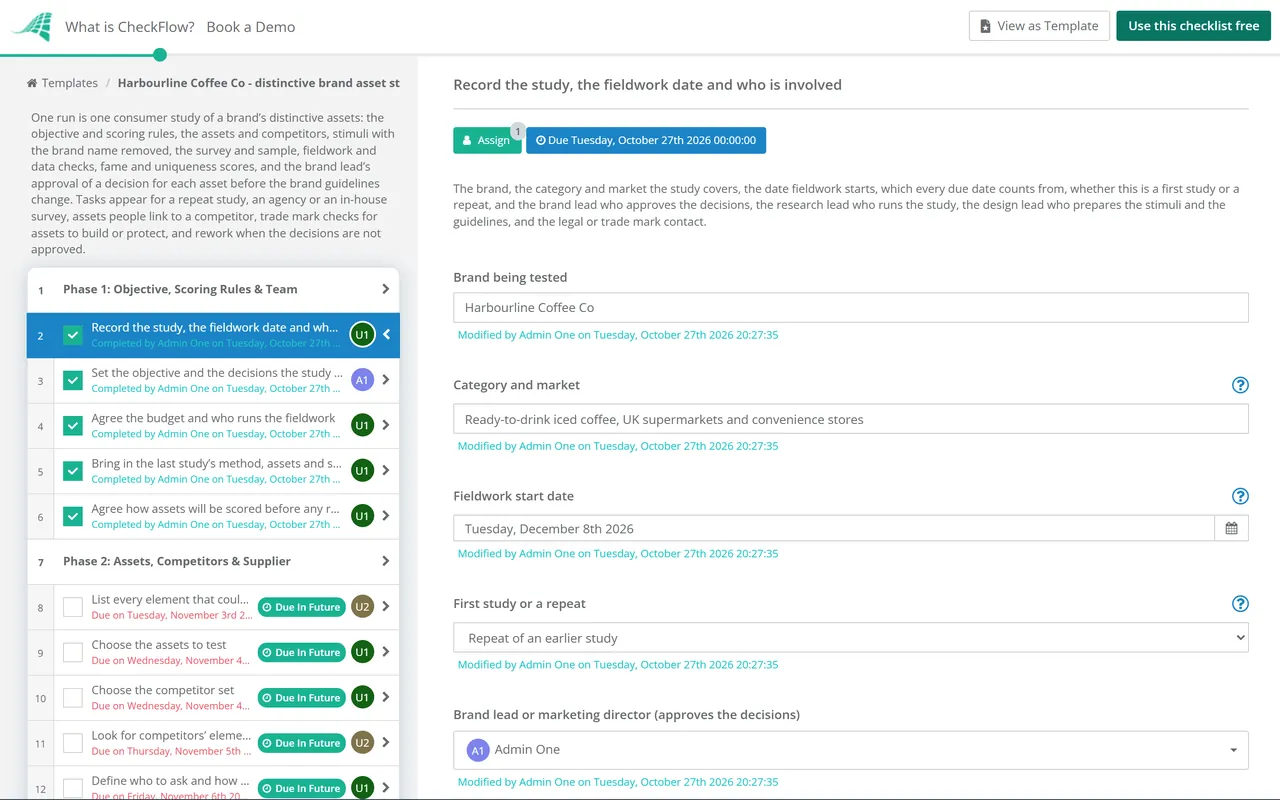
Brand Asset Testing Checklist Template

A brand can have a logo, a colour, a character and a tagline and still not know which of them people link to it without the name. This checklist tests each asset with the brand name taken out, scores it, and has the brand lead approve what to keep, build, protect or drop before the brand guidelines change.

Last reviewed: October 2026

Printed from checkflow.io/templates/marketing/brand-asset-testing-checklist

This free brand asset testing checklist is for brand managers, marketing directors and insight teams running a brand asset assessment: a consumer study of the brand’s distinctive assets, such as its logo, colours, shapes, characters, sounds, taglines and packaging. One run is one study. It sets the objective and agrees how assets will be scored before any results come in, chooses the assets, the competitor set, the sample and the research supplier or panel, prepares each asset with the brand name removed, and writes a survey that asks category buyers whether they recognise each asset and which brand it makes them think of. It fields the survey, removes poor-quality responses, and scores each asset’s fame and uniqueness. Each asset is placed on the Ehrenberg-Bass Institute’s Distinctive Asset Grid and given a proposed decision: use and protect, invest, change, test again or drop. The brand lead approves the decisions before the brand guidelines change. Tasks appear for a repeat study, an agency or an in-house survey, assets people link to a competitor, and trade mark checks for assets to build or protect.

Brand Asset Testing Is the Consumer Research Step, Not Asset Management

Brand asset testing asks consumers, not the brand team, which elements signal the brand. Ask the team and you learn what the team believes; ask category buyers, with the brand name taken out, and you learn what they link to the brand from memory. This checklist is that consumer research step: one study, scored the same way each time, with the decisions approved before anything changes.

It is not brand asset management. The Brand Asset Management Checklist organises and governs the asset files: its first phase is an audit and inventory of what exists, then storage, permissions and keeping the guidelines current. This checklist takes the assets from that library and finds out which of them work. The Brand Development Checklist creates a brand in the first place, and when the results lead to a new name or identity, the Rebrand Launch Checklist rolls it out.

This checklist

Testing the assets with consumers

Asks: which of our assets do category buyers link to us without the name, and which point to a competitor?

When: once per study, before a refresh, a new campaign or a change to the guidelines, and again to track progress.

Output: fame and uniqueness scores, an asset grid and an approved decision for each asset.
Keeping the files in order

Managing the brand assets

Asks: what assets do we have, where are they, who may use them and which version is current?

When: continuously, in the Brand Asset Management Checklist.

Output: an asset inventory, an organised library, approval workflows and current guidelines.

When the brand changes

Launching a new brand

Asks: where does the old brand appear, and is everything ready before the new one goes public?

When: once per rebrand, in the Rebrand Launch Checklist.

Output: a touchpoint inventory, an approved launch and the old brand retired.

What the Brand Asset Testing Checklist Covers

Eight phases take one study from the objective to the updated brand guidelines. Preparation counts back in working days from the date fieldwork starts, and the analysis and decisions count forward from it. Tasks appear for a repeat study, an agency or an in-house survey, assets people link to a competitor, and trade mark checks for assets to build or protect. The brand lead approves the decision for each asset before the guidelines change.

  1. Phase 1

    Phase 1: Objective, Scoring Rules & Team

    5 tasks

    Answer the first task before anything else: the brand, the market, the day fieldwork starts and the people involved. Every due date counts in working days from the fieldwork start date: back from it for the preparation, and forward from it for the analysis and the decisions. Start the checklist about six weeks before fieldwork. A repeat study adds a task to bring in the last one, and the choice of an agency or an in-house survey adds that route’s tasks.

    • Record the study, the fieldwork date and who is involved — the brand, the category and market the study covers, the date fieldwork starts, which every due date counts from, whether this is a first study or a repeat, and the brand lead who approves the decisions, the research lead who runs the study, the design lead who prepares the stimuli and the guidelines, and the legal or trade mark contact
    • Set the objective and the decisions the study will inform — why the study is being run now, such as a pack or logo refresh, a new campaign or a review of which assets to use, and the decisions it must inform: which assets to keep using, which to build, which to protect and which to drop
    • Agree the budget and who runs the fieldwork — the budget for sample, fieldwork and analysis, and whether the team runs the survey itself on an online panel or a research agency runs the study; an agency adds tasks to brief it and approve its survey, and an in-house survey adds tasks to build it and order the sample
    • Bring in the last study’s method, assets and scores — shown for a repeat study: the last report, questionnaire, stimuli, sample definition, competitor set and scores, so this study asks the same questions of the same kind of people and the results can be compared; change the method only on purpose, and record any change
    • Agree how assets will be scored before any results come in — this template’s two measures: fame, the share of all respondents who name your brand when shown the asset alone, and uniqueness, the share of respondents naming any brand who name yours rather than a competitor; agree the cut-offs for high and low on each now, before anyone sees the data, and record them
  2. Phase 2

    Phase 2: Assets, Competitors & Supplier

    7 tasks

    Decide what to test, against whom and with whom. List every element that might signal the brand, including ones used in the past, then choose the assets for this study, the competitors whose names respondents could give instead of yours and the people to ask, and choose the agency or panel that can reach them. An agency is briefed now, so it can help with the stimuli.

    • List every element that could signal the brand — logo and symbol, colours, shapes, pack design, characters and mascots, sounds and jingles, taglines, fonts and any celebrity or spokesperson, with where each is used today and since when; include elements retired in the past that could be brought back
    • Choose the assets to test — the elements from the list that this study will test, kept to a number the survey can show without tiring respondents, including any new element being considered, and why each element left out was left out
    • Choose the competitor set — the brands category buyers choose between, which go into the answer list so respondents can name a competitor instead of your brand, including any brand known to use a similar colour, shape or style
    • Look for competitors’ elements that resemble yours — the colours, shapes, characters, sounds and taglines competitors use in the category, so you know in advance which of your assets may be confused with theirs; keep examples for the stimulus check and for the legal contact
    • Define who to ask and how many — category buyers in the market, not only your own customers, so the results show how each asset works on people who buy other brands too; the age range, regions and quotas, and the number of completed responses needed in total and in any group you will report on its own
    • Choose the research supplier or panel — the agency, or the online panel provider for an in-house survey: its experience of brand research, whether it can reach the people defined in the last task, the price, the timings, the research code it works to and how it will keep unreleased assets confidential; choosing now leaves an agency time to help with the stimuli and the survey
    • Brief the agency and agree what it delivers — shown when an agency runs the study: the objective, assets, competitor set, sample, scoring rules and dates, and who prepares the stimuli, the agency or your design team, with the deliverables agreed in writing: the questionnaire for your approval, the cleaned data file, the coded open answers, the scores for each asset and the report
  3. Phase 3

    Phase 3: Stimuli Without the Brand Name

    4 tasks

    Each asset is shown on its own, with the brand name and every other clue taken out, so the survey measures what people link to the asset itself. Prepare every stimulus the same way, so none stands out because of how it is shown.

    • Gather the master file for each asset — the current approved version of each asset from the asset library, in the format the survey needs: image files for logos, colours, shapes, characters and packs, audio for sounds and jingles, and the exact wording of taglines
    • Remove the brand name and other clues from each asset — the brand name, product names, web addresses, other logos and anything else that names the brand taken out: a colour shown as a plain swatch or on a neutral shape, a pack with the name removed, a sound without the voiceover and a tagline with the brand name taken out of the line
    • Have someone outside the team check no stimulus gives the brand away — a colleague who does not work on the brand looks at and listens to each stimulus and says whether anything other than the asset itself, such as a fragment of text, a product photo or a familiar setting, points to the brand; fix any that do
    • Prepare the stimuli for screens and speakers — every stimulus at the same size, quality and background, checked on a phone and a computer, with sounds cut to the same length and played at the same volume
  4. Phase 4

    Phase 4: Survey & Sample

    8 tasks

    Write the questions and get the survey ready. Each asset gets the same questions: has the respondent seen it before, and which brand, if any, it makes them think of. An agency study adds a task to approve its survey, and an in-house survey adds tasks to build it and order the sample.

    • Write the screener and the quotas — the questions that decide who takes part, age first, then region and whether they bought in the category in a recent period you choose, with quotas so the completed sample matches the people defined in Phase 2; screen out people who work in marketing, market research or the category
    • Write the recognition and brand attribution questions — for each asset shown alone: whether the respondent has seen it before, then which brand, if any, it makes them think of, with a don’t know or no brand answer so nobody is pushed into a guess; when an agency runs the study, agree the wording with it
    • Set the answer list and how open answers will be coded — whether respondents pick from a list of your brand and the competitors, with another brand and don’t know, or type the brand they think of; for typed answers, a coding frame that counts misspellings, sub-brands and the parent brand the same way every time
    • Randomise the order and add quality checks — assets shown in a random order so none gains from coming first, the brands in the answer list rotated, and checks for poor answers: an attention question, a minimum completion time and open answers to read; decide now what removes a response
    • Write the introduction, privacy notice and consent — what respondents are told before they start: who is collecting the data, the general subject, why, how long it takes and that they can stop at any time, without naming your brand before the asset questions, so the answers stay blind; agree with the supplier, or for an in-house survey with your data protection lead, when and how your company is named: when your company collects the answers itself, the privacy information has to name it, so ask how the asset questions can stay blind
    • Approve the agency’s survey before it goes live — shown when an agency runs the study: its test link checked against the questionnaire you agreed: every stimulus shows correctly and without the brand name, the routing works, the assets rotate, and nothing before the asset questions names your brand
    • Build the survey in your survey tool — shown for an in-house survey: the screener, questions, stimuli, answer list and routing set up in the survey tool, with assets in a random order, then tested on a phone and a computer by two people who did not build it
    • Order the panel sample and set the quotas — shown for an in-house survey: the number of completed responses, the screener, the quotas and the expected incidence agreed with the panel provider, with the dates fieldwork opens and closes and the price per complete
  5. Phase 5

    Phase 5: Fieldwork & Data Quality

    5 tasks

    Start with a soft launch, check the first answers, then open the survey to everyone. Do not change the questions or stimuli once fieldwork is open. Remove poor-quality responses by the rules set in Phase 4 before anything is scored.

    • Run a soft launch and check the first responses — a small first batch of responses, then a check of completion times, the routing, how each stimulus displays, drop-outs at any question and the first open answers, before fieldwork opens fully
    • Open fieldwork to the full sample — the survey opened to the whole sample once the soft launch is clean, with the closing date confirmed with the supplier
    • Watch quotas and completes during fieldwork — completes against each quota every day, with a quota that is running short raised with the supplier early rather than at the close
    • Close fieldwork and get the data file — fieldwork closed when the quotas are met, and the data file, the open answers and the completion times received from the supplier or exported from the survey tool
    • Remove poor-quality responses — the rules set in Phase 4 applied to every response: answers too fast, the same answer throughout, a failed attention check, duplicates and nonsense open answers removed, with the number removed for each reason and the final base recorded
  6. Phase 6

    Phase 6: Scores & the Asset Grid

    6 tasks

    Score every asset the same way, by the rules agreed in Phase 1, and place each on the fame and uniqueness grid. A repeat study adds a comparison with last time, and assets that people link to a competitor add a review of what to do about them.

    • Code the open answers to brands — typed answers coded to your brand, a named competitor, another brand or don’t know with the coding frame from Phase 4, and a sample of the coding checked by a second person
    • Score each asset’s fame and uniqueness — for each asset: the share who recognised it, the share who named your brand (fame), the share who named a competitor and which one, the share who did not know, and uniqueness, the share of those naming any brand who named yours
    • Place each asset on the fame and uniqueness grid — each asset in one of the four quadrants of the Ehrenberg-Bass Institute’s Distinctive Asset Grid, using the cut-offs agreed in Phase 1: Use or Lose (famous and unique), Invest (unique but not yet famous), Avoid (famous but not unique) and Test or ignore (neither yet)
    • Compare each asset with the last study — shown for a repeat study: fame and uniqueness for each asset against the last study, checking any change in method, sample or stimuli that could explain a difference before treating it as a real change
    • Review assets that people link to a competitor — shown when an asset is below the uniqueness cut-off because people name a competitor: which competitor, whether it uses a similar colour, shape, character, sound or line, and the options: protect it if it is yours and you hold or can get rights in it, use it only beside the brand name, change it so it is clearly yours, or stop using it; ask the legal contact whether the competitor has a trade mark on the element
    • Check the results for groups of buyers — fame and uniqueness among your own buyers against buyers of other brands, and for the age groups or regions you set quotas for, reported only where the group is at least the size agreed in Phase 1
  7. Phase 7

    Phase 7: Decisions & Brand Lead Approval

    5 tasks

    Turn the scores into a proposed decision for each asset, check the assets you want to build or protect against trade marks, and present the results. The brand lead approves the decisions, and nothing after that step can be completed until they do.

    • Propose a decision for each asset — for each asset, a proposed decision from its quadrant and the objective: use it and protect it, invest to build its fame, change it, test it again or drop it, with the reason and the owner; an asset to build or protect adds a trade mark check before the brand lead decides
    • Check trade marks for the assets to build or protect — shown when an asset is to be built or protected: a search for the same or similar marks in each market where you trade, for the goods or services you sell, and advice from a trade mark attorney or adviser on whether it can be registered and who else may have rights in it, before money goes into it
    • Present the results and the proposed decisions — the scores, the grid, any comparison with last time and the proposed decisions presented to the brand lead and the people who use the assets, with the method, the sample and its limits stated plainly
    • Approve the decision for each asset — the brand lead or marketing director reviews the results and the proposed decisions and records a decision for each asset; nothing after this step can be completed until a decision is recorded, and the brand guidelines change only after Approved or Approved with changes
    • Rework the proposed decisions — shown when the decisions are not approved: revise the proposals with the brand lead’s reasons, then the brand lead un-completes the approval step, records a new decision and completes it again; do not change the brand guidelines until the decision reads Approved or Approved with changes
  8. Phase 8

    Phase 8: Brand Guidelines & Follow-Through

    6 tasks

    Put the approved decisions into the brand guidelines and the work that uses them, then file the study so the next one can repeat its method. Assets to build or protect add a task to brief the trade mark filings.

    • Update the brand guidelines with the approved decisions — for each asset: whether it must appear, may appear or must no longer be used, how it is shown (colour values, proportions, sound length, exact wording) and where it can stand in for the brand name, with the date of the change and who approved it
    • Tell agencies and teams what has changed — creative, media, packaging and in-house design teams told which assets to use more, which to change and which to stop using, with the updated guidelines and the date from which the changes apply
    • Brief the trade mark filings for the assets to protect — shown when an asset is to be built or protected: the legal contact or attorney asked to file for the approved assets in each market, for the classes and terms of the goods or services you plan to sell; a UK application is published on GOV.UK as soon as it is made, so agree with the attorney when to file for a new asset that is not yet public; if the approved decisions dropped every asset to build or protect, mark this task not applicable
    • Plan how to build fame for the assets to invest in — for each asset in Invest: where it will appear, beside the brand name until people link it to the brand without it, and shown the same way everywhere, because inconsistent colours, fonts and logos work against building a distinctive asset
    • Retire the assets to drop or replace — dropped or replaced elements taken out of templates, artwork files and the asset library and archived, so nobody uses them by mistake
    • File the study and set the date of the next one — the report, questionnaire, stimuli, data file and scoring rules stored together so a repeat study can use the same method, and a date set for the next study, or the event that will trigger one, such as a pack or logo change

The Fame and Uniqueness Grid, and Trade Marks for Brand Assets

The first table sets out the four quadrants of the Ehrenberg-Bass Institute’s Distinctive Asset Grid, as described by Professor Jenni Romaniuk, and what this template does with an asset in each. The second sets out the UK and US trade mark points the checklist uses when an asset is to be built or protected. Neither is legal advice: take advice on your own assets.

The Distinctive Asset Grid

Quadrant Fame Uniqueness What Romaniuk’s article says What this template does next
Use or LoseHighHighCan be considered a distinctive asset and used to replace or extend the footprint of the brandProposes using it consistently, records it in the guidelines as an asset that must appear, and adds a trade mark check if it is to be protected
InvestLowHighNeeds investment to build its fameProposes using it beside the brand name, the same way everywhere, and testing it again in the next study
AvoidHighLowFamous but not unique, so it should be avoidedProposes using it only with the brand name, changing it or dropping it, and reviews which competitor people named
Test or ignoreLowLowNeeds testing; every new asset starts here, and one that still does not register after you have tried to build it needs a very different execution, or a switch to another elementProposes testing it again after a period of use, changing it, or dropping it

Trade marks for brand assets: UK and US

Topic UK US
What a trade mark can beWords, sounds, logos, colours, or a combination of these.Any word, phrase, symbol, design, or a combination of these things that identifies your goods or services.
What cannot be registered, or is hard toA mark cannot describe the goods or services it relates to, be too common and non-distinctive, or be just a generic shape associated with your business.Descriptive marks are registrable only in certain circumstances, such as gaining distinctiveness through extensive use in commerce over many years. Generic terms are not federally registrable.
Checking for similar marksSearch the trade marks database before you apply, and get professional advice first if you know of a mark that is the same or similar. The IPO contacts holders of identical or similar marks when you apply.Search the USPTO database, state trade mark databases and the internet. The examining attorney checks only the federal database, and likelihood of confusion is one of the most common reasons applications are rejected.
Rights without registrationTake advice.You become the owner as soon as you use the mark with your goods or services, but those rights apply only in the area where you provide them. Registration creates nationwide rights.
When an application becomes publicYour application is published on GOV.UK as soon as you apply, so someone could use its details, for example to buy the domain for the brand name.Take advice.
What registration coversThe UK and the Isle of Man, only in the classes and terms you choose. It lasts 10 years and must be renewed.Nationwide rights, for the goods or services listed in the registration.
Symbols® once the trade mark is registered.TM for goods or SM for services at any time; ® only once the mark is registered, and only with the goods or services listed.

Sources. The grid: Jenni Romaniuk, “Brands of Distinction”, on the Ehrenberg-Bass Institute’s website, which describes a distinctive asset as both unique to the brand and famous, with uniqueness the more important of the two. The measures, the cut-offs and the proposed decisions are this template’s choices; research suppliers measure fame and uniqueness in their own ways. Trade marks: “Register a trade mark” on GOV.UK (Intellectual Property Office), and the USPTO’s “What is a trademark?”, “Strong trademarks” and “Why search for similar trademarks?”. Fees and timings change, so check them when you file.

Research codes. The checklist’s survey tasks follow the Market Research Society Code of Conduct (2023) on age checks and what participants are told. Outside the UK, follow the code your research supplier works to and your local data protection law.

Why Run Brand Asset Studies in CheckFlow?

1

Every study run the same way

Enter the fieldwork start date and every task falls due a set number of working days before or after it. Tasks are assigned from the people named in the first task, overdue alerts go to the assignees, and studies in progress show on the Reports Grid with their answers. Tables keep the assets, the stimuli, the scores and the decisions in one place, so a repeat study can use the same method.

2

Only the tasks this study needs

A repeat study adds a task to bring in the last one and another to compare each asset with it. An agency adds a brief and an approval of its survey; an in-house survey adds building it and ordering the panel sample. Assets that people link to a competitor add a review, and assets to build or protect add a trade mark check and the filings.

3

Decisions approved before the guidelines change

The brand lead records Approved, Approved with changes or Not approved, with the decision for each asset, and nothing after that approval step can be completed until a decision is recorded. Not approved adds a rework task, so the guidelines wait for an approved decision.

CheckFlow does not run surveys, recruit respondents or score assets. Your survey tool, panel or agency does that. CheckFlow makes sure each study has an objective, scoring rules set in advance, blind stimuli, clean data and an approved decision for every asset. Workflow software shows how hand-offs like these run across a team.

Keep the asset files in order with the Brand Asset Management Checklist, and take a changed or new asset through the Design Review & Approval Checklist. Create a brand with the Brand Development Checklist and roll a new one out with the Rebrand Launch Checklist. For feedback on a product rather than a brand, use the User Feedback Collection Checklist.

AI generator

Didn’t find what you need? Describe it.

Describe the process in a sentence and the AI checklist generator drafts the phases and tasks for you.

Frequently Asked Questions

What is brand asset testing?

A consumer study that finds out which of a brand’s elements people link to it without the name: the logo, colours, shapes, characters, sounds, taglines and packaging. Each asset is shown on its own with the brand name removed, and category buyers say whether they recognise it and which brand, if any, it makes them think of. The answers show how many link it to your brand and how many name a competitor, so you can decide which assets to use, build, protect or drop.

How do you run a brand asset assessment?

Set the objective and agree how assets will be scored before any results come in. Choose the assets and the competitors, remove the brand name from each asset, and write a survey that asks category buyers which brand each asset brings to mind. Field it with a panel or an agency, remove poor-quality responses, score each asset, place it on a grid, and have the brand lead approve a decision for each one before the brand guidelines change.

What are distinctive brand assets?

Elements other than the brand name, such as colours, logos, shapes, characters, sounds and taglines, that bring one brand to mind. Professor Jenni Romaniuk of the Ehrenberg-Bass Institute describes a distinctive asset as both unique, so it evokes only one brand, and famous, so people who see it think of that brand. Of the two, she puts uniqueness first. Until an element is both, it is part of the brand’s identity rather than a distinctive asset.

How do you measure fame and uniqueness?

This template measures fame as the share of all respondents who name your brand when shown the asset alone, and uniqueness as the share of respondents naming any brand who name yours rather than a competitor. You agree the cut-offs for high and low before fieldwork. Research suppliers define these measures in different ways, so agree yours with your supplier and keep them the same in every repeat study.

Why remove the brand name from the asset?

Because the study is about what the asset does on its own. With the name in view, people simply read it, and every asset scores well. Removing the name, product names, web addresses and any other clue shows whether the colour, shape, character, sound or line brings your brand to mind from memory. This template has someone outside the team check every stimulus for clues before fieldwork.

Who should take part in a distinctive asset study?

Buyers in the category, not only your own customers. People who buy competitors’ brands show whether an asset reaches beyond your existing customers, and their answers reveal assets that point to a competitor. This template screens for recent category buyers, sets quotas for age and region, excludes people who work in marketing or research, and reports smaller groups only when they meet the size you agree in advance.

Should we run the study in-house or use an agency?

Either works. An in-house survey on an online panel can cost less, and suits a team with survey skills and a survey tool. An agency brings experience of brand research, coding and reporting, and can keep the method the same across studies. This template asks the question at the start and adds the right tasks: briefing the agency and approving its survey, or building the survey and ordering the panel sample.

Can you trade mark a colour, a shape or a sound?

In the UK, GOV.UK says a trade mark can include words, sounds, logos and colours, but not just a generic shape associated with your business or a mark that is too common and non-distinctive. The USPTO describes a trademark as any word, phrase, symbol, design or combination that identifies your goods or services. Registering colours, shapes and sounds raises its own questions, so this template asks a trade mark attorney or adviser before an asset is built or protected.

Is CheckFlow free for this template?

14-day free trial, no card required. The Business plan is $10 per user per month after the trial. Full details at checkflow.io/pricing.

Find Out Which Brand Assets People Link to You

Free trial — no credit card required.

14-day free trial, no credit cardFull refund in your first 30 daysUS hosting, EU on request