A logo is not a brand. Visual assets are the visible expression of a brand — but the brand itself is the story, the positioning, the personality, and the promise that gives those assets meaning.
Most brand development efforts start in the wrong place. They begin with a brief to a designer — “we need a new logo and colour scheme” — and produce beautiful visual assets built on a strategic foundation that was never defined. The result is a brand that looks professional but communicates nothing distinctive. Why this company? What does it stand for? Who is it for and why would they choose it over the alternatives? A structured brand development process answers these questions first — through brand discovery, positioning work, and audience definition — and uses those answers to brief the visual and verbal identity work that follows. The visual assets are then not arbitrary design choices but deliberate expressions of a clearly articulated strategy. This free checklist gives founders, marketing directors, and brand managers a structured framework for the full brand development process — from first principles to published brand guidelines.
Brand Strategy and Brand Identity — Why You Must Build the Strategy Before the Identity
Do this first
Brand Strategy
What it is: The thinking that defines what the brand stands for — purpose (why it exists beyond profit), mission (what it is trying to achieve), values (what it will and will not do), positioning (the specific, differentiated space it occupies in the market), target audience (precisely who it is for), and personality (how it behaves in its communications).
Why it must come first: Visual and verbal decisions have no rational basis without strategy. A logo brief without a positioning statement is a design problem; with one, it is a communication problem with a clear solution. Every identity decision becomes defensible by reference to strategy.
Do this second
Brand Identity
What it is: The visual and verbal assets that express the brand strategy — logo, colour palette, typography, photography style, tone of voice, messaging framework, and tagline.
Why it comes second: Every identity decision should be defensible by reference to the strategy: “We chose this colour palette because our brand personality is X.” “Our tone of voice is direct and jargon-free because our audience values Y.” Decisions without a strategy are purely aesthetic and likely inconsistently applied.
What the Brand Development Checklist Covers
Seven phases from brand discovery through external rollout — ensuring strategy precedes identity and the brand launches with consistency across every touchpoint.
Phase 1
Phase 1: Brand Discovery & Foundation
Brand discovery is the research and thinking phase that generates the input for everything that follows. It cannot be rushed. Shortcuts in discovery produce weak strategy and inconsistent identity.
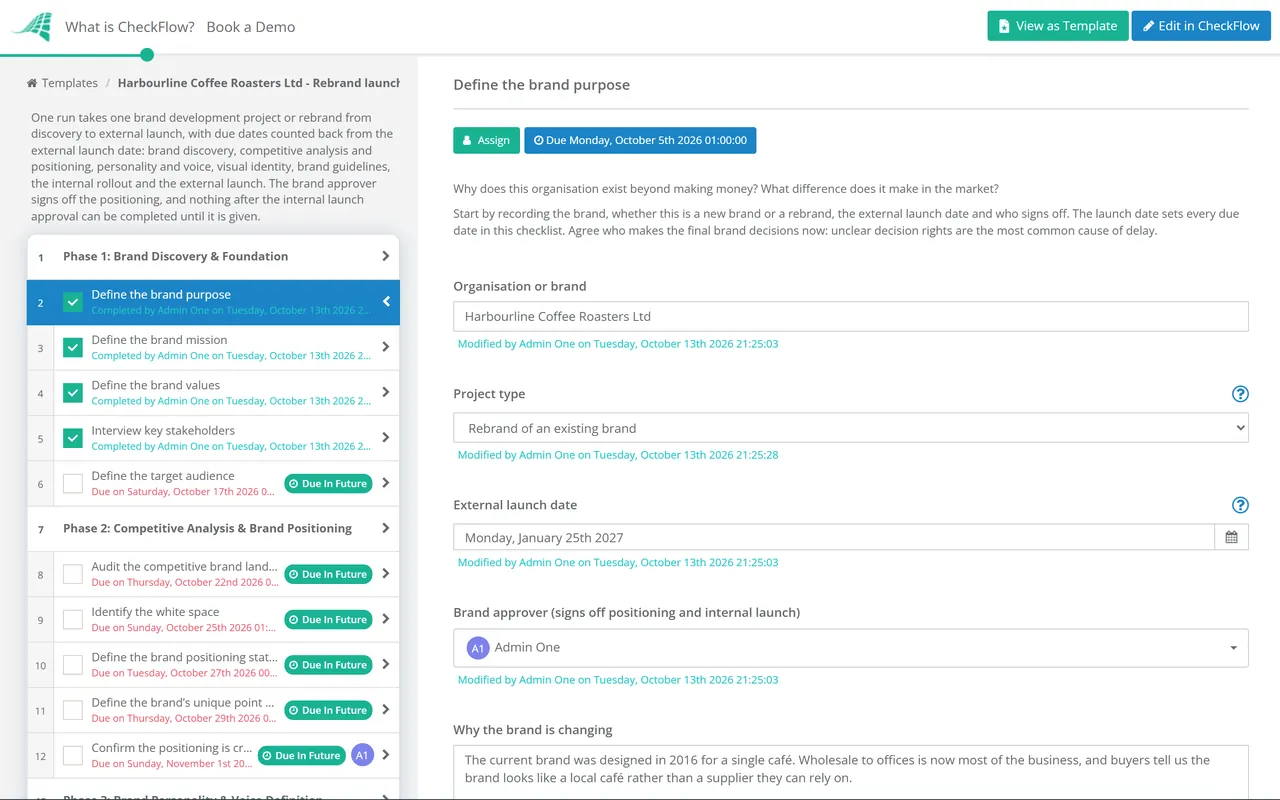
Define the brand purpose — why does this organisation exist beyond making money? What difference does it make in the market?
Define the brand mission — what is it trying to achieve in concrete terms? The measurable or observable goal the brand is working towards
Define the brand values — 3–5 genuine commitments about how the organisation behaves; aspirational and behavioural — not generic (“integrity”, “innovation”)
Interview key stakeholders — founders, leadership team, long-term customers, and the people who do the work; what makes the brand distinctive?
Define the target audience — specific and researched; who is the brand most specifically for?
Phase 2
Phase 2: Competitive Analysis & Brand Positioning
Audit the competitive brand landscape — how do the main competitors position themselves? What visual and verbal territory do they occupy?
Identify the white space — what positioning territory is available? Where are competitors not? What genuine differentiation is possible?
Define the brand positioning statement — “For [target audience], [brand] is the [category] that [differentiating benefit] because [reason to believe]”; internal tool, not marketing copy
Define the brand’s unique point of difference — what does this brand do, stand for, or deliver that the alternatives do not? Specific and evidenced
Confirm the positioning is credible — does the organisation currently or demonstrably able to deliver what the positioning claims?
Phase 3
Phase 3: Brand Personality & Voice Definition
Define the brand personality — if the brand were a person, how would they speak, behave, and present themselves? 3–5 personality attributes; with “the brand is X but not Y” distinctions for each
Define the brand voice — the consistent character of all brand communications; formal or informal? Expert or accessible? Witty or serious?
Define the brand tone — how the voice adapts to context; the voice is consistent, the tone shifts; warmer in a customer complaint response, more precise in a technical document
Define messaging pillars — the 3–5 key messages the brand consistently communicates; the things we always want the audience to take away
Phase 4
Phase 4: Visual Identity Development
Brief the logo design — using the brand strategy; what should the logo communicate? What personality attributes should it express? What contexts will it appear in?
Define the colour palette — primary brand colours with hex, RGB, and CMYK values; secondary palette; confirm accessibility (contrast ratios for WCAG compliance)
Define the typography system — primary typeface (headings), secondary typeface (body); font weights, sizes, and hierarchy; web-safe or licensed
Define photography and illustration style — what does brand-appropriate photography look like? What to include, what to exclude; reference examples
Define iconography and graphic elements — if applicable; icon style, decorative elements, pattern or texture usage
Phase 5
Phase 5: Brand Guidelines Documentation
Document all visual identity elements — in a brand guidelines document; logo usage rules (minimum size, clear space, approved backgrounds, what NOT to do)
Document all verbal identity elements — voice and tone, messaging pillars, tagline, and writing style guidelines (vocabulary to use and avoid)
Include usage examples — correct and incorrect examples for each element; examples of the brand voice in different contexts; visual do/don’t comparisons
Make the guidelines accessible — digital-first; where do team members and agency partners access the brand guidelines? Not a PDF that is emailed and lost
Version-control the guidelines — version number and date; anyone holding an old version knows to get the current one
Phase 6
Phase 6: Internal Brand Rollout
Launch internally before externally — the team must understand and be able to apply the brand before external audiences see it
Brief all teams — what has changed, why, and what it means for each team’s output (sales decks, support communications, LinkedIn profiles)
Update all internal assets — email signatures, presentation templates, document templates, letterhead, and any internal communications using old brand elements
Train teams on the brand voice — particularly teams that write customer-facing copy: marketing, sales, support; practical examples of on-brand vs off-brand writing
Phase 7
Phase 7: External Brand Launch
Update all digital touchpoints — website, social profiles, Google Business Profile, app stores, LinkedIn company page; co-ordinated update, not piecemeal
Update all marketing assets — ad creative, email templates, landing pages, lead magnets
Notify key clients and partners — proactively; no partner should discover the rebrand by stumbling on the new logo
Announce the rebrand publicly — blog post, LinkedIn, email to subscribers; explain the why, not just the what
Monitor for inconsistencies — old brand elements appearing in unexpected places for the first 60 days; update as found
This checklist is available as a free, runnable template in CheckFlow — with stakeholder interview tasks, design briefing phases, approval tracking, and the internal and external rollout coordinated across every team involved in the brand launch.
A structured discovery-first brand development process
The temptation to start brand development with the visual brief is the mistake that produces rebrands that need to be redone in three years because the strategy was never defined. CheckFlow’s brand development checklist requires the strategy phases (discovery, positioning, personality) to be completed before the visual identity brief can begin — ensuring the design work is grounded in strategic thinking.
2
Stakeholder engagement and approval tracked across phases
Brand development involves multiple stakeholders — founders, marketing, design agency, legal (trademark check), and senior leadership. CheckFlow assigns each review and approval task to the right person at the right phase, with deadlines and reminders. The brand does not launch internally before leadership approval, and does not launch externally before the internal rollout is complete.
3
Brand guidelines as a living, version-controlled process
Brand guidelines that are created and never updated become irrelevant within two years as the brand evolves. CheckFlow’s recurring annual brand review ensures guidelines are audited and updated — confirming all touchpoints are consistent and guidelines reflect how the brand has evolved.
Brand asset management — maintaining and distributing the brand assets created through the brand development process — is covered in CheckFlow’s creative design template series. See the Brand Asset Management Checklist →
The campaign launch process that brings a brand to market is covered in CheckFlow’s creative design campaign launch template. See the Campaign Launch Checklist →
Brand development is the structured process of defining what a brand stands for (strategy), creating the assets that express it (identity), documenting the rules for consistent application (guidelines), and implementing it across all touchpoints (rollout). It covers seven phases: brand discovery (purpose, mission, values, stakeholder research), competitive analysis and positioning (differentiated positioning statement), brand personality and voice (how the brand communicates), visual identity development (logo, colour, typography, photography), brand guidelines documentation (accessible rules for consistent application), internal rollout (briefing teams and updating internal assets), and external launch (updating digital touchpoints and announcing the brand).
What is the difference between brand strategy and brand identity?
+
Brand strategy is the thinking that defines what the brand stands for — its purpose, positioning, values, target audience, and personality. It answers why the brand exists, who it is for, and what makes it different. Brand identity is the visual and verbal expression of that strategy — the logo, colours, typography, tone of voice, and messaging that communicate the strategy to the audience. The relationship between them is directional: strategy informs identity. A well-executed brand identity built on a weak or undefined strategy will look professional but communicate nothing distinctive — and will require revision as soon as the strategic thinking catches up.
What should brand guidelines include?
+
Brand guidelines should cover: logo usage (the approved versions, minimum size, clear space, approved and prohibited backgrounds, and common misuse examples to avoid), colour palette (primary and secondary colours with hex, RGB, CMYK, and Pantone values, and accessibility contrast ratios), typography (primary and secondary typefaces, weights, hierarchy, and web usage), photography and illustration style (what types of imagery represent the brand and what to avoid), iconography (if applicable), and verbal identity (brand voice, tone, messaging pillars, writing style do’s and don’ts, and worked examples across different communication contexts). Guidelines should be digital-first, version-controlled, and genuinely accessible to the people who need them.
How long does brand development take?
+
Brand development timelines vary significantly by scope and organisation size. For a start-up or small business doing a focused brand development process: 6–12 weeks from discovery kickoff to completed guidelines. For a mid-size company with more stakeholders and a more complex visual identity: 12–20 weeks. For a large enterprise rebrand with multiple markets, languages, and extensive stakeholder engagement: 6–18 months. The most common cause of extended timelines is decision-making delays — particularly on the visual identity — due to unclear approval processes and undefined decision rights. Defining who makes the final brand decisions before the process begins reduces timeline significantly.
Is CheckFlow free to use for this template?
+
You can start a free 14-day trial with no credit card required, giving you full access to all features including this template. The Business plan is $10 per user per month after the trial. Full details at checkflow.io/pricing.
Build a Brand That Is More Than a Logo — From Strategy to Guidelines
Free trial — no credit card required.
Do you like cookies? 🍪 We use cookies to ensure you get the best experience on our website. Learn more