One source of truth for your brand assets — audited, organised, governed, and kept current.
Brand inconsistency rarely happens because people do not care about the brand. It happens because the right assets are hard to find, the latest version is unclear, nobody is sure which logo is approved for which context, and the brand guidelines document was last updated eighteen months ago. A structured brand asset management process solves this — by defining exactly what assets exist, where they live, who owns them, how they get updated, and how the organisation ensures everyone uses the right ones. This free brand asset management checklist gives brand managers, marketing teams, and creative leads a structured framework for auditing, organising, governing, and maintaining brand assets consistently — whether you are setting up a BAM process for the first time or bringing order to one that has grown without structure.
Without a structured brand asset management process, the same problems appear in every growing organisation: a sales deck using a logo from two rebrands ago, a social media post in a colour that is close to brand but not quite right, a partner organisation asking for the logo and receiving a low-resolution JPEG from someone’s desktop because nobody knew where the master files were. Each individual instance feels minor. The cumulative effect on brand perception is significant — and the time spent finding, correcting, and re-doing work because the wrong asset was used is entirely avoidable.
Managed well, brand assets are a strategic asset — not just a file management problem. A brand with a clear, accessible, well-governed asset library produces more consistent work faster, with fewer revisions and less friction between creative, marketing, sales, and partner teams. A structured BAM process is the operational foundation that makes that possible.
What the Brand Asset Management Checklist Covers
This checklist covers six phases — from the initial asset audit and brand guidelines review through to ongoing governance, approval workflows, and periodic maintenance cycles.
Phase 1
Brand Asset Audit & Inventory
You cannot manage what you have not inventoried. A complete asset audit — however uncomfortable it is to see how scattered things have become — is the only honest starting point.
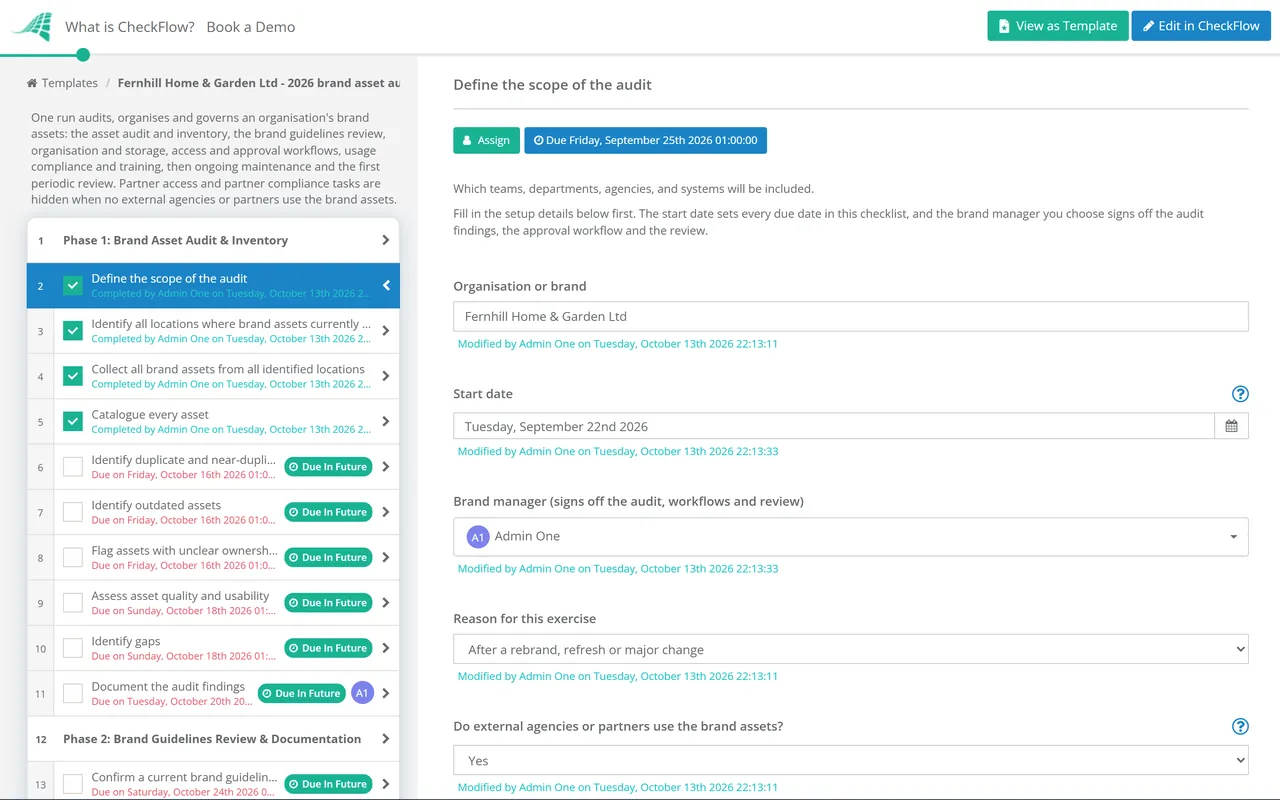
Define the scope of the audit — which teams, departments, agencies, and systems will be included
Identify all locations where brand assets currently live — shared drives, local computers, cloud storage, DAM platforms, agency servers, email attachments, and project management tools
Collect all brand assets from all identified locations — logos, wordmarks, icons, colour palettes, typography files, photography, illustration, video, templates, brand guidelines documents, tone of voice guides, and any other brand materials
Catalogue every asset — name, file type, dimensions, creation date, last modified date, owner, and current usage status
Identify duplicate and near-duplicate assets — flag assets that appear to be different versions of the same element
Identify outdated assets — logos, colours, or materials from previous brand iterations that are no longer approved for use
Flag assets with unclear ownership or approval status — confirm which assets are officially approved and which are unofficial variations
Assess asset quality and usability — confirm master files exist in appropriate formats and resolutions for all intended use cases
Identify gaps — assets that should exist but do not (specific logo lockups, approved dark/light versions, social media formats, etc.)
Document the audit findings — a complete inventory of what exists, what is approved, what is outdated, and what is missing
Phase 2
Brand Guidelines Review & Documentation
Confirm a current brand guidelines document exists — if it does not, create one; if it does, review it for accuracy and completeness
Verify the guidelines cover all core brand elements — logo usage rules, colour palette (with HEX, RGB, CMYK, and Pantone values), typography (primary and secondary typefaces, weights, and sizing guidance), photography and illustration style, iconography, and tone of voice
Confirm usage rules are explicit — not just how assets should be used, but how they should NOT be used; include “do and don’t” examples for common misapplications
Verify the guidelines cover digital and print use cases — screen and web specifications as well as print production requirements
Confirm the guidelines address co-branding and partner use — rules for how the brand appears alongside other brands, sponsors, or partner logos
Verify accessibility requirements are addressed — minimum contrast ratios, accessible colour combinations, and any relevant WCAG compliance guidance
Confirm the guidelines are version-controlled — dated, versioned, and with a clear record of what changed between versions
Confirm the guidelines are accessible to all relevant stakeholders — internal teams, agencies, and approved external partners
Set a review schedule — confirm who owns the guidelines and when the next formal review is due
Document any brand guidelines gaps identified — elements that exist in practice but are not yet documented
Phase 3
Asset Organisation & Storage
Define the folder structure and taxonomy — a clear, logical hierarchy that allows users to find assets without knowing what they are called
Confirm naming conventions — a consistent file naming standard that makes assets identifiable and searchable without opening them
Establish a single source of truth — one designated location where all master approved assets live; confirm all teams know where it is
Migrate approved assets to the single source of truth — remove or archive outdated and duplicate assets to eliminate confusion
Confirm master files are stored in appropriate formats — original source files (AI, EPS, PSD, Sketch, Figma) alongside export formats (SVG, PNG, PDF, JPEG) for different use cases
Apply metadata and tags where the storage system supports it — to improve searchability and usability
Confirm archive procedures — how outdated assets are retired rather than deleted, so historical versions remain accessible if needed
Document the folder structure and naming conventions — ensure all users can understand and follow the system without guidance
Confirm the storage system is backed up — with appropriate redundancy and disaster recovery for critical brand assets
Review storage access — confirm the right people can reach what they need quickly, and the wrong people cannot modify or delete master files
Phase 4
Access, Permissions & Approval Workflows
Define user roles and permission levels — who can view assets, who can download them, who can upload new assets, and who can modify or archive master files
Assign a Brand Asset Owner — a named individual responsible for the integrity of the brand asset library and the approval of new or modified assets
Implement appropriate access controls — confirm read, download, and write permissions are configured correctly for each user group
Define the approval workflow for new assets — the process by which new brand assets are reviewed, approved, and added to the library
Define the approval workflow for asset modifications — how existing approved assets can be updated or replaced, and who must sign off
Establish a process for external partner access — agencies, suppliers, co-marketing partners; confirm how they access approved assets without gaining access to internal systems
Define the process for handling out-of-brand requests — what happens when a stakeholder requests an asset that does not meet brand guidelines, or asks for a one-off exception
Document the approval workflow — confirm all relevant team members understand how to submit assets for approval and what the review process looks like
Confirm escalation path for brand disputes — who has final authority when brand decisions are contested
Audit existing access permissions — remove access for former team members and agencies no longer working with the brand
Phase 5
Usage Compliance & Team Training
Identify which teams and individuals regularly create or use brand assets — marketing, sales, HR, product, communications, and any external agencies
Deliver brand guidelines training to all regular asset users — confirm they know where assets live, how to find what they need, and what the key usage rules are
Create a quick-reference brand guide — a shorter, more accessible version of the full guidelines for day-to-day use by non-design team members
Confirm onboarding includes brand asset training — new team members should receive brand guidelines access and an introduction to the asset library as part of their first-week induction
Audit recent brand output for compliance — review a sample of recent marketing materials, presentations, and communications to identify any brand inconsistencies
Identify the most common brand compliance failures — which guidelines are being ignored or misunderstood most frequently, and why
Address compliance gaps with targeted guidance — not just correction but explanation of why the guideline exists and what problem it solves
Confirm agency and partner compliance — ensure external partners have current guidelines and are using approved assets
Establish a brand compliance feedback channel — a clear, low-friction way for team members to report brand inconsistencies they observe
Document training completion — maintain a record of who has received brand guidelines training and when
Phase 6
Ongoing Maintenance & Periodic Review
Brand asset management is not a one-time project. It is an ongoing practice. The brands that stay consistent are the ones that schedule regular reviews — and actually run them.
Schedule a quarterly asset library review — confirm new assets have been correctly added, outdated assets have been archived, and the folder structure remains clean and current
Schedule an annual brand guidelines review — confirm the guidelines still reflect the current brand, identify any elements that need updating, and version the document
Review asset usage data where available — which assets are used most frequently, which are never used, and what that suggests about gaps or redundancies
Confirm access permissions are current — remove access for leavers and add access for new team members on a rolling basis
Review agency and partner access — confirm external parties still require access and that their permissions are appropriate
Review the approval workflow — confirm it is being followed and identify any bottlenecks or workarounds that have emerged
Collect feedback from asset users — what is working well, what is hard to find, and what is missing?
Update the asset library based on feedback — add missing formats, create new templates, or restructure the folder taxonomy if needed
Brief the team on any brand asset updates — confirm changes to guidelines or assets are communicated clearly rather than quietly updated
Document the review completion — record date, findings, and any changes made
This checklist is available as a free, runnable template in CheckFlow — with tasks assigned to brand owners and creative leads, quarterly and annual reviews scheduled automatically on a recurring basis, and a complete governance record for every review cycle.
Brand assets are everything that makes your brand visually and verbally identifiable. A complete asset inventory covers more than most teams initially expect.
Visual Identity
Primary logo, secondary logo lockups, wordmark, monogram or icon, logo variations for light and dark backgrounds, favicon, and any sub-brand or product logos.
Colour & Typography
Primary and secondary colour palettes with all values (HEX, RGB, CMYK, Pantone), approved colour combinations, primary and secondary typefaces, licensed font files, and typographic scale guidance.
Photography & Illustration
Approved photography library, photography style guidelines, illustration style, icon library, and any recurring visual motifs or graphic elements.
Templates & Materials
Presentation templates, document templates, social media templates, email signature templates, letterhead, business card designs, and any recurring marketing collateral formats.
Motion & Video
Animation style guidelines, intro and outro sequences for video, approved stock footage sources, motion graphics elements, and approved music or audio branding.
Brand Voice & Messaging
Brand guidelines document, tone of voice guide, messaging framework, approved taglines, mission and vision statements, key proof points, and product or service descriptions.
A complete brand asset audit typically uncovers more assets than expected — and more inconsistency than anyone is comfortable admitting. That is the point. You cannot improve what you have not documented.
Why Manage Brand Asset Governance in CheckFlow?
Note: CheckFlow manages the process around your brand assets — the audit, the governance workflows, the approval procedures, and the recurring reviews. It does not store or host brand asset files. For file storage, use a DAM platform, shared drive, or brand portal alongside CheckFlow.
1
Structure the audit and keep it moving
A brand asset audit that lives in a spreadsheet tends to stall — there is no owner for each task, no deadline, and no visibility into where things stand. CheckFlow turns the audit into a structured, assigned checklist: each phase has an owner, each task has a due date, and the brand manager has a live view of what has been completed and what is outstanding. The audit gets done — not deferred.

2
Run quarterly and annual reviews automatically
Brand asset reviews only deliver value if they actually happen on schedule. CheckFlow’s recurring checklist feature schedules quarterly library reviews and annual guidelines reviews automatically — assigning tasks to the brand owner and relevant stakeholders at the right time, with reminders before deadlines. Consistent brand governance becomes a reliable process, not a good intention.
3
A complete governance record for every review cycle
When a stakeholder, new team member, or external auditor asks what brand governance looks like in practice — when the last review happened, what was changed, and who approved the current guidelines — CheckFlow has a timestamped record of every completed task in every review cycle. Brand governance is documented, not reconstructed.
Brand asset management is one of many creative and operational processes that benefit from a structured, recurring checklist. CheckFlow’s recurring checklist feature lets you schedule any repeatable process automatically — from quarterly brand reviews to monthly content approvals. Learn more about recurring checklists in CheckFlow →
A brand asset management process works best when it is documented as a standard operating procedure — one that any team member can follow consistently, regardless of whether the brand manager is available. CheckFlow’s SOP software turns your BAM process into a structured, repeatable checklist that runs itself. Learn more about SOP software in CheckFlow →
Brand asset management (BAM) is the system an organisation uses to store, organise, govern, and maintain consistent use of its brand assets — the logos, colours, typography, photography, templates, and brand voice elements that define how the brand looks and sounds across every touchpoint. Effective BAM ensures that everyone in the organisation — and authorised external partners — uses the correct, approved, current version of every brand asset, and that outdated or unofficial versions are retired rather than continuing to circulate. It is distinct from digital asset management (DAM), which covers a broader category of digital files beyond brand assets.
What is the difference between brand asset management and digital asset management?
+
Digital asset management (DAM) is a broader category covering all digital files — marketing collateral, photography, video, documents, and any other digital content. Brand asset management is a subset of DAM specifically focused on the assets that define brand identity — logos, colour palettes, typography, brand guidelines, and brand-compliant templates. In practice, many organisations use a DAM platform to store and distribute brand assets alongside other digital content. What distinguishes BAM from general DAM is the governance layer — the processes, approval workflows, and usage rules that ensure brand assets are used correctly, not just stored accessibly.
How often should brand assets be audited and reviewed?
+
A full brand asset audit should be conducted whenever a significant brand change occurs — a rebrand, brand refresh, product launch, or major organisational change. For ongoing maintenance, a quarterly review of the asset library (checking for outdated assets, confirming new assets have been correctly added, and reviewing access permissions) and an annual review of the brand guidelines document are considered best practice. CheckFlow’s recurring checklist feature can schedule both reviews automatically so they never slip — the brand manager receives a structured checklist at the right time rather than having to remember to initiate the review.
What should brand guidelines documentation include?
+
Comprehensive brand guidelines should cover: logo usage rules (including do and don’t examples, clearspace requirements, and approved variations), colour palette (with HEX, RGB, CMYK, and Pantone values for each colour), typography (primary and secondary typefaces, approved weights and sizes, and hierarchy guidance), photography and illustration style, iconography, co-branding rules (how the brand appears alongside other brands), and tone of voice. Strong guidelines include visual examples of correct usage and explicit examples of common misapplications to avoid. They should be version-controlled, dated, and stored in a location accessible to all relevant stakeholders.
How do you manage brand consistency when working with external agencies and partners?
+
External agencies and partners are among the most common sources of brand inconsistency — not because they do not care about the brand, but because they often work from outdated assets or incomplete guidelines. The most effective approach is to give external partners structured access to the approved asset library and current brand guidelines — a specific folder or portal with exactly what they need, rather than ad hoc emails. CheckFlow’s approval workflow for new and modified assets can include external agency submissions, and the secure sharing feature allows asset-related tasks to be shared with external partners without giving them access to internal systems.
Is CheckFlow free to use for this template?
+
You can start a free 14-day trial with no credit card required, giving you full access to all features including this template. The Business plan is $10 per user per month after the trial. Full details at checkflow.io/pricing.
Start Managing Your Brand Assets Consistently Today
Free trial — no credit card required.
Do you like cookies? 🍪 We use cookies to ensure you get the best experience on our website. Learn more