Trial Preparation Checklist Template

A trial can turn on something that went wrong weeks before it started: a witness nobody summonsed, an objection not made in time, or a bundle without the page the case depends on.

Last reviewed: October 2026

This free trial preparation checklist takes one case from the day the trial date is fixed to the first morning of the trial. It is for litigators, trial lawyers, paralegals and supervising partners in law firms and in-house legal teams. Enter the day the trial starts and every later task is dated back from it: the court’s deadlines, the case theory and the issues, the evidence and exhibits, fact and expert witnesses, pre-trial applications or motions, a settlement review with the client, the trial bundle, logistics and the client’s own preparation. The supervising lawyer’s sign-off at the final pre-trial review is the gate before the last steps to court. Court rules vary by court and by country, so the court’s rules and any directions or scheduling order always come first, and this template is not legal advice. Open the matter with the Legal Case Intake Process Checklist and close it with the Legal Matter Closing Checklist.

Trial Preparation, Case Intake or Matter Closing?

Trial preparation is the stretch of a case where most of the deadlines fall at once. The court has fixed a date, and every step before it has a date of its own: lists of witnesses and exhibits, pre-trial checklists or a pretrial order, applications or motions, the skeleton argument or trial brief and the trial bundle. Miss one and the evidence you need may not be heard.

This checklist runs that stretch for one case, counting every due date back from the day the trial starts. It is written to work in any court: it names the step and tells you to follow the court’s rules and any directions or scheduling order, with examples from England and Wales and from US federal courts. Court rules vary by court and by country, and this template is not legal advice. If litigation is only expected, preserving documents comes first: see the Legal Hold Checklist.

This checklist

Preparing one case for trial

Starts: the day the trial date is fixed.

Covers: court deadlines, case theory, evidence, witnesses and experts, applications or motions, settlement, the trial bundle, logistics and the client.

Ends: the supervising lawyer’s sign-off and the first morning at court.

Start of the matter

The Legal Case Intake Process Checklist

Covers: the request, the conflict check, triage, engagement terms, opening the file and the kickoff.

Use it: when a new matter arrives, long before any trial date. Legal Case Intake Process Checklist.

After the matter

The Legal Matter Closing Checklist

Covers: the final bill, client money, the closing letter, returning originals, conflicts records and retention.

Use it: once the judgment, settlement or appeal period is over. Legal Matter Closing Checklist.

What the Trial Preparation Checklist Covers

Nine phases take one case from the day the trial date is fixed to the first morning at court. Every due date after the first task counts back in business days from the day the trial starts. A jury, an arbitration, experts, a witness summons or subpoena, an interpreter, an electronic bundle, a settlement still in play and a client giving evidence each add their own tasks. The supervising lawyer’s sign-off at the final pre-trial review is the gate before the last steps to court.

  1. Phase 1

    Phase 1: Trial Date, Timetable & Team

    4 tasks

    Start the run as soon as the trial date is fixed. Enter the day the trial starts on the first task: every later due date counts back from it in business days, starting about twelve weeks out. The answers on the first task add the tasks this case needs.

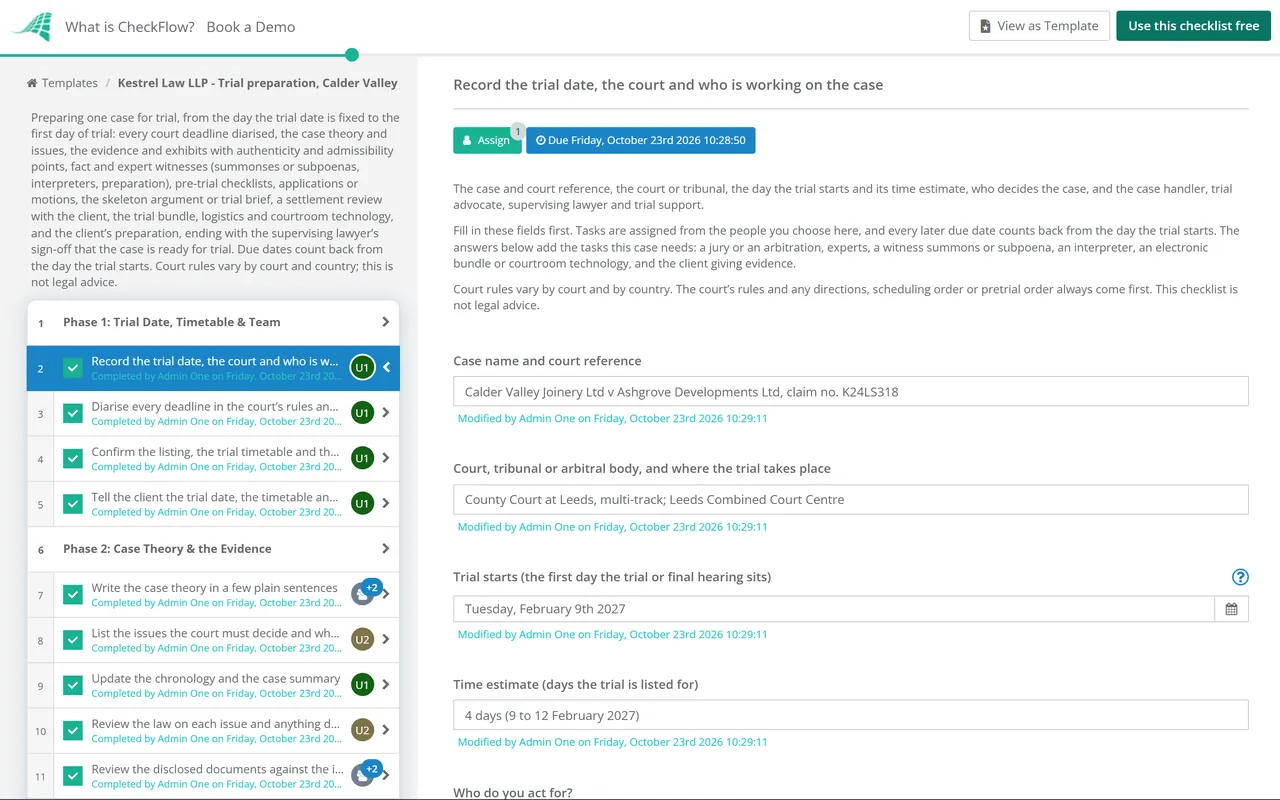
    • Record the trial date, the court and who is working on the case — the case and court reference, the court or tribunal, the day the trial starts and its time estimate, who decides the case, and the case handler, trial advocate, supervising lawyer and trial support
    • Diarise every deadline in the court’s rules and its directions or scheduling order — each step the court has ordered before trial, with its date, the person responsible and a reminder well before it: pre-trial checklists or pretrial disclosures, witness and exhibit lists, applications or motions, skeleton arguments or trial briefs and the trial bundle
    • Confirm the listing, the trial timetable and the team’s availability — the date and time the trial starts, where it sits, the number of days it is listed for, any timetable the court has set, whether the time estimate is still right, and the advocate and team free for every day of it
    • Tell the client the trial date, the timetable and the cost of going to trial — the trial dates in writing, what happens between now and then, what the client must do and when, and an updated estimate of the cost of preparing for and attending the trial
  2. Phase 2

    Phase 2: Case Theory & the Evidence

    9 tasks

    Decide what the case is about before you choose the evidence. The case theory and the list of issues guide every later choice: which documents go in, which witnesses are called and what each one must prove.

    • Write the case theory in a few plain sentences — what happened, why your client should win and the strongest point against you, short enough to open with and to test every piece of evidence against
    • List the issues the court must decide and who must prove each one — every issue of fact and law still in dispute, the burden and standard of proof on each, and the issues agreed or no longer pursued
    • Update the chronology and the case summary — every key event in date order with the document that proves it, and a short neutral case summary, agreed with the other side where the court asks for one
    • Review the law on each issue and anything decided since the case began — the authorities for each issue, any new decision or change in the rules, and the authorities the other side is likely to rely on
    • Review the disclosed documents against the issues — every document disclosed or produced by each party read against the list of issues, with gaps found early enough to ask for more
    • Choose the documents and exhibits each issue relies on — the documents, photographs, plans and other exhibits you will rely on, and those you may need if a point arises, each linked to the issue it proves
    • Check the authenticity of each document and agree it with the other side where possible — originals located, copies checked, and authenticity and the use of documents as evidence of their contents agreed in writing where the other side will agree
    • Identify the admissibility points on both sides’ evidence — hearsay, privilege, relevance, late evidence and any other objection you will raise or must answer, with the notices or applications each one needs
    • Serve any notices the rules require for the evidence you rely on — notices of hearsay evidence, of plans, photographs or models, and notices to admit facts or documents, each served by the date the rules or the court set
  3. Phase 3

    Phase 3: Witnesses

    11 tasks

    Confirm early that every witness will be there and is ready. A witness who needs a summons or subpoena, an expert or an interpreter adds the tasks for them.

    • List every witness, the order they will be called and the time each needs — fact witnesses and any experts, what each one proves, the order the advocate wants, and an estimate of the time for evidence in chief and cross-examination
    • Confirm each witness is available for the trial dates — every witness contacted in writing with the dates, any clash or travel problem raised with the advocate, and the dates they cannot attend recorded
    • Check each witness statement, summary or deposition is final and served — signed statements with the right statement of truth, any supplemental statement needed, deposition designations where they are used, and proof of service
    • Serve the witness and exhibit lists or pretrial disclosures the court requires — the lists, designations or disclosures in the form and by the date the rules or the court set, filed where they must be filed
    • Review the other side’s lists and serve any objections in time — their witnesses, exhibits and designations checked against the evidence served, and objections to admissibility or to a deposition served by the deadline
    • Experts: confirm each report, any joint statement and the expert’s availability — each expert’s final report and any answers to questions, a joint statement or meeting where the court ordered one, and each expert’s dates for giving evidence
    • Experts: hold a conference with each expert before trial — the advocate and each expert go through the report, the other side’s expert evidence and the points likely to be put in cross-examination
    • Witness summons or subpoena: issue it and serve it in time — the summons or subpoena issued for each witness who will not come voluntarily, served by the method and deadline the rules set, with any fees or expenses that must go with it
    • Interpreter: book a qualified interpreter and tell the court — an interpreter in the right language and dialect for each person who needs one, booked for the days they give evidence, with the court told as its rules require
    • Prepare each witness for giving evidence, within the rules on witness preparation — how the hearing works, the oath or affirmation, the documents they will be shown and how to answer questions, without rehearsing or suggesting what their evidence should be; the rules on this differ between countries, so follow your own
    • Send each witness the date, time, place and what to bring — the address and courtroom, the time to arrive, who will meet them, their own statement, identification, and any travel or expenses arrangements
  4. Phase 4

    Phase 4: Court Filings & Pre-Trial Applications

    8 tasks

    Make every filing and application in time. A pre-trial application or motion decided weeks before trial can change what evidence is heard.

    • Complete and file the pre-trial checklist or the proposed pretrial order — the court’s questionnaire, listing information or the joint proposed order, with the witnesses, time estimate and any directions still needed, filed by the court’s date
    • Decide which pre-trial applications or motions in limine to make — applications or motions to exclude or admit evidence, to amend, for further directions or to deal with a late step by the other side, each agreed with the supervising lawyer
    • File and serve each application or motion by the court’s deadline — each application or motion with its evidence and draft order, filed and served on every party, with the hearing date diarised
    • Respond to the other side’s applications or motions — every application or motion served on you answered in writing by the deadline, with any evidence in reply
    • Prepare for the pre-trial review or final pretrial conference — the matters the court will deal with: the trial timetable, outstanding evidence, admissibility, the bundle and any agreed facts, attended by the lawyer who will conduct the trial where the rules require it
    • Jury trial: prepare jury selection and proposed jury instructions or directions — any questions for jury selection the court allows, proposed instructions or directions on the law, and a plan for presenting the evidence to a jury
    • Arbitration: confirm the hearing room, transcription and the tribunal’s procedural directions — the hearing venue and rooms booked, any transcription or interpretation agreed, and the tribunal’s procedural order or directions for the hearing checked and followed
    • Draft and serve the skeleton argument or trial brief — the issues, the evidence and the law in the form and by the date the court sets, with a reading list and time estimate if the court asks for them, and the bundle page references
  5. Phase 5

    Phase 5: Settlement Review & the Client

    7 tasks

    Review settlement with the client one last time before the heaviest trial costs are spent, and prepare the client for the trial. If settlement is still possible, or the client is giving evidence, the tasks for that are added.

    • Review the offers made so far and whether settlement is still possible — every offer made by either side, any formal offer that affects costs and the date it expires, and the client’s current position
    • Settlement: advise the client on the risks, the costs and the offers — the strengths and weaknesses of the case, the likely outcomes, the cost of going to trial and of losing, and the effect of any offer on costs, given in writing
    • Settlement: confirm the client’s settlement authority in writing — the terms the client will accept or offer, who can approve a settlement on the client’s side, and how to reach them during the trial
    • Settlement: make, accept or reject any last offer on the client’s instructions — any last offer made or answered within the client’s authority, recorded on the file with the client’s instructions
    • Settlement: if the case settles, record the terms and tell the court at once — the settlement terms recorded in writing and signed, the court told straight away, any order needed drawn up, and the remaining trial tasks marked not applicable
    • Brief the client on what happens at trial — the timetable, who will be in court, how the day runs, how to behave in court, what the client must bring and how long the decision may take
    • Client evidence: prepare the client to give evidence — how giving evidence works, the oath or affirmation, the documents they will be referred to, and answering only the question asked, within the rules on witness preparation
  6. Phase 6

    Phase 6: Trial Bundle

    5 tasks

    Agree the contents with the other parties, then build the bundle in the order and format the court requires. An electronic bundle adds a task to prepare and test it.

    • Agree the bundle index with the other parties — the contents and order agreed where possible, with a note of anything the parties cannot agree on, and who is responsible for preparing the bundle
    • Assemble the bundle with continuous page numbers and an index — statements of case, orders, witness statements, expert reports and the documents in the agreed order, paginated throughout, indexed, with dividers and legible copies
    • Prepare the bundle of authorities and any core bundle — the cases and legislation the advocate will rely on, agreed with the other side where the court asks for a joint bundle, and a core bundle if there are many files
    • Electronic bundle: prepare it in the court’s format and test it — one searchable file or the platform the court uses, page numbers that match the paper bundle, bookmarks for each section, and a test that the court and the other side can open it
    • File and serve the trial bundle by the court’s deadline — the bundle lodged with the court and served on every party in the form and within the window the rules or the court set, with identical copies for the witness box and the team
  7. Phase 7

    Phase 7: Logistics & Courtroom Technology

    4 tasks

    Plan how people, documents and equipment get to court. A trial with video links, evidence display or an electronic bundle adds a task to book and test the technology.

    • Book travel, accommodation and any room near the court — travel and hotels for the team and the witnesses, a consultation room at or near the court, and parking or access needs
    • Courtroom technology: book and test screens, video links and evidence display — the equipment the court provides or allows, any remote witness link set up and tested with the court, and a plan for if it fails
    • Plan how the bundles, originals and equipment get to court — who brings each bundle, the original documents and exhibits the court may ask to see, laptops and chargers, and spare copies
    • Prepare the advocate’s trial file — the opening, an outline for each witness, the cross-examination points, the issues list and notes for closing, with bundle references
  8. Phase 8

    Phase 8: Final Pre-Trial Review

    3 tasks

    The supervising lawyer reviews the whole case with the team and signs off that it is ready for trial. The sign-off is the gate: the last steps before court cannot be completed until it is done.

    • Check every court deadline has been met and nothing is outstanding — each deadline on the diary list ticked off with the date it was met, and anything late, missed or still to come raised with the supervising lawyer
    • Hold the final pre-trial review with the trial team — the case theory, the witnesses, the evidence, the bundle, any settlement position and the logistics gone through with the advocate, case handler and trial support
    • Supervising lawyer confirms the case is ready for trial — the sign-off that the case is ready; if it is not, record what must change and leave this task open, because the last steps before court cannot be completed until it is done
  9. Phase 9

    Phase 9: The First Day of Trial

    3 tasks

    The last checks before the trial starts and the first morning at court.

    • Confirm the start time, the courtroom and the judge with the court — the court’s list or the tribunal checked for the time, the room and any change, with the team, the client and the first witnesses told
    • Take the bundles, originals and equipment to court — every bundle, the original documents, the trial file and the equipment at court in good time before the start
    • Meet the client and the first witnesses at court before the start — a short meeting to settle nerves, answer last questions and confirm any settlement position before the case is called

Pre-Trial Deadlines and the Trial Bundle at a Glance

Pre-trial steps, with examples from two systems

Your court’s rules and its directions, scheduling order or pretrial order set your deadlines, and the judge can change the defaults. These examples show how two systems handle the same steps: the Civil Procedure Rules (CPR) in England and Wales and the Federal Rules of Civil Procedure (FRCP) in US federal courts. State courts, criminal courts, tribunals and arbitrations have their own rules.

Step England and Wales (CPR, example) US federal courts (FRCP, example)
Moving the trial dateA party must apply to the court to vary the trial date, a pre-trial review or the pre-trial check list date (rule 28.3 on the fast and intermediate tracks, rule 29.5 on the multi-track)The pretrial order controls the case unless the court modifies it (Rule 16(d))
Pre-trial check list or pretrial orderReturned by the date the court sets: on the fast and intermediate tracks not more than 8 weeks before trial (rule 28.4); on the multi-track by the date in the directions (rule 29.6)Form and content settled at the pretrial conference (Rule 16(c))
Witness and exhibit listsAs the court’s directions setPretrial disclosures at least 30 days before trial unless the court orders otherwise; objections within 14 days (Rule 26(a)(3))
Making a witness attendA witness summons is binding if served at least 7 days before the witness must attend, with expenses and compensation for loss of time offered (rules 34.5 and 34.7)A subpoena served by a non-party aged 18 or over, with one day’s attendance fee and mileage tendered (Rule 45(b)(1))
Pre-trial reviewThe court may hold one on the multi-track and gives at least 7 days’ notice (rule 29.7)A final pretrial conference as close to trial as is reasonable, attended by a lawyer who will conduct the trial (Rule 16(e))
Trial bundleFiled by the claimant not more than 7 and not less than 3 days before trial (rule 39.5)As the pretrial order and the court’s local rules require
Settling after the date is fixedTell the trial court’s listing officer immediately (rule 39.10)As the judge’s orders and the local rules require

What goes in a trial bundle

Practice Direction 32 in England and Wales gives a useful default list. Your court may ask for more, less or a different order.

Section What it contains Checks
Statements of case and ordersThe claim form and all statements of case, and any order giving directions for the trialThe latest amended versions; every order the trial judge needs
Case summary and chronologyWhere appropriate, agreed with the other side if possibleNeutral wording; dates match the documents
Witness evidenceAll witness statements relied on, witness summaries and hearsay noticesSigned, final versions in the order the witnesses will be called
Expert evidenceExperts’ reports and the responses to them; they may go in a separate bundleJoint statements and answers to questions included
DocumentsContemporaneous documents relied on, as one set in date order unless the court directs otherwiseLegible copies, with a typed copy beside anything hard to read
FormatPaginated continuously, indexed, numbered dividers over 100 pages, a core bundle where there are manyIdentical bundles for every party and for the witnesses

Sources, read 23 October 2026. CPR Part 28, Part 29, Part 34 and Part 39, and Practice Direction 32 (paragraphs 27.1 to 27.15); FRCP Rule 16, Rule 26 and Rule 45. These are examples to show what to look for, not a summary of the law where you practise.

Why Prepare for Trial in CheckFlow?

1

Every deadline dated back from the trial

Enter the day the trial starts and every later task gets a due date counted back from it in business days, from about twelve weeks out to the first morning at court. Overdue alerts go to the people assigned, and the Reports Grid lists every case being prepared with its answers, so a supervising partner can see them all at once.

2

Each case gets only the tasks it needs

A jury, an arbitration, expert witnesses, a witness summons or subpoena, an interpreter, an electronic bundle, a settlement still in play and a client giving evidence each add their own tasks, assigned to the case handler, the advocate, trial support or the supervising lawyer. A case without them stays short.

3

Signed off before anyone goes to court

The supervising lawyer’s sign-off is a gate: the last steps before court cannot be ticked off until the case is confirmed ready. The deadline list, the offers made, the skeleton argument and the bundle index are kept on the tasks they belong to, and the activity log shows who did what and when. See how approval steps work.

CheckFlow does not file documents with the court, work out court deadlines from the rules or build the bundle; your case management system, the court’s filing service and your bundling tool do that. CheckFlow runs the process around them: who does each step by when, what was filed and served, and who confirmed the case is ready. See how checklists run.

Open the matter with the Legal Case Intake Process Checklist and preserve documents early with the Legal Hold Checklist. When the case ends, close it with the Legal Matter Closing Checklist. For an employment dispute, the Workplace Investigation Checklist covers the investigation that often comes before it.

AI generator

Didn’t find what you need? Describe it.

Describe the process in a sentence and the AI checklist generator drafts the phases and tasks for you.

Frequently Asked Questions

What should a trial preparation checklist include?

Every deadline the court has set before trial, the case theory and the issues, the evidence and exhibits with any authenticity and admissibility points, the witnesses and experts, pre-trial applications or motions, a settlement review with the client, the trial bundle, logistics, the client’s own preparation and a final review before the trial starts. This template covers each of those and adds tasks for juries, arbitrations, experts, summonses or subpoenas, interpreters and electronic bundles when a case needs them.

When should trial preparation start?

As soon as the trial date is fixed. Court deadlines such as pre-trial checklists, pretrial disclosures and applications fall weeks before the trial, and some witnesses need weeks of notice. This template starts about twelve weeks out and counts every later due date back from the day the trial starts. If your trial is sooner, start anyway: the earliest tasks will show as overdue, which tells you what to do first.

What is a trial bundle and when is it due?

It is the indexed, paginated set of documents the judge and witnesses use at trial: statements of case, orders, witness statements, expert reports and the documents relied on. In England and Wales, unless the court orders otherwise, the claimant files it not more than 7 days and not less than 3 days before the trial starts (CPR 39.5), and Practice Direction 32 sets out its contents and format. Other courts set their own rules.

What are pretrial disclosures in US federal court?

Under FRCP Rule 26(a)(3), each party must give the others the witnesses it expects to present or may call, the testimony it will present by deposition, and the documents and exhibits it expects or may offer. Unless the court orders otherwise, they are due at least 30 days before trial, and objections must be served within 14 days after, or most are waived. State courts have their own rules.

How do you make sure a witness attends trial?

Confirm every witness’s availability in writing as soon as the date is fixed. A witness who will not come voluntarily needs a witness summons or subpoena. In England and Wales a summons is binding if served at least 7 days before the witness must attend, with travel expenses and compensation for loss of time offered (CPR 34.5 and 34.7). In US federal courts the fee for one day’s attendance and mileage must be tendered when a subpoena is served (FRCP 45(b)(1)).

What happens at a pre-trial review or final pretrial conference?

The court checks the case is ready and settles how the trial will run: the timetable, the evidence, admissibility questions and the bundle. In US federal courts a final pretrial conference is held as close to trial as is reasonable, attended by a lawyer who will conduct the trial, and the order after it can be changed only to prevent manifest injustice (FRCP 16(e)). In England and Wales the court may hold a pre-trial review on the multi-track (CPR 29.7).

What if the case settles before trial?

Record the terms in writing, get them signed and tell the court at once. In England and Wales the rules require the trial court’s listing officer to be told immediately when a claim settles after the trial date is fixed (CPR 39.10). In this template, answering that settlement is still possible adds tasks to advise the client, confirm their authority, deal with any last offer and tell the court; mark the remaining trial tasks not applicable once it settles.

Is this template legal advice?

No. It is a working checklist for organising trial preparation. Court rules vary by court and by country, and the court’s rules and any directions, scheduling order or pretrial order decide your deadlines. The rule references on this page are examples read from primary sources, not a statement of the law where you practise.

Is CheckFlow free for this template?

14-day free trial, no card required. The Business plan is $10 per user per month after the trial. Full details at checkflow.io/pricing.

Walk Into Court Ready

Free trial — no credit card required.

14-day free trial, no credit cardFull refund in your first 30 daysUS hosting, EU on request