
Legal Hold Checklist Template

A hold notice is only the start. Evidence goes missing through the mailbox policy nobody paused, the leaver whose laptop was reimaged and the backup that rotated on schedule.

Last reviewed: October 2026

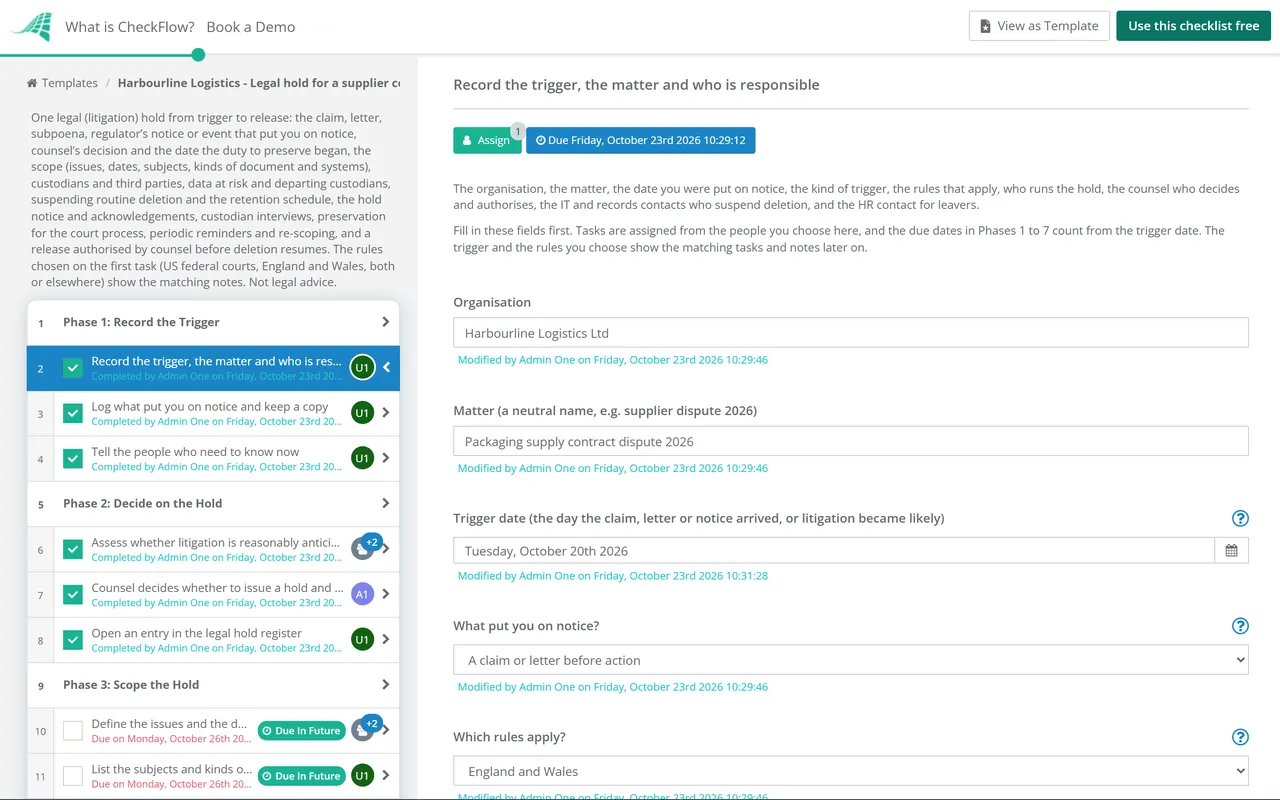
This free legal hold checklist runs one litigation hold from the day you are put on notice to the day counsel releases it. It is for in-house legal teams, outside counsel, litigation support, compliance, IT and records managers. The hold owner records the trigger, whether a claim, a letter before action, a subpoena, a regulator’s investigation or an event that makes litigation reasonably likely. Counsel decides whether to issue a hold and from what date. Then the checklist scopes it (issues, dates, subjects, kinds of document and systems), lists custodians and third parties, deals with leavers and data at risk, suspends routine deletion and the retention schedule, and sends the hold notice and chases every acknowledgement. Interviews, preservation for the court process and periodic reminders follow, until counsel authorises the release and deletion resumes. Choose US federal courts, England and Wales or both on the first task and the matching notes appear. Routine disposal stays with the Data Retention & Disposal Review Checklist, which the hold suspends.

Data Sources, and the Rules at a Glance

Where relevant data lives, and what deletes it

A notice reaches people. Each of these places also deletes or overwrites data by itself, so each needs its own suspension or copy.

Source Examples What deletes it routinely How to preserve it
EmailCustodians’ mailboxes, shared mailboxes, former employees’ accountsRetention and auto-delete policies; accounts removed when people leavePut the mailboxes on hold in the email system; keep leavers’ accounts
Chat and messagingCollaboration chat, channels, text and messaging appsMessage retention settings; messages set to disappearSuspend chat retention for custodians; ask about apps on phones
Files and documentsFile shares, document management, personal drives, cloud storageClean-up jobs, version limits, archive purgesPause the jobs; hold or copy the folders in scope
Business systemsFinance, CRM, ticketing and line-of-business databasesScheduled purges and record archivingPause purges for the records in scope or export them
DevicesLaptops, phones and tablets, including personal devices used for workRefresh, reimaging and recycling; leaver returnsKeep or image the devices before they are reissued
BackupsBackup sets and archive mediaRotation and overwrite cyclesSet aside the backups that hold data in scope
PaperFiles, notebooks, offsite boxesConfidential waste; scheduled destruction at storageStop destruction orders for the records in scope
Third partiesCloud and IT providers, outsourcers, agents, advisersTheir own retention and deletionSend preservation letters and record the replies

US federal courts and England and Wales at a glance

Where the rules differ, the notes on each task follow the answer on the first task. US state courts and other countries have their own rules.

Point US federal courts (FRCP) England and Wales (CPR)
When the duty startsThe common-law duty to preserve once litigation is reasonably foreseeable; Rule 37(e) is based on it and creates no new duty (2015 committee note)As soon as litigation is contemplated (PD 31B para 7); anyone who knows it may become a party (PD 57AD para 3.1, Business and Property Courts)
What it coversRule 37(e) covers electronically stored information (ESI)Any document, including email, texts, social media, voicemail, backups, deleted information and metadata (PD 57AD paras 2.5 and 2.6)
Routine deletionRoutine good-faith operation is one factor, but litigation may call for intervening in it (2015 committee note)Suspend relevant deletion or destruction processes, including under a retention policy (PD 57AD paras 4.1 and 4.2(1); PD 31B para 7)
Notice to peopleNot prescribed by Rule 37(e), which asks whether reasonable steps were takenWritten notification to relevant employees and former employees, naming the documents to keep (PD 57AD paras 4.2(2) and 4.3)
Third partiesInformation lost despite reasonable steps, for example not in the party’s control, is outside Rule 37(e) (2015 committee note)Reasonable steps so agents or third parties holding documents for the party do not delete them (PD 57AD para 4.2(3))
Telling the court and the other sideDiscuss preservation at the Rule 26(f) conference; the discovery plan states views on preserving ESIConfirm in writing with the particulars of claim or defence that steps were taken (PD 57AD para 4.5)
When it endsWhen counsel decides the duty has endedAt the end of the proceedings, including any appeal, or when it is clear there will be none (PD 57AD para 3.3)
Which courtsFederal courts only; state courts have their own rulesPD 57AD in the Business and Property Courts (from 1 October 2022, with exceptions); PD 31B in other multi-track claims

Sources. Federal Rules of Civil Procedure, Rule 37 (subdivision (e) and the 2015 committee note) and Rule 26 (subdivision (f)); 18 U.S.C. § 1519 for US federal investigations; Practice Direction 31B (disclosure of electronic documents) and Practice Direction 57AD (disclosure in the Business and Property Courts) of the Civil Procedure Rules. Read on 23 October 2026.

AI generator

Didn’t find what you need? Describe it.

Describe the process in a sentence and the AI checklist generator drafts the phases and tasks for you.

Frequently Asked Questions

What is a legal hold?

A legal hold, or litigation hold, is an instruction to stop deleting information that may be relevant to a dispute or an investigation. It has two parts: a written notice telling the people who hold the information (the custodians) what to keep, and the suspension of the automatic deletion, retention schedules and disposal that would otherwise remove it. It stays in place until counsel releases it.

When does the duty to preserve start?

Often before any claim is filed. In US federal courts, the 2015 committee note to Rule 37(e) describes a common-law duty to preserve relevant information once litigation is reasonably foreseeable. In England and Wales, Practice Direction 31B says lawyers must tell clients to preserve documents as soon as litigation is contemplated, and in the Business and Property Courts, Practice Direction 57AD puts the duty on anyone who knows it is or may become a party. Counsel decides the date for your matter.

What happens if electronically stored information is lost?

In US federal courts, Rule 37(e) applies when ESI that should have been preserved is lost because a party did not take reasonable steps, and it cannot be restored or replaced. On finding prejudice to another party, the court may order measures no greater than necessary to cure it. Only if the party intended to deprive the other side of the information may it presume the information was unfavourable, instruct the jury that it may or must presume so, or dismiss the action or enter a default judgment. Other courts have their own rules.

What should a legal hold notice say?

Describe the matter neutrally, then say which subjects, kinds of document, places and dates are covered. Tell the recipient not to delete, alter or move anything in scope, and that the notice overrides normal retention rules. Name who to ask, and ask for an acknowledgement. In the Business and Property Courts, Practice Direction 57AD (paragraph 4.3) says the notice should identify the documents or classes of documents and tell the recipient not to delete or destroy them.

Does a legal hold override our retention schedule?

Yes, for the data in scope. Practice Direction 57AD requires relevant deletion or destruction processes to be suspended, including deletion under a retention policy, and Practice Direction 31B (paragraph 7) says the electronic documents to be preserved include those a retention policy would otherwise delete. In US federal courts, the committee note to Rule 37(e) says the prospect of litigation may call for intervening in a system’s routine operation. The Data Retention & Disposal Review Checklist checks for open holds before anything is destroyed.

Who should receive the notice?

Every custodian likely to hold relevant data: the people involved in the events, their teams, assistants and anyone copied in, and the IT and records staff who run the systems. In the Business and Property Courts, Practice Direction 57AD also names former employees who may hold documents, and asks for reasonable steps so that agents and third parties holding documents for you do not delete them. That is why the checklist sends preservation letters to third parties.

What happens when a custodian leaves during the hold?

Their data must outlive their access. Before the account is removed or the laptop reimaged, keep or copy their mailbox, files, chat history and devices, and put the hold into the leaver process so HR and IT know. The checklist asks about leavers when it lists the custodians and again at every review. Run the departure with the Employee Offboarding Checklist and note the hold on it.

When can a legal hold be released?

When counsel decides the duty to preserve has ended: judgment and any appeal are over, a settlement has been carried out, or it is clear no claim will follow. In the Business and Property Courts, Practice Direction 57AD says the duties continue until the proceedings end, including any appeal, or until it is clear there will be none. Before releasing anything, check that no other hold or regulatory duty covers the same data.

Is CheckFlow free for this template?

14-day free trial, no card required. The Business plan is $10 per user per month after the trial. Full details at checkflow.io/pricing.

Put Every Legal Hold on Record

Free trial — no credit card required.

14-day free trial, no credit cardFull refund in your first 30 daysUS hosting, EU on request