Suspicious Activity Report (SAR) Investigation Checklist Template

A suspicious activity report is only as good as the case behind it, and the deadline runs while the case is worked. This template takes one alert to a filing decision that a named decision maker owns, keeps every question routine so nothing reaches the customer, and shows the filing steps only when the decision is to file.

Last reviewed: November 2026

Printed from checkflow.io/templates/financial-services/suspicious-activity-report-investigation-checklist

This free SAR investigation checklist is for AML investigators, financial crime teams and the BSA officers, MLROs and nominated officers who decide whether to report. One run is one case: one alert from transaction monitoring, one referral from a member of staff or one continuing activity review, from the start to the decision and what follows it. The first phase sets up the case and keeps it confidential. The investigator then reviews the customer’s profile and expected activity, pulls and traces the transactions, asks colleagues and, only where it is needed, the customer for information in routine wording, and recommends filing or not with the reasons. The decision maker’s decision is the gate. A decision to file adds the SAR itself: filed with FinCEN through BSA E-Filing in the US, or submitted to the NCA through the SAR Portal in the UK, with a phase for a request for a defence against money laundering where a transaction is waiting. Every decision ends with the account decision, the record and the closure. US and UK only: the rules are FinCEN’s and the Proceeds of Crime Act 2002’s as read on 24 November 2026. The template never says whether to file; your decision maker does.

One Case, From Alert to Filing Decision

The Sanctions Screening Checklist runs one screening cycle against the official lists, where a true match means you stop and report to the sanctions regulator. The AML Compliance Programme Review Checklist looks at the whole programme once a month, including how many cases and SARs there were and how old they are. The KYC Periodic Review Checklist and the Customer Due Diligence Checklist keep the customer file this case reads.

This checklist is the investigation of one case: the customer, the activity, the questions, the recommendation, the decision maker’s decision whether to file, the SAR and the record. Use it for each alert or referral that needs more than a quick look, and feed its outcomes into the monthly review.

This checklist

One case, to a decision whether to file

Covers: the customer’s profile, the activity and its red flags, requests for information in routine wording, the recommendation, the decision, the SAR and any defence request, the account decision and the record.

When: for every alert or referral that becomes a case, and for continuing activity reviews.

Output: a decision with its reasons, a SAR filed on time or a short record of why not, and a closed case.
A different test

The Sanctions Screening Checklist

Covers: one screening cycle, from the list update to alerts, ownership tests, freezing or rejecting and reporting a match.

Use it: when a name may be a designated person; a possible match found in a case goes there. Sanctions Screening Checklist.

Every month

The AML Compliance Programme Review Checklist

Covers: the monthly review of the programme’s management information, from monitoring and cases to training and actions.

Use it: to count and age the cases this checklist closes. AML Compliance Programme Review Checklist.

What the SAR Investigation Checklist Covers

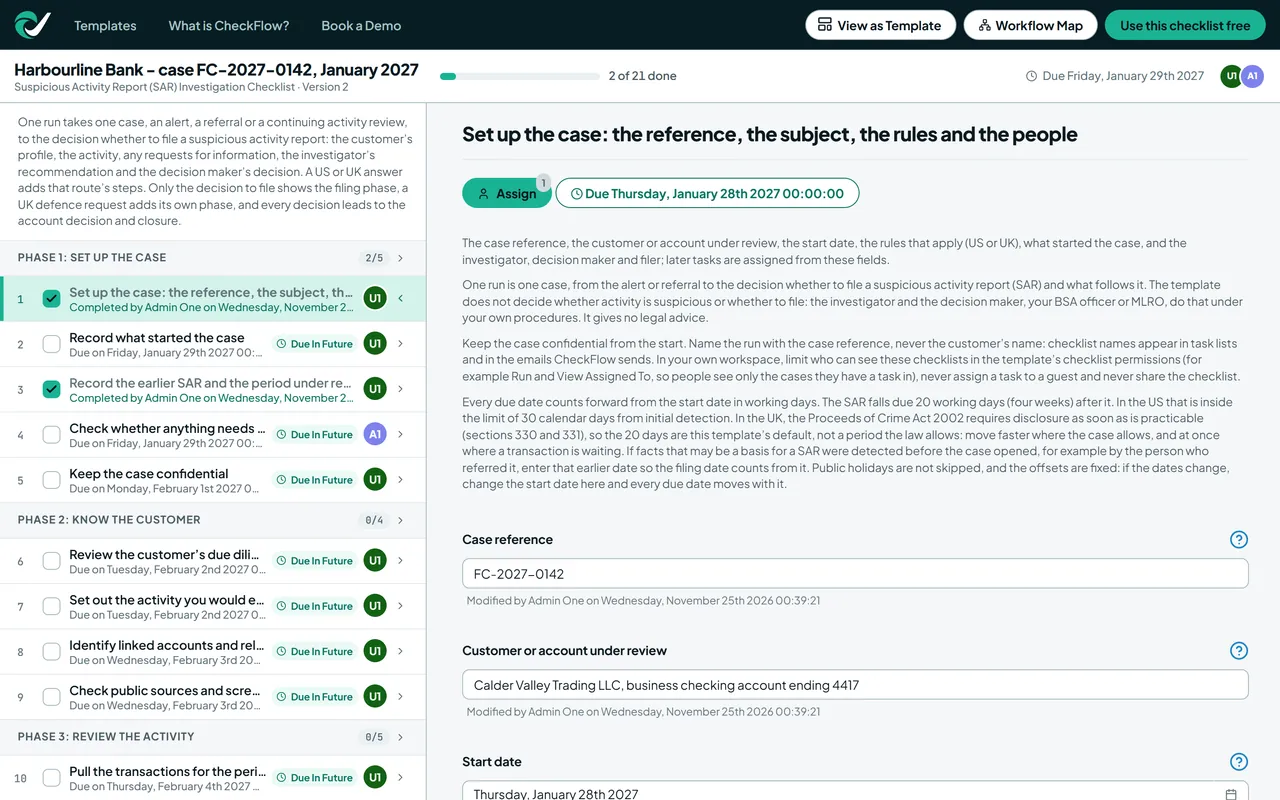
Nine phases take one case from the alert to its closure. The first task sets the start date and the people, and every due date counts forward from the start date in working days: the decision falls due after 17 and the SAR after 20, four weeks, inside the US limit of 30 calendar days from initial detection. In the UK the law asks for disclosure as soon as is practicable, so the 20 days are only this template’s default. Answers add only what the case needs: the US or UK steps, the continuing activity record, the customer request, and the checks when filing would pass 30 or 60 days. The decision maker’s decision is the gate. Nothing after it can be completed until it is done, the filing phase appears only on a decision to file, and a UK defence request adds its own phase.

  1. Phase 1

    Phase 1: Set Up the Case

    6 tasks

    The investigator opens one run for one case: one alert, one referral or one continuing activity review on one customer. The first task assigns every task, sets the start date that every due date counts from in working days, and adds the US or UK steps and the continuing activity steps.

    • Set up the case: the reference, the subject, the rules and the people — the case reference, the customer or account under review, the start date, the rules that apply (US or UK), what started the case, and the investigator, decision maker and filer; later tasks are assigned from these fields
    • Record what started the case — the alerts or referral, the scenario or rule that fired, the date each arrived, who referred it and what they saw
    • Record the earlier SAR and the period under review — the earlier SAR’s BSA ID and filing date, the amount it reported, and the review period, which starts the day after that filing
    • Record the internal report to the nominated officer — who made the report, when it reached the nominated officer and what it said, or how the case reached the nominated officer instead
    • Check whether anything needs immediate action — any sign of an ongoing scheme, an imminent threat or a risk to someone’s safety, and who was told, when and with what reference
    • Keep the case confidential — who may know about the case, a check that the investigator has no link to the customer, and a reminder to everyone involved that nothing about the case may reach the customer
  2. Phase 2

    Phase 2: Know the Customer

    4 tasks

    The investigator reads what the institution already knows about the customer, so the activity can be judged against it. Linked accounts and related parties are found here, before the transactions are pulled.

    • Review the customer’s due diligence file and risk rating — identity, ownership and control, occupation or business, the purpose of the account, the risk rating and the date of the last review
    • Set out the activity you would expect — what the customer said the account is for, its usual volumes and types of payment, and what is normal for similar customers
    • Identify linked accounts and related parties — other accounts the customer holds or controls, signatories, beneficial owners and the counterparties that matter
    • Check public sources and screening results — adverse media, company registers and court records, and the latest sanctions and politically exposed person screening results, with the date and source of each
  3. Phase 3

    Phase 3: Review the Activity

    5 tasks

    The investigator pulls the transactions for the period under review, compares them with what was expected and sets out what makes them unusual. A US case also checks the amount against the institution’s own filing threshold.

    • Pull the transactions for the period under review — every account in scope, the dates the review covers, the number of transactions and their total value
    • Compare the activity with what you expected — volumes, types of payment, counterparties, places and timing against the customer’s profile, and anything the profile explains
    • Identify the red flags and patterns — each feature that makes the activity unusual, such as cash just below a reporting threshold, funds moving straight through or payments with no clear purpose, and any reasonable explanation
    • Trace where the money came from and where it went — the sources and destinations of the funds, the key transactions in a table, and any link between the parties
    • Check the amount against your filing threshold (US) — the amount involved in the suspicious activity against the dollar threshold in the SAR rule for your type of institution
  4. Phase 4

    Phase 4: Ask for Information

    5 tasks

    The investigator fills the gaps from people who know the customer and, where it is needed, from the customer. Every question is worded as routine, so nothing tells the customer there is a case.

    • Ask colleagues who know the customer — questions to the relationship manager or branch about the customer’s business and the activity, kept to what the case needs and recorded
    • Decide whether to ask the customer for information — whether a question to the customer would fill a real gap, and whether asking could alert them, agreed with the decision maker
    • Send the customer a routine request for information — questions any account review might ask, such as the source of the funds or the purpose of the payments, in your usual wording and read by the decision maker first
    • Share information with other financial institutions under section 314(b) (US) — where both institutions have a current notice with FinCEN, questions to another institution about the customer’s payments, and what came back
    • Record the customer’s answer — what the customer said and sent, whether it explains the activity, and a note if no reply came by the date you set
  5. Phase 5

    Phase 5: The Investigator’s Recommendation

    4 tasks

    The investigator writes up the case and recommends filing or not filing, with the reasons. A US case records the date of initial detection, and a planned filing date more than 30 days after it adds the checks the rule requires.

    • Write the case summary — who is involved, what happened, when and where, how the money moved and why it is or is not suspicious, with the evidence for each point
    • Make the investigator’s recommendation — a recommendation to file or not to file, the reasons, and for a US case the date of initial detection and the days from it to the planned filing date
    • Check whether the extra 30 days apply (US) — whether a suspect was identified on the date of detection, since only when none was may filing wait up to 60 days to identify one, and the planned date moved if the extra time does not apply
    • Escalate a filing that would pass 60 days (US) — the decision maker told at once, the reasons for the delay recorded, and the SAR filed as soon as possible
  6. Phase 6

    Phase 6: The Filing Decision

    3 tasks

    The decision maker, your BSA officer or MLRO, reads the case and decides whether to file. The decision is the gate: nothing after it can be completed until it is done, and only the steps for the decision made appear.

    • Review the case file — the summary, the evidence, the recommendation and any gaps, with questions back to the investigator
    • Do the further work the decision maker asked for — each question answered or gap filled, the case summary updated, and the case sent back for a decision
    • Decide whether to file a SAR — the decision maker reads the case and decides to file, not to file or to ask for more work, with the reasons, and completes this task with the decision
  7. Phase 7

    Phase 7: File the SAR

    6 tasks

    Applies only when the decision is to file. On a UK defence request the transaction is stopped first. The filer drafts the SAR from the case summary, the decision maker checks it, and it is filed with FinCEN or submitted to the NCA within the deadline.

    • Keep the transaction stopped until a defence applies — the transaction stopped before the SAR goes in, the restriction checked so no one can override it, and the date the 7 working day notice period will end
    • Draft the SAR narrative — who, what, when, where, why and how, in plain words, with the amounts, dates and accounts, and nothing the case did not establish
    • Check the SAR before it is filed — the subjects, accounts, amounts and dates against the case file, the narrative against the evidence, and the date against the deadline
    • File or submit the SAR — the SAR filed through FinCEN’s BSA E-Filing System or submitted through the NCA’s SAR Portal, the BSA ID or reference number from the acknowledgement saved, and the date checked against the deadline
    • Keep the supporting documentation with the SAR — the evidence the SAR rests on, identified as its supporting documentation and kept with the case, ready for a lawful request
    • Tell the board or its committee where your rules require it — the notice your rules or procedures require, given promptly in the way they set, and never to a director or officer who is a subject of the SAR
  8. Phase 8

    Phase 8: Defence Against Money Laundering (UK)

    3 tasks

    Applies only when the decision is to file a SAR with a request for a defence against money laundering. The transaction stays stopped while the NCA considers it, and the customer’s questions are handled without tipping them off.

    • Handle the customer’s questions without tipping them off — who answers the customer, the holding wording your procedures approve, and a record of each contact while the transaction waits
    • Record the NCA’s response — a granted letter, a refusal with the date it was received and the 31-day moratorium it starts, or the notice period ending with no refusal
    • Decide whether to go ahead with the transaction — go ahead only once a defence is granted, the notice period ends with no refusal or the moratorium ends, and record what was done; a defence does not oblige you to go ahead
  9. Phase 9

    Phase 9: Account Decision and Closure

    5 tasks

    Applies only once the decision is made, whichever it is. The decision maker decides what happens to the relationship after any NCA answer, and the case is closed with its record kept for the period that applies.

    • Record why no SAR was filed — a short statement of the decision and the facts behind it, enough for your own procedures
    • Decide what happens to the customer relationship — keep the account with closer monitoring, restrict it or end the relationship, decided under your procedures after any NCA answer and carried out without tipping off
    • Decide whether to review continuing activity — whether your procedures call for a separate review after this SAR and, if so, the date it falls due and a new run of this checklist diaried for it
    • Keep the case record for the period that applies — the case file, the evidence and any SAR kept with access limited, and the date the record may be destroyed
    • Close the case — every task done or marked not applicable, the case closed in your case system, and the result counted in the monthly management information

US and UK Reporting Rules Compared

The rules this checklist follows

The answer on the first task decides which steps and notes the run shows.

Topic United States (FinCEN) United Kingdom (POCA and the NCA)
Who must reportEach type of financial institution under its own SAR rule in 31 CFR chapter X (table below)Anyone in the regulated sector to the nominated officer, and the nominated officer to the NCA (POCA sections 330 and 331)
AmountFor banks, transactions involving or aggregating at least $5,000; other rules set their own amounts, and the banking agencies add cases such as insider abuse involving any amountNone in POCA sections 330 and 331
Deadline30 calendar days from initial detection; up to 60 if no suspect was identified on that date (31 CFR 1020.320(b)(3))“As soon as is practicable” (POCA sections 330 and 331)
How to fileBSA E-Filing, which returns a BSA IDThe SAR Portal, which returns a reference number
A transaction waitingImmediate telephone call to law enforcement for violations needing immediate attention, as well as the SARA request for a defence against money laundering: a notice period of 7 working days and, if refused, a moratorium of 31 days (POCA section 335)
Continuing activityA separate review is not required; FinCEN’s optional guidance is a review after 90 days and a SAR within 120 days of the last onePOCA sets no review cycle; new knowledge or suspicion is reported under sections 330 and 331
ConfidentialityNo disclosure of a SAR or anything that would reveal one (31 CFR 1020.320(e); 31 U.S.C. 5318(g)(2))Tipping off and prejudicing an investigation are offences (POCA sections 333A and 342)
RecordsThe SAR and its supporting documentation for five years from filing (31 CFR 1020.320(d))Customer due diligence and transaction records for five years from the end of the relationship (MLR 2017 regulation 40)

FinCEN SAR rules by type of institution

FinCEN’s 9 October 2025 SAR FAQs list the institutions covered by SAR rules. Each rule sets its own amount and terms, so the first task asks which applies, and the threshold task asks whether the amount is met.

Type of institution SAR rule
Banks31 CFR 1020.320, with the banking agencies’ rules: 12 CFR 208.62 (Federal Reserve), 12 CFR part 353 (FDIC), 12 CFR 748.1(d) (NCUA) and 12 CFR 21.11 (OCC)
Casinos and card clubs31 CFR 1021.320
Money services businesses31 CFR 1022.320
Brokers or dealers in securities31 CFR 1023.320
Mutual funds31 CFR 1024.320
Insurance companies31 CFR 1025.320
Futures commission merchants and introducing brokers in commodities31 CFR 1026.320
Loan or finance companies31 CFR 1029.320
Housing government sponsored enterprises31 CFR 1030.320

Read on 24 November 2026: 31 CFR 1020.320, 1010.430 and 1010.540 and 12 CFR 21.11 on eCFR (up to date as of 23 November 2026), 31 U.S.C. 5318(g), FinCEN’s SAR FAQs of 9 October 2025 and its SAR FAQ page, the Proceeds of Crime Act 2002 and the Money Laundering Regulations 2017 on legislation.gov.uk, and the UKFIU’s SARs best practice guidance, Chapters 2 and 3 (December 2025). FinCEN’s 2025 FAQs say they do not change any legal or regulatory requirement. Terrorist financing reports under the Terrorism Act 2000 follow their own rules, which this template does not cover. The NCA says it cannot advise whether to submit a SAR, and neither does this template: take advice from your supervisor, regulator or a lawyer where a case is not clear.

Why Run SAR Investigations in CheckFlow?

1

A decision only the decision maker can make

The filing decision is a gate: nothing after it can be completed until it is done, and only the named BSA officer, MLRO or nominated officer can open it. Do not file shows its own short record and never the filing steps. See how approval steps work.

2

Deadlines from the day the case starts

Every due date counts from the start date, so the SAR falls due four weeks later and a planned date past 30 or 60 days adds the checks the US rule needs. A UK defence request adds the notice period and moratorium steps. Every case sits on the Reports Grid with its answers.

3

Confidential by design

Name each run by case reference, not by customer. Limit who sees these checklists with the template’s checklist permissions, for example Run and View Assigned To, and keep guests and share links out of it. Analytics shows overdue and late work by person and by step.

CheckFlow does not decide whether activity is suspicious or whether to file, and it does not file the SAR: your investigator and decision maker decide, and you file through BSA E-Filing or the SAR Portal. CheckFlow runs the process around them: who looked at what, which questions were asked and how they were worded, who decided, when the SAR went in and how long the record is kept.

Send a possible sanctions match to the Sanctions Screening Checklist, refresh an out-of-date customer file with the KYC Periodic Review Checklist, and count and age your cases each month in the AML Compliance Programme Review Checklist. Law firms forming a suspicion during client checks can start from the Law Firm AML Client Due Diligence Checklist.

AI generator

Didn’t find what you need? Describe it.

Describe the process in a sentence and the AI checklist generator drafts the phases and tasks for you.

Frequently Asked Questions

What is a suspicious activity report (SAR)?

A SAR is a confidential report a financial institution makes when it knows or suspects that activity may involve money laundering or another crime. In the US, institutions covered by FinCEN’s SAR rules file them with FinCEN; for banks, the rule covers transactions of at least $5,000 that meet its tests (31 CFR 1020.320). In the UK, people in the regulated sector report to their nominated officer, who reports to the National Crime Agency (Proceeds of Crime Act 2002, sections 330 and 331).

What should a SAR investigation checklist include?

What started the case and whether anything needs immediate action; the customer’s profile and expected activity; linked accounts and public sources; the transactions, red flags and flow of funds; any request for information, worded as routine; the investigator’s recommendation; the decision maker’s decision and reasons; the SAR, filed on time; any defence request in the UK; the account decision; and the record. This checklist covers each one, and shows the filing steps only on a decision to file.

How long does a US bank have to file a SAR?

No later than 30 calendar days after the date of initial detection of facts that may constitute a basis for filing. If no suspect was identified on that date, a bank may take another 30 days to identify one, but never more than 60 days in all (31 CFR 1020.320(b)(3)). Where a violation needs immediate attention, such as an ongoing money laundering scheme, the bank must also telephone law enforcement at once.

What is tipping off, and how does an investigation avoid it?

In the UK, tipping off is disclosing that a report has been made, or that an investigation is contemplated or under way, where that is likely to prejudice an investigation (POCA section 333A). In the US, no one may tell a person involved that a transaction has been reported (31 U.S.C. 5318(g)(2)). This checklist keeps requests to the customer in routine wording, limits who knows about the case, and handles questions and exit letters without hinting at a report.

Do you have to document a decision not to file a SAR?

In the US, FinCEN and the federal banking agencies said on 9 October 2025 that there is no requirement or expectation under the BSA to document a decision not to file. An institution that chooses to can usually rely on a short, concise statement. In the UK, follow your own procedures and your supervisor’s guidance. This checklist asks for a short statement when the decision is Do not file a SAR.

What is a continuing activity review, and is it required?

It is a look at whether suspicious activity carried on after a SAR was filed. FinCEN’s 2025 FAQs say a separate review is not required: institutions may rely on risk-based monitoring. Where an institution chooses to follow FinCEN’s continuing activity guidance, it reviews the 90 days after the SAR and files any continuing activity SAR within 120 days of it. This checklist runs that review as its own case, with the earlier SAR recorded.

What is a DAML, and how long does the NCA have to respond?

A defence against money laundering (DAML) is requested in a SAR to the NCA when a firm is about to do something with property it suspects is criminal. The notice period is seven working days from the first working day after the disclosure. If the NCA refuses, a 31-day moratorium starts on the day the refusal is received, and a court can extend it (POCA sections 335 and 336A). The transaction waits until a defence applies.

How long must SAR records be kept?

A US bank keeps a copy of each SAR and its supporting documentation for five years from the date of filing, and makes the documentation available to FinCEN, law enforcement and its examiners on request (31 CFR 1020.320(d)). In the UK, regulation 40 of the Money Laundering Regulations 2017 keeps customer due diligence and transaction records for five years from the end of the relationship; set your own period for the case file.

Does this checklist decide whether to file, or file the SAR for us?

No. Your investigator recommends and your BSA officer, MLRO or nominated officer decides; the template never says whether to file. The SAR is filed through FinCEN’s BSA E-Filing System or submitted through the NCA’s SAR Portal, and the checklist records the BSA ID or reference number. The NCA also says it cannot advise whether to submit a SAR, so take advice from your supervisor or a lawyer where a case is not clear.

Is CheckFlow free for this template?

14-day free trial, no card required. The Business plan is $10 per user per month after the trial. Full details at checkflow.io/pricing.

Take Every Alert to a Decision Your Records Can Defend

Free trial — no credit card required.

14-day free trial, no credit cardFull refund in your first 30 daysUS hosting, EU on request