IPO Readiness Checklist Template

Planning a listing in the US or the UK? Line up the advisers, get the audits, controls and board to listing standard, take the registration statement or prospectus through review, and record the board’s go or no-go before you launch.

Last reviewed: November 2026

Printed from checkflow.io/templates/investor-relations/ipo-readiness-checklist

This free IPO readiness checklist is for CFOs, finance teams and general counsel preparing a company for a stock market listing in the US or the UK. One run covers one company’s readiness programme, planned back from the target listing date about 18 months ahead. It records the board’s decision to start and the market, appoints counsel, the auditor, the banks and, in the UK, a sponsor, and brings the financial statements, the close and the internal controls up to the standard a listed company needs. It builds the board and its committees, tidies the cap table, adopts the policies, writes the equity story and briefs everyone on the publicity rules. It takes the registration statement through the SEC’s nonpublic review, or the prospectus through the FCA’s, alongside a data room for the banks. One named person records the board’s go or no-go before the launch, and the run ends with the first report after listing. It reflects the SEC, Nasdaq and FCA rules as read on 4 November 2026, including the UK prospectus rules in force since 19 January 2026.

IPO Readiness, SOX Compliance or an Investor Data Room?

This checklist is the company’s own readiness programme before a listing in the US or the UK: the work the CFO runs to make the company fit to be public, from the first board decision to the first report after the listing. It does not run the banks’ side of the offering, the bookbuilding or the legal drafting itself; it tracks that those steps happen, on time and with a named owner.

The first annual report on internal control after the listing has its own checklist, the SOX 404 Compliance Checklist, and this one hands over to it. A data room for a private funding round is the Investor Data Room Checklist; this checklist opens a data room for the banks’ due diligence and links to it for the detail. The board meetings along the way use the Company Board Meeting Preparation Checklist, and a sale to a private equity buyer instead of a listing is covered by the Private Equity Due Diligence Checklist from the buyer’s side.

This checklist

IPO readiness

Covers: the decision and the market, advisers, audited financial statements, the close and controls, the board, equity, the equity story, publicity rules, the registration statement or prospectus, the data room, the board’s go or no-go, the launch and the first reports.

Planned around: the target listing date, about 18 months ahead.

Output: a company ready to list, and a record of who did what.

After the listing

SOX 404 compliance

Covers: one year’s scoping, documentation, testing and reporting of internal control over financial reporting.

Planned around: the fiscal year end.

Output: management’s report on internal control. This checklist hands the controls work over to it.

A private round

Investor data room

Covers: the documents a startup gathers and shares for investors’ due diligence in a funding round.

Planned around: the round’s timetable.

Output: a complete, well-indexed data room. This checklist links to it for the banks’ data room.

What the IPO Readiness Checklist Covers

Nine phases take one company from the decision to prepare for a listing to its first months as a listed company. The first task records the target listing date, which sets every due date, and the market, which adds the US tasks (emerging growth company status, SOX planning, testing the waters, the registration statement and Section 16 reports) or the UK tasks (the sponsor, working capital, the controls declaration, re-registration as a plc, the prospectus and insider lists). The go or no-go in Phase 8 is assigned to one person, and nothing after it can be completed until the board decides to launch.

  1. Phase 1

    Phase 1: Decision & Target Market

    5 tasks

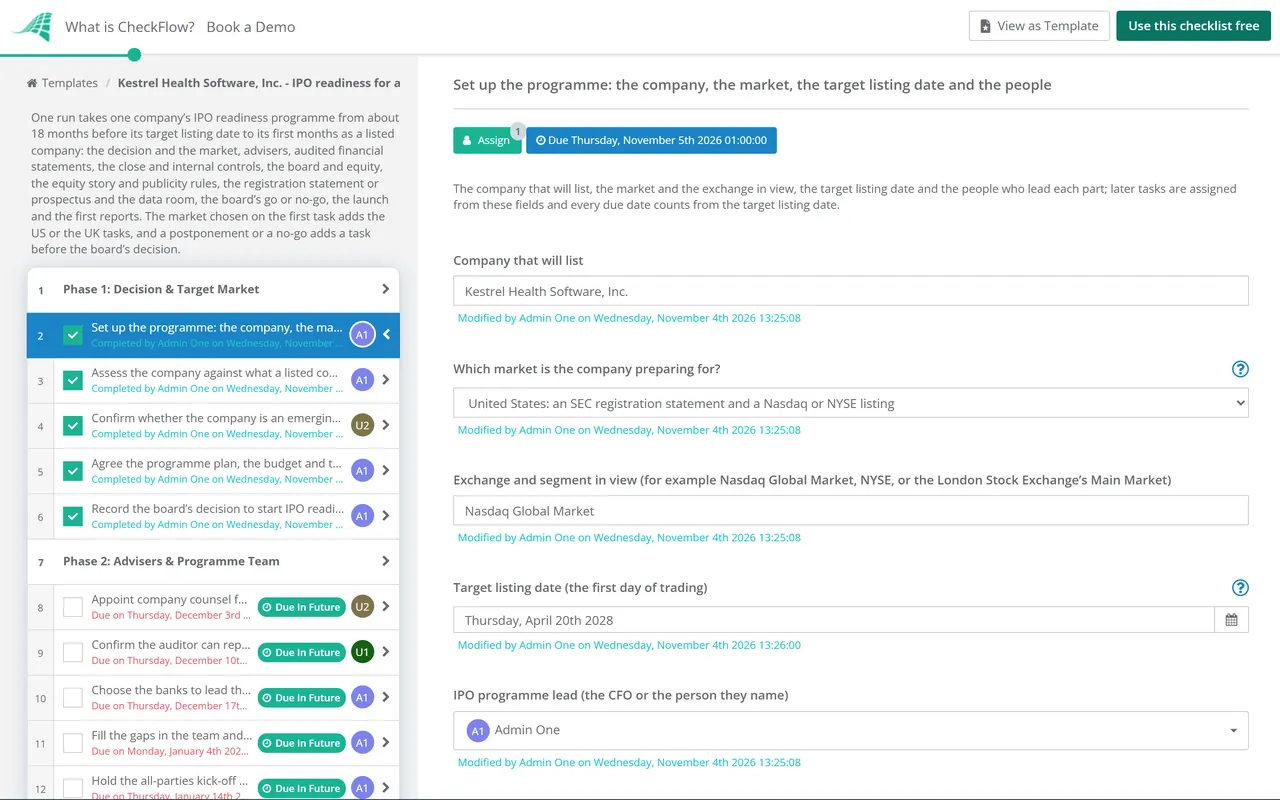
    Owned by the IPO programme lead. Enter the target listing date on the first task: every due date counts back from it in working days, starting about 18 months before, and the tasks after the listing count forward. Choose the market, and the tasks and notes for the US or the UK route appear.

    • Set up the programme: the company, the market, the target listing date and the people — the company that will list, the market and the exchange in view, the target listing date and the people who lead each part; later tasks are assigned from these fields and every due date counts from the target listing date
    • Assess the company against what a listed company must do — a gap analysis across financial reporting, the close, internal controls, governance, legal structure, systems, tax and people, with an owner and a target date for each gap
    • Confirm whether the company is an emerging growth company (US) — the company’s total annual gross revenues for its most recently completed fiscal year, whether it has sold common equity under a registration statement before, and counsel’s view of its status
    • Agree the programme plan, the budget and the timetable — the workstreams from this checklist, the budget for advisers and new hires, the timetable back from the target listing date, and how progress is reported to the board
    • Record the board’s decision to start IPO readiness — the board’s approval to start the programme, the market and the target date it agreed, and how often it wants updates; this is not the decision to launch, which comes in Phase 8
  2. Phase 2

    Phase 2: Advisers & Programme Team

    6 tasks

    Appoint the advisers who will work on the listing and fill the gaps in the finance, legal and investor relations team. The auditor, counsel and the banks each need time to learn the business before the drafting starts.

    • Appoint company counsel for the listing — a firm with experience of listings on the chosen market, its scope, the team and the fee basis, and conflicts checked
    • Confirm the auditor can report on the company to listing standard — that the auditor is independent of the company under the rules of the chosen market and can audit every period the registration statement or prospectus needs, and any extra accountants’ work agreed
    • Choose the banks to lead the offering — the lead underwriters or bookrunners chosen after the pitches, their roles, and the research and distribution each brings
    • Appoint an FCA-approved sponsor (UK) — a firm on the FCA’s list of approved sponsors, appointed before the prospectus is submitted; it may be one of the banks
    • Fill the gaps in the team and appoint the other advisers — the finance, technical accounting, tax, legal, company secretarial and investor relations roles a listed company needs, and the registrar or transfer agent, the financial printer and any other adviser
    • Hold the all-parties kick-off and agree the working group list — everyone working on the listing, their roles and contact details, the timetable, the confidentiality rules for the project and the codename if one is used
  3. Phase 3

    Phase 3: Financial Statements to Listing Standard

    7 tasks

    The registration statement or prospectus needs audited financial statements for set periods, the latest interim period and a review of results. Settle the periods and the hard accounting questions first, then the audits.

    • Confirm which periods must be audited, and in which framework — the fiscal years and the interim period the document will contain, the accounting framework, and the date by which each set of figures must be ready
    • Settle the accounting judgements a regulator is likely to ask about — revenue recognition, share-based payments and the value of recent grants, segments, earnings per share, related parties, acquisitions and any restatement, each written up with the auditor’s view
    • Define the key performance indicators and any non-GAAP measures — the operating measures the business will report, how each is calculated and controlled, and every non-GAAP or alternative performance measure with its reconciliation
    • Have the historical financial statements audited — every period the document needs audited to the standard of the chosen market, with the audit reports signed and the auditor’s points closed
    • Prepare the latest interim financial statements and have them reviewed — the interim period the document will include, prepared on the same basis as the audited years and reviewed by the auditor where the market or the banks require it
    • Draft the review of results and financial condition — the discussion of results, liquidity, capital resources and trends for each period, written from the audited figures and checked against them
    • Prepare the working capital forecast and the financial position and prospects procedures (UK) — the board’s working capital forecast and its basis, and the procedures the directors use to judge the company’s financial position and prospects, ready for the sponsor’s work
  4. Phase 4

    Phase 4: Close Calendar, Reporting & Controls

    7 tasks

    A listed company reports on fixed dates and stands behind its controls. Shorten the close, document and test the key controls, and set up disclosure controls before the first report falls due.

    • Shorten the close and set the reporting calendar for a listed company — the close timetable, the dates for each periodic report and results announcement in the first year, and who prepares and reviews each
    • Scope and document the key controls over financial reporting — the significant accounts and processes, the risks in each, the key controls and IT general controls that address them, and the framework used (for example COSO 2013)
    • Run a close to the listed company timetable as a rehearsal — one quarter or half-year closed, reviewed and reported to the new deadlines, with what slipped and why
    • Rate and fix the control deficiencies — each deficiency found in documenting and testing the controls, its rating, the fix, its owner and when it was retested
    • Plan the SOX 302 certifications and the 404 reports from the first filings (US) — who signs the certifications in each 10-Q and 10-K and the sub-certifications behind them, the year of the first management report on internal control, and whether and when an auditor attestation applies
    • Prepare for the Code’s declaration on material internal controls (UK) — the material controls the board will declare on, how the board monitors and reviews them, and the evidence it will rely on
    • Set up disclosure controls and a disclosure committee — who decides what must be disclosed and when, how information reaches them, the committee’s members and how each decision is recorded
  5. Phase 5

    Phase 5: Board, Governance & Equity

    8 tasks

    Build the board and committees the exchange and the code require, adopt the policies a listed company needs, and tidy the share capital so the cap table in the document is right.

    • Recruit independent directors and set the make-up of the board — the independent directors needed, the search, each director’s independence assessed and recorded, and the dates they join
    • Clean up the cap table and the classes of shares — the register reconciled to the cap table, preferred shares, warrants, convertible notes and options mapped to what happens to each at the listing, and every holder’s consent needed
    • Form the audit, pay and nominations committees and adopt their terms — each committee’s members, chair and written charter or terms of reference, with the audit committee’s financial expertise recorded
    • Put in place the equity incentive plans for after the listing — the plans for employees and executives, the share pool, the terms, shareholder approval and how awards will be granted after the listing
    • Re-register the company as a public limited company (UK) — the special resolution, the share capital and net assets conditions, the application to Companies House and the new name ending in plc, before any offer of shares to the public
    • Adopt the policies a listed company needs — the code of conduct, the insider dealing or insider trading policy, the disclosure policy, the related party policy and the compensation recovery policy where it applies
    • Adopt the constitution for a listed company — the new articles, or charter and bylaws, approved by the shareholders and taking effect at the listing, with any change to voting rights or share classes agreed
    • Agree the lock-up arrangements with existing shareholders — who is locked up, for how long, the exceptions, and the signed lock-up letters the banks ask for
  6. Phase 6

    Phase 6: Equity Story, Investor Relations & Publicity

    4 tasks

    Decide how the company will explain itself to investors, set up investor relations, and make sure nobody says anything about the offering that the rules on publicity do not allow.

    • Write the equity story and test it against comparable listed companies — the investment case in a few points, the comparable listed companies, the measures investors will use to value the company, and the evidence for each claim
    • Brief directors and staff on the publicity rules before the offering — what may and may not be said about the company and the offering, who may speak, how normal advertising and announcements continue, and who checks a communication before it goes out
    • Set up investor relations and the investor calendar — the investor relations website, the contact for investors and analysts, the first year’s calendar of results and meetings, and who may speak to investors
    • Plan any testing-the-waters meetings with institutional investors (US) — whether to test the waters, the investors to be met, what may be said and shown, and the record of each meeting
  7. Phase 7

    Phase 7: Registration Statement, Prospectus & Data Room

    6 tasks

    Open the data room for the banks’ due diligence, draft the registration statement or the prospectus, take it through the regulator’s review, and verify every statement in it.

    • Open the due diligence data room for the banks and their counsel — the index, the documents behind every statement the document will make, access by party, and the questions log
    • Collect directors’ and officers’ questionnaires and arrange their insurance — a completed questionnaire from every director and officer, the answers checked against the document, and directors’ and officers’ insurance for a listed company
    • Draft the registration statement, submit it for nonpublic review and answer the SEC’s comments (US) — the Form S-1 drafted with counsel and the banks, submitted to the SEC staff as a draft registration statement, and each round of staff comments answered
    • Draft the prospectus, submit it to the FCA and answer its comments (UK) — the prospectus drafted with counsel, the sponsor and the reporting accountants, submitted to the FCA for review, and each round of comments answered until it is ready for approval
    • Verify the document and collect the comfort letters, opinions and consents — every statement in the document traced to its evidence, the auditor’s comfort letter, the legal opinions and the consents of the experts named
    • Start the listing application with the exchange — the exchange’s application or eligibility process started, its questions answered, and the timetable for the final applications agreed with the exchange and, in the UK, the FCA
  8. Phase 8

    Phase 8: Board Go or No-Go & Launch

    9 tasks

    The person named on the first task records the board’s go or no-go to launch the offering. Nothing after it can be completed until it is done. A postponement or a no-go shows a task above it, and the decision stays open.

    • Confirm every readiness item is closed or has an agreed plan — each gap from the first assessment closed or accepted, the audits, controls, board, policies, document and data room ready, and anything open listed for the board
    • Set a new target listing date and finish the open work — after ‘Not yet: postpone to a new target listing date’ only: why the launch is postponed, the new date agreed, and what must be finished before the board decides again
    • Record the decision not to go ahead and close the programme — after ‘No-go: do not go ahead with the listing’ only: the reasons, what the advisers have been told, which readiness work the company keeps (controls, governance, reporting), and the costs to settle
    • Record the board’s go or no-go to launch the offering — the board’s decision on the readiness paper: whether the company launches the offering on this timetable, with any conditions
    • Launch the offering: file publicly or publish the prospectus — the public filing or the published prospectus, the announcement, and the price range or offer terms agreed with the banks
    • Start the insider lists and the PDMR dealing notifications (UK) — from the day the company requests admission to trading: the insider list drawn up and kept up to date, each person on it told of their duties in writing, and the persons discharging managerial responsibilities briefed on notifying their dealings
    • Make sure directors, officers and 10% holders file their first Section 16 reports (US) — each insider’s first statement of holdings filed when the shares are registered, and every insider briefed on reporting later changes
    • Hold the road show and record the pricing approval — the road show meetings, the book, and the approval of the price and the allocation by the board or its pricing committee
    • Confirm the shares are admitted and trading has started — the exchange’s confirmation, the first day of trading, settlement of the offering and the announcements made
  9. Phase 9

    Phase 9: First Months as a Listed Company

    3 tasks

    The first report, the first results call and the hand-over to the first annual control cycle. Review the programme while it is fresh.

    • Work out the first periodic report’s deadline, file or publish it, and hold the results call — the deadline for the first quarterly, half-yearly or annual report after the listing worked out from the rule for the chosen market (this task is due 30 working days after the listing date; if the rule gives an earlier date, work to that), the report taken through the reporting calendar and the disclosure committee with the certifications or responsibility statements signed, then the results release and the investor call
    • Hand the controls work over to the first annual cycle — the controls documentation, the open deficiencies and the testing plan handed to the owner of the first annual report on controls
    • Review the IPO programme and close the checklist — what went well, what did not, the advisers’ performance, the lock-up end dates and the plan for them, and the actions for the first year

What Listing in the US or the UK Involves

The US and UK routes side by side

The market chosen on the first task shows the tasks and notes for one column. Shared work, such as advisers, audits, controls, the board and the equity story, runs the same way on both.

Topic United States (SEC, Nasdaq) United Kingdom (FCA, commercial companies category) Source
The offering documentA registration statement (the SEC says any company may use Form S-1), with the prospectus as Part I and audited financial statements.A prospectus approved by the FCA and published before the shares are admitted to trading.SEC, What is a registration statement?; PRM 1.4.1R
Review before launchThe SEC staff can review drafts on a nonpublic basis if the company files them publicly at least 15 days before any road show.The FCA reviews the draft prospectus before approving it.SEC, March 2025; PRM 1.4.1R
Adviser the rules requireNo equivalent of a sponsor; counsel and the underwriters lead the work.An FCA-approved sponsor when a prospectus must be submitted to the FCA.UKLR 4.2.1R
Audited yearsThree fiscal years, or two for an emerging growth company or a smaller reporting company.As PRM sets for the prospectus; confirm with your sponsor and reporting accountants.SEC, emerging growth companies; Regulation S-X Rule 8-02; PRM
BoardA majority of independent directors, with twelve months from the first day of trading for an IPO company (Nasdaq).The UK Corporate Governance Code 2024 on a comply or explain basis; independence from any controlling shareholder.Nasdaq Rules 5605(b) and 5615(b); FRC; UKLR 5.3.1R
Audit committeeAt least three independent members meeting Rule 10A-3, phased in over a year for an IPO (Nasdaq).A body with a majority of independent members, one with accounting or auditing competence, and an independent chair.Nasdaq Rules 5605(c) and 5615(b); DTR 7.1
Internal controlsCEO and CFO certifications in each 10-Q and 10-K; management’s report from the second annual report; auditor attestation unless an emerging growth company or non-accelerated filer.The Code’s Provision 29 declaration on material internal controls, for financial years from 1 January 2026.SOX 302 and 404; Item 308 of Regulation S-K; FRC
Shares in public handsSet by the exchange’s own listing standards.At least 10% of the class in public hands at admission.UKLR 5.5.2R
Publicity before the offeringSection 5 of the Securities Act, with the safe harbours in Rules 163A and 169 and testing the waters under Rule 163B.The financial promotion restriction in section 21 of FSMA 2000.Rules 163A, 163B and 169; FSMA s21
InsidersSection 16 reports from directors, officers and 10% holders; changes reported within two business days.Insider lists kept under UK MAR Article 18, and PDMRs’ dealings notified within three working days under Article 19.Exchange Act s16(a); UK MAR Articles 18 and 19
Periodic reportsForms 10-K, 10-Q and 8-K; the first 10-Q within 45 days of effectiveness or when otherwise due, whichever is later.Annual financial report within four months of the year end; half-yearly report within three months.Rule 13a-13; DTR 4.1.3R and 4.2.2R

Where this comes from. Read on 4 November 2026: the SEC’s Going public pages and its draft registration statement accommodations (March 2025); Regulations S-K, S-X, G and FD and the Exchange Act rules on Cornell’s Legal Information Institute; the Nasdaq 5600 series; the FCA Handbook’s UKLR, PRM and DTR as in force that day; the Public Offers and Admission to Trading Regulations 2024, the UK Market Abuse Regulation and the Companies Act 2006 on legislation.gov.uk; and the FRC’s page on the UK Corporate Governance Code 2024. The UK prospectus rules changed on 19 January 2026, when the FCA’s PRM sourcebook replaced the old regime, so older UK checklists may describe rules that no longer apply. The NYSE sets its own governance rules in section 303A of its Listed Company Manual. Take legal advice on your own listing.

Why Run IPO Readiness in CheckFlow?

1

A go or no-go the launch waits for

The board’s decision to launch is assigned to one person alone, and the checklist halts there: the public filing or the prospectus, the road show and the listing day cannot be completed until the board says go. A postponement or a no-go shows its own task above the decision and leaves it open, so the launch tasks stay locked.

2

One route, US or UK

Choose the market on the first task. The US route adds emerging growth company status, SOX 302 and 404 planning, testing the waters, the registration statement and Section 16 reports; the UK route adds the sponsor, working capital, the Provision 29 declaration, re-registration as a plc, the prospectus and insider lists. Shared tasks show a short, sourced note for the market chosen.

3

Every workstream has an owner and a date

Name the programme lead, the financial reporting lead, the legal lead, the investor relations lead and the person who records the board’s decision on the first task, and every task is assigned from those fields. Due dates count back from the target listing date in working days, so moving the date moves the whole plan. Track the programme in the Reports Grid.

CheckFlow does not draft the registration statement or the prospectus, file anything with a regulator or give legal or accounting advice: those stay with your team and your advisers. It keeps the readiness programme in one place, with each task, decision and document on the task it came from.

Hand the first annual control work to the SOX 404 Compliance Checklist, run the banks’ data room with the Investor Data Room Checklist, and each quarter’s close with the Quarter-End Close Checklist.

AI generator

Didn’t find what you need? Describe it.

Describe the process in a sentence and the AI checklist generator drafts the phases and tasks for you.

Frequently Asked Questions

What should an IPO readiness checklist include?

The decision and the target market, the advisers, audited financial statements for the periods the document needs, a faster close and a reporting calendar, internal controls, the board and its committees, the cap table and incentive plans, the equity story and investor relations, publicity rules, the registration statement or prospectus, a data room for the banks, the board’s go or no-go and the first reports after listing. This template covers those steps for one listing in the US or the UK.

How far ahead should IPO readiness work start?

This template plans the programme about 18 months before the target listing date and counts every due date back from it in working days, so the audits, controls and board changes have time to settle before the drafting starts. That lead time is this template’s choice, not a rule. Your advisers will set the real timetable; change the target listing date on the first task and every due date moves.

What is an emerging growth company?

The SEC says a company qualifies if it had total annual gross revenues of less than $1.235 billion in its most recently completed fiscal year and had not sold common equity under a registration statement as of 8 December 2011. It may give two years of audited financial statements instead of three, skip the auditor’s attestation under SOX 404(b), defer certain accounting changes and test the waters with institutional investors, for up to five fiscal years after the IPO.

Can a company submit its IPO registration statement to the SEC confidentially?

Yes. The SEC staff reviews draft registration statements for an IPO on a nonpublic basis, for any issuer since 2017, if the company confirms in its cover letter that it will publicly file the registration statement and the drafts at least 15 days before any road show, or before the requested effective date if there is no road show. The SEC expanded these accommodations again in March 2025.

What does a company need to list in the UK’s commercial companies category?

Under the FCA’s UK Listing Rules (in force since 29 July 2024, amended on 19 January 2026): a sponsor approved by the FCA, at least 10% of the class of shares in public hands at admission, a constitution that lets it comply with the rules with equal votes for each share in a class, and independence from any controlling shareholder. A prospectus approved by the FCA under its PRM rules must be published first. A private company must re-register as a public company before offering shares to the public.

What changed in the UK prospectus rules in January 2026?

The Public Offers and Admission to Trading Regulations 2024 replaced the old prospectus regime, and the FCA’s new PRM sourcebook took effect on 19 January 2026. Shares can only be admitted to a UK regulated market after a prospectus approved by the FCA is published, unless an exemption applies. The FCA also stopped requiring a listed company to apply for admission to listing for further issues of a class already listed.

What can a company say publicly before its IPO?

In the US, Rule 163A treats communications made more than 30 days before filing that do not mention the offering as outside section 5(c), Rule 169 covers the regular release of factual business information, and Rule 163B allows testing the waters with qualified institutional buyers and institutional accredited investors. In the UK, section 21 of FSMA 2000 restricts financial promotions. This template briefs directors and staff on these rules; counsel checks each communication.

What board committees does a company need to list on Nasdaq?

Nasdaq’s Rule 5605 asks for a board with a majority of independent directors, an audit committee of at least three independent members who meet Rule 10A-3 and can read financial statements, one with finance or accounting experience, and a compensation committee of at least two independent directors with a written charter. Under Rule 5615(b), a company listing with its IPO phases in the audit committee over a year and has twelve months for the majority independent board.

What reporting starts after a company lists?

In the US, annual and quarterly reports on Forms 10-K and 10-Q with CEO and CFO certifications, current reports on Form 8-K, and Section 16 reports from directors, officers and 10% holders; the first 10-Q falls due within 45 days of effectiveness or when otherwise due. In the UK, an annual financial report within four months of the year end, a half-yearly report within three months, and inside information disclosure, insider lists and PDMR notifications under UK MAR.

Is CheckFlow free for this template?

14-day free trial, no card required. The Business plan is $10 per user per month after the trial. Full details at checkflow.io/pricing.

Run Your IPO Readiness Programme to One Timetable

Free trial — no credit card required.

14-day free trial, no credit cardFull refund in your first 30 daysUS hosting, EU on request