Invoices what the contract says
- Monthly, across all customers
- Follows payment terms and usage
- Creates receivables, not revenue decisions
Last reviewed: October 2026
No Credit Card Required
Printed from checkflow.io/templates/finance-accounting/revenue-recognition-review-checklist
This free revenue recognition review checklist is for controllers, revenue accountants and CFOs who need every new or changed customer contract assessed before revenue is recorded. It takes one contract through the five-step model in ASC 606, IFRS 15 and the revised Section 23 of FRS 102: the contract, performance obligations, transaction price, allocation and timing, then contract costs, disclosure data, a review memo and controller approval. Three scope questions decide whether the contract modification, over-time measurement and non-standard technical review phases appear, so a standard order form gets a short review and an unusual deal gets the full one.
Revenue passes through three processes that are easy to confuse. The billing run raises invoices on the contract’s payment terms. The month-end close books revenue from schedules already set up. The contract review, which this checklist runs, decides what those schedules should be in the first place, one contract at a time, before any revenue is recognised on it.
Under all three frameworks, revenue follows the transfer of control of goods or services, not the invoice. A three-year subscription billed annually in advance, a hardware sale with installation, or a licence with a year of support each produce a revenue pattern that differs from the billing pattern, and the difference sits on the balance sheet as a contract asset or a contract liability. If the review is wrong, every later close repeats the error.
Seven phases take one contract from intake to approval. Phase 2 appears only for a contract modification, Phase 5 only when a performance obligation is satisfied over time, and Phase 7 only for non-standard terms or a contract above your review threshold.
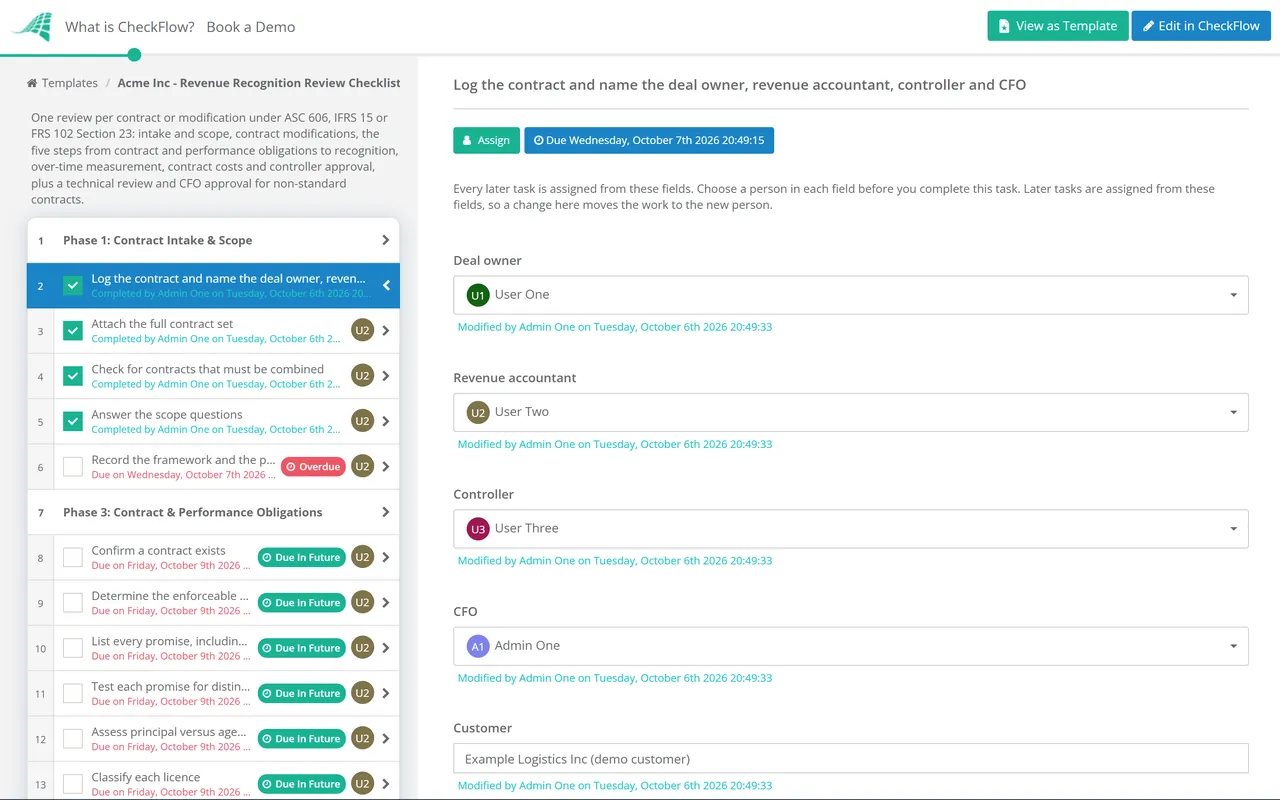
Owned by the revenue accountant. The scope questions decide which later phases this review shows.
Shown only when the contract changes the scope or price of an existing one. Classify the modification first, because it decides what the later steps are applied to.
Shown only when at least one performance obligation is satisfied over time.
Shown only for non-standard terms or a contract value above the review threshold set in Phase 1.
ASC 606 and IFRS 15 were issued as a converged standard and share the five steps, but they are not identical. The differences below are the ones most likely to change the answer, which is why Phase 1 records the framework.
| Topic | ASC 606 (US GAAP) | IFRS 15 |
|---|---|---|
| Collectability (Phase 3) | Collection must be probable, meaning likely to occur, a higher bar | Collection must be probable, meaning more likely than not |
| Constraint on variable consideration (Phase 4) | Include only to the extent it is probable that a significant reversal will not occur | Include only to the extent it is highly probable that a significant reversal will not occur; the boards intended the same level of confidence |
| Financing component (Phase 4) | No adjustment needed if the gap between transfer and payment is expected to be one year or less | The same one-year practical expedient |
| Sales taxes (Phase 4) | Policy election to exclude sales and similar taxes collected from customers from the transaction price | No election: assess each tax as principal or agent |
| Shipping after control passes (Phase 3) | Policy election to treat it as a fulfilment cost | No election: often a separate performance obligation |
| Licences (Phase 3) | Functional intellectual property is generally a right to use; symbolic intellectual property, such as brands, is a right to access | Right to access where your activities significantly affect the intellectual property the customer is exposed to; otherwise a right to use |
| Loss-making contracts (Phase 5) | No general rule in ASC 606; ASC 605-35 applies to construction- and production-type contracts | IAS 37 onerous contract provisions |
| Contract costs (Phase 6) | ASC 340-40: capitalise incremental costs of obtaining a contract you expect to recover; expense them if the amortisation period is one year or less | The same requirement and expedient, in IFRS 15 itself |
| Disclosures (Phase 6) | Private companies may elect not to disclose remaining performance obligations and may give a reduced disaggregation | Full disclosures; obligations in contracts of one year or less may be left out of the remaining obligations disclosure |
FRS 102 now follows the five steps. The FRC’s Periodic Review 2024 rewrote Section 23 as Revenue from Contracts with Customers on the five-step model, for periods beginning on or after 1 January 2026, so the first calendar-year accounts affected are for 2026. It keeps some simplifications: a policy choice to expense or capitalise incremental costs of obtaining a contract, simpler allocation of discounts, a choice on whether to adjust for the time value of money when payment is received in advance, and fewer disclosures. On transition, companies can restate comparatives or record the cumulative effect in opening retained earnings. Companies that bill in advance, sell bundles or run long contracts should review them now.
What else is changing. FASB’s ASU 2025-07 clarifies that share-based payment received from a customer in a revenue contract stays within ASC 606 until the right to receive or keep it becomes unconditional, for annual and interim periods beginning after 15 December 2026. The IASB completed its post-implementation review of IFRS 15 in September 2024 and concluded the standard is working as intended, with no fundamental change planned.
The controller’s approval task halts the checklist until it is answered, and a non-standard contract adds a CFO approval on top. Start a review through the API when a deal closes, so no signed contract is missed.
Three questions in Phase 1 decide the rest. A standard renewal at list price skips the modification and technical review phases. A bespoke multi-year deal with milestones gets all of them.
The contract set, the review memo and each judgement are attached to the task that produced them, and every step records who completed it and when. Export the trail when the auditors select a sample of contracts.
Once the schedule is approved, the Monthly Invoicing & Billing Run Checklist invoices it and the Month-End Close Checklist books and reconciles it. Contracts usually reach finance through the Contract Review & Approval workflow, and the SOX Internal Control Testing Checklist tests the review control.
CheckFlow is not a revenue recognition engine or an accounting system: it does not calculate allocations or build schedules. It runs the review workflow around those tools, so every contract is assessed, approved and evidenced before the first revenue entry.
Describe the process in a sentence and the AI checklist generator drafts the phases and tasks for you.
Under ASC 606, IFRS 15 and the revised FRS 102 Section 23: identify the contract with the customer, identify the performance obligations in it, determine the transaction price, allocate that price to the performance obligations, and recognise revenue when or as each obligation is satisfied. Phases 3 to 6 of this checklist follow those steps in order.
They share the same model and most of the wording. The main differences are a higher collectability threshold under ASC 606, US-only policy elections for sales taxes and shipping, different guidance on classifying licences, different treatment of loss-making contracts and lighter disclosure options for US private companies. The table above sets them out.
When at least one of three criteria is met: the customer receives and consumes the benefit as you perform, your work creates or enhances an asset the customer controls as it is built, or your work creates an asset with no alternative use to you and you have an enforceable right to payment for work completed to date. Otherwise revenue is recognised at the point control transfers.
Under ASC 340-40 and IFRS 15, incremental costs of obtaining a contract that you expect to recover are capitalised and amortised, unless the amortisation period would be one year or less, when they can be expensed. That period can be longer than the initial contract if renewals are expected. Under the revised FRS 102 there is a policy choice to expense or capitalise them.
Yes, if they report under FRS 102, including small entities using Section 1A. The revised Section 23 applies to periods beginning on or after 1 January 2026, with simplifications and fewer disclosures than IFRS 15. Micro-entities using FRS 105 get a further simplified version of the same five-step model from the same date.
14-day free trial, no card required. The Business plan is $10 per user per month after the trial. Full details at checkflow.io/pricing.
14-day free trial, no credit cardFull refund in your first 30 daysUS hosting, EU on request