AGM Planning Checklist Template

The notice went out a day short of 21 clear days, the proxy statement was missing and the special resolution was never sent to Companies House. An AGM is a fixed set of legal steps on a fixed timetable, and each one needs an owner and a date.

Last reviewed: October 2026

This free AGM planning checklist is for company secretaries, general counsel, finance teams and investor relations leads who run a company’s annual general meeting. One run plans one AGM, from setup about twelve weeks before to the actions a few weeks after. It confirms the deadline for holding the meeting and the rules in the articles, agrees the timetable, lists the business and drafts each resolution, and checks any members’ requests. The notice of meeting, the proxy statement and the proxy form go to the board, which approves them with the annual report before anything is sent. Then the pack goes to members, directors and the auditor, the venue and registration are prepared, and the chair is briefed with a script, likely questions and the proxy figures. On the day it covers quorum, voting by show of hands or poll and the results, and afterwards the minutes, the Companies House filings and next year’s date. The company type shows the notes for a private, public or traded company, or another body.

An AGM Is a Members’ Meeting, Not a Board Meeting

An annual general meeting is a meeting of the company’s members, not of its board. The board calls it, but the members receive the accounts, elect the directors, appoint the auditor and vote on the resolutions. In the UK a public company must hold one every year, and a private company holds one only if its articles require it or it is a traded company.

Most of the risk in an AGM sits in the weeks before it. A notice that goes out a day late, or does not give the text of a special resolution, can mean the resolution is not validly passed, and a notice without the proxy statement is an offence by the officers in default. This checklist plans one AGM from the timetable to the filings, with the board’s approval of the notice before anything goes to members. It is a planning aid, not legal advice: check your own articles and take advice where the rules are unclear.

This checklist

The annual general meeting

Who meets: the members, with the directors and the auditor attending.

Planned around: the deadline for holding it, the notice period, proxies and the resolutions.

Output: resolutions passed, minutes signed and the filings made.

Every quarter

A board meeting

Who meets: the directors.

Planned around: the agenda, the board pack, conflicts of interest and quorum.

Output: board decisions, minutes and an action log, in the Company Board Meeting Preparation Checklist.

Every year

The annual accounts

Who does it: finance, the auditor and the directors.

Planned around: preparing, auditing, approving and filing the accounts.

Output: accounts filed at Companies House and HMRC, in the Annual Accounts & Statutory Filing Checklist.

What the AGM Planning Checklist Covers

Nine phases take one AGM from setup about twelve weeks before to the actions a few weeks after. The first task records the kind of company, how members attend, whether special resolutions or the auditor are on the agenda and whether every resolution goes to a poll, and each answer adds the tasks or notes it needs. Nothing after the board’s approval of the notice, the resolutions and the annual report can be completed until it is recorded.

  1. Phase 1

    Phase 1: Timetable, Rules & Venue

    6 tasks

    Start about twelve weeks before the AGM. Answer the questions in the first task before anything else: the company type shows the notes that apply to you, and the other answers add the tasks for electronic attendance, special resolutions, the auditor and a planned poll. Due dates count back from the AGM date for the planning and forward from it for the follow-up.

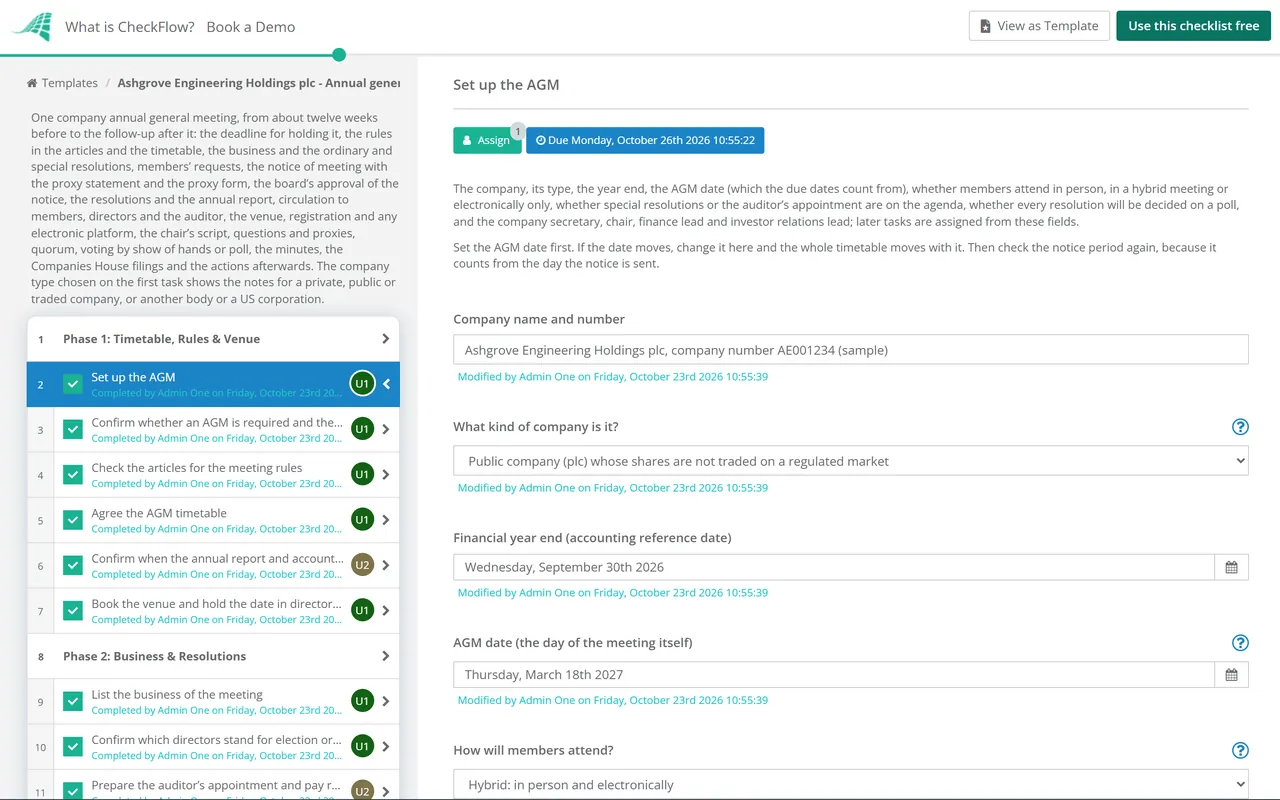
    • Set up the AGM — the company, its type, the year end, the AGM date (which the due dates count from), whether members attend in person, in a hybrid meeting or electronically only, whether special resolutions or the auditor’s appointment are on the agenda, whether every resolution will be decided on a poll, and the company secretary, chair, finance lead and investor relations lead; later tasks are assigned from these fields
    • Confirm whether an AGM is required and the latest date for it — the rule that applies to this kind of company, the latest date the AGM can be held, and the AGM date checked against it
    • Check the articles for the meeting rules — the notice period, quorum, who chairs, proxies, how a poll is demanded, electronic attendance and which directors must retire and stand again, since the articles can add to the Act or change its defaults
    • Agree the AGM timetable — the board meeting that approves the accounts, the board meeting that approves the notice, the date the notice and annual report go out, the proxy deadline, the AGM and the filings afterwards, each with an owner
    • Confirm when the annual report and accounts will be ready — the audit sign-off, the board meeting that approves the accounts and the date the printed or online annual report will be ready, early enough to go out with the notice
    • Book the venue and hold the date in directors’ diaries — a step-free venue large enough for the members you expect, with sound, screens and a room for registration, booked before the notice is drafted because the notice must state the place
  2. Phase 2

    Phase 2: Business & Resolutions

    7 tasks

    Decide what the meeting will deal with and write each resolution in full. Special resolutions and the auditor’s appointment add their own tasks, and a valid request from members adds the tasks to check it and circulate it.

    • List the business of the meeting — receiving the accounts and reports, electing or re-electing directors, the auditor, any final dividend and any authorities the board needs, each marked as an ordinary or a special resolution
    • Confirm which directors stand for election or re-election — directors appointed since the last AGM and those the articles or the board’s policy require to stand again, with a short biography for each
    • Prepare the auditor’s appointment and pay resolutions — shown when the auditor is on the agenda: the resolution to appoint or reappoint the auditor and the one authorising the directors to agree their pay
    • Draft the special resolutions — shown when special resolutions are on the agenda: the full text of each one, such as a change to the articles, marked as a special resolution
    • Write an explanatory note for each resolution — a plain explanation of what each resolution does and why the board recommends it, for the notice
    • Check for members’ requests to add resolutions, statements or matters — any request from members to circulate a resolution, a statement or a matter for the AGM, recorded with the date it arrived
    • Check each member request is valid and in time — shown when a member request has been received: the voting rights or number of members behind it, the date it arrived, whether it could properly be moved, and who pays for circulating it
  3. Phase 3

    Phase 3: Notice, Proxy Form & Board Approval

    7 tasks

    Draft the notice of meeting and the proxy form, then put them, the resolutions and the annual report to the board. The board’s approval halts the checklist: nothing in the later phases can be completed until it is recorded.

    • Draft the notice of meeting — the date, time and place of the meeting, the general nature of the business, the full text of each resolution, a statement that it is the annual general meeting, and the explanatory notes
    • Add the proxy statement and voting notes to the notice — a prominent statement of each member’s right to appoint one or more proxies to attend, speak and vote, how to appoint one and the deadline, and how votes will be taken
    • Prepare the proxy form and set the proxy deadline — a form for each resolution with for, against and vote withheld, where to send it, and a deadline the articles allow
    • Set out how members join and vote electronically — shown for a hybrid or electronic meeting: the platform, how members and proxies log in and are identified, how they ask questions and vote, and what happens if the connection fails, written into the notice
    • Prepare the annual report and accounts for circulation — the signed accounts, the reports that go with them and the auditor’s report where there is one, printed or ready to publish online, to go out with the notice
    • Review the notice pack against the articles and the Act — the notice, the resolutions, the proxy statement and form, any electronic arrangements and the circulation list checked by the company secretary or the company’s lawyers before the board sees them
    • Board approves the notice, the resolutions and the annual report for circulation — Approved, Approved with changes or Not approved, recorded with the date of the board meeting; nothing is sent to members until it is recorded
  4. Phase 4

    Phase 4: Circulate the Notice & Annual Report

    5 tasks

    Send the approved pack to everyone entitled to it, in a way the company can prove, early enough to give the full notice period. A traded company also publishes the meeting information on its website, and a valid member request is circulated with the notice.

    • Check the register of members and the circulation list — every member, every director, the auditor, anyone entitled to a share through a member’s death or bankruptcy whom the company knows of, and debenture holders for the annual report, with how each has agreed to receive documents
    • Send the notice, proxy form and annual report — in hard copy, by email or through the website for members who have agreed to it, with the date and method recorded for each group
    • Publish the meeting information on the company’s website — shown for a traded company: the notice, the total shares and voting rights by class, and any members’ statements, resolutions or matters, on a free website that identifies the company
    • Circulate members’ resolutions and statements — shown when a member request has been received: each valid resolution or statement sent to everyone entitled to the notice, in the same way as the notice
    • Confirm the notice period was met — the clear days between the day the notice is treated as received and the AGM counted, not counting the day it was given or the day of the meeting
  5. Phase 5

    Phase 5: Venue, Registration & Electronic Meeting

    4 tasks

    Get the room, the registration desk and any electronic platform ready. A hybrid or electronic meeting adds the platform test, and a planned poll adds the scrutineer and the poll cards.

    • Confirm the venue arrangements — the room layout, microphones for questions, the screen for slides and voting results, step-free access, a hearing loop, signage and the timings for setting up
    • Plan registration on the day — the attendance list from the register of members, how proxies and corporate representatives show their appointment, voting cards, guests who may attend but not vote, and a count of who is present for the quorum
    • Appoint the scrutineer and prepare the poll cards — shown when every resolution will be decided on a poll: an independent scrutineer, usually the registrar, poll cards for each member and proxy, and how proxy votes are added to the count
    • Set up and test the electronic meeting platform — shown for a hybrid or electronic meeting: a full test with the chair, the registrar and a test member, covering log-in, sound, questions, voting and what to do if the connection drops
  6. Phase 6

    Phase 6: Chair’s Script, Questions & Proxies

    5 tasks

    Prepare the chair to run the meeting and answer members’ questions, and count the proxies as they arrive so the chair knows how each resolution is likely to go.

    • Write the chair’s script — the opening, confirming the quorum, taking the notice as read, each resolution in order, the proxy figures, questions, how a poll is taken if one is demanded and the close
    • Prepare answers to likely questions — the questions members are likely to ask about the results, strategy, pay and the resolutions, with an agreed answer and who gives it
    • Track proxy appointments as they arrive — each appointment checked against the register, its voting instructions recorded and anything incomplete queried with the member while there is time
    • Close proxies at the deadline and give the chair the figures — the votes for, against and withheld on each resolution, and any resolution where the vote looks close
    • Brief the chair and the directors — a walk-through of the script, the proxy figures, the likely questions and who answers them, and what happens if the meeting is not quorate or a poll is demanded
  7. Phase 7

    Phase 7: Running the AGM

    7 tasks

    On the day, register everyone who attends, confirm the quorum, take the business in the order of the notice and record each result. A hybrid or electronic meeting adds the electronic attendance, and a poll adds the count.

    • Register members, proxies and representatives as they arrive — each person checked against the register or their appointment, given a voting card if they can vote, and recorded on the attendance list
    • Confirm the meeting is quorate — the number of qualifying people present checked against the quorum before any business is taken
    • Run the electronic attendance and questions — shown for a hybrid or electronic meeting: members online counted in the attendance, their questions read out alongside those in the room, and their votes collected and recorded
    • Present the business and take questions — the accounts and reports laid before the meeting, the chair’s and chief executive’s remarks, and members’ questions answered or taken away with a promise of a reply
    • Put each resolution to the vote — each resolution read and voted on in the order of the notice, by show of hands unless a poll is planned or demanded, with the proxy figures announced
    • Count the poll and declare the results — shown when a poll was taken: poll cards and proxy votes counted by the scrutineer, the result of each resolution declared by the chair or announced as soon as the count is done
    • Record each result and close the meeting — whether each resolution was passed or not, with the votes where there was a poll, then the meeting formally closed
  8. Phase 8

    Phase 8: Minutes, Results & Filings

    5 tasks

    Write up the meeting and make the filings while the deadlines are short. A poll adds the publication of the results, and special resolutions add the Companies House filing within 15 days.

    • Publish the poll results on the website — shown when a poll was taken: for a quoted or traded company, the date, each resolution and the votes on the website; other companies can mark this not applicable
    • Draft the minutes — who attended and the quorum, the business taken, the questions asked and the answers given, and each resolution with its result
    • File the special resolutions at Companies House — shown when special resolutions were on the agenda: a copy of each special resolution passed, and the amended articles if they changed, sent to the registrar within 15 days
    • Chair signs the minutes — the minutes read, corrected if needed and signed by the chair of the meeting, then kept with the company’s records of general meetings
    • Update the registers and the company’s records — directors elected or not re-elected, any change of auditor, the resolutions passed, and any change Companies House must be told about, filed in the time allowed
  9. Phase 9

    Phase 9: Actions & Lessons for Next Year

    5 tasks

    Finish what the meeting decided, reply to the questions taken away and record what to change, so next year’s AGM starts from this one.

    • Confirm the auditor’s appointment and terms — shown when the auditor was on the agenda: the auditor told the result, the engagement letter and fee agreed by the directors as the resolution allowed
    • Act on the resolutions passed — any final dividend paid on its date, new authorities recorded for the board, and anything the board must now do, each with an owner
    • Reply to questions taken away at the meeting — each member who was promised an answer sent one, and any answer of wider interest published for all members
    • Review the AGM and record the lessons — attendance, the votes against any resolution and why, the questions asked, the venue or platform and the timetable, and what to change next year
    • Set the deadline for next year’s AGM — the latest date for next year’s AGM put in the board calendar, with the board meeting dates that lead up to it

AGM Rules for Private, Public and Traded Companies

The Companies Act 2006 sets different AGM rules for private, public and traded companies. A traded company is one whose voting shares are admitted to trading on a UK or EU regulated market (section 360C). The articles can add to these rules, for example with a longer notice period. The table is a summary, not a substitute for the Act or your articles.

Rule Private company Public company Traded company Where
Must it hold an AGM?Only if its articles require one, or it is a traded companyYes, every yearYes, every years.336
DeadlineSet by its articles, if they require an AGMWithin six months beginning with the day after the year endSix months (public) or nine months (private) after the year ends.336(1), (1A)
Notice of the AGMAt least 14 clear daysAt least 21 clear daysAt least 21 clear daysss.307, 307A, 360
Shorter noticeIf a majority in number of the members, holding at least 90% of the voting shares, agree (up to 95% if the articles say so)Only if every member entitled to attend and vote agreesNot for an AGMss.307(4)–(6), 337(2)
Annual report sentBy the filing deadline, or when filed if earlierAt least 21 days before the AGMAs for its public or private statuss.424
Members’ resolutionsNot under section 338 (statements under section 314 still apply)5% of voting rights or 100 members; by six weeks before or when notice is givenAs public, plus other matters under section 338Ass.314, 338, 338A
Website publicationNot required by the ActNot required by the ActNotice, voting totals and members’ requests, kept for two yearss.311A
Poll resultsNot required by the ActPublished on a website if the company is quotedPublished on a website within 16 dayss.341

Rules that apply to every company. The notice states the time, date and place and the general nature of the business (section 311), and a special resolution is valid only if its text was in the notice (section 283(6)). Every notice states the right to appoint a proxy (section 325), and the articles cannot set a proxy deadline earlier than 48 hours before the meeting, not counting non-working days (section 327). Two qualifying persons are a quorum unless the articles say otherwise (section 318), the articles cannot stop five members or 10% of the voting rights demanding a poll (section 321), and minutes are kept for at least ten years (section 355). Special resolutions go to Companies House within 15 days (sections 29 and 30).

Other bodies and the US. A charity that is not a company, a society or a club follows its own constitution for its annual meeting. In the US, annual shareholder meetings are set by state corporate law and the company’s bylaws. Under Delaware’s General Corporation Law, for example, the annual meeting to elect directors is held on a date set by or under the bylaws (section 211(b)), notice goes out between 10 and 60 days before the meeting (section 222(b)), and the board can allow stockholders to attend and vote by remote communication (section 211(a)). Listed US companies also follow the SEC’s proxy rules and their exchange’s rules. The first task’s notes cover these cases.

Why Plan Your AGM in CheckFlow?

1

A timetable that moves with the date

Enter the AGM date and each task falls due a set number of working days before or after it, from the deadline check about twelve weeks out to the filings and next year’s date afterwards. If the meeting moves, change the date once and the timetable follows. Tasks are assigned from the four people named in the first task, and the Tasks Grid shows each of them what is due. Run it on a recurring schedule so next year’s AGM starts on time.

2

Only the tasks this AGM needs

The company type shows the notes on the deadline, the notice period, the annual report and the notice contents for a private, public or traded company, or another body. A hybrid or electronic meeting adds the platform tasks, special resolutions add the drafting and the Companies House filing, the auditor adds its resolutions, and a poll adds the count and the published results.

3

Nothing goes to members before the board approves it

The board approves the notice, the resolutions and the annual report before they are sent. That step halts the checklist, so the pack cannot be circulated and the meeting cannot be run in the checklist until the decision is recorded. See how approvals that halt a checklist work.

CheckFlow does not send notices, collect proxies or count votes; your registrar or your own systems do that. It keeps the AGM plan in one place: who does what and by when, the board’s approval, the proxy figures, the results and the minutes on the tasks they came from, and a record of what was done, so next year’s AGM starts from this one. The checklist view shows the whole plan to the company secretary, the chair and the finance team.

Preparing the board meetings around the AGM? Use the Company Board Meeting Preparation Checklist for the board meetings that approve the accounts and the notice, and the Annual Accounts & Statutory Filing Checklist for the accounts themselves. For the wider investor programme, see the Investor Communication & Reporting Framework Checklist and the Strategic Investor Relations & Stewardship Checklist. A charity board meeting has its own Board Meeting Preparation Checklist for Nonprofits & Charities.

AI generator

Didn’t find what you need? Describe it.

Describe the process in a sentence and the AI checklist generator drafts the phases and tasks for you.

Frequently Asked Questions

What should an AGM planning checklist include?

The deadline for holding the AGM and the rules in your articles; a timetable agreed with the board; the business and each resolution in full, marked ordinary or special; any members’ requests; the notice of meeting with the proxy statement and the proxy form; the board’s approval before anything is sent; circulation of the notice and annual report to members, directors and the auditor; the venue, registration and any electronic platform; the chair’s script, likely questions and the proxy count; quorum, voting and the results on the day; and the minutes, filings and follow-up actions afterwards.

Does a private company have to hold an AGM?

Not under the Companies Act 2006, unless it is a traded company. Section 336 requires an AGM of public companies and of private companies whose voting shares are traded on a UK or EU regulated market. A private company holds one when its articles require it, and many older articles do. If yours do not, the members can take most decisions by written resolution instead. Check the articles before you decide not to hold one.

When must a public company hold its AGM?

Within six months beginning with the day after its accounting reference date, its financial year end (section 336(1)). For a 31 December year end, that means by 30 June. Missing it is an offence by every officer in default. The accounts must also be laid before a general meeting by the end of the period for filing them, which is six months after the year end for a public company (sections 437 and 442). A private company that is a traded company has nine months.

How much notice is needed for an AGM?

At least 21 clear days for a public or traded company’s AGM, and at least 14 clear days for a private company’s general meeting, or longer if the articles say so (sections 307 and 307A). Clear days leave out the day the notice is given and the day of the meeting (section 360). A notice posted or emailed is treated as received 48 hours later, not counting non-working days (section 1147), so allow for that too. This checklist sends the notice about five weeks before the meeting.

What must the notice of an AGM contain?

The time, date and place of the meeting and the general nature of the business (section 311); for a public company, a statement that it is the annual general meeting (section 337); the full text of any special resolution, marked as special (section 283(6)); and a prominent statement of the member’s right to appoint one or more proxies (section 325). A traded company adds the website address, the voting record time, how to attend and vote, proxy forms, any advance or electronic voting and the right to ask questions (section 311(3)).

What is the difference between an ordinary and a special resolution?

An ordinary resolution is passed by a simple majority, and a special resolution by at least 75% (sections 282 and 283). On a show of hands that is a majority of the votes cast; on a poll, of the voting rights of the members who vote. Special resolutions are needed for decisions such as changing the articles. They are valid only if the notice gave their text, and a copy goes to Companies House within 15 days of being passed (section 30).

Can an AGM be held online or as a hybrid meeting?

The Companies Act does not stop members attending, speaking and voting by electronic means (section 360A), but whether your company can hold an electronic or hybrid AGM depends on its articles, so check them first. A traded company can put conditions on electronic participation only to identify the people taking part and keep the communication secure, and they must be proportionate. In Delaware, the board can allow stockholders to take part and vote by remote communication (section 211(a) of the General Corporation Law).

What has to happen after the AGM?

Write up the minutes and have the chair sign them; minutes of general meetings are kept for at least ten years (section 355). Send any special resolution, and amended articles, to Companies House within 15 days (sections 26, 29 and 30). A quoted or traded company publishes poll results on its website, a traded company within 16 days (section 341). Then pay any dividend declared, reply to questions taken away, update the registers and set next year’s date.

Is CheckFlow free for this template?

14-day free trial, no card required. The Business plan is $10 per user per month after the trial. Full details at checkflow.io/pricing.

Run Every AGM on Time, From Notice to Filings

Free trial — no credit card required.

14-day free trial, no credit cardFull refund in your first 30 daysUS hosting, EU on request