Deadlines counted from your year end
An annual schedule starts the checklist after each year end, with filing and tax tasks due well before the statutory dates, so nothing waits for month nine.
Last reviewed: October 2026
No Credit Card Required
Printed from checkflow.io/templates/finance-accounting/annual-accounts-filing-checklist
This checklist is written for UK companies under the Companies Act 2006. It is for finance managers, company secretaries, owner-directors and their accountants. It starts once the books are closed and covers size and audit status, preparing the statutory accounts, approval and signing by the directors, circulation to members, filing at Companies House, the CT600 and corporation tax payment, and the confirmation statement with identity verification. A first-accounts phase appears only for a company’s first period, and an audit phase only when an audit is required. US businesses should use the Tax Preparation Checklist, since private US companies file no public accounts.
The Year-End Close Checklist gets the numbers right: the final period close, counts, estimates and the audit hand-off. This checklist takes those numbers and turns them into a statutory filing. It answers the legal questions the close does not: what size the company is, which framework and reports apply, whether an audit is needed, who must approve and sign, who gets a copy, and what goes to Companies House and HMRC by when.
Size comes first, because it drives almost everything else. A company is micro, small or medium if it meets at least two of the three limits below, normally in two consecutive years. The limits were raised for financial years beginning on or after 6 April 2025, and a transitional rule lets you apply the new limits to the previous year when testing the first year under them. Public companies, banks, insurers and some other regulated companies cannot use the small companies regime whatever their size.
| Size | Limits (two of three) | What it usually means |
|---|---|---|
| Micro-entity | Turnover £1m, balance sheet £500,000, 10 employees | Can use FRS 105; no directors’ report; can file the balance sheet only; usually exempt from audit |
| Small | Turnover £15m, balance sheet £7.5m, 50 employees | FRS 102 Section 1A; directors’ report prepared but need not be filed; can file the balance sheet only; usually exempt from audit |
| Medium | Turnover £54m, balance sheet £27m, 250 employees | Full FRS 102 or IFRS; strategic report and directors’ report; audit usually required |
| Large | Above the medium limits | Full FRS 102 or IFRS; full reports and audit |
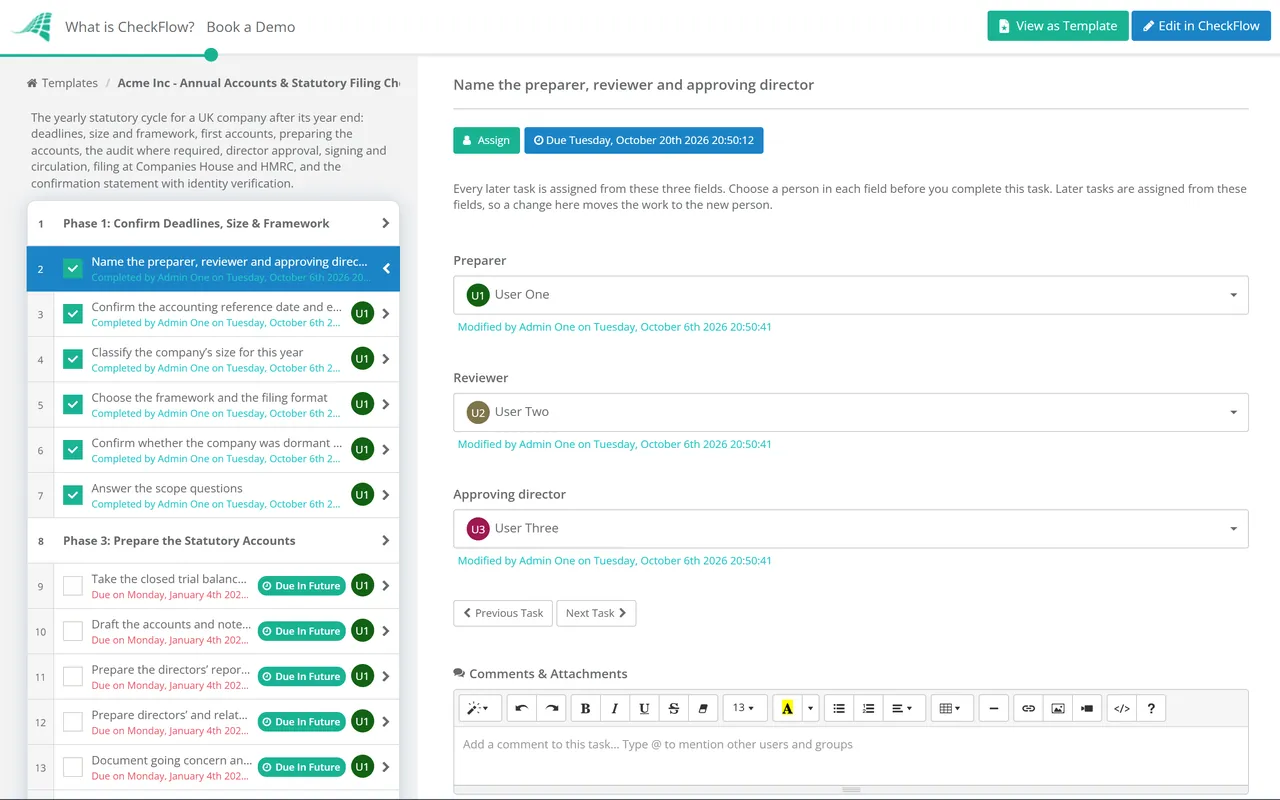
Seven phases take each financial year from a closed trial balance to filed accounts and an up-to-date register. Phase 2 appears only for a company’s first accounts, and Phase 4 only when the accounts must be audited.
Owned by the preparer. The two scope questions decide whether Phases 2 and 4 appear.
Shown only for a company’s first set of accounts.
Shown only when the company is not exempt, is excluded from exemption, or members holding 10% have required an audit.
Due on the company’s own review date, which is often months away from the accounts deadline. Set it as a Date field so this phase is due on time.
Companies House and HMRC deadlines carry different penalties and run from different dates: the accounts deadline from the accounting reference date, the tax deadlines from the end of the corporation tax accounting period, which is usually but not always the same.
| Obligation | Deadline | If late |
|---|---|---|
| Accounts to Companies House, private company | 9 months after the year end; first accounts 21 months from incorporation | £150 up to one month late, £375 up to three, £750 up to six, £1,500 after that; doubled if the previous year’s accounts were also late |
| Accounts to Companies House, public company | 6 months after the year end; first accounts 18 months from incorporation | £750, £1,500, £3,000 or £7,500 on the same scale; doubled for a second late year |
| Company Tax Return (CT600) | 12 months after the end of the accounting period | £200, rising to £400 at three months, for returns due on or after 1 April 2026; £1,000 and £2,000 for a third late return in a row; plus 10% of unpaid tax at six months late and another 10% at twelve |
| Corporation tax payment | 9 months and 1 day after the period end; large companies (profits over £1.5m) pay in months 7, 10, 13 and 16, very large ones (over £20m) in months 3, 6, 9 and 12 | Late payment interest |
| Confirmation statement | At least every 12 months, within 14 days of the end of the review period; £50 fee online | An offence by the company and its officers, and grounds for striking the company off |
Failing to file accounts is also a criminal offence by every director, and Companies House can begin striking off a company that stops filing. The penalties above are civil and automatic: Companies House accepts appeals only in exceptional circumstances, so a missed deadline usually costs the full amount.
Every company must have a registered email address and an appropriate registered office, and confirm on each confirmation statement that its activities will be lawful.
The micro, small and medium limits in the table above apply to financial years beginning on or after this date.
New directors must verify their identity before appointment. Existing directors confirm theirs with their next confirmation statement during a 12-month transition, and PSCs have their own deadlines.
For periods beginning on or after this date, FRS 102 brings most leases onto the balance sheet and introduces a five-step revenue model. FRS 105 is not affected.
Fixed late filing penalties for Company Tax Returns doubled for returns with a filing date on or after this date, the first increase since 1998.
Small companies and micro-entities will have to file a profit and loss account, with an option to keep it off the public register; abridged accounts will end; and all accounts will be filed through commercial software in iXBRL, closing WebFiling and paper for accounts. These were due in April 2027, were paused in January 2026 and were confirmed for April 2028 in June 2026. Until then, the current filing options remain.
An annual schedule starts the checklist after each year end, with filing and tax tasks due well before the statutory dates, so nothing waits for month nine.
A first-year company sees the accounting period tasks; an audited one sees the audit phase. The filing tasks stay locked until the approving director marks the accounts approved.
CheckFlow is not accounts production software or a filing service. It does not prepare iXBRL accounts or submit anything to Companies House or HMRC. It runs the workflow around the accounting and filing software you already use, so every year is prepared, approved and filed the same way, with a timestamped record of who did what.
The filing starts with a clean close. The Year-End Close Checklist produces the trial balance, the External Audit Preparation Checklist handles the auditors’ requests, and the VAT Return Checklist and Payroll Year-End Checklist cover the other annual HMRC obligations. Accountancy practices running many clients will find more in our professional services overview.
Describe the process in a sentence and the AI checklist generator drafts the phases and tasks for you.
Nine months after the end of the financial year for a private company and six months for a public company. A company’s first accounts, if they cover more than 12 months, are due 21 months after incorporation for a private company (18 for a public one), or three months after the accounting reference date if that is later.
No. Corporation tax is usually payable nine months and one day after the end of the accounting period, before the CT600 is due at 12 months. The accounts deadline at Companies House is a separate obligation, and HMRC receives its own copy of the accounts in iXBRL with the CT600.
Not if it qualifies as small and is not excluded, for example as a public company or a bank or insurer, or as a member of an ineligible group. Members holding at least 10% of the shares can still require an audit by notice given no later than one month before the year end. Dormant companies and some subsidiaries have their own exemptions.
Yes. A dormant company still files accounts with Companies House every year, usually simple dormant accounts with an audit exemption statement, and still files a confirmation statement. Tell HMRC it is dormant for corporation tax as well, or it may keep expecting returns.
Yes, as at October 2026. Small companies and micro-entities can file the balance sheet without the profit and loss account, and abridged accounts remain available with the consent of all members. From April 2028 small and micro companies will have to file a profit and loss account, with an option to keep it off the public register, and abridged accounts will end.
14-day free trial, no card required. The Business plan is $10 per user per month after the trial. Full details at checkflow.io/pricing.
14-day free trial, no credit cardFull refund in your first 30 daysUS hosting, EU on request