The company that tells its own story clearly, targets the right investors deliberately, and manages its shareholder base actively closes the gap between intrinsic value and market valuation. The company that does none of these lets the market write the story.
Investor relations is often confused with investor reporting — producing quarterly results and responding to calls. Strategic investor relations is something different: it is the deliberate management of how the investment community understands, values, and engages with the company. This means developing an equity story that is specific, differentiated, and evidenced — not a mission statement. It means identifying which investors’ mandates and philosophies genuinely align with the company’s strategy and proactively building relationships with them. It means using market intelligence — perception studies, analyst conversations, shareholder analysis — to understand the gap between how investors see the company and how management believes it should be seen. And increasingly, it means demonstrating credible, measurable stewardship of ESG commitments in a way that connects to financial performance rather than operating as a separate narrative. Nasdaq’s 2025 Global Issuer Pulse found that investors now expect more context around strategy to assess credibility and long-term potential — reporting raw numbers without strategic context is no longer sufficient. This free checklist gives IR directors, CFOs, and CEOs a structured framework for the full strategic IR programme.
Strategic IR — Five Components That Determine How the Market Values Your Company
Equity Story
The company’s investment case — why an investor should own this stock rather than any other. Specific: TAM, competitive differentiation, growth pathway, management capability, financial model. Evidenced: every claim supported by data. Differentiated: what this company offers that its peers do not.
Investor Targeting
Identifying which investors’ mandates, sector focus, time horizon, and investment philosophy align with the company’s equity story — and proactively engaging them. Research shows 40% of companies do not track active shareholders not currently invested in their stock; most do not systematically target shareholders whose mandates align with their strategy.
Market Intelligence
Understanding how the market currently views the company — via perception audits, analyst feedback, share price analysis, and peer comparisons. The gap between intrinsic value and market value is often a perception gap, not a performance gap.
ESG Stewardship
Articulating how the company manages its environmental, social, and governance responsibilities in a way that is specific, measured, and connected to business value. ESG assets are projected to cross $50 trillion — investors use ESG criteria to assess long-term risk and value.
Programme Measurement
Tracking whether the IR programme is producing the intended outcomes: valuation alignment, shareholder base quality, analyst coverage, and investor sentiment trends. “You can’t improve what you can’t measure” applies as directly to IR as to operations.
What the Strategic IR & Stewardship Checklist Covers
Seven phases covering the full strategic IR programme — from equity story development and investor targeting through analyst management, perception monitoring, ESG stewardship, AGM planning, and programme measurement.
Phase 1
Equity Story Development & Maintenance
An equity story is not a marketing document. It is a specific, evidenced investment case that helps an investor who does not know your business understand why it should trade at a premium to peers — and helps existing investors understand why they should continue to hold.
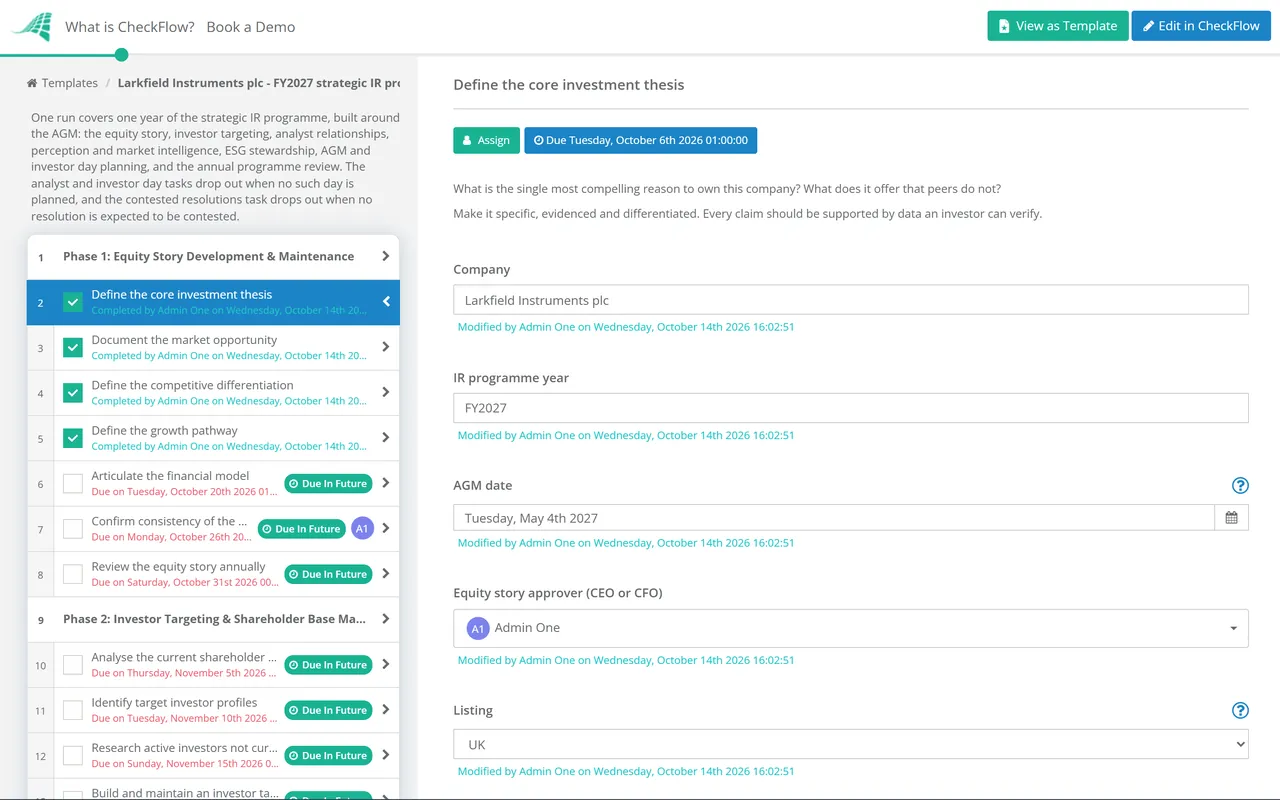
Define the core investment thesis — what is the single most compelling reason to own this company? What does it offer that peers do not?
Document the market opportunity — TAM, SAM, and the company’s realistic addressable share; specific to the actual business, not the widest possible market definition
Define the competitive differentiation — specific, evidenced reasons why customers choose this company over alternatives; structural advantages not easily replicated
Define the growth pathway — how the business gets from here to the value it believes it can reach; with specific milestones and KPIs as signposts
Articulate the financial model — how the business makes money; margin profile; capital requirements; cash generation characteristics; how scale improves the model
Confirm consistency of the equity story across all channels — CEO, CFO, IR materials, analyst day, results presentations; all voices saying the same thing
Review the equity story annually — or after any significant strategic change; a story that no longer reflects reality creates credibility problems
Phase 2
Investor Targeting & Shareholder Base Management
Analyse the current shareholder base — institutional vs retail; long-term holders vs short-term; geographic distribution; sector specialist vs generalist; identify any concentration risk
Identify target investor profiles — the mandate, sector focus, investment philosophy, and time horizon of investors whose approach aligns with the equity story
Research active investors not currently in the register — peer-company shareholders whose mandates suggest alignment with this company’s equity story
Build and maintain an investor target list — with research on each target’s recent activity, published views, and preferred engagement channels
Plan targeted non-deal roadshows — structured investor meetings outside results periods; proactive engagement with target investors rather than waiting for inbound interest
Track engagement quality — not just volume; did the meetings result in increased understanding or increased ownership? Track outcomes
Phase 3
Analyst Coverage & Relationship Management
Map the current analyst coverage — which analysts cover the company; their ratings; their price targets; their investment thesis for the stock
Identify target additional analyst coverage — analysts covering the peer group who do not cover this company; meaningful coverage increases visibility and trading liquidity
Manage analyst day preparation — the format, agenda, presentations, and deep-dive content that gives analysts sufficient depth to build or refresh their models
Brief analysts consistently with all investors — Regulation FD (US) and MAR (UK/EU) compliance; information provided to analysts must be simultaneously public
Review consensus estimates regularly — are sell-side estimates broadly aligned with management’s view of the business? Significant divergence warrants a messaging review
Maintain records of analyst interactions — date, analyst, topics discussed; for compliance purposes
Phase 4
Perception Management & Market Intelligence
Conduct an annual investor perception study — structured feedback from investors and analysts on how they view the company; third-party conducted for honest responses
Identify the valuation gap — where the market’s assessment differs from management’s; what specific perceptions are driving the gap?
Monitor share price relative to peers — outperformance and underperformance episodes analysed against news flow and communications
Review the short interest position — understand who is short the stock and why; short thesis often contains valid critique of the equity story
Respond to significant perception gaps — where market perception diverges from reality, a targeted communications programme addresses the specific information gap
Phase 5
ESG Stewardship & Responsible Business Communication
Define the company’s material ESG issues — the environmental, social, and governance topics most relevant to this business and sector; materiality assessment conducted
Set measurable ESG commitments — specific targets with defined timeframes; vague ESG commitments are a credibility risk rather than a credibility asset
Integrate ESG into investor communications — progress against targets reported consistently; connected to business performance and risk management
Manage shareholder ESG engagement — institutional investors with ESG mandates often engage with governance and remuneration questions; a defined response process
Align with relevant reporting frameworks — TCFD (climate), GRI, SASB, or applicable sector frameworks; consistency with peers improves comparability
Review and respond to proxy adviser recommendations — ISS, Glass Lewis, and other proxy advisers influence institutional shareholder votes; their recommendations require monitoring and proactive engagement
Phase 6
AGM & Investor Day Planning
Plan the AGM calendar — notice periods, proxy materials, resolution drafting; well in advance of the statutory deadline
Draft and review proxy materials — Directors’ Report, Remuneration Report (UK) or Proxy Statement (US); review for compliance and clarity
Prepare for contested resolutions — if any AGM resolution is expected to be contested, prepare a shareholder engagement programme in advance
Plan the investor/analyst day — if applicable; format, agenda, speakers, deep-dive topics; clear investment case reinforcement goal
Brief the board on major shareholder views — before the AGM; no director should encounter material shareholder concern for the first time at the AGM
Phase 7
IR Programme Measurement & Annual Review
Define IR KPIs — valuation metrics (P/E vs peers, P/NAV), shareholder base quality (% long-term holders), analyst coverage (number and quality), investor meeting volume and quality, perception audit scores
Review IR performance annually — against defined KPIs; what improved; what did not
Review the IR team and resources — is the IR function adequately resourced for the programme required?
Benchmark against peers — quality of disclosure, reporting clarity, ESG positioning, and analyst coverage depth compared to the peer group
What a Strong Equity Story Contains — and What Makes Each Element Credible
Element 1 — Market Opportunity
Strong version
“The $8B total addressable market for mid-market procurement automation is growing at 18% CAGR, with 73% of target buyers still using manual processes.”
Weak version
“We are addressing a multi-billion dollar market opportunity with significant growth potential.”
Element 2 — Competitive Position
Strong version
“Our proprietary data flywheel creates increasing value with each customer added — a structural advantage that requires 3–5 years of data accumulation to replicate.”
Weak version
“We have a strong competitive position and experienced team.”
Element 3 — Growth Pathway
Strong version
“We have identified four specific expansion pathways: geographic (EU launch, H2 2026), product (enterprise module, Q1 2027), channel (VAR network, FY2026), and M&A (two identified targets).”
Weak version
“We have multiple levers for continued growth.”
Element 4 — Financial Model
Strong version
“SaaS model with 78% gross margin, expanding with scale. Path to positive FCF at $50M ARR based on current unit economics.”
Weak version
“Our business model is capital-efficient and scalable.”

Why Run the Strategic IR Programme in CheckFlow?
1
A structured annual strategic IR planning process
Strategic investor relations that exists as a general intention — “we should do more roadshows,” “we need to improve our equity story” — produces nothing. CheckFlow runs the annual strategic IR review as a structured process: equity story review, shareholder base analysis, target investor research, perception audit, and programme KPI review — each as a defined task with an owner, a deadline, and a documented outcome.
2
Cross-functional IR coordination across CEO, CFO, and legal
The equity story must be consistent across every channel — CEO presentations, CFO earnings calls, IR website, roadshow materials, and analyst day. CheckFlow coordinates the review and sign-off of IR materials across all functions, ensuring no channel goes out with a message that contradicts another.
3
Compliance tracking for every investor interaction
Regulation FD and MAR compliance requires that records be kept of investor interactions — who was met, what was discussed, and what was disclosed. CheckFlow tracks every investor meeting task with its disclosed materials and timestamps. The interaction log is a compliance document that exists as a byproduct of running the process.
Strategic IR determines what to communicate. Operational IR delivers it consistently. CheckFlow’s Investor Communication & Reporting Framework covers the calendar-driven reporting cycle that operationalises the strategic IR programme. See the Investor Communication & Reporting Checklist →
AGM planning involves significant governance and compliance overlap. CheckFlow’s compliance template series covers related governance frameworks. See the Compliance Templates →
What is strategic investor relations and how does it differ from IR reporting?
+
Strategic investor relations is the deliberate management of how the investment community understands, values, and engages with a company — encompassing equity story development, investor targeting, perception management, ESG stewardship, analyst relationships, and AGM strategy. IR reporting is the operational execution of that strategy through consistent, compliant investor communications. The distinction matters because many IR functions focus almost entirely on reporting — responding to regulatory requirements and producing quarterly results — without the strategic layer that determines which investors the company is attracting, whether the market understands the business correctly, and whether the valuation reflects intrinsic value.
What is an equity story and what makes one effective?
+
An equity story is the investment case — the specific, evidenced argument for why an investor should own a company’s stock. An effective equity story is specific (not general claims about “significant market opportunity” but precise TAM, competitive differentiation, and growth pathway), evidenced (every claim supported by data that investors can verify), differentiated (articulating what this company offers that peers do not), and consistent (the same story told by every spokesperson across every channel). An equity story that is vague, internally inconsistent, or disconnected from financial performance creates the perception gap that widens the spread between intrinsic and market value.
What is ESG stewardship and why does it matter for IR?
+
ESG stewardship refers to how a company manages its environmental, social, and governance responsibilities and demonstrates accountability to shareholders. With ESG assets projected to exceed $50 trillion, institutional investors increasingly use ESG criteria to evaluate long-term risk, operational quality, and governance standards. For IR, this means that vague ESG commitments carry no credibility; specific, measured targets connected to business performance do. Proxy advisers (ISS, Glass Lewis) increasingly base their voting recommendations on governance and remuneration disclosures, making proactive engagement with major shareholders on ESG topics an IR function rather than solely a sustainability function.
What is a perception study and when should one be conducted?
+
A perception study (or perception audit) is structured, independent research into how investors and analysts currently view a company — conducted through confidential interviews with institutional shareholders, potential investors, and sell-side analysts. It reveals the specific elements of the equity story that are not being understood or believed, identifies the perceptions driving valuation discounts vs peers, and surfaces concerns that investors hold but do not raise in formal meetings. It should typically be conducted annually or after major strategic changes. The independent conduct is important — investors give more honest feedback to a third party than to the IR team directly.
Is CheckFlow free for this template?
+
14-day free trial, no card required. The Business plan is $10 per user per month after the trial. Full details at checkflow.io/pricing.
Build an IR Programme That Closes the Gap Between Value and Valuation
Free trial — no credit card required.
Do you like cookies? 🍪 We use cookies to ensure you get the best experience on our website. Learn more