
Gender Pay Gap Reporting Checklist Template

The arithmetic is the easy part. The hard part is the data: who counts as a full-pay relevant employee, which payments are ordinary pay or bonus pay, and having the right person sign before the figures go live.

Last reviewed: October 2026

This free gender pay gap reporting checklist runs one year’s report for one employer in Great Britain, from checking that the duty applies to publishing the figures and planning next year. It follows the Equality Act 2010 (Gender Pay Gap Information) Regulations 2017 for private and voluntary sector employers with 250 or more employees, and the Equality Act 2010 (Specific Duties and Public Authorities) Regulations 2017 for listed public authorities, which use a 31 March snapshot date. HR confirms the headcount, the snapshot date and the deadline, payroll extracts ordinary pay, bonus pay and working hours, and the six required figures are calculated and checked. A supporting narrative and a voluntary action plan can be added. A director or equivalent confirms the figures are accurate and signs the written statement, and only then are they published on the government’s gender pay gap service and on your own website. Gender pay gap reporting is a Great Britain duty: Northern Ireland has no reporting regime in force.

One Year’s Report, From the Snapshot Date to Publication

Employers with 250 or more employees on the snapshot date must publish six figures each year: the mean and median gender pay gaps in hourly pay, the mean and median gaps in bonus pay, the proportions of men and women paid bonus pay, and the proportions of men and women in each of four pay quarters. The figures compare the average pay of all men and all women in the organisation, whatever their jobs.

That makes the report different from an equal pay audit, which asks whether men and women doing equal work are paid the same. A gap in the report does not by itself show unequal pay, and a small gap does not prove there is none. This checklist runs the report; an equal pay review is separate work.

This checklist

One year’s gender pay gap report

Covers: who must report, the snapshot date and the deadline, the employee lists, ordinary pay, bonus pay and hours, the six figures, the checks, the signed written statement, publication and next year.

Where: Great Britain: private and voluntary sector employers, and listed public authorities with a 31 March snapshot.

Output: six published figures, a signed written statement and the records behind them.

Equal work

An equal pay audit

Covers: whether men and women doing like work, work rated as equivalent or work of equal value (section 65 of the Equality Act 2010) are paid the same, and whether each difference has a reason other than sex.

Where: job by job, not the whole workforce at once.

Use it: when you need to know whether pay for equal work is equal. CheckFlow has no equal pay audit template; the Annual Compensation Review Checklist includes a pay equity analysis.

Pay reviews

The Annual Compensation Review Checklist

Covers: the yearly pay review: the budget, market data and pay bands, a pay equity analysis, recommendations, approval, letters and payroll.

Where: the United Kingdom and the United States.

Use it: to set next year’s pay; what this report finds is one input to it. Annual Compensation Review Checklist.

What the Gender Pay Gap Reporting Checklist Covers

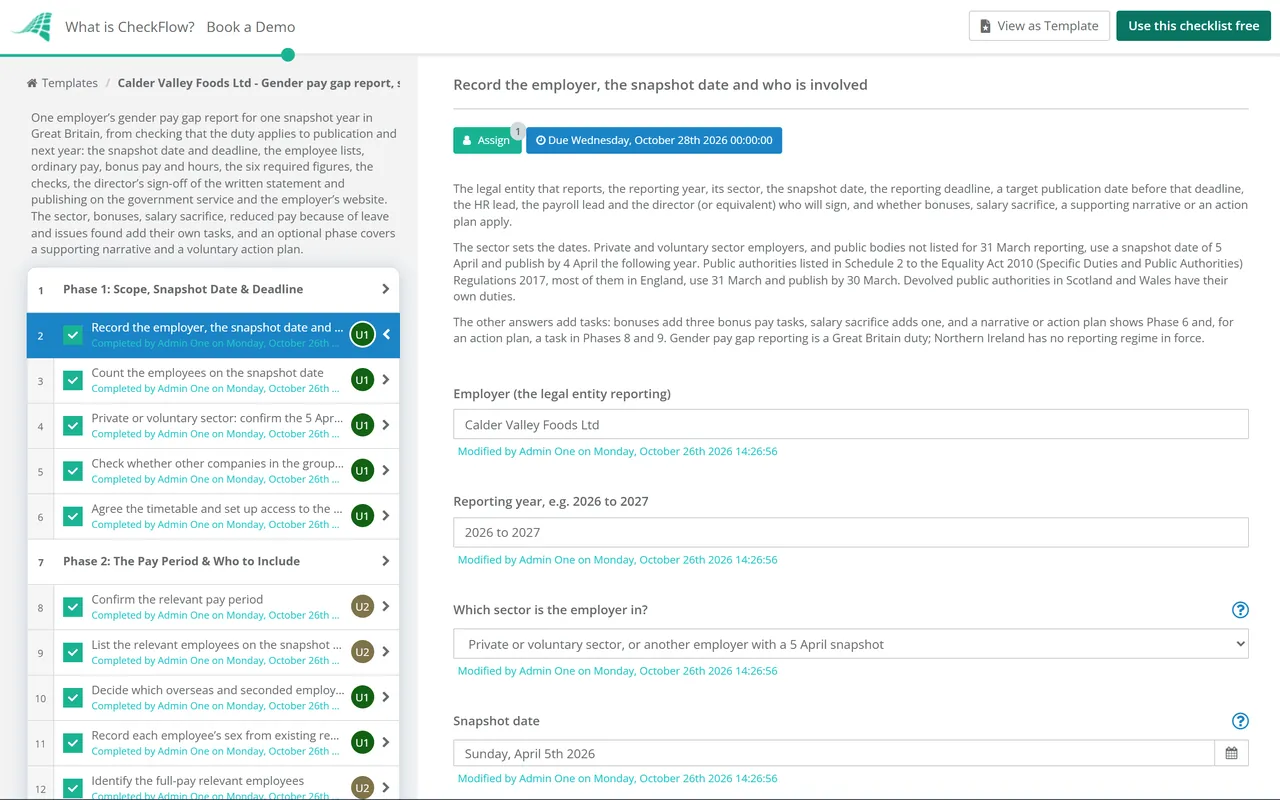
Nine phases follow one year’s report from the snapshot date to publication and next year. The sector on the first task shows the dates and duties for a private or voluntary sector employer, a listed public authority or a devolved authority in Scotland or Wales. Fewer than 250 employees, employees on reduced pay because of leave, salary sacrifice, bonuses and issues found in the checks each add their own tasks, and choosing a supporting narrative or a voluntary action plan shows Phase 6. The director’s confirmation of the figures is the gate: nothing after it can be completed until it is recorded.

  1. Phase 1

    Phase 1: Scope, Snapshot Date & Deadline

    8 tasks

    Start by confirming that the duty applies to this legal entity this year, which snapshot date and deadline it has, and who will sign. Enter the target publication date first: every due date counts in business days from it, back from it up to publication and forward from it for the follow-up.

    • Record the employer, the snapshot date and who is involved — the legal entity that reports, the reporting year, its sector, the snapshot date, the reporting deadline, a target publication date before that deadline, the HR lead, the payroll lead and the director (or equivalent) who will sign, and whether bonuses, salary sacrifice, a supporting narrative or an action plan apply
    • Count the employees on the snapshot date — a headcount of individuals, not full-time equivalents: part-time staff, job-sharers and people on leave each count as one, self-employed people who must do the work personally are included, and agency workers are not; 250 or more means this entity must report
    • Fewer than 250: decide whether to report voluntarily and update the service — an employer with fewer than 250 employees on the snapshot date does not have to report but may choose to; if this entity has reported before, change its reporting requirement on the gender pay gap service so it is not shown as late
    • Private or voluntary sector: confirm the 5 April snapshot and the 4 April deadline — the figures must be published within 12 months beginning with the 5 April snapshot date, so by 4 April the following year, with a written statement confirming they are accurate, signed by the person the regulations name for your type of body
    • Public authority: confirm the 31 March snapshot and the 30 March deadline — public authorities listed in Schedule 2 to the Specific Duties and Public Authorities Regulations 2017 use a 31 March snapshot and publish within 12 months, by 30 March; gov.uk says most do not need a written statement, schools report through their governing body and arm’s length bodies report their own figures
    • Devolved public authority in Scotland or Wales: check which duty applies — devolved public authorities in Scotland and Wales are outside the 2017 reporting regulations and have their own specific duties: in Scotland, listed authorities with at least 20 employees publish their pay gap every two years by 30 April, and in Wales, authorities consider objectives on any gender pay difference and publish an action plan
    • Check whether other companies in the group must report — each legal entity with 250 or more employees on the snapshot date reports its own figures, a group may also publish combined figures for the whole group, and an entity with more than one payroll merges them into one set of figures
    • Agree the timetable and set up access to the gender pay gap service — the person who will submit creates their own account on the service and adds the organisation to it, and the dates for the data, the checks and the sign-off are agreed so publication comes well before the deadline
  2. Phase 2

    Phase 2: The Pay Period & Who to Include

    6 tasks

    The figures use two lists. Relevant employees are everyone employed on the snapshot date and give the bonus figures. Full-pay relevant employees are those not paid at a reduced rate or nil because of leave, and give the hourly pay and pay quarter figures. Build both lists before collecting any pay.

    • Confirm the relevant pay period — the pay period in which the snapshot date falls, whether weekly, fortnightly, monthly or another period; for someone paid no basic pay, the period in which they are most often paid another element of ordinary pay
    • List the relevant employees on the snapshot date — everyone employed on the snapshot date, whatever their contract or length of service: full-time, part-time, job-share, apprentices, temporary, casual and zero-hours employees, people on leave and self-employed people who must do the work personally; not partners, LLP members or agency workers
    • Decide which overseas and seconded employees to include — as a general rule, anyone who could bring a claim under the Equality Act 2010 in an employment tribunal: usually someone whose contract is under British employment law, who keeps their home in Great Britain and whose pay is taxed in the UK; secondees into Great Britain are decided case by case
    • Record each employee’s sex from existing records — gov.uk’s guidance, updated in May 2026 after the Supreme Court ruling on the meaning of sex in the Equality Act 2010, says the figures must be based on biological sex: use what HR and payroll records already hold, follow one process that is the same for every employee, and where records are missing or unreliable give people a confidential way to check and update them; do not single people out, and gov.uk recommends not asking for documents
    • Identify the full-pay relevant employees — everyone on the relevant list except those paid at a reduced rate or nil in the relevant pay period because they were on leave: annual, maternity, paternity, adoption, parental, shared parental, sick, special or other leave; people paid less for another reason, such as strike days or irregular hours, stay in
    • Reduced pay because of leave: keep them in the bonus figures only — they still count in the headcount and as relevant employees, so their bonus pay goes into the bonus figures, but they are left out of hourly pay, the hourly pay gaps and the pay quarters
  3. Phase 3

    Phase 3: Collect the Pay & Hours Data

    8 tasks

    Payroll extracts the pay for the relevant pay period and the bonuses for the 12 months ending on the snapshot date. Use gross pay, before tax, National Insurance and employee pension contributions. Bonuses and salary sacrifice, answered on the first task, add their own tasks.

    • Extract ordinary pay for each full-pay relevant employee — basic pay, allowances, pay for piecework, pay for leave and shift premium pay paid in the relevant pay period, gross before tax, National Insurance and employee pension contributions; leave out anything that belongs to a different pay period, such as back pay correcting an earlier underpayment
    • Sort allowances from payments that are not ordinary pay — include allowances such as first aider or fire warden pay, location allowances, car allowances, on-call pay and recruitment or retention allowances; leave out overtime pay, redundancy and termination pay, pay in lieu of leave, expense repayments, benefits in kind and loans such as season ticket loans
    • Salary sacrifice: use pay after the sacrifice — use each employee’s gross pay and bonus after any reduction for salary sacrifice; a bonus given up through a bonus sacrifice scheme is a reduction, so use the amount after it, while part of a bonus used to make a pension contribution is a deduction, so use the amount before it
    • Bonuses: collect bonus pay for the 12 months ending on the snapshot date — for every relevant employee, including those on reduced pay because of leave, the bonuses actually paid in those 12 months: profit sharing, productivity, performance, incentive and commission pay and long service awards in cash, vouchers or securities, not prorated; overtime, redundancy and termination pay and benefits in kind are not bonus pay
    • Bonuses: prorate bonus paid in the relevant pay period — a bonus paid to a full-pay relevant employee in the relevant pay period also goes into their hourly pay; if it covers a different period, divide it by the days in that period and multiply by the days in the pay period, treating a month as 30.44 days and a year as 365.25 days
    • Bonuses: count securities only when they are taxed — shares, share options and other securities count as bonus pay when, and in the amount that, they give rise to an income tax charge, so a deferred long-term incentive award, or shares still held in a share incentive plan, are not counted yet
    • Record weekly working hours for each full-pay relevant employee — contracted weekly hours; for variable hours, the average over the 12 weeks ending with the last complete week of the relevant pay period, replacing any week with no work by an earlier one; never count overtime, and count on-call hours only when the person is awake and available
    • Reconcile the extract to payroll and merge every payroll — the totals for the relevant pay period agree to the payroll reports, every payroll the entity runs is in one data set, and nobody on the relevant list is missing pay or hours
  4. Phase 4

    Phase 4: Calculate the Six Figures

    7 tasks

    The regulations set six figures. Each pay gap is the men’s figure minus the women’s, divided by the men’s figure, as a percentage, so a positive figure means women are paid less. You can report whole numbers or one decimal place. Record each result here with the workbook it came from.

    • Work out each full-pay relevant employee’s hourly pay — ordinary pay plus any prorated bonus paid in the relevant pay period, multiplied by 7 and divided by the number of days in the pay period (30.44 for a month), then divided by the employee’s weekly working hours
    • Calculate the mean gender pay gap in hourly pay — the mean hourly pay of male full-pay relevant employees minus that of female full-pay relevant employees, divided by the men’s mean and multiplied by 100
    • Calculate the median gender pay gap in hourly pay — the middle hourly pay of the men minus the middle hourly pay of the women, divided by the men’s median and multiplied by 100; with an even number of people, the median is the mean of the two in the middle
    • Calculate the mean gender pay gap in bonus pay — the mean bonus paid to the men who received bonus pay in the 12 months ending on the snapshot date minus the mean paid to the women who received it, divided by the men’s mean and multiplied by 100; these figures use relevant employees, so people on reduced pay because of leave are included
    • Calculate the median gender pay gap in bonus pay — the middle bonus of the men who received one minus the middle bonus of the women who received one, divided by the men’s median and multiplied by 100
    • Calculate the proportion of men and women paid bonus pay — the number of male relevant employees paid bonus pay in the 12 months ending on the snapshot date as a percentage of all male relevant employees, and the same for women; if no bonus was paid, both are 0%
    • Divide full-pay relevant employees into four pay quarters — rank everyone by hourly pay and split the list into four equal groups; one left over goes in the lower quarter, two in the lower and upper middle, three in the lower, lower middle and upper middle; people on the same hourly pay who straddle a line are split so each quarter has the same mix of men and women at that rate; then give the percentage of men and women in each
  5. Phase 5

    Phase 5: Check the Figures

    6 tasks

    gov.uk’s guidance says you are responsible for the accuracy of your data even if a third party does the calculations. Check the data and the arithmetic before anyone is asked to sign. Issues found on the last check add a task to correct them.

    • Check the headcounts and the pay quarters add up — there are no more full-pay relevant employees than relevant employees, the four quarters hold the same number of people within the leftover rule, the men’s and women’s percentages in each quarter add up to 100, and each figure was worked out on the right list
    • Compare each figure with last year’s and explain big movements — a change in headcount, a bonus round, a restructure or a pay award can move the figures; trace any movement nobody can explain back to the data before sign-off
    • Check the sign and the rounding of every figure — a positive figure means women’s pay or bonus is lower, a negative figure means men’s is lower, and every figure is a whole number or rounded to one decimal place, the same way throughout
    • Have a second person recalculate a sample independently — someone who did not run the calculations rebuilds the hourly pay of a sample of employees and one of the pay gaps from the source data and compares the results
    • Record the result of the checks — whether every check passed or issues were found, what they were and who checked; anything found adds a task to correct the data and recalculate before the figures go for sign-off
    • Issues found: correct the data and recalculate — fix the source data, rerun the affected calculations, update the figures in Phase 4 and run the checks again before the figures go to the signatory
  6. Phase 6

    Phase 6: Supporting Narrative & Action Plan (Optional)

    4 tasks

    Applies only when a supporting narrative or a voluntary action plan was chosen on the first task. Neither is required by the 2017 regulations. Since April 2026 employers with 250 or more employees can publish a voluntary action plan on the gender pay gap service, and the government says plans will become mandatory from spring 2027, subject to legislation.

    • Analyse what is behind the figures — the mix of men and women in each pay quarter, grade, job type and department, and in recruitment, promotion and part-time work, using gov.uk’s guidance on closing your gender pay gap
    • Write the supporting narrative — an explanation of each figure, what is driving the gap, what has already been done and why some actions take time; a group that reported several entities can add combined figures for the whole group
    • Action plan: choose at least two actions — from the government’s list of 18 recommended actions, at least one that addresses the gender pay gap and one that supports employees experiencing menopause, with at least two marked new or in progress; actions already in place can be added as embedded
    • Action plan: write the supporting text and name the responsible person — up to 100 words for each action on why it was chosen and how progress will be tracked, an overall narrative of up to 200 words, no files or links, and, for private and voluntary sector employers, a responsible person, usually a director, partner or senior officer, who confirms the plan is accurate
  7. Phase 7

    Phase 7: Sign-Off & Written Statement

    2 tasks

    The written statement confirms that the information is accurate and is signed by the person the regulations name for your type of body, a director (or equivalent) for a company. The signatory’s confirmation is the gate: nothing in Phases 8 and 9 can be completed until it is recorded.

    • Prepare the figures and the written statement for signature — the six figures, the snapshot date, a short note of the method and the checks, any narrative or action plan, and a written statement confirming the information is accurate, ready for the signatory named on the first task
    • Director (or equivalent) confirms the figures are accurate and signs the written statement — the signatory reviews the figures, the checks and any narrative, confirms the information is accurate and signs the statement; if anything needs correcting, record it, have it fixed and complete this task once it is right; nothing after this task can be completed until it is done
  8. Phase 8

    Phase 8: Publish on the Service & Your Website

    5 tasks

    Publish in two places by the deadline: the government’s gender pay gap service and your own website, where the figures and the statement stay for at least three years. These due dates count from the target publication date.

    • Submit the figures on the gender pay gap service — the six figures and the name and job title of the person who signed the written statement, with a link to your web page; gov.uk’s guidance also says private and voluntary sector employers upload the written statement when they submit
    • Action plan: submit the action plan on the service — the actions, the supporting text, any overall narrative and the responsible person, submitted on the service, where the published plan is shown to the public with your figures
    • Publish the figures and the statement on your website — on a page that all employees and the public can reach, kept there for at least three years from the date of publication; gov.uk’s guidance says an employer without a website can use its intranet or its parent company’s website
    • Tell employees where to find the report — a message or intranet post with the link to the published figures and any narrative, as gov.uk’s guidance asks
    • Check both published versions match the signed figures — the entry on the service and your web page show the same six figures and statement as were signed, the link works, and the employer is not shown as late on the service
  9. Phase 9

    Phase 9: Records & Next Year

    5 tasks

    Keep the working papers, keep the web page up for three years and carry what you learned into next year’s report. These tasks fall after the publication date.

    • File the working papers with restricted access — the employee lists, the pay and hours extracts, the workbook, the checks and the signed statement, kept where only the people who need them can see them, with any information about a person’s gender recognition kept to one person or anonymised
    • Record the earliest date the web page can come down — three years from the date of publication at the earliest; diary a check so a website change does not remove the page before then
    • Note what to change for next year — data that was hard to get, payments that were hard to classify, delays in the timetable and anything the checks found, each with an owner
    • Set up next year’s snapshot and owners — the next snapshot date and its deadline, who owns each phase, and any change in headcount, payrolls, or pay and bonus schemes that will affect the data
    • Action plan: record the baseline and track each action — the measures each action will be judged by, recorded before it starts, and a date to check progress; gov.uk says the review steps are subject to legislation, and current plans are progress reviews one and two years after a mandatory plan is submitted and a detailed review after three

The Six Figures and the Two Reporting Regimes at a Glance

The six figures

What each required figure measures, who it counts and where it is defined in the 2017 regulations. A pay gap is the men’s figure minus the women’s, divided by the men’s figure, as a percentage.

Figure Who is counted Pay used Regulation
Mean gender pay gap in hourly payFull-pay relevant employeesHourly pay in the relevant pay period2(1)(a) and 8
Median gender pay gap in hourly payFull-pay relevant employeesHourly pay in the relevant pay period2(1)(b) and 9
Mean gender pay gap in bonus payRelevant employees paid bonus payBonus pay in the 12 months ending on the snapshot date2(1)(c) and 10
Median gender pay gap in bonus payRelevant employees paid bonus payBonus pay in the 12 months ending on the snapshot date2(1)(d) and 11
Proportion of men and women paid bonus payAll relevant employeesWhether any bonus pay was paid in the 12 months2(1)(e) and 12
Proportion of men and women in each pay quarterFull-pay relevant employees, ranked by hourly payHourly pay in the relevant pay period2(1)(f) and 13

Private sector and public sector at a glance

The duties are the same six figures with different dates. The sector on the first task shows the matching task in the checklist.

Point Private and voluntary sector Listed public authorities
RegulationsEquality Act 2010 (Gender Pay Gap Information) Regulations 2017Equality Act 2010 (Specific Duties and Public Authorities) Regulations 2017, Schedule 1
Who reportsAn employer with 250 or more employees on the snapshot dateAn authority listed in Schedule 2 with 250 or more employees on the snapshot date
Snapshot date5 April31 March
DeadlineWithin 12 months: 4 April the following yearWithin 12 months: 30 March the following year
Written statementConfirms the information is accurate; signed by a director (or equivalent) for a company (regulation 14)Not needed for most public authorities (gov.uk)
Where to publishYour website for at least three years, and the government’s service with the signatory’s name and job title (regulation 15)Your website for at least three years, and the government’s service (Schedule 1, paragraph 14)
Action planVoluntary since April 2026; the government plans to make it mandatory from spring 2027, subject to legislationThe same

Sources. The Equality Act 2010 (Gender Pay Gap Information) Regulations 2017, Schedule 1 to the Specific Duties and Public Authorities Regulations 2017, gov.uk’s gender pay gap reporting guidance for employers (updated 21 May 2026) and guidance on creating an action plan, and section 33 of the Employment Rights Act 2025. Devolved public authorities in Scotland and Wales have their own duties, and Northern Ireland has no reporting regime in force. This table is not legal advice.

Why Run Gender Pay Gap Reporting in CheckFlow?

1

Every step dated from your publication date

Enter the target publication date and every step gets a due date counted back in business days, so the data, the checks and the sign-off are done well before the deadline. Open reports show on the Reports Grid, and overdue alerts go to the people assigned.

2

The right rules for your data

The sector on the first task shows the dates and duties for a private or voluntary employer, a listed public authority or a devolved body. Bonuses, salary sacrifice and employees on reduced pay because of leave each add the task that handles them, and a narrative or action plan adds its own phase.

3

Signed before it is published

The director’s confirmation is a gate: nothing in the publishing phase can be ticked off until the figures are confirmed accurate and the written statement is signed, and the activity log shows who did what and when. See how approval steps work.

CheckFlow does not calculate your figures or decide which payments count as ordinary pay or bonus pay. Payroll, HR and your advisers do that, with the regulations and gov.uk’s guidance. CheckFlow makes sure each step happens on time, that every task has an owner and that the report leaves a complete record. HR checklist software shows how reports, reviews and audits run from templates across a team.

Set next year’s pay with the Annual Compensation Review Checklist, close the payroll year with the Payroll Year-End Checklist, test the payroll data itself with the Payroll Audit Checklist, review HR compliance as a whole with the Human Resources Audit Checklist, and gather workforce data for wider reporting with the ESG & CSRD Reporting Data Collection Checklist.

AI generator

Didn’t find what you need? Describe it.

Describe the process in a sentence and the AI checklist generator drafts the phases and tasks for you.

Frequently Asked Questions

Who has to report their gender pay gap?

In Great Britain, any employer with 250 or more employees on its snapshot date, counted as individuals rather than full-time equivalents. That includes part-time staff, job-sharers, people on leave and self-employed people who must do the work personally, but not agency workers. Each legal entity in a group reports separately. Most public authorities report under separate regulations with a 31 March snapshot date. An employer with fewer than 250 employees can report voluntarily.

When is the gender pay gap reporting deadline?

The figures must be published within 12 months beginning with the snapshot date. For private and voluntary sector employers the snapshot date is 5 April, so the deadline is 4 April the following year. For most public authorities the snapshot date is 31 March and the deadline is 30 March. gov.uk suggests reporting as early as you can, which this template plans for with a target publication date before the deadline.

How do you calculate the gender pay gap?

Work out each full-pay relevant employee’s hourly pay from their ordinary pay and any bonus in the pay period that includes the snapshot date, and their weekly hours. For the mean and median gaps, take the men’s figure, subtract the women’s, divide by the men’s figure and multiply by 100. The bonus gaps use bonuses paid in the 12 months ending on the snapshot date. The other figures are the share of men and women paid a bonus and in each pay quarter.

What are the six gender pay gap figures?

The mean and median gender pay gaps in hourly pay, the mean and median gender pay gaps in bonus pay, the proportions of men and women who were paid bonus pay, and the proportions of men and women in each of four pay quarters, from the lowest paid to the highest. They are set out in regulation 2 of the 2017 regulations, and can be reported as whole numbers or to one decimal place.

Who signs the gender pay gap written statement?

For a private or voluntary sector employer, the statement confirming the figures are accurate is signed by a director (or equivalent) of a company, a designated member of an LLP, a general partner of a limited partnership, a partner of another partnership, a governing body member or senior officer of an unincorporated body, or otherwise the most senior employee. The signatory’s name and job title go on the government’s service. Most public authorities do not need a statement.

Are employees on maternity leave included?

Yes, in the headcount and the bonus figures. Anyone paid at a reduced rate or nil in the pay period because of leave, such as maternity, sick or unpaid special leave, is left out of the hourly pay figures and the pay quarters. Someone on full pay during leave, such as paid annual leave, stays in every figure. Someone paid less for another reason, such as strike days, also stays in.

Is the gender pay gap the same as equal pay?

No. The gender pay gap compares the average pay of all men and all women in the organisation, whatever their jobs. Equal pay is the right of men and women doing like work, work rated as equivalent or work of equal value to be paid the same, under the Equality Act 2010. A gap can come from more men in senior roles without any unequal pay, and equal pay problems can exist alongside a small gap.

Do employers have to publish a gender pay gap action plan?

Not yet. Since April 2026, employers with 250 or more employees can publish a voluntary action plan on the gender pay gap service, with at least one action on the pay gap and one supporting employees experiencing menopause. The government says plans will become mandatory from spring 2027, subject to legislation. Section 33 of the Employment Rights Act 2025, in force since 6 April 2026, allows regulations to require them, but none had been made by October 2026.

Does gender pay gap reporting apply in Northern Ireland?

No regime is in force there. The 2017 regulations cover Great Britain: England, Scotland and Wales. Section 19 of the Employment Act (Northern Ireland) 2016 provides for gender pay gap regulations, but it has not been brought into force. gov.uk’s guidance says an employer based in Northern Ireland with 250 or more employees working in Great Britain may still have to report.

Is CheckFlow free for this template?

14-day free trial, no card required. The Business plan is $10 per user per month after the trial. Full details at checkflow.io/pricing.

Publish Your Gender Pay Gap Report on Time

Free trial — no credit card required.

14-day free trial, no credit cardFull refund in your first 30 daysUS hosting, EU on request