
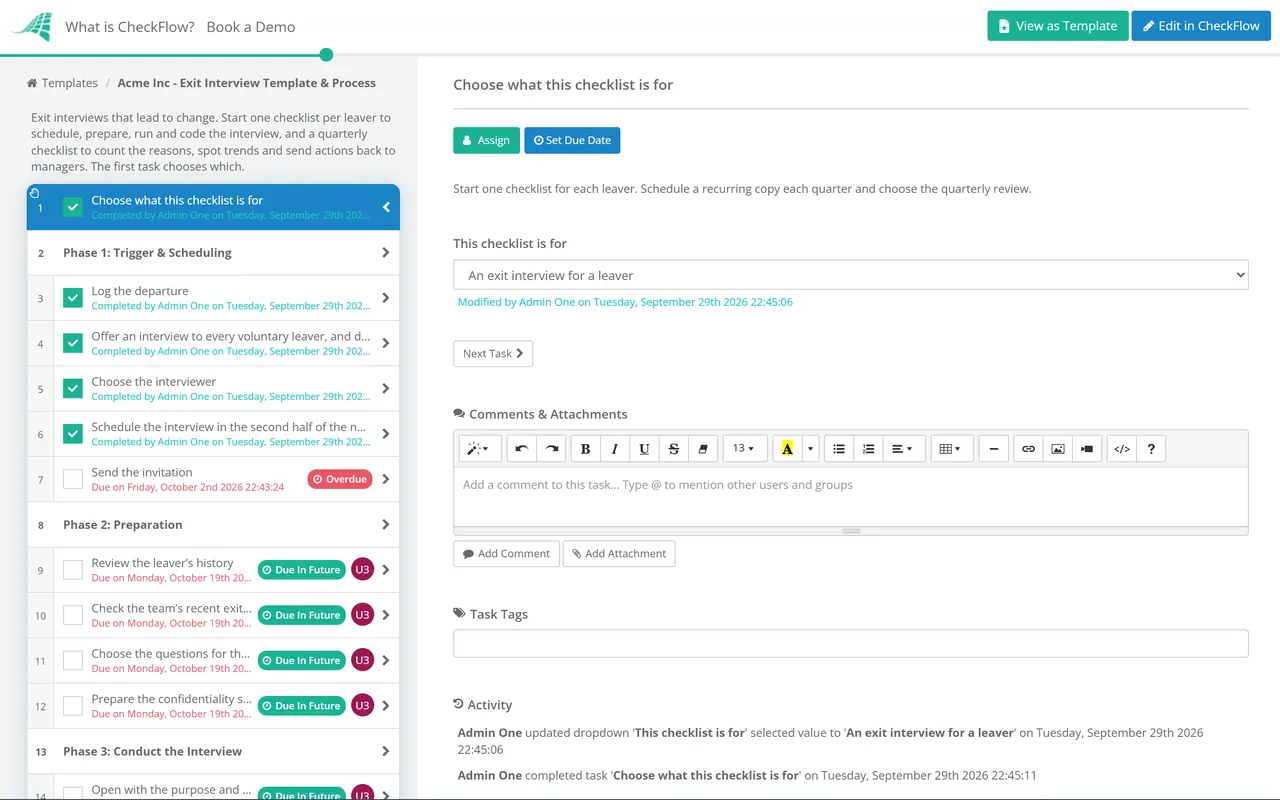
The exit interview
Who: HR or a skip-level manager, never the direct manager.
When: the second half of the notice period.
Output: notes in the leaver’s words and a coded reason for leaving.
Covered by: Phases 1–4.
An exit interview is worth doing only if two things happen. The conversation has to be honest, which depends on who asks, when they ask and what the leaver is told about confidentiality. And the answers have to be counted, compared and turned into actions for the managers who can do something about them. This free exit interview template covers both: a per-leaver process for scheduling, preparing, running and coding the interview, and a quarterly analysis that finds the trends and sends actions back to managers. It includes a question bank organised by theme. The rest of a departure, such as access removal, final pay and equipment return, is covered by the Employee Offboarding Checklist.
Who asks matters most. People rarely give a candid account of why they are leaving to the manager they are leaving. Research published in Harvard Business Review by Everett Spain and Boris Groysberg argues that interviews are more useful when run by someone outside the leaver’s reporting line, such as an HR partner or a more senior manager, and when the organisation is clear about what it wants to learn. The same research treats the exit interview as a retention tool, not an HR formality.
Timing matters next. On the last afternoon, the leaver is handing over work and saying goodbye. Holding the interview in the second half of the notice period gives them time to reflect while they are still engaged. Some organisations add a short survey a couple of months after the leaving date, when people often speak more freely.
Confidentiality has limits, and the leaver should hear them. Tell the leaver who will read their answers, that themes are reported in aggregate, and that anything suggesting harassment, discrimination, fraud or a safety risk will be passed to the formal process. Do not promise more confidentiality than you can give. Exit interview notes are also personal data, so hold them under your normal HR retention rules.
Three numbers are worth tracking from the start. The share of leavers who were interviewed tells you whether the process is being followed. The share of leavers you regret losing tells you whether turnover is a problem or just movement. And the count of each coded reason, quarter by quarter, tells you whether the actions you took last quarter changed anything. None of the three needs a survey platform; each only needs every interview to be recorded the same way.
Who: HR or a skip-level manager, never the direct manager.
When: the second half of the notice period.
Output: notes in the leaver’s words and a coded reason for leaving.
Covered by: Phases 1–4.
Who: the HR business partner or people analytics lead.
When: once a quarter, on a fixed date.
Output: a trend report, actions for managers and a check on last quarter’s actions.
Covered by: Phases 5–6.
Four phases run for every leaver. Two more run once a quarter, when the checklist is started as the quarterly review.
Shown when the checklist is started as the quarterly review rather than for a leaver.
Pick eight to twelve questions for each interview: always the first and last theme, plus the themes that fit the leaver’s role. Each theme is also a reason code. When the interviewer codes the primary reason for leaving in Phase 4, they choose from these same themes, which is what makes the quarterly counts possible.
Add two codes that are not about the job: Personal (relocation, study, caring responsibilities, health) and Other. Keeping them separate stops personal reasons from diluting the themes managers can act on. A code list should stay fixed for at least a year, or quarter-on-quarter comparisons stop working.
Start the checklist when a resignation is logged and the interviewer is assigned straight away, with a due date inside the notice period. Leavers stop slipping through because the interview was nobody’s job that week.
The reason for leaving is a fixed dropdown, not a paragraph of notes. Regretted loss and would-return are recorded the same way for every leaver, so the quarterly analysis starts from clean data instead of a re-read of fifty write-ups.
The quarterly review runs on a recurring schedule, and its first task is to check last quarter’s actions. Managers see their team’s themes, own the actions and know they will be asked about them again.
Exit interviews sit alongside the rest of the employee lifecycle. CheckFlow’s HR checklist software runs recruitment, onboarding, performance reviews and departures from templates, with assignments and approvals between HR and line managers.
The interview is one part of a departure. Our HR offboarding checklist guide covers the full process, from the resignation letter to final pay, and the Employee Offboarding Checklist turns it into assigned tasks.

Employee Offboarding Checklist
Employee Performance Review Checklist

Remote Team Engagement Checklist

Employee Engagement Survey Process Checklist
Internal Transfer & Role Change (Mover) Checklist
Describe the process in a sentence and the AI checklist generator drafts the phases and tasks for you.
An exit interview is a structured conversation with an employee who is leaving, to find out why they are going and what the organisation could do better. Its value comes from the analysis afterwards: when reasons are coded consistently and reviewed together, they show which teams, managers or policies are driving people away, and whether changes made in response are working.
Someone outside the leaver’s reporting line: usually an HR business partner, or a manager one level above the leaver’s own. Leavers are less candid with the manager they are leaving, and many of the most useful answers are about that relationship. The interviewer should be trained to listen, follow up and stay neutral rather than argue with the leaver’s account.
In the second half of the notice period is a good default. The decision has settled, but the leaver is still engaged and not yet busy with goodbyes. Avoid the final afternoon. Some organisations also send a short survey a month or two after the leaving date, when people may speak more openly about their manager or pay.
They should be confidential within clear limits, and the leaver should be told those limits at the start. Report themes in aggregate and only break results down where the group is large enough that no one can be identified. Tell the leaver that allegations of harassment, discrimination, fraud or safety risks will be passed to the formal process, because the organisation may have a duty to act on them. Store the notes as HR records under your normal retention policy.
Code every interview’s primary reason for leaving from a fixed list of themes, then count them once a quarter. Compare each theme with the previous four quarters, break it down by team, manager, tenure and role where the numbers allow, and set it against turnover and engagement data. Turn the main themes into one or two actions per manager, and check those actions at the next quarterly review.
Both work, and many organisations combine them. A conversation gets richer answers and lets the interviewer follow up. A survey is quicker, easier to count and may feel safer for some leavers. The template supports either: record the format in Phase 1, and use the same reason codes in Phase 4 so both kinds of input feed the same quarterly analysis.
14-day free trial, no card required. The Business plan is $10 per user per month after the trial. Full details at checkflow.io/pricing.
14-day free trial, no credit cardFull refund in your first 30 daysUS hosting, EU on request