Company Insurance Due Diligence Checklist Template

A structured framework for reviewing a company’s insurance portfolio — whether auditing your own coverage or assessing a target organisation’s protection.

Most companies know they have insurance. Few have systematically reviewed whether their coverage is adequate for their current risk profile, whether exclusions leave material gaps, whether policies have been properly maintained, or whether the claims history reveals patterns that demand attention. A structured insurance due diligence process — run annually as an internal review or as part of M&A and partnership due diligence — answers all of these questions before they become expensive discoveries. This free company insurance due diligence checklist gives finance directors, CFOs, operations managers, and deal teams a comprehensive framework for reviewing every material insurance line: liability, property, professional indemnity, cyber, D&O, employment practices, business interruption, and more — with coverage adequacy, policy terms, exclusions, claims history, and compliance requirements all systematically assessed.

Use This Template Free See Live Example
No Credit Card Required

Why Most Companies Only Discover Insurance Gaps When They Need to Claim

The standard approach to corporate insurance is to renew what existed last year, sometimes with a broker’s guidance and sometimes without. Policies accumulate over time without systematic review of whether coverage limits have kept pace with business growth, whether new risks have emerged that are not covered, or whether exclusions in existing policies leave material exposures that management believes are covered. The result is an insurance portfolio that looks comprehensive on paper and reveals its gaps at the worst possible moment — when a claim is made.

In a transaction context, insurance due diligence is frequently treated as a secondary consideration — reviewed quickly or delegated to a junior team member at the end of a deal process. Yet inadequate insurance in a target company can transfer directly to the acquirer: uninsured property damage, uninsured employment claims, D&O coverage with gaps that crystallise post-closing, or cyber policies with exclusions that precisely match the breach the company suffered last year. A structured insurance review — either as an annual internal discipline or as a formal due diligence workstream — is the process that converts the assumption of coverage into confirmed protection.

What the Company Insurance Due Diligence Checklist Covers

This checklist covers eight phases — from the initial insurance inventory through to coverage gap analysis, claims history review, cyber liability assessment, and renewal and risk management strategy. It applies to both internal annual reviews and due diligence review of a target company’s insurance arrangements.

Phase 1

Insurance Inventory & Documentation Review

A complete, current inventory of all insurance policies is the foundation of any meaningful review. Many companies discover during this phase that they cannot locate current copies of all their policies — which is itself a governance finding.

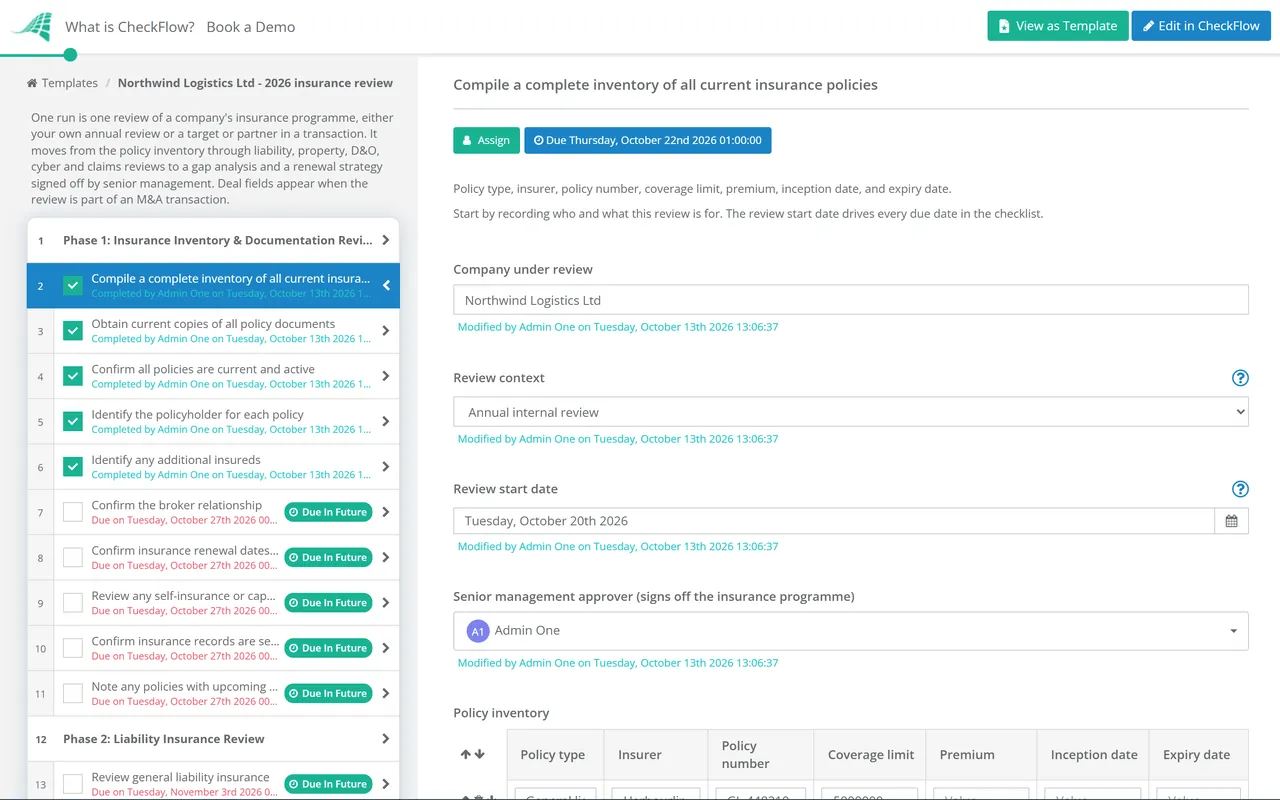
  • Compile a complete inventory of all current insurance policies — policy type, insurer, policy number, coverage limit, premium, inception date, and expiry date
  • Obtain current copies of all policy documents — not just schedule summaries; full policy wording including terms, conditions, and endorsements
  • Confirm all policies are current and active — no lapsed, expired, or cancelled policies being relied upon
  • Identify the policyholder for each policy — confirm the correct legal entity is named on each policy; particularly relevant for group structures with multiple entities
  • Identify any additional insureds — confirm which third parties (landlords, lenders, customers, partners) are named as additional insureds and whether this is appropriate
  • Confirm the broker relationship — who places and manages insurance for the company? Is the broker arrangement current and documented?
  • Confirm insurance renewal dates are tracked — are renewal dates in a central calendar with adequate lead time for review and renewal?
  • Review any self-insurance or captive arrangements — document scope and any regulatory requirements associated
  • Confirm insurance records are securely stored and accessible — not solely held by the broker or a single employee
  • Note any policies with upcoming renewals within 90 days — flag for priority review and renewal action
Phase 2

Liability Insurance Review

  • Review general liability insurance — confirm coverage limits, retroactive date (if applicable), and key exclusions; assess adequacy for the company’s risk profile and contractual requirements
  • Review professional indemnity / errors and omissions insurance — confirm coverage reflects current services provided; assess whether limits meet customer contractual requirements or regulatory minimums
  • Review product liability insurance where applicable — confirm coverage extends to all current products and markets; assess adequacy of limits relative to product revenue and potential claims
  • Review public liability insurance — confirm coverage for third-party bodily injury and property damage; assess limits relative to premises and activity risk
  • Review employers’ liability or workers’ compensation insurance — confirm it meets statutory minimums in all jurisdictions where employees are located; confirm no gaps for remote workers or international employees
  • Confirm liability policies cover the correct business activities — any new services, products, or markets entered since the last review must be within scope
  • Review any umbrella or excess liability policy — confirm attachment point aligns with underlying limits and that coverage is not gaps-riddled
  • Assess coverage for contractual liability — many liability policies exclude or limit coverage for liabilities assumed under contract; assess whether this creates gaps
  • Review occurrence vs claims-made basis for each policy — confirm reporting requirements and extended reporting periods (ERPs) for claims-made policies
  • Document liability coverage findings — adequacy assessment, key exclusions, gaps identified, and recommended actions
Phase 3

Property & Business Interruption Insurance Review

  • Review commercial property insurance — confirm all owned and leased properties are covered; assess whether insured values reflect current reinstatement costs, not original purchase or market values
  • Confirm contents coverage is adequate — all equipment, inventory, and business assets are covered at current replacement value
  • Review property policy exclusions — flood, earthquake, terrorism, and other excluded perils; confirm whether additional cover is required given the company’s location and risk profile
  • Review business interruption (BI) insurance — confirm coverage period is adequate (typically 12–24 months) for the time required to resume full trading following a major loss
  • Assess the BI indemnity period — is it sufficient to cover the time to rebuild, restock, replace equipment, and restore the customer base?
  • Review contingent BI coverage — does the policy cover losses arising from a supplier or key customer suffering an insured loss?
  • Confirm any lease-imposed insurance obligations are met — landlords typically require specific property and liability coverage minimums
  • Review any equipment breakdown or machinery insurance — applicable for businesses reliant on critical plant, equipment, or technology infrastructure
  • Assess coinsurance and underinsurance risk — property policies with average clauses can result in proportional reduction of claims if sums insured are below replacement value
  • Document property and BI findings — coverage adequacy, valuation status, key exclusions, and any recommended uplifts
Phase 4

Directors & Officers and Management Liability Review

D&O insurance is frequently misunderstood and inadequately reviewed. Coverage scope, Side A vs Side B vs Side C distinctions, and exclusions for known circumstances all require specific attention.

  • Review Directors and Officers (D&O) insurance — confirm coverage structure (Side A, B, and C), policy limits, and whether limits are shared or separate
  • Assess D&O coverage adequacy for current risk profile — regulatory environment, investor base, litigation environment, and the personal exposure of current directors
  • Confirm D&O covers all current entities and subsidiaries — coverage must extend to all entities where individuals act as directors
  • Review key D&O exclusions — dishonesty, fraud, prior and pending litigation, prior known circumstances; confirm no material known circumstances that should have been disclosed at inception
  • Review Employment Practices Liability (EPLI) — coverage for wrongful termination, discrimination, harassment, and other employment-related claims; confirm limits and key exclusions
  • Review fiduciary liability insurance where applicable — for companies managing pension plans or other employee benefit plans
  • Review crime and fidelity insurance — coverage for employee dishonesty, theft, fraud, and forgery; assess limits relative to the company’s financial exposure
  • Confirm run-off coverage exists or is available — for outgoing directors and in M&A contexts where the target’s D&O coverage will be replaced
  • Review any prior acts coverage — confirm claims relating to acts before the current policy inception date are covered where applicable
  • Document D&O and management liability findings — coverage structure, adequacy assessment, known risks, and any recommended enhancements
Phase 5

Cyber Liability Insurance Review

Cyber liability is the fastest-growing and most frequently contested insurance line in corporate portfolios. Coverage scope, exclusions, and the interplay with other policies require specific, detailed review — not a line item in a general liability review.

  • Confirm a standalone cyber liability policy exists — do not assume cyber risks are adequately covered under general liability, property, or professional indemnity policies
  • Review first-party cyber coverage — breach response costs, business interruption from cyber events, data recovery, ransomware payments (confirm policy position on ransomware), and system replacement costs
  • Review third-party cyber liability coverage — claims arising from a breach affecting customers, regulatory fines and penalties (confirm GDPR fines are covered), and defence costs
  • Assess cyber coverage limits relative to the company’s data risk profile — volume of personal data held, customer data sensitivity, payment card data, and healthcare data
  • Review cyber policy exclusions carefully — war and terrorism exclusions (increasingly relevant for nation-state attacks), system failure vs malicious attack distinctions, and prior known incidents
  • Confirm the policy’s position on infrastructure failure — many cyber policies exclude losses caused by failure of cloud or internet infrastructure providers; assess whether this creates a gap
  • Review the insurer’s security requirements — most cyber policies require specific security controls (MFA, patching policies, EDR, backups); confirm the company is compliant; non-compliance can void coverage
  • Assess coverage for social engineering and funds transfer fraud — confirm whether business email compromise and invoice fraud are covered under cyber or crime insurance
  • Review incident response provisions — confirm the policy provides access to breach response services (legal, forensics, PR) and that the approved panel is accessible
  • Document cyber coverage findings — coverage scope assessment, critical exclusions, security control compliance status, and recommended enhancements
Phase 6

Claims History Review

  • Request a claims history for all insurance lines for the past three to five years — date, nature, amount paid or reserved, and current status of each claim
  • Review the claims history for patterns — recurring claim types may indicate underlying risk management failures rather than isolated incidents
  • Review any declined or disputed claims — confirm the grounds for declination; a history of coverage disputes may indicate policy terms or insurer quality issues
  • Confirm all currently open claims — nature, reserve level, expected resolution, and any policy limits implications
  • Assess the impact of the claims history on current and future premiums — understand how past claims are affecting the current cost of insurance
  • Identify any incidents that should have been reported under a claims-made policy but were not — late notification can void coverage
  • Review the company’s claims management process — who manages claims? Is there a documented notification process? Are claims reported promptly?
  • Identify any large potential claims not yet formally notified — circumstances that may give rise to a claim should be notified to the insurer as potential circumstances
  • Review any self-insured retentions (SIRs) or deductibles — confirm they are financially manageable and appropriately reserved in financial statements
  • Document claims history findings — claims summary, pattern analysis, open claims, and notification compliance assessment
Phase 7

Coverage Gaps, Compliance Requirements & Adequacy Assessment

  • Identify contractual insurance requirements — customer contracts, supplier agreements, lease agreements, financing documents, and any other contracts imposing specific insurance obligations; confirm all are met
  • Identify statutory and regulatory insurance requirements — mandatory covers in the company’s jurisdictions (employers’ liability, workers’ compensation, motor insurance, professional indemnity minimums for regulated activities); confirm all are in place
  • Review key customer and supplier certificate requirements — confirm certificates of insurance can be provided in the formats and with the limits requested
  • Conduct a structured coverage gap analysis — review the company’s principal risk areas against existing coverage; identify any material risks without insurance protection
  • Assess insurance adequacy for key risk scenarios — worst-case property loss, major liability claim, cyber breach, director investigation; confirm coverage would respond adequately
  • Review any risks that are deliberately uninsured — confirm this is a documented, conscious decision rather than an oversight
  • Assess whether insurance limits have kept pace with business growth — revenue, headcount, assets, and geographic footprint may have grown significantly since limits were last reviewed
  • Review any industry-specific insurance requirements — regulated sectors, professional bodies, and industry standards may impose specific coverage requirements
  • Assess the quality and financial strength of insurers — confirm key insurers carry investment-grade credit ratings; an insurer that cannot pay a claim is no protection at all
  • Document gap analysis findings — identified gaps, uninsured risk assessment, compliance shortfalls, and prioritised recommended actions
Phase 8

Renewal Strategy & Risk Management Review

  • Review the broker relationship — is the current broker providing adequate market access, technical advice, and claims support? When was the appointment last reviewed?
  • Confirm renewal strategy for each policy line — renewal at current terms, market test, tender, or restructure
  • Review the risk management programme — what controls are in place to reduce insured risks? Is the insurer aware of and giving credit for these controls?
  • Review health and safety practices as they affect employers’ liability and public liability premiums — documented H&S policy, training records, and incident reporting
  • Review cybersecurity controls as they affect cyber insurance renewal — MFA adoption, patching cadence, backup strategy, and incident response plan; these directly affect both premium and coverage availability
  • Prepare renewal documentation — proposal form responses, updated risk information, and any material changes to the business that must be disclosed
  • Review any recommendations from insurers or surveyors — outstanding risk improvement recommendations that have not been implemented may affect coverage at renewal
  • Benchmark premiums against the market — are current premiums competitive? Has the market hardened or softened since the last renewal?
  • Confirm senior management sign-off on the insurance programme — the board or relevant committee should formally approve the insurance programme annually
  • Document renewal strategy and risk management findings — recommended actions for each line, renewal timeline, and accountability for implementation

This checklist is available as a free, runnable template in CheckFlow — with tasks assigned across finance, legal, operations, and IT security teams, annual reviews scheduled automatically as a recurring checklist, and a complete documented record for board and audit committee reporting.

Use This Template Free

The Principal Insurance Lines in a Corporate Insurance Programme

A comprehensive corporate insurance programme typically covers nine principal lines. Not all are required by every company — coverage requirements vary by sector, size, and risk profile.

General Liability

Covers: Third-party bodily injury and property damage claims arising from business operations.

Who typically needs it: All businesses with premises, operations, or customer-facing activities.

Watch for: Contractual liability exclusions; claims-made vs occurrence form differences.

Professional Indemnity / E&O

Covers: Claims arising from professional advice, services, or errors and omissions.

Who typically needs it: Professional services firms, consultants, IT companies, financial services, healthcare providers.

Watch for: Ensure coverage reflects all services provided; check retroactive dates.

Directors & Officers (D&O)

Covers: Personal liability of directors and officers for decisions made in their capacity as managers.

Who typically needs it: All companies with a board; particularly important for VC-backed companies and regulated businesses.

Watch for: Side A adequacy for individual protection; prior known circumstances exclusions.

Cyber Liability

Covers: Data breach response costs, cyber business interruption, third-party liability, regulatory fines (where insurable), and ransomware response.

Who typically needs it: Any company holding personal data, processing payments, or reliant on digital systems.

Watch for: War exclusions; infrastructure failure exclusions; MFA and security control compliance requirements.

Property & Business Interruption

Covers: Physical damage to business property and financial losses from inability to trade following an insured event.

Who typically needs it: All businesses with physical assets or premises; all businesses where an operational disruption would cause financial loss.

Watch for: Underinsurance risk on property; adequacy of BI indemnity period.

Employment Practices Liability (EPLI)

Covers: Wrongful termination, discrimination, harassment, and other employment-related claims.

Who typically needs it: All employers, particularly those with significant headcount or in regulated sectors.

Watch for: Exclusions for known circumstances; check coverage extends to third-party claims.

Product Liability

Covers: Claims arising from injury or damage caused by products manufactured, distributed, or sold.

Who typically needs it: Manufacturers, importers, distributors, and retailers.

Watch for: Coverage should extend to all markets where products are sold; product recall coverage may be separate.

Crime / Fidelity

Covers: Financial losses from employee theft, fraud, forgery, and increasingly social engineering and funds transfer fraud.

Who typically needs it: All businesses with financial operations; particularly important for finance functions handling large transactions.

Watch for: Social engineering and BEC fraud coverage; confirm whether crime or cyber policy covers funds transfer fraud.

Employers’ Liability / Workers’ Compensation

Covers: Employee injury or illness claims arising from work activities; statutory minimum coverage in most jurisdictions.

Who typically needs it: All employers — statutory in most jurisdictions.

Watch for: Coverage for remote workers, contractors, and internationally located employees.

Why Run Insurance Due Diligence in CheckFlow?

1

Coordinate across finance, legal, IT, and operations

Insurance due diligence involves the finance director reviewing premiums and financial adequacy, legal reviewing contractual compliance and policy terms, IT security confirming cyber policy compliance requirements, and operations confirming property and liability coverage for business activities. CheckFlow assigns each phase to the right team member, notifies them of their responsibilities, and gives the review lead a live view of progress across all workstreams.

2

Annual reviews that actually happen on schedule

Insurance review is genuinely well suited to a recurring checklist — policy renewals are annual, board reporting requirements are annual, and the risk profile review should be annual. CheckFlow’s recurring feature schedules the full review automatically, assigns tasks to the right team members at the right time, and ensures the review is complete and documented before renewal decisions are made — not after.

3

A documented record for governance and audit

Every completed review task is timestamped and attributed to a named reviewer in CheckFlow. The full insurance review record — coverage assessment, gap analysis, claims history review, and renewal decisions — is archived for board and audit committee reporting. When a claim is disputed or governance is questioned, the documented record demonstrates that the insurance programme was systematically reviewed and maintained.

Cyber liability insurance adequacy depends directly on the security controls the company has in place. Most cyber policies require specific controls — MFA, patching, EDR, backups — as conditions of coverage. CheckFlow’s ISO 27001 Compliance Checklist covers the security control framework that both reduces cyber risk and satisfies cyber insurer requirements. See the ISO 27001 Compliance Checklist →

Insurance review is one of several annual governance processes that benefit from a structured recurring checklist. CheckFlow’s recurring feature schedules insurance reviews, compliance audits, and other annual obligations automatically — so they happen on schedule, every year, with a documented record. Learn more about recurring checklists in CheckFlow →

Frequently Asked Questions

What is insurance due diligence and when is it required?

+

Insurance due diligence is the systematic review of a company’s insurance policies to assess coverage adequacy, identify gaps, review policy terms and exclusions, examine claims history, and ensure all contractual and regulatory insurance obligations are met. It is conducted in two main contexts: as an internal annual review — a governance discipline that ensures the company’s insurance programme keeps pace with its evolving risk profile — and as part of transaction due diligence, where the insurance arrangements of a target company, investment candidate, or material business partner are reviewed as part of broader M&A, investment, or partnership diligence. Both contexts use the same structured framework.

What are the most common insurance coverage gaps found during due diligence?

+

The five most common coverage gaps identified during corporate insurance due diligence are: cyber liability — many companies still rely on extensions within other policies rather than standalone cyber cover, leaving material gaps in breach response and business interruption coverage; underinsured property values — insured values that have not kept pace with construction cost inflation; inadequate business interruption indemnity periods — many policies cover 12 months when the actual recovery time for a major loss would be 18–24 months; D&O limits that have not kept pace with company growth or increased regulatory risk; and employment practices liability absent from the programme despite significant headcount and jurisdictional employment law exposure.

What is the difference between occurrence-based and claims-made insurance policies?

+

An occurrence-based policy covers claims arising from events that occur during the policy period, regardless of when the claim is made — even if the policy has since expired. A claims-made policy covers claims that are first made during the policy period, regardless of when the underlying event occurred (subject to a retroactive date). Claims-made policies are common for professional indemnity, D&O, and cyber insurance. The key implication for claims-made policies is that coverage must be continuous — a gap in coverage can leave historic incidents uninsured — and that extended reporting period (ERP or “tail”) coverage is needed when a claims-made policy is not renewed.

How should cyber insurance be reviewed differently from other insurance lines?

+

Cyber insurance requires more technically detailed review than most other insurance lines for three reasons. First, exclusions are particularly material — the war and terrorism exclusion has been invoked for nation-state cyberattacks and is actively litigated; infrastructure failure exclusions can apply to the most common cloud-based business interruption scenarios. Second, compliance requirements are active conditions of coverage — most cyber policies require specific security controls (MFA on all privileged accounts, regular patching, EDR deployment, offline backups) and can void coverage if these controls were not in place at the time of a claim. Third, the coverage landscape is evolving rapidly — what was standard cyber coverage in 2021 may have significant gaps in 2025–26, requiring active comparison against current market terms.

Is insurance review required in M&A due diligence?

+

Yes — insurance review is a standard component of M&A due diligence and is typically conducted as part of the legal and financial workstream. Key objectives are: identifying any insurance requirements imposed by material contracts that the acquirer will need to maintain; assessing whether the target has adequate coverage for its known risk profile (gaps become the acquirer’s problem post-closing); reviewing the claims history for patterns indicating risk management weaknesses; confirming D&O run-off coverage is in place or will be arranged for outgoing directors; and identifying any known circumstances that may give rise to future claims but have not yet been notified to insurers. Post-closing, the target’s insurance programme will typically need to be integrated with or replaced by the acquirer’s.

Is CheckFlow free to use for this template?

+

You can start a free 14-day trial with no credit card required, giving you full access to all features including this template. The Business plan is $10 per user per month after the trial. Full details at checkflow.io/pricing.

Review Your Insurance Programme Before You Need to Claim

Free trial — no credit card required.