
Peak season squeezes weeks of onboarding into a few days, for dozens of people who all start on the same morning. Returning staff get pushed through the whole process again, and nobody writes down who is worth asking back.
This free seasonal employee onboarding checklist is for HR teams and operations managers taking on peak staff in retail, hospitality, warehouses, events and agriculture. It treats each intake as a cohort with one start date and one season end date, runs a group induction and a short role module, and gives returning workers a fast track that checks what still holds instead of repeating everything. The end of the season is planned on day one: final pay, kit returned, an exit conversation and an invitation to come back. Seasonal covers the hiring and rehire process. For till, cash and age-restricted sales training on the shop floor, run the Retail Employee Onboarding Checklist alongside it, and for kitchens use the Restaurant Employee Training Checklist. A permanent hire belongs in the Employee Onboarding Checklist.
An ordinary onboarding plan assumes one person, a few weeks of notice and a long future with the company. Seasonal hiring breaks all three. Forty people may start on the Saturday before a holiday rush, most will leave within three months, and the role training has to fit into a shift or two. The work that matters is getting every starter cleared to work and paid correctly on the same date, then teaching each of them one job well.
Returning workers are the second difference. Someone who did the job last summer already knows the site and the routine, but their paperwork has not simply carried over. Some eligibility checks have to be updated or repeated, certificates may have expired, and the business may have changed its products or systems. Asking one question on the first task, whether this person has worked a season with you before, lets the checklist show a short rehire path to returners and the full path to everyone else.
First season
New seasonal starter
Checks: full eligibility to work check, plus any reference or background check the job needs.
Paperwork: written terms, payroll and tax set-up from scratch.
Training: group induction and the complete role module.
Ready when: the trainer has signed off each task in their role.

Returning
Worker back from a previous season
Checks: last season’s record reviewed, eligibility updated or repeated, certificates checked for expiry.
Paperwork: new terms for the new season, contact and bank details confirmed.
Training: group induction and a refresher on what has changed.
Ready when: the supervisor confirms they are back up to speed.
What the Seasonal Employee Onboarding Checklist Covers
The template follows a seasonal worker from cohort planning to the invitation to return. Returning workers see the rehire fast track, first-timers see the full checks, and country decides which eligibility tasks appear.
Phase 1
Phase 1: Plan the Cohort Start
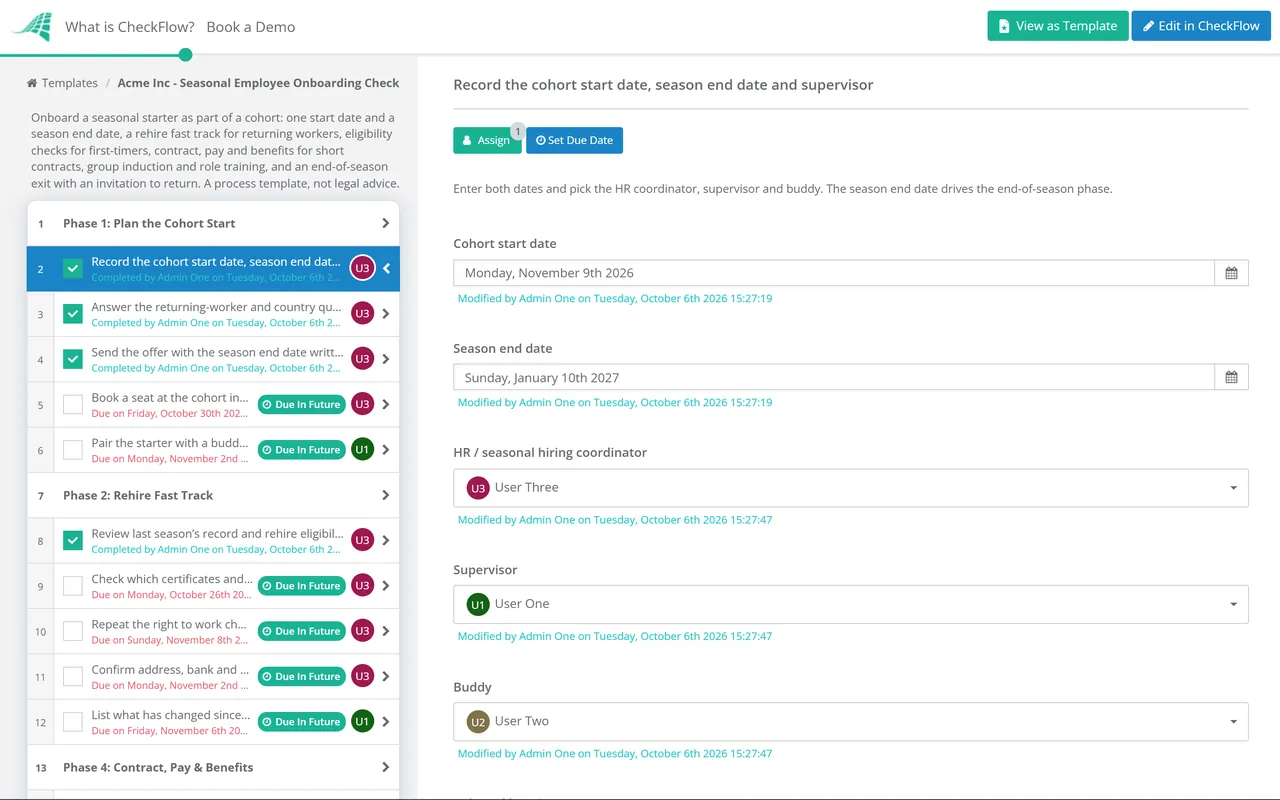
Record the cohort start date, season end date and supervisor — the buddy is chosen here too, and the end date drives every end-of-season task
Answer the returning-worker and country questions — have they worked a previous season with you, and will they work in the US, the UK or elsewhere?
Send the offer with the season end date written in — hours pattern, pay rate and how the job ends
Book a seat at the cohort induction — one session per start date, not one per person
Pair the starter with a buddy from a previous season
Phase 2 — If Returning
Phase 2: Rehire Fast Track
Shown only for workers who have done a previous season with you. It checks what still holds rather than repeating every step. A process step, not legal advice.
Review last season’s record and rehire eligibility — exit notes, conduct issues and the return flag set at the end of their last season
Check which certificates and documents are still in date — first aid, equipment tickets, licences, ID
Complete Supplement B or a new Form I-9 — US only; Supplement B is an option within three years of the original form
Repeat the right to work check before the first shift — UK only; a return after the job ended is a new employment
Confirm address, bank and emergency contact details
List what has changed since last season — products, systems, prices, rules and people
Phase 3 — If New
Phase 3: Eligibility & Pre-Start Checks
Shown only for first-season starters. The country answer shows the US or the UK eligibility task.
Complete Form I-9 for a US starter — Section 1 by the first day of work, Section 2 within three business days
Complete the right to work check before employment starts — UK, by a manual check, the Home Office online service or a registered digital verification service
Run any reference or background check the role needs — for driving, cash handling or work with children, and nothing more
Send the pre-start pack — rota, uniform size, parking, where to report and who to ask for
Phase 4
Phase 4: Contract, Pay & Benefits
For every starter, new or returning. The UK holiday and pension tasks appear only for UK workers.
Issue the written terms with the season end date — in the UK, the principal written statement must reach them by their first day
Set up payroll and tax withholding — Form W-4 and any state form, or a P45 or the HMRC starter checklist
File the state new-hire report — US; returners count too if they were away 60 days or more
Confirm how holiday will accrue and be paid — 12.07% of hours for irregular-hours and part-year workers
Decide on pension postponement and send the notice — up to three months, with a letter within six weeks
Phase 5
Phase 5: Cohort Induction & Role Training
First-season starters get the full role module; returners get a refresher instead.
Run the group induction for the whole cohort — site rules, emergency exits, welfare facilities, breaks and who to ask
Deliver the short role module — one job taught properly, not a tour of every department
Give returning workers a refresher on what has changed
Train the safety essentials for the role — lifting, equipment, protective kit and heat or cold if they work outdoors
Sign off each role task with the trainer watching
Phase 6
Phase 6: First Two Weeks on Shift
Check in at the end of the first shift — what was confusing, what they still need, whether the rota works
Review attendance, timekeeping and pace after week one
Supervisor approves the starter to work without a buddy
Note who could cover extra shifts or a lead role — useful for the rest of the season and the next one
Phase 7
Phase 7: End of Season & Invitation to Return
Due dates count back from the season end date recorded in Phase 1, so the exit is planned before the busy weeks start.
Confirm the last shift and the final pay date
Pay any untaken holiday and issue the leaving paperwork — in the UK, untaken statutory leave must be paid and a P45 issued
Collect uniform, keys and badges, and close system access
Hold an exit conversation and record rehire eligibility — yes, no or with conditions, plus a short reason
Invite eligible workers back for next season — with their consent to be contacted and the dates they could do
Most of the rules for seasonal staff are the ordinary employment rules applied to short, repeated periods of work. The table sets out the points where a returner or a short contract changes what you do. Use it to set up the template, not as legal advice: state law, the worker’s immigration status and your own contracts can all change the answer.
Topic
United States
United Kingdom
Eligibility to work
Rehired within three years of the date the previous Form I-9 was completed: complete Supplement B or a new form. After three years, a new Form I-9. If the old form is an outdated edition, use Supplement B of the current one
Checks are made before employment starts, so a worker whose job ended last season is checked again. A worker who stays engaged between assignments needs no fresh check each time, provided the employer holds a valid statutory excuse and makes any follow-up check
Reporting the hire
State new-hire report within 20 days. A rehire counts as a new hire if they were separated for at least 60 consecutive days
HMRC learns of the starter through payroll, using a P45 or the starter checklist
Contract
No federal written-contract rule, but some states require a notice at hire; California, for example, requires written pay details
A seasonal or casual employee taken on for up to six months in a peak period can be a fixed-term employee, entitled to the same pay and conditions as permanent staff unless the difference is objectively justified
Holiday
Federal law does not require paid vacation; follow state law and your own policy
Irregular-hours and part-year workers accrue 12.07% of hours worked; rolled-up holiday pay is allowed for them if shown separately on each payslip. Untaken statutory leave is paid on leaving
Benefits and pensions
Under the ACA, a seasonal employee is one hired into a position whose customary annual employment is six months or less, starting at about the same time each year; this matters for employers using the look-back measurement method
Automatic enrolment can be postponed for up to three months, with a letter to the worker within six weeks. Temporary staff are assessed every time they are paid
Two points are moving or easy to miss. Since 1 October 2026 the Home Office employer guide has brought people on workers’ contracts into the right to work scheme, and many casual seasonal arrangements are set up that way. And workers from overseas on the UK Seasonal Worker visa, which covers horticulture for up to six months and poultry from 2 October to 31 December, come through a sponsor and still need the right to work check. For the detail, read the USCIS rehire guidance, the Home Office right to work guide, GOV.UK on holiday pay and The Pensions Regulator on seasonal staff.
Why Run Seasonal Onboarding in CheckFlow?
1
Returners skip what still holds
One answer on the second task decides the route. A returning worker sees the rehire fast track and a refresher, a first-timer sees the full checks and the role module, and the country answer shows only the eligibility tasks that apply where they work.
2
Two dates run the whole season
Pre-start tasks count from the cohort start date, so the I-9 and the new-hire report fall due on time for every starter. End-of-season tasks count back from the season end date, so final pay and kit returns are scheduled before anyone is too busy to plan them.
3
Next season starts with a list
The exit task records whether each person is eligible to return, why, and whether they agreed to be contacted. With a name and timestamp on every task, next year’s recruiter can see who was good, who said yes and which checks were done.
Each seasonal starter gets their own checklist from the same template. CheckFlow’s onboarding software reports across all of them, so a supervisor can see on the Friday which members of Saturday’s cohort are still missing a check or a signature.
Does a returning seasonal worker need a new Form I-9?
+
Not always. If you rehire someone within three years of the date their previous Form I-9 was completed, USCIS lets you either complete a new form or fill in Supplement B of the old one. Supplement B needs no new documents if the worker’s employment authorisation has not expired; if it has, they show a current document. If the old form is an outdated edition, use Supplement B from the current edition. After three years, a new Form I-9 is required.
Do I need a new right to work check when a seasonal worker comes back?
+
If their employment ended when the season finished, treat the return as a new employment and complete the check again before their first shift, since the statutory excuse comes from a check made before employment starts. If they stayed engaged with you between seasons, the Home Office guide says a fresh check is not needed before each assignment, as long as you hold a valid statutory excuse and make any follow-up check before their permission expires. Keep last season’s record as well.
How is holiday worked out for seasonal staff in the UK?
+
It depends on the contract. Workers whose paid hours are wholly or mostly variable, and part-year workers with unpaid weeks inside their contract, accrue holiday at 12.07% of the hours they work, and you can pay rolled-up holiday pay with each wage payment if it appears as a separate item on the payslip. A seasonal worker on regular hours gets a pro-rata share of the 5.6 weeks. Whatever the method, statutory leave they have not taken by the end of the season must be paid.
Do seasonal workers have to be put into a workplace pension?
+
In the UK, automatic enrolment applies to temporary staff as it does to anyone else, and The Pensions Regulator says they must be assessed each time they are paid. You can postpone that assessment for up to three months, which suits staff who will have left before then, but you must write to each of them within six weeks of the postponement starting. A worker can still ask to join during postponement.
How do you onboard a large group of seasonal workers at once?
+
Give the intake one start date and run the shared parts once: a single group induction, one session for paperwork questions and one safety briefing. Keep the individual parts individual, because eligibility checks, payroll and role sign-off belong to each person. Start each starter’s checklist from the same template a few weeks ahead so the checks are finished before the induction, and keep returners off the full path so the trainers can concentrate on first-timers.
Is CheckFlow free for this template?
+
14-day free trial, no card required. The Business plan is $10 per user per month after the trial. Full details at checkflow.io/pricing.
The Whole Seasonal Cohort, Cleared and Trained by Opening Day
Free trial — no credit card required.
Do you like cookies? 🍪 We use cookies to ensure you get the best experience on our website. Learn more