ISO 27001 Compliance Checklist Template

A structured checklist for implementing, certifying, and maintaining an ISO 27001:2022 Information Security Management System.

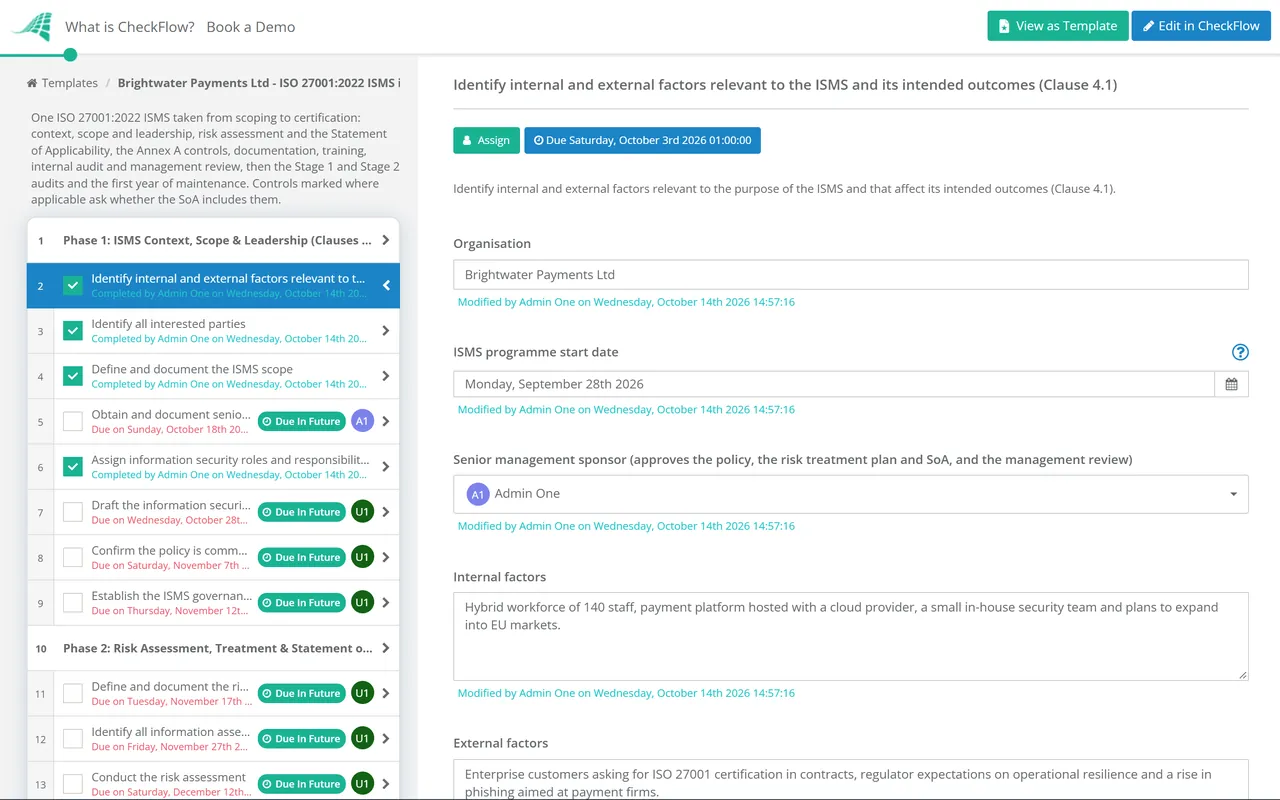
ISO 27001:2022 is the international standard for information security management — a risk-based framework that requires organisations to identify their information security risks, implement controls to treat them, and demonstrate through documented evidence and independent audit that their ISMS is operating effectively. This free ISO 27001 compliance checklist covers the full implementation lifecycle: ISMS scoping and context, risk assessment and treatment, the Statement of Applicability, all four Annex A control themes (Organizational, People, Physical, and Technological), internal audit and management review, and certification preparation. Use it as an implementation roadmap or run it as a live, trackable checklist in CheckFlow — with tasks assigned across IT, HR, operations, and senior management, and every completed step logged as certification evidence.

Use This Template Free See Live Example
No Credit Card Required

What Is ISO 27001 and Why Does It Matter?

ISO/IEC 27001 is the internationally recognised standard for Information Security Management Systems (ISMS). Published by the International Organization for Standardization and the International Electrotechnical Commission, it specifies the requirements for establishing, implementing, maintaining, and continually improving an ISMS — the systematic approach to managing sensitive company and customer information to keep it secure.

The current version, ISO 27001:2022, updated the previous 2013 standard significantly — reducing and restructuring the Annex A controls from 114 across 14 domains to 93 controls organised into four thematic groups (Organizational, People, Physical, and Technological), and introducing 11 new controls addressing modern threats including threat intelligence, data masking, data leakage prevention, secure coding, and ICT readiness for business continuity.

ISO 27001 certification is increasingly required by enterprise customers, government contracts, and regulated industry procurement processes — and is a meaningful differentiator for any organisation that handles sensitive data. Certification is awarded by accredited certification bodies following a two-stage external audit, and maintained through annual surveillance audits and three-yearly recertification.

The standard has two components: the mandatory Clauses (4 to 10) that define the ISMS management system requirements, and Annex A — a catalogue of 93 security controls from which organisations select applicable controls based on their risk assessment.

What the ISO 27001 Compliance Checklist Covers

This checklist maps to the mandatory clauses of ISO 27001:2022 and the four Annex A control themes. Clauses 4–10 are mandatory for all organisations. Annex A controls are selected based on your risk assessment — not all 93 controls apply to every organisation.

Phase 1

ISMS Context, Scope & Leadership (Clauses 4–5)

  • Identify internal and external factors relevant to the purpose of the ISMS and that affect its intended outcomes (Clause 4.1)
  • Identify all interested parties — customers, regulators, employees, suppliers — and their relevant requirements (Clause 4.2)
  • Define and document the ISMS scope — which information assets, business processes, locations, and organisational units are included (Clause 4.3)
  • Obtain and document senior management commitment to the ISMS — confirm the information security policy is approved and signed at the appropriate level (Clause 5.1)
  • Assign information security roles and responsibilities — appoint an ISMS lead or Information Security Manager (Clause 5.3)
  • Draft the information security policy — confirm it states objectives, commitment to compliance, and continual improvement (Clause 5.2)
  • Confirm the policy is communicated to all relevant internal and external parties
  • Establish the ISMS governance structure — confirm who owns the ISMS, who reviews it, and who has authority to make decisions
Phase 2

Risk Assessment, Treatment & Statement of Applicability (Clause 6)

  • Define and document the risk assessment methodology — criteria for accepting risks and performing assessments
  • Identify all information assets within the ISMS scope
  • Conduct the risk assessment — identify threats, vulnerabilities, and impacts for each information asset
  • Evaluate risks against the risk acceptance criteria and prioritise by likelihood and impact
  • Select risk treatment options for each identified risk — accept, treat, transfer, or avoid
  • Map selected treatment options to applicable Annex A controls
  • Produce the risk treatment plan — document treatment actions, owners, and target dates
  • Produce the Statement of Applicability (SoA) — list all 93 Annex A controls, confirm which are applicable, which are excluded, and justify each exclusion
  • Obtain management approval of the risk treatment plan and SoA
  • Establish a process for managing and reviewing the risk register on an ongoing basis
Phase 3

Annex A — Organisational Controls (A.5, 37 controls)

Organisational controls cover policies, rules, and procedures affecting the organisation as a whole. Select applicable controls based on your SoA.

  • Develop and publish information security policies covering all relevant areas — access control, cryptography, physical security, supplier relationships, incident management (A.5.1)
  • Establish information security roles and responsibilities — confirm segregation of duties where required (A.5.2, A.5.3)
  • Implement asset management — identify and document all information assets, assign ownership, and classify by sensitivity (A.5.9, A.5.10, A.5.12)
  • Implement access control policy — define rules for granting, reviewing, and revoking access rights (A.5.15)
  • Establish supplier and third-party security requirements — confirm security clauses are included in supplier contracts (A.5.19, A.5.20)
  • Implement incident management procedures — define how incidents are reported, classified, and responded to (A.5.24, A.5.25, A.5.26)
  • Implement threat intelligence processes — collect and analyse information about relevant threats (A.5.7) [New in 2022]
  • Implement data leakage prevention measures where applicable (A.5.33) [New in 2022]
  • Confirm all applicable organisational controls are documented and implemented per the SoA

Phase 4

Annex A — People, Physical & Technological Controls (A.6–A.8)

Select applicable controls based on your SoA. People controls (A.6) cover the full employee lifecycle and are typically implemented jointly by IT and HR.

People Controls (A.6, 8 controls)
  • Conduct pre-employment background and reference checks for roles with access to sensitive information (A.6.1)
  • Include information security responsibilities in employment contracts (A.6.2)
  • Deliver information security awareness training to all staff — maintain training records as mandatory evidence (A.6.3)
  • Define and implement a structured offboarding process — ensure access rights are revoked and assets returned promptly when employment ends (A.6.5)
  • Implement remote working security controls — policies, equipment standards, and VPN requirements (A.6.7) [New in 2022]
  • Establish a confidential reporting mechanism for employees to report security concerns (A.6.8) [New in 2022]
Physical Controls (A.7, 14 controls)
  • Define and implement physical security perimeter controls — access restrictions to facilities housing sensitive information (A.7.1, A.7.2)
  • Implement clear desk and clear screen policies (A.7.7)
  • Confirm secure disposal of storage media before reuse or disposal (A.7.10, A.7.14)
  • Implement physical security monitoring where applicable (A.7.4) [New in 2022]
Technological Controls (A.8, 34 controls)
  • Implement user endpoint device management — policies for laptops, mobiles, and removable media (A.8.1)
  • Implement privileged access management — restrict and monitor privileged accounts (A.8.2)
  • Implement access rights management — provisioning, periodic review, and timely revocation (A.8.3, A.8.5)
  • Implement malware protection across all relevant systems (A.8.7)
  • Implement vulnerability management — regular scanning and timely patching (A.8.8)
  • Implement logging and monitoring — activity logs, anomaly detection, and log protection (A.8.15, A.8.16)
  • Implement data masking where personal or sensitive data is processed (A.8.11) [New in 2022]
  • Implement secure coding practices where software is developed in-house (A.8.28) [New in 2022]
  • Confirm ICT readiness for business continuity — redundancy and failover for critical systems (A.8.14) [New in 2022]
  • Confirm all applicable technological controls are documented and implemented per the SoA
Phase 5

Documentation, Training & Performance Evaluation (Clauses 7–9)

  • Confirm all mandatory documented information required by ISO 27001:2022 is in place — scope, policy, risk assessment, risk treatment plan, SoA, objectives, and records of competence, training, and monitoring
  • Establish document control procedures — version control, approval, distribution, and defined review cycles
  • Deliver information security awareness training to all staff — confirm completion is recorded for all employees
  • Deliver role-specific training for staff with ISMS responsibilities
  • Implement ongoing security awareness programme — confirm it covers phishing, social engineering, data handling, and incident reporting
  • Define ISMS performance metrics and objectives — establish how effectiveness will be measured
  • Implement monitoring and measurement procedures for key controls
  • Develop and execute the internal audit programme — confirm all clauses and applicable SoA controls are covered across the audit cycle
  • Conduct internal audits — document findings and nonconformities
  • Conduct management review — confirm senior management participation, document inputs, outputs, and decisions
Phase 6

Certification Audit & Ongoing Maintenance (Clause 10 + External Audit)

  • Address all internal audit nonconformities before the external certification audit
  • Confirm the certification body is accredited by a recognised national accreditation body (e.g. UKAS, ANAB)
  • Submit ISMS documentation for Stage 1 (documentation review) audit
  • Address any issues identified at Stage 1 before Stage 2
  • Undergo Stage 2 (on-site) certification audit — confirm all mandatory documents and evidence are available and current
  • Address any nonconformities from Stage 2 within the agreed timeframe and submit corrective action evidence
  • Receive ISO 27001 certificate — verify the scope statement is accurate and references ISO/IEC 27001:2022
  • Establish the annual surveillance audit schedule
  • Maintain ongoing ISMS activities between surveillance audits — internal audits, management reviews, risk assessment updates, and control monitoring
  • Assess impact of any significant changes (new systems, new processes, staff changes) on the ISMS and update documentation accordingly
  • Schedule recertification (every three years) with adequate preparation time

This checklist is available as a free, runnable template in CheckFlow — with tasks assigned across IT, HR, and management, all 93 Annex A control implementation activities tracked, and a complete evidence file built automatically as your team works through the checklist.

Use This Template Free

ISO 27001:2022 — What Changed From the 2013 Version?

If your organisation is transitioning from ISO 27001:2013 to the current 2022 version, here are the key changes to be aware of.

Controls restructured from 14 domains to 4 themes

The 2013 version had 114 controls across 14 domains. ISO 27001:2022 restructures these into 93 controls across four themes — Organizational (37), People (8), Physical (14), and Technological (34). The reduction reflects consolidation of overlapping controls, not a weakening of requirements.

11 new controls added

New controls address modern threats and working practices: Threat Intelligence (A.5.7), Data Masking (A.8.11), Data Leakage Prevention (A.5.33), Web Filtering (A.8.23), Secure Coding (A.8.28), ICT Readiness for Business Continuity (A.8.14), Remote Working (A.6.7), Physical Security Monitoring (A.7.4), and others. Review each new control against your risk assessment and update your SoA accordingly.

Transition deadline passed — action required

The deadline for transitioning from ISO 27001:2013 to ISO 27001:2022 certification was October 2025. Organisations still holding a 2013 certificate should have transitioned their ISMS and obtained a 2022 certificate by this date. Confirm your certificate references ISO/IEC 27001:2022.

Updated Statement of Applicability required

Your SoA must be updated to reflect the 2022 Annex A structure — 93 controls across four themes, replacing the 114 controls across 14 domains. Any controls added in 2022 must be assessed against your risk profile and either included or explicitly excluded with documented justification.

Why Manage ISO 27001 Compliance in CheckFlow?

1

Build your certification evidence file as you go

ISO 27001 certification requires documented evidence that controls are implemented and operating — not just documented on paper. Every task completed in CheckFlow is timestamped and attributed to the person who completed it. Your evidence file builds itself throughout the implementation, ready for Stage 1, Stage 2, and every surveillance audit that follows.

Audit Trail
2

Coordinate across IT, HR, and management

ISO 27001 implementation is not just an IT project. People controls involve HR. Physical controls involve facilities. Organisational controls involve senior management. CheckFlow assigns tasks to the right person in each function automatically, notifies them when their action is due, and gives the ISMS lead a live view of progress across the entire implementation — without manual chasing.

Auto-Assignments
3

Annual audits and reviews on autopilot

Maintaining ISO 27001 certification requires annual internal audits, risk assessment reviews, and management reviews — on schedule, every year, with documented evidence. CheckFlow’s recurring checklist feature automates the schedule so nothing is deferred. The same structured checklist, every cycle, with a fresh evidence trail for each surveillance audit.

Recurring Checklists

ISO 27001 Annex A.6.5 requires that information security responsibilities following termination or change of employment are defined, communicated, and enforced — including prompt revocation of all access rights. CheckFlow’s IT offboarding checklist provides a structured, automated way to ensure every leaver’s accounts, devices, and access rights are handled correctly, with a timestamped record that satisfies the A.6.5 evidence requirement. Learn more about CheckFlow for IT offboarding →

Frequently Asked Questions

What is ISO 27001 and who needs it?

+

ISO/IEC 27001 is the international standard for Information Security Management Systems (ISMS). It specifies requirements for establishing, implementing, maintaining, and continually improving an ISMS — the systematic approach to protecting sensitive information from threats. ISO 27001 certification is increasingly required by enterprise customers as a procurement condition, by regulated industries including financial services, healthcare, and government contracting, and by any organisation that handles significant volumes of personal or sensitive data. Certification demonstrates to customers, partners, and regulators that your organisation takes information security seriously and has independent verification to prove it.

What is the Statement of Applicability and why is it important?

+

The Statement of Applicability (SoA) is one of the most important documents in an ISO 27001 ISMS. It lists all 93 Annex A controls and, for each one, states whether it is applicable to your organisation, whether it has been implemented, and — crucially — justifies any exclusions. The SoA is the primary document a certification auditor uses to understand which controls your organisation has chosen to implement and why. It must be kept current and updated whenever your risk assessment changes, new controls are added to the standard, or significant changes occur in your organisation’s scope or risk profile.

Are all 93 Annex A controls mandatory?

+

No. ISO 27001 is a risk-based framework. Organisations must assess each of the 93 Annex A controls against their specific risks and operational context, and select those that are applicable. Controls can be excluded from the SoA — but every exclusion must be justified with a documented rationale showing the excluded control is not required to manage any identified risk. Certification auditors scrutinise exclusions, so justifications must be sound. In practice, most organisations implement the majority of controls, with exclusions typically limited to controls that are genuinely not applicable to their environment.

What is the difference between ISO 27001:2013 and ISO 27001:2022?

+

ISO 27001:2022 restructured and updated the Annex A controls — reducing from 114 controls across 14 domains to 93 controls across four themes (Organizational, People, Physical, and Technological), and adding 11 new controls addressing modern threats and working practices including threat intelligence, data masking, secure coding, remote working, and ICT readiness for business continuity. The mandatory Clauses 4–10 were also updated with clarifications. The transition deadline from the 2013 to the 2022 version was October 2025 — organisations should now hold a certificate referencing ISO/IEC 27001:2022.

How does ISO 27001 relate to SOC 2?

+

Both ISO 27001 and SOC 2 address information security controls, and there is significant overlap between the two frameworks. The key differences are in purpose and geography: SOC 2 is a US-originated framework based on the AICPA Trust Services Criteria, primarily used in North America; ISO 27001 is an international standard recognised globally. ISO 27001 issues a certification; SOC 2 produces an audit report. Many organisations pursue both — ISO 27001 for European and international customers, SOC 2 for US enterprise customers. The controls and evidence required for each have significant overlap, making dual compliance more efficient than it might appear. See our SOC Report Review Checklist for the SOC 2 side of this.

Is CheckFlow free to use for this template?

+

You can start a free 14-day trial with no credit card required, giving you full access to all features including this template. The Business plan is $10 per user per month after the trial. Full details at checkflow.io/pricing.

Start Building Your ISO 27001 Evidence File Today

Free trial — no credit card required.