Insider Threat Investigation Checklist Template

Someone inside may be taking data, damaging systems or committing fraud? Triage it within hours, get legal approval before any evidence is collected, preserve it without alerting the person, and record the decision and the lessons.

Last reviewed: November 2026

Printed from checkflow.io/templates/cybersecurity/insider-threat-investigation-checklist

This free insider threat investigation checklist is for security, HR and legal teams investigating one suspected insider case: data theft, sabotage, fraud or other misuse of access by a current or departing employee or a contractor, in the UK or the US. One run starts from the date and time the concern was reported. The security investigation lead triages it with HR and legal within hours, and the next working day legal counsel advises, approves the scope and the case team is named, with a restricted case file and a breach assessment started where personal data may be involved. Containment is planned so it does not alert the person. Logs, devices and accounts are preserved with a chain of custody, and any further monitoring happens only within policy and the law, with covert monitoring authorised by the decision maker. After the analysis and the interview, the findings go to the decision maker, whose decision shows the actions (HR referral, access, data recovery, a police referral) or a closing task. The run ends with the case file closed and lessons for the insider risk programme. This checklist does not give legal advice: take legal advice before monitoring or interviewing anyone.

Insider Threat Investigation, Workplace Investigation or Incident Response?

This checklist runs one suspected insider case: data theft, sabotage, fraud or other misuse of access by a current or departing employee or a contractor. The security investigation lead runs it with HR and legal counsel, from the report through legal approval, quiet containment, evidence with a chain of custody, monitoring only within policy and law, analysis, the interview and the findings to the decision maker’s action decision and the lessons for the insider risk programme.

A misconduct case with no technical evidence to collect belongs in the Workplace Investigation Checklist, and HR’s own process after the findings runs in the Disciplinary Procedure Checklist. An attack from outside runs in the Cybersecurity Incident Response Checklist. Where personal data may be involved, the Data Breach Response Checklist makes the notification decision and this checklist records its outcome. A leaver’s access removal runs in the IT Offboarding Checklist once the evidence is preserved, and a concern raised as a whistleblowing disclosure also follows the Whistleblowing Report Handling Checklist.

This checklist

One suspected insider case

Covers: triage, legal approval, the restricted case team, containment that does not alert the person, preserving logs, devices and accounts, monitoring within policy and law, analysis, the interview, findings, the action decision and lessons.

Planned around: the date and time the concern was reported.

Output: evidence that holds up, a decision with reasons, and a closed, restricted case file.
HR misconduct

Workplace investigation

Covers: complaints and allegations about conduct, witness interviews and a findings report for whoever decides a grievance or disciplinary case.

Planned around: the complaint and the meetings.

Output: fair findings. This checklist hands it a case with no technical evidence to collect.

Outside attack

Cybersecurity incident response

Covers: detecting, containing and recovering from an attack, and the notifications it triggers.

Planned around: the moment the incident is detected.

Output: systems back in service. This checklist hands it an attack that turns out not to involve an insider.

What the Insider Threat Investigation Checklist Covers

Nine phases take one case from the report to the closed case file, about six and a half weeks later. The first task records when the concern was reported: triage falls due within hours of it, legal approval and the case team the next working day, the evidence within a week, and the decision maker’s action decision 24 working days after the report. The answers on the first task add tasks for a leaver, a contractor, data theft, sabotage or fraud, and a safety task where someone may be at risk, with UK or US notes. Triage can add a breach assessment, a triage outcome that hands the case on or closes it hides Phases 2 to 9, and the monitoring decision adds the covert monitoring authorisation. The action decision in Phase 8 is assigned to one person, and nothing after it can be completed until they do.

  1. Phase 1

    Phase 1: Intake & Triage

    5 tasks

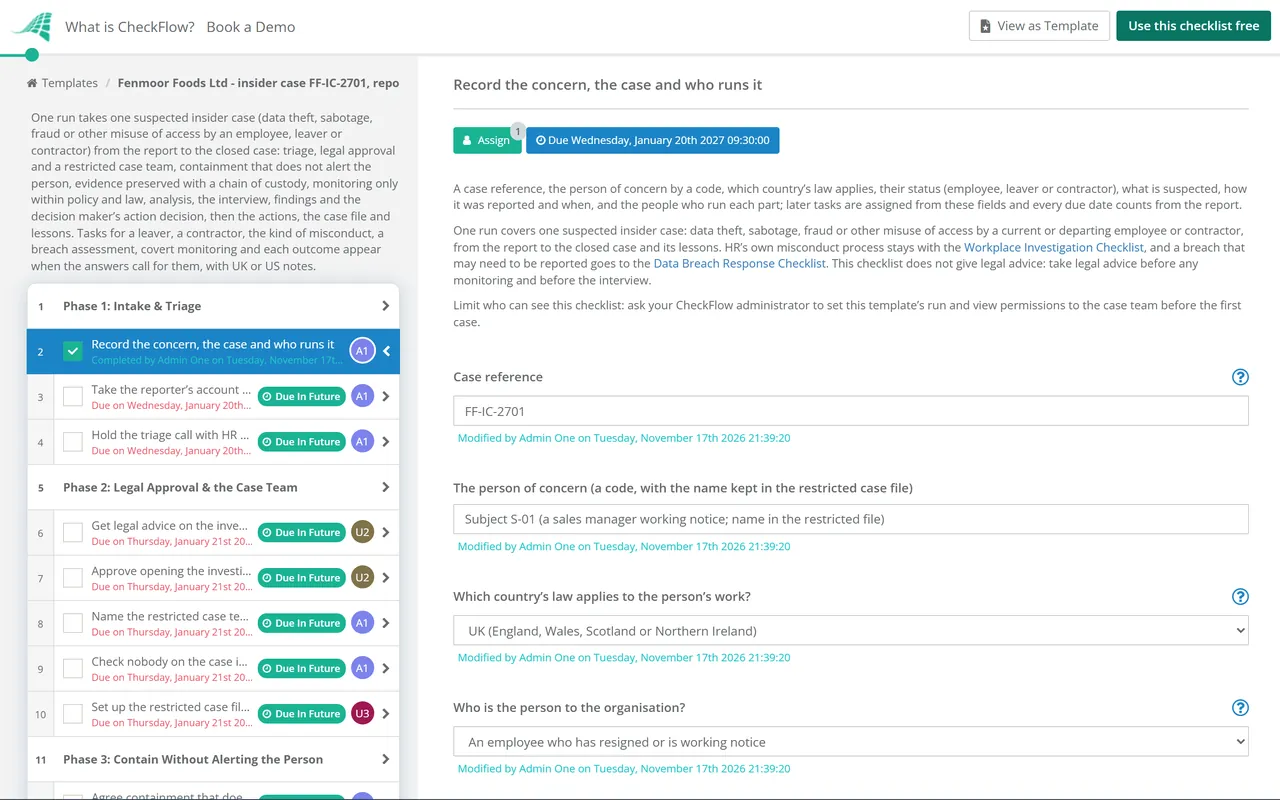
    Owned by the security investigation lead. Enter the date and time the concern was reported on the first task: triage falls due within hours of it, legal approval and the case team the next working day, and the action decision about five weeks later. Say which country’s law applies, who the person is to the organisation and what is suspected, and the tasks for that case appear.

    • Record the concern, the case and who runs it — a case reference, the person of concern by a code, which country’s law applies, their status (employee, leaver or contractor), what is suspected, how it was reported and when, and the people who run each part; later tasks are assigned from these fields and every due date counts from the report
    • Deal with any risk of harm first — anyone at risk kept safe, the emergency services called if there is an immediate threat (999 in the UK, 911 in the US), and building security told; the investigation waits until people are safe
    • Take the reporter’s account and protect their identity — what they saw, when, and what evidence they hold, written down; their name kept to the case team; a whistleblowing report also handled under that procedure
    • Hold the triage call with HR and legal — whether this is an insider case at all, what is known and from where, how urgent it is, whether personal data may be involved, and whether to open a case, hand it on or close it
    • Record the hand-over or the reason for closing — the case handed to HR or incident response with what is known, or the reason no case is opened, recorded and agreed by legal; Phases 2 to 9 hide with this outcome, and any task still shown that does not apply is marked not applicable
  2. Phase 2

    Phase 2: Legal Approval & the Case Team

    6 tasks

    Due the working day after the report. Legal counsel advises on what may be collected and approves opening the case and its scope; the case team is kept small and signs a confidentiality undertaking; the case file is restricted to people who need it. A breach assessment starts now if personal data may be involved.

    • Get legal advice on the investigation before anything is collected — what may be collected and how, monitoring rules, data protection, any employment contract, policy or union agreement that applies, whether the work should be done at counsel’s direction, and how evidence must be kept to be usable later
    • Start the breach assessment with the data protection lead — the data protection lead told what data may be involved and when the organisation became aware, so they can judge whether a breach must be reported and its deadline, in the Data Breach Response checklist
    • Approve opening the investigation and its scope — the allegation, the systems, accounts and period in scope, what is out of scope, and the advice the work must follow, approved by legal counsel
    • Name the restricted case team and get confidentiality undertakings — the lead, HR, legal, the IT or forensics lead and the data protection lead only, each told what they may see and share, each signing a confidentiality undertaking
    • Check nobody on the case is close to the person — no one on the team manages, reports to, works closely with or is related to the person, and the decision maker sits outside their reporting line
    • Set up the restricted case file and its access log — one restricted folder for the case, with access limited to the case team and logged, a log of who opened what and when, and no case details in email subjects or chat
  3. Phase 3

    Phase 3: Contain Without Alerting the Person

    7 tasks

    Due two working days after the report. Agree what to change now and what to leave, weighing the risk of more loss against the risk of alerting the person and losing evidence. The answers on the first task add tasks for a leaver, a contractor, data theft, sabotage or fraud.

    • Agree containment that does not alert the person — what must stop now (further copying, deletion, payments), what can wait, which changes would look routine, and who approves each change, with legal counsel’s view recorded
    • Make the agreed access changes — access to the most sensitive data narrowed, data loss prevention rules tightened, risky destinations blocked or watched, and each change recorded with its time
    • Identify the data at risk and who owns it — which data the person could reach and may have copied (customer lists, prices, designs, source code, personal data), its owner and classification, and where it could have gone
    • Check systems and backups for changes the person could make — the person’s administrative rights listed, recent changes to systems, scheduled jobs, code and configuration checked, and backups confirmed intact and kept out of their reach
    • Secure payment approvals and financial records — the person’s approval limits reviewed with finance, a second approver added where needed, and the records in scope preserved before anyone corrects them
    • Plan around the person’s exit date — the last working day and any garden leave, when access will be removed, the return of devices and data, and the exit meeting, agreed with HR so the leaving process does not destroy evidence
    • Check the contract and decide how to involve the supplier — the confidentiality, audit, data return and termination terms in the contract or agency agreement, and whether and when to involve the supplier, decided with legal counsel
  4. Phase 4

    Phase 4: Preserve the Evidence

    5 tasks

    The preservation hold and the logs are due two working days after the report, the same day as the containment changes; the devices, access records and custody register by five. Stop anything that would delete evidence, collect the logs, secure the devices and keep a record of who handled each item and when.

    • Put a preservation hold on the person’s accounts and data — the mailbox, files, chat and cloud storage in scope placed on hold, automatic deletion and scheduled wipes suspended, and the hold noted so routine leaver steps do not undo it
    • Collect the logs before they roll over — sign-ins, file access and downloads, email forwarding and sending, USB and print activity, cloud uploads and data loss prevention alerts for the period in scope, exported with their time zone and source
    • Secure the organisation’s devices the person uses — laptops, phones and removable media the organisation owns, imaged or secured by a trained person with the hashes recorded; personal devices only as legal counsel advises
    • Preserve building access records and CCTV — door access logs and any CCTV for the period in scope saved before their normal retention ends, with who saved them and when
    • Record the chain of custody for every item — each item with a reference, what it is, who collected it, when, how it was secured, where it is stored and every hand-over since
  5. Phase 5

    Phase 5: Monitoring Within Policy & Law

    4 tasks

    Any monitoring beyond the logs already kept starts here, after legal advice, and only within the organisation’s policy and the law. Covert monitoring needs the decision maker’s authorisation first. This template ends any monitoring 10 working days after the report.

    • Decide whether any further monitoring is needed and allowed — whether the logs already kept are enough, and if not, what further monitoring the policy and the law allow, whether the person has been told about it, and what legal counsel advised
    • Set the monitoring scope, time limit and who sees the results — the accounts, systems and data types covered, what is left out (private messages, special category data), the end date, and the one or two people who review what it finds
    • Authorise the covert monitoring — the grounds for suspicion, why telling the person would prejudice the investigation, the DPIA, the scope and the end date, authorised by the decision maker
    • Run the monitoring within its scope and end it on time — the monitoring run only as authorised, results reviewed by the named people, anything outside the scope set aside unread, and the monitoring stopped on its end date
  6. Phase 6

    Phase 6: Analysis

    4 tasks

    Put the evidence together in one timeline, establish what was affected, and test other explanations before anyone talks to the person.

    • Build the timeline of events — every relevant action from the logs, devices, access records and accounts in one timeline, each entry tied to its evidence reference, in one time zone
    • Establish what data, systems or money were affected — what was copied, sent, changed, deleted or paid, how much, where it went, and whether personal data is involved after all
    • Test other explanations and other people — whether the activity had a business reason, was authorised, was done by someone else using the account, or involved others, checked against the evidence
    • Write up the analysis for the interview plan — what the evidence shows, what is still unclear, and the points to put to the person, reviewed by legal counsel
  7. Phase 7

    Phase 7: The Interview

    4 tasks

    Planned with HR and legal, with the person’s rights respected. Inviting the person is the point at which they learn of the case, so the evidence must be preserved first.

    • Plan the interview with HR and legal counsel — who leads, who takes notes, the questions, the evidence to show, how the person is told, any companion the policy allows, breaks and any adjustments they need
    • Tell the person and invite them to the interview — the person told in writing that there is an investigation, what it is about in general terms, when and where the interview is, and who may come with them under the policy
    • Hold the interview and record it — the evidence put to the person, their account in their own words, the notes read back or shared for comment as the policy says, and any documents they offer
    • Check what the person said against the evidence — every explanation or new fact the person gave checked, any further evidence collected and logged, and any second meeting held if needed
  8. Phase 8

    Phase 8: Findings & the Action Decision

    6 tasks

    Write the findings, check what must be reported whatever the outcome, and get the decision maker’s decision. Only the person named on the first task can complete it, and nothing after it can be completed until they do.

    • Write the findings report — the allegation, the evidence, the person’s account, other explanations tested, and a finding on each point against the standard your policy sets, with the evidence references
    • Confirm the breach decision is on file — the data protection lead’s decision and any notifications made, or a note that no personal data was involved, recorded in this case
    • Check whether a regulator or other party must be told whatever the outcome — any duty to tell a regulator, an insurer, a customer under contract or a licensing body, checked by legal counsel, with its deadline
    • Review the findings and the options with legal counsel — whether the findings are supported, the options (disciplinary referral, access changes, data recovery, civil action, a police referral) and their risks
    • Finish the work the decision maker asked for — the further checks, evidence or advice named at the decision done and added to the findings; then change the decision and complete it
    • Decide the action on the findings — the findings accepted and the actions chosen, the case closed without action, or more work asked for, decided by the decision maker with the reasons recorded
  9. Phase 9

    Phase 9: Act, Learn & Close

    7 tasks

    The action tasks appear when the findings are accepted; a closing task appears when they are not substantiated. Every run ends with the case file closed and lessons for the insider risk programme.

    • Close the case without action — the person told the outcome if they knew of the investigation, any restrictions on their access lifted, and the reasons recorded
    • Refer the findings to HR’s process — the findings handed to HR for any disciplinary or contract action under the organisation’s own procedure, with only the evidence that process needs
    • Remove or change the person’s access and recover devices — access removed or reduced as decided, the organisation’s devices and media returned, and shared passwords and keys the person knew changed
    • Recover the data and get copies deleted — the person asked, through legal counsel, to return the data and delete every copy, with a written confirmation, and any copy held by a new employer or a third party dealt with as counsel advises
    • Decide on a referral to the police — whether to report a possible crime, decided with legal counsel, who makes the report, and what evidence is handed over and how
    • Close the case file and set its retention — the findings, decisions and evidence register filed in the restricted case file, monitoring data deleted when no longer needed, a retention date set, and access kept to the case team
    • Feed the lessons into the insider risk programme — how the concern was found, which controls worked or failed (access, logging, data loss prevention, leaver steps), and actions agreed with owners and dates, without naming the person

Monitoring Rules and Roles for an Insider Investigation

Monitoring and evidence rules, UK and US

The country answer on the first task shows short notes on the legal advice, monitoring, interview, data recovery and records tasks. These are the rules they draw on.

Rule Where What it says Source
Telling workersUKApart from very exceptional circumstances where covert monitoring is justified, you must tell workers about any monitoring.ICO, monitoring workers
Covert monitoringUKShould be authorised by senior management; a DPIA must be carried out; there should be grounds for suspecting criminal activity or equivalent, such as gross misconduct, and telling workers would prejudice its prevention or detection; it should be strictly targeted and time limited, not used in private areas, and in most cases not used to capture personal communications.ICO, monitoring workers
Criminal offence dataUKMonitoring to detect criminal activity needs a specific condition in Schedule 1 of the Data Protection Act 2018.ICO, monitoring workers
The person’s access to the fileUKInformation collected through monitoring must be made available to a worker who makes a subject access request, unless an exemption applies.ICO, monitoring workers
Taking personal dataUKKnowingly or recklessly obtaining or disclosing personal data without the controller’s consent, or retaining it afterwards without consent, is an offence, subject to the defences in the section.Data Protection Act 2018, s170
Interception with consentUS (federal)Not unlawful for a person not acting under color of law to intercept a communication where a party to it has given prior consent, unless it is intercepted to commit a criminal or tortious act.18 U.S.C. 2511(2)(d)
Stored communicationsUS (federal)The offence of unlawful access to stored communications does not apply to conduct authorised by the provider of the communications service. Ask counsel how this applies to your systems.18 U.S.C. 2701(c)(1)
Notice of monitoringNew YorkPrior written notice on hiring to employees subject to electronic monitoring, acknowledged by them, and a posted notice. It does not apply to processes not targeted at a particular person and run only for system maintenance or protection.Civil Rights Law § 52-c
Notice of monitoringConnecticutPrior written notice of the types of monitoring (a posted notice counts). Monitoring without notice is allowed where there are reasonable grounds to believe an employee is breaking the law, the legal rights of the employer or its employees, or creating a hostile workplace, and monitoring may produce evidence.Conn. Gen. Stat. § 31-48d
Notice of monitoringDelawareBefore monitoring phone, email or internet use: a daily electronic notice, or a one-time written or electronic notice acknowledged by the employee.19 Del. C. § 705
Trade secretsUS (federal)The owner of a misappropriated trade secret related to a product or service used in, or intended for use in, interstate or foreign commerce may bring a civil action; a court may order seizure of property on an ex parte application only in extraordinary circumstances.18 U.S.C. 1836(b)

Who does what

Each role is a person picked on the first task, and the tasks are assigned from it.

Role Owns Assigned in this template
Security investigation leadThe case from report to close: triage, containment, the evidence register, analysis, findings and lessons.Most tasks in Phases 1, 3, 4, 6 and 8
Legal counselAdvice before anything is collected, approval of the scope, the monitoring decision, the options and any police referral.Phases 2, 3, 5, 8 and 9
HR leadThe leaver plan, the interview and HR’s own process after the findings.Phases 3, 7 and 9
IT or forensics leadThe case file, access changes, the preservation hold, logs and devices.Phases 2, 3, 4 and 9
Data protection leadThe breach assessment and its outcome.Phases 2 and 8
Decision makerCovert monitoring authorisation and the action decision, from outside the person’s reporting line.Phases 5 and 8

Where this comes from. The ICO’s Employment practices and data protection: monitoring workers (October 2023), read on 17 November 2026, which says it is under review after the Data (Use and Access) Act 2025 and may change. Section 170 of the Data Protection Act 2018 on legislation.gov.uk. 18 U.S.C. 2511, 2701 and 1836 on Cornell LII. New York Civil Rights Law § 52-c, Connecticut § 31-48d and Delaware § 705 on each state’s own site; other states have their own rules. CISA’s Insider Threat Mitigation Guide (2026 edition) for the team, need-to-know records and police referrals, and NIST SP 800-86 for forensics. The roles are this template’s choices. This checklist does not give legal advice: take legal advice before monitoring anyone or interviewing them.

Why Run Insider Threat Investigations in CheckFlow?

1

Legal advice before evidence

Legal counsel advises and approves the scope the working day after the report, before logs, devices or accounts are collected. Monitoring beyond the usual logs waits for a recorded decision, and covert monitoring needs the decision maker’s authorisation first, and a DPIA in the UK (an equivalent assessment in the US). The UK or US notes appear where each rule applies.

2

A small case with a full record

The case team is named and signs undertakings, the case file is restricted with an access log, and every piece of evidence goes in a chain of custody register. Each task is assigned from the people named on the first task, so the record shows who did what and when.

3

Only the tasks for this case

A leaver gets an exit plan, a contractor a contract check, and data theft, sabotage or fraud its own task. A breach assessment starts early where personal data may be involved. Accepted findings show the action tasks; unsubstantiated ones show the closing task. Track every open case in the Reports Grid.

CheckFlow does not monitor anyone, collect evidence or decide what a case shows: those stay with your security, HR and legal teams and your forensic tools. CheckFlow makes sure each step is done in order, by the right person, with the record kept.

Run HR’s misconduct process with the Workplace Investigation Checklist, breach notifications with the Data Breach Response Checklist, and a leaver’s access removal with the IT Offboarding Checklist.

AI generator

Didn’t find what you need? Describe it.

Describe the process in a sentence and the AI checklist generator drafts the phases and tasks for you.

Frequently Asked Questions

What should an insider threat investigation checklist include?

Triage of the report, legal advice and an approved scope before evidence is collected, a small case team on a need-to-know basis, containment that does not alert the person, preservation of logs, devices and accounts with a chain of custody, monitoring only within policy and the law, analysis, the interview, findings, a recorded action decision and lessons for the insider risk programme. This template adds tasks for leavers, contractors, the kind of misconduct and a possible data breach.

What is the difference between insider risk and an insider threat?

The UK’s NPSA defines insider risk as the likelihood of harm or loss to an organisation, and its impact, because of an insider’s action or inaction. An insider threat is an insider, or group of insiders, who either intends to or is likely to cause harm or loss. An insider is anyone who has, or had, authorised access to or knowledge of the organisation’s resources. See NPSA’s insider risk guidance.

Can a UK employer monitor a worker covertly during an investigation?

Only in exceptional circumstances, according to the ICO’s monitoring workers guidance: for example where it is necessary to prevent or detect suspected criminal activity or gross misconduct and telling the worker would prejudice that. It should be authorised by senior management, a DPIA must be carried out, and it should be targeted and time limited. The guidance is under review after the Data (Use and Access) Act 2025. Take legal advice first.

Do US employers have to tell employees about electronic monitoring?

It depends on the state. New York requires prior written notice on hiring, acknowledged by the employee, and a posted notice. Connecticut requires prior written notice but allows monitoring without it where there are reasonable grounds to believe an employee is breaking the law and monitoring may produce evidence. Delaware requires a daily electronic notice or a one-time acknowledged notice. Federal law also limits interception. Take legal advice on the states where the person works.

Should the person be told they are being investigated?

Not until the evidence is preserved and legal counsel agrees, in this template. Containment is planned so that it does not alert the person, and the invitation to the interview is the point at which they are told, after the preservation hold, the logs and the devices are secured. HR then tells them about the interview and who may come with them under the policy. Your own policy and legal advice decide the timing.

When should the police be involved in an insider case?

CISA’s Insider Threat Mitigation Guide says to call the emergency services if anyone is in immediate danger, to involve law enforcement early where a crime may have been committed, to consult legal counsel when asking for their help, and to make sure the organisation’s own actions do not interfere with a police investigation or a later prosecution. In this template, legal counsel decides on a referral after the findings are accepted.

Is a departing employee taking customer data a data breach?

It can be. If the data includes personal data, such as customer contacts, the data protection lead decides whether it is a personal data breach that must be reported, and that decision does not wait for the investigation to end. This template hands it to the Data Breach Response Checklist. In the UK, knowingly or recklessly taking or keeping personal data without the controller’s consent can also be an offence under section 170 of the Data Protection Act 2018.

Who should be on an insider risk investigation team?

A small team with the skills the case needs: in this template a security investigation lead, an HR lead, legal counsel, an IT or forensics lead and a data protection lead, plus a decision maker outside the person’s reporting line. CISA’s guide describes threat management teams drawn from HR, IT, legal, security and other functions, with records shared on a strict need-to-know basis. Nobody who manages or works closely with the person should be on it.

Can the person see the investigation file?

In the UK, the person can make a subject access request for the personal data the investigation holds about them. The ICO says information from monitoring must be made available unless an exemption applies, and that requests should be handled case by case. Keep the file organised so it can be searched, and take legal advice on what may be withheld. In the US, ask legal counsel what the person may see under state law and your policies.

Is CheckFlow free for this template?

14-day free trial, no card required. The Business plan is $10 per user per month after the trial. Full details at checkflow.io/pricing.

Investigate Every Insider Concern the Same Careful Way

Free trial — no credit card required.

14-day free trial, no credit cardFull refund in your first 30 daysUS hosting, EU on request