Regulatory Change Management Checklist Template

A new rule takes effect on a fixed date. The email about it reached three people, and nobody wrote down who is changing what.

Last reviewed: November 2026

Printed from checkflow.io/templates/compliance/regulatory-change-management-checklist

This free regulatory change management checklist is for compliance leads, risk managers and the business owners who carry out a change in their teams. One run takes one new or changed law, rule, standard or piece of regulator guidance from the day you log it to sign-off after it takes effect, with every due date counted in working days from the effective date. It records the source and what changes, decides whether the change applies, assesses the impact on policies, processes and controls, systems, contracts and people, turns that into an action plan with owners, and has the changes checked against the source and approved by a senior manager before they roll out. Then it publishes and trains, collects evidence once the change is live, tests the new controls after the first cycle and signs the change off. CheckFlow does not find, monitor or interpret regulatory changes: you, your advisers, your regulator’s updates or an alert service do that, and this checklist makes sure each change you identify is owned, done on time and evidenced.

One Change at a Time, From Log to Sign-Off

Regulatory change management is the work between learning that a law, rule or standard is changing and being able to show that you meet the new version. This checklist runs that work for one change: the applicability decision, the impact assessment, the actions and their owners, the approval, the roll-out and the evidence. It is country-neutral; you record where the change applies and read its own source.

It sits beside three other compliance templates. Keeping a dated list of the obligations you already have, with owners and lead times, is the Annual Compliance Calendar Checklist, and this checklist’s last task adds any new recurring deadline to that list. Reviewing the whole policy library once a year is the Annual Policy Review Checklist; here only the policies one change touches are updated. Setting up or refreshing the compliance programme as a whole is the Compliance Program Checklist.

This checklist

One change, end to end

Covers: the source, whether it applies, the impact assessment, the action plan, the changes and the expert’s check, the senior manager’s approval, roll-out and training, evidence, a test after the first cycle and sign-off.

Planned around: the effective date, from 62 working days before it to 27 working days after.

Output: an approved, evidenced change with an owner for every action.

Dated obligations

The year’s deadlines

Covers: the obligations you already have, each with an owner, a date, a lead time and a recurring schedule, in the Annual Compliance Calendar Checklist.

Planned around: the calendar year.

Output: a register of dated obligations, checked monthly and quarterly.

Policy library

Every policy, once a year

Covers: the policy register, owners, redlines, approval, version control and staff attestation for the whole library, in the Annual Policy Review Checklist.

Planned around: the annual review cycle.

Output: a reviewed, approved and acknowledged policy library.

What the Regulatory Change Management Checklist Covers

Eight phases take one change from the day it is logged, 62 working days before its effective date, to sign-off 25 working days after it. The applicability check in Phase 2 decides what follows: No hides Phases 3 to 5 and shows a task to record the reasons. In Phase 3, fewer than 30 days to the effective date adds an escalation to the compliance committee. The senior manager’s approval is the gate: Phases 6 to 8 appear only on Approved or Approved with conditions, and nothing in them can be completed until the approval is completed. Not approved shows a rework task before the approval and keeps the roll-out hidden, and Approved with conditions adds a task to meet them. In Phase 6, more than 0 staff to train adds the training task.

  1. Phase 1

    Phase 1: Log the Change

    3 tasks

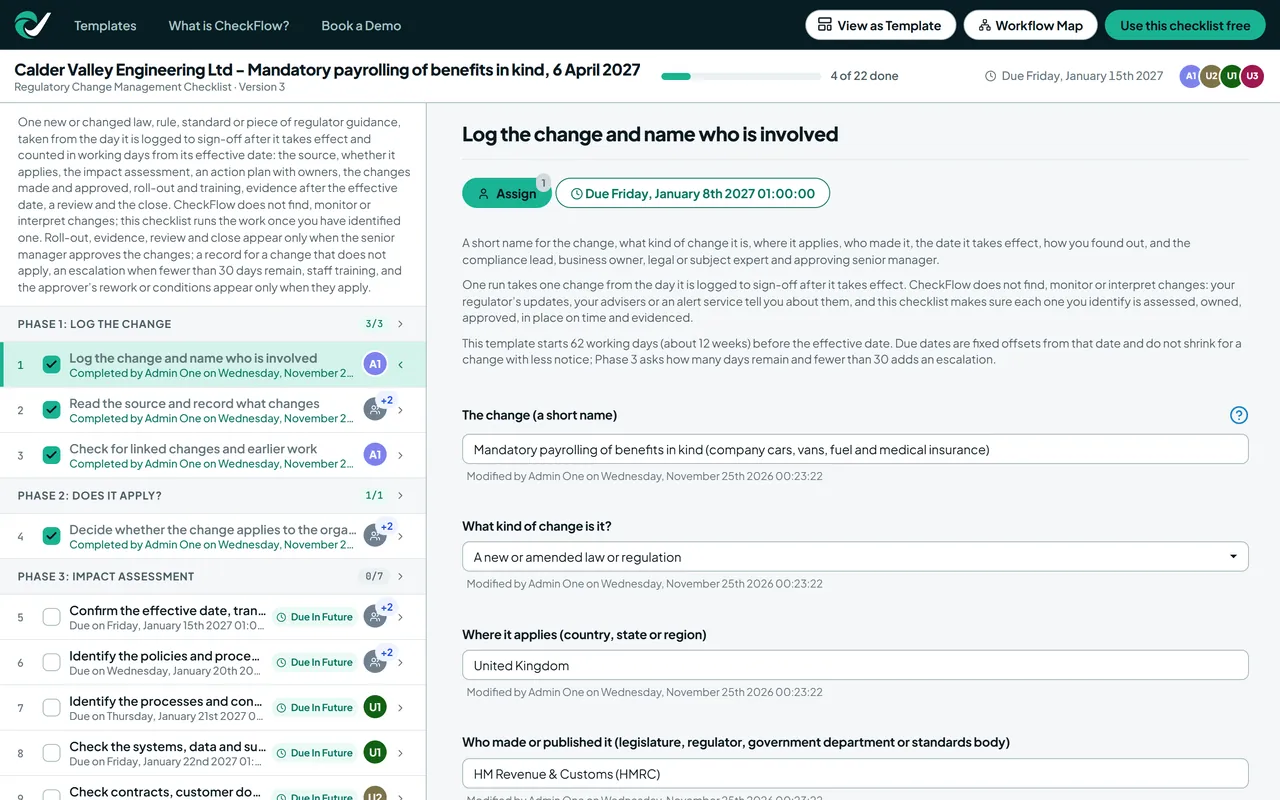
    Log one change with its source, who made it, where it applies and the date it takes effect, and name the four people involved. Every due date counts in working days from the effective date.

    • Log the change and name who is involved — a short name for the change, what kind of change it is, where it applies, who made it, the date it takes effect, how you found out, and the compliance lead, business owner, legal or subject expert and approving senior manager
    • Read the source and record what changes — the official text and any guidance from the body that made it, its status (made and in force on a date, made with a date to come, or still a draft or consultation), the date you read it, and a plain summary of what changes and for whom
    • Check for linked changes and earlier work — other changes already logged on the same subject, earlier versions of the rule and how you met them, related projects or audit findings, and the reference this change has in your change log
  2. Phase 2

    Phase 2: Does It Apply?

    2 tasks

    Decide whether the change applies to the organisation, in full or in part, and why. A change that does not apply is recorded with its reasons and the rest of the run is hidden.

    • Decide whether the change applies to the organisation — the scope of the change (the firms, activities, products, people or places it covers) against what the organisation does, any exemptions or thresholds, the areas of the business it touches, and the reasons for the answer
    • Record why the change does not apply and close it — the reasons with the scope words relied on, who checked them, any condition that would make it apply later (growth past a threshold, a new product or activity), and a date to look again
  3. Phase 3

    Phase 3: Impact Assessment

    8 tasks

    Confirm the dates, then work through every area the change touches: policies and procedures, processes and controls, systems and data, contracts and customer documents, and people and training. Fewer than 30 days to the effective date adds an escalation.

    • Confirm the effective date, transitional provisions and interim deadlines — the date or dates each part takes effect, any transitional period, registrations, applications or notices due before the effective date, and how many days remain
    • Escalate the short lead time to the compliance committee — what cannot be ready by the effective date, the actions to do first, any interim measures, and the committee’s or senior manager’s decision on the risk
    • Identify the policies and procedures affected — each policy, procedure, standard or work instruction that must change, what must change in it, and its owner
    • Identify the processes and controls affected — each process, check, approval, reconciliation or report that must change or be added, who runs it, and what will show that it works
    • Check the systems, data and suppliers affected — system changes, new data to capture or report, records to keep for longer, and whether a software supplier or outsourced provider must change something and has confirmed when
    • Check contracts, customer documents and notices — contract terms, customer or employee documents, website wording and disclosures that must change, and any notice the change requires you to give, with its deadline
    • Assess who needs training and who needs to be told — the staff whose work changes and how many, what each group needs to learn, and the people inside and outside the organisation who need to be told about the change
    • Rate the impact and summarise the assessment — an overall rating, the risk of not being ready by the effective date, and a short summary the approver can read in a few minutes
  4. Phase 4

    Phase 4: Action Plan & Owners

    4 tasks

    Turn the assessment into actions, each with one owner and a due date before the effective date, and agree them with the people who will do them. Interim deadlines get their own owners.

    • Write the action plan with an owner and a due date for each action — every change from the impact assessment as an action, with one owner, a due date before the effective date and a status
    • Agree the plan with the business owners — each owner accepts their actions and dates, or the plan is changed until they can
    • Confirm the people, budget and outside help needed — time from the teams involved, any cost for systems, suppliers or advice, and who has agreed to fund it
    • Give each interim deadline an owner and a date — each registration, application or notice due before the effective date, with its owner, its deadline and, as each is met, the date it was done
  5. Phase 5

    Phase 5: Make & Approve the Changes

    8 tasks

    Make the changes in draft and test them, have the expert check them against the source, then the senior manager approves them. The approval is the gate: Phases 6 to 8 appear only when the approver chooses Approved or Approved with conditions, and nothing in them can be completed until the approval is completed.

    • Check progress against the action plan — the status of each action, anything behind and how it will catch up, and whether the effective date is still the same
    • Draft the changes to the policies and procedures — a marked-up version of each document in the impact assessment, with the owner’s agreement
    • Change the processes and controls — the new or changed steps, checks, approvals and reports written down, with who runs each one and how it will be evidenced
    • Make and test the system changes — changes to systems, reports and data made and tested, and supplier or provider changes confirmed in writing
    • Update contracts, customer documents and notices — the new wording for contracts, documents, website pages and disclosures, and any notice the change requires, ready to send
    • Check the changes against the source — the legal or subject expert reads the drafts, controls and notices against the source and confirms they meet it, or lists what still needs to change
    • Fix what stopped the approval and send the changes back — the approver’s reasons, what was changed in response, and the date the changes went back for approval
    • Approve the changes before they take effect — the senior manager reads the impact summary, the expert’s check and the changed documents, then completes this task with the decision
  6. Phase 6

    Phase 6: Roll Out & Train

    6 tasks

    Appears once the senior manager approves the changes. Publish them, tell the people affected and confirm how many staff need training (above zero adds the training task), train them and update your registers, then confirm everything is in place two working days before the effective date.

    • Meet the approver’s conditions — each condition the approver set, what was done to meet it, and the approver’s confirmation
    • Publish the approved policies and procedures — the approved versions published where staff find them, each with a new version number and the date it takes effect, and the old versions withdrawn
    • Tell the people affected — staff, customers, suppliers or others on the list from the impact assessment, told what changes and when, and the number of staff who need training (notices with their own deadline are handled in Phase 4)
    • Train the staff whose work changes — the training or briefing delivered to each group, attendance recorded, and anyone missed booked in before the effective date
    • Update the registers the change touches — the policy register, risk register, controls library and any list of obligations, so each shows the change and its owner
    • Confirm everything is in place before the effective date — every action in the plan done or with an agreed date, interim deadlines met, systems ready and staff trained
  7. Phase 7

    Phase 7: Go Live & Evidence

    3 tasks

    On the effective date, check the change is working, collect the evidence that it is in place, and look again at the source for guidance or corrections published since.

    • Check the change is working from the effective date — the new process, controls and systems used from the first day, and any problem logged with an owner
    • Collect the evidence that the change is in place — the approved documents, training records, notices sent, test results and the first records the new process produced, kept together for an auditor or regulator
    • Check for guidance or corrections published since — new guidance, answers to common questions, corrections or further changes from the body that made the change, and whether any of them changes what you did
  8. Phase 8

    Phase 8: Review, Sign-Off & Close

    4 tasks

    Test the new controls after the first full cycle, report the outcome, then the compliance lead signs the change off and closes it, with the lessons for the next change.

    • Test the new controls after the first full cycle — a sample of the records the changed process produced in its first cycle, checked against the source, with any issue logged and given an owner
    • Report the outcome to the compliance committee or board — what changed, what it cost, the test result, any open issues and anything still to come from the same change
    • Sign off the change as implemented — the compliance lead confirms the change is in place and evidenced, or that the open actions are owned and dated
    • Record the change in your obligations list and close it — the new or changed obligation added with its owner and any recurring dates, the change log closed with its reference, and lessons for the next change

Where to Read the Source, and What the Impact Assessment Covers

Every change starts from its own official text. The first table lists where several jurisdictions publish theirs, in the publishers’ own words, and what to note when you log a change. The second shows what this checklist asks in the impact assessment; the areas and questions are this template’s choices.

Where official text is published

Source What the publisher says it is What to note in Phase 1
legislation.gov.uk (UK)UK legislation in enacted and revised versions. Its enacted versions “do not provide any information about in force/commencement”; for primary legislation, changes not yet applied show in a “Changes to Legislation” banner, and it aims to incorporate amendments within three months of their coming into forceWhich version you read, whether the provision is in force, and any changes not yet applied
Federal Register (US federal)“the official daily publication for rules, proposed rules, and notices of Federal agencies and organizations” (govinfo)Whether it is a proposed or a final rule, and its effective date
eCFR (US federal)A daily updated compilation of the Code of Federal Regulations; govinfo says it “is not an official legal edition of the CFR”The date the text is current to; check a new rule against the Federal Register
Official Journal of the European Union, on EUR-Lex“the official publication (gazette) for EU legal acts”The dates in the act’s own final provisions
FCA Handbook (UK financial services)The FCA’s Handbook of rules and guidance, which “contains the complete record of FCA Legal Instruments” in one consolidated viewThe provision, whether it is a rule or guidance, and the instrument that changed it
Standards bodies, such as ISOEach standard’s page gives its edition and amendments; ISO 37301:2021, on compliance management systems, is edition 1 with one amendment and was “last reviewed and confirmed in 2026”The edition you hold, and whether a new one is published or in draft

What the impact assessment covers

Area What this checklist asks Where
DatesWhen each part takes effect, any transitional period, interim deadlines, and how many days remainPhase 3, with an escalation below 30 days
Policies and proceduresWhich documents must change, what must change and who owns eachPhase 3, changed in Phase 5, published in Phase 6
Processes and controlsWhich steps, checks, approvals and reports must change or be added, and how each will be evidencedPhase 3, changed in Phase 5, tested in Phase 8
Systems, data and suppliersSystem and report changes, data to capture or keep, and what a supplier must changePhase 3, made and tested in Phase 5
Contracts, documents and noticesContract terms, customer or employee documents, disclosures and required noticesPhase 3, updated in Phase 5
PeopleWho needs training and what they need to learn, and who must be toldPhase 3; the number to train is confirmed in Phase 6, where it adds the training task

Read on 24 November 2026: Understanding legislation on legislation.gov.uk; govinfo’s help pages for the Federal Register and the Code of Federal Regulations; Access to the Official Journal on EUR-Lex; the FCA Handbook home page and SYSC 6.1; and ISO’s page for ISO 37301:2021, a paid standard named here only and not drawn on. This checklist does not decide whether a change applies to you or whether you meet it; your legal and compliance advisers do.

Why Run Regulatory Change in CheckFlow?

1

Nothing rolls out before the senior manager approves

The approval is assigned to the senior manager alone, and the checklist halts there. Publishing, training, evidence and sign-off appear only when they approve, and cannot be completed until they complete the approval. Not approved shows a rework task before the approval, and the roll-out phases stay hidden; Approved with conditions adds a task to meet them. See how approvals that halt a checklist work.

2

The answers decide what comes next

A change that does not apply hides the rest of the run and asks for the reasons, so the record shows it was considered. Fewer than 30 days to the effective date adds an escalation to the compliance committee, and once the changes are approved, a count of staff to train above zero adds the training task.

3

Every action has an owner and a date

Name the compliance lead, the business owner, the legal or subject expert and the approver on the first task, and every task is assigned from those fields and dated from the effective date. The Reports Grid lists every change in progress with its answers and dates.

CheckFlow runs the work for each change you identify: who does what and by when, the impact assessment, the approval and the evidence. It does not find, monitor or interpret regulatory changes, and it does not give legal advice; your advisers, your regulator’s updates or an alert service tell you what is changing. Start one checklist per change, or a run per stage when parts of a law take effect on different dates.

Keep your dated obligations in the Annual Compliance Calendar Checklist, review the policy library with the Annual Policy Review Checklist, test controls with the Compliance Monitoring & Testing Checklist and run larger training with the Training Program Rollout Checklist.

AI generator

Didn’t find what you need? Describe it.

Describe the process in a sentence and the AI checklist generator drafts the phases and tasks for you.

Frequently Asked Questions

What is regulatory change management?

It is how an organisation handles a new or changed law, rule, standard or piece of regulator guidance: deciding whether it applies, working out what it changes, giving each action an owner, making and approving the changes, training people and keeping evidence that the change is in place. This checklist covers one change from the day it is logged to sign-off after it takes effect. Finding changes in the first place is a separate job for your advisers, your regulator’s updates or an alert service.

What should a regulatory change management checklist include?

The source and its status, an applicability decision with reasons, an impact assessment across policies, processes and controls, systems, contracts and people, an action plan with one owner and a due date per action, an expert’s check of the changes against the source, a senior manager’s approval, roll-out and training, evidence after the effective date, a test after the first cycle, and sign-off. This template has all of these in eight phases.

How do you carry out a regulatory change impact assessment?

Start from the official text, not a summary. Confirm the dates, including any staged or interim deadlines, then go area by area: which policies and procedures change, which processes and controls, which systems, data and suppliers, which contracts and documents, and which staff need training or need to be told. Count what is affected, rate the overall impact and write a summary the approver can read in a few minutes. Phase 3 of this checklist asks each question in turn.

Who should own a regulatory change?

In this template the compliance lead runs the change and the business owner leads it in the area it touches, because the people who run a process are the ones who change it. A legal or subject expert checks the reading of the source and the finished changes, and a senior manager approves them before they roll out. One person can hold several of these roles in a small organisation.

What if the change takes effect in less than 30 days, or already has?

Enter the days remaining in Phase 3; below 30, including 0 or a negative number, adds a task to escalate to the compliance committee or senior manager. They agree which actions come first and any interim measures, and the new dates go in the action plan. Due dates count from the effective date, so with little notice the early ones are already past; complete them as you go rather than waiting for them.

Does CheckFlow find or interpret regulatory changes for us?

No. CheckFlow does not find, monitor or interpret changes, and it does not give legal advice. Your advisers, your regulator’s updates or an alert service tell you what is changing, and your legal or subject expert reads the source. This checklist runs the work once a change is identified: who does what and by when, the approval, and the evidence that it is in place.

Do regulators expect a process for regulatory change?

Some set a general duty rather than a named process. For the firms it covers, the FCA’s rule SYSC 6.1.1R says a firm “must establish, implement and maintain adequate policies and procedures sufficient to ensure compliance” with its obligations under the regulatory system; it does not prescribe a change process. ISO 37301:2021, a paid standard on compliance management systems, is named here only. Check what your own regulator or standard says.

What if a change turns out not to apply to us?

Answer No in Phase 2. The rest of the run is hidden and a task asks for the reasons, the scope words you relied on, any condition that would bring you into scope later and a date to look again. Keeping that record shows an auditor or regulator that the change was considered. If you change the answer later, the hidden phases come back.

Is CheckFlow free for this template?

14-day free trial, no card required. The Business plan is $10 per user per month after the trial. Full details at checkflow.io/pricing.

Every Regulatory Change With an Owner, a Date and the Evidence

Free trial — no credit card required.

14-day free trial, no credit cardFull refund in your first 30 daysUS hosting, EU on request