Handled by the payroll SOP
- Timesheets, starters, leavers and pay changes
- Gross-to-net calculation and pre-run approval
- Tax deposits (US) or the FPS on each payday (UK)
- Payslips and the payroll journal
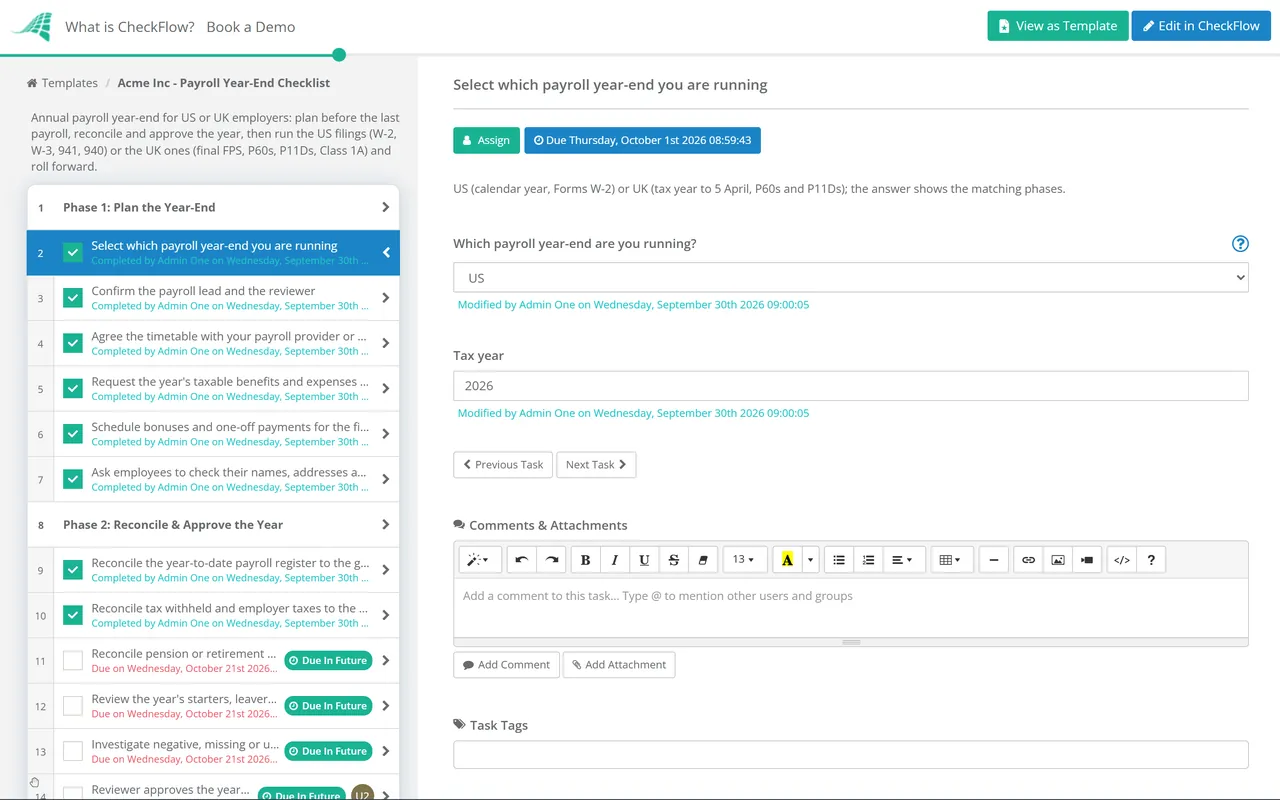
Payroll teams run the pay cycle every week or month. The year-end comes round once, in the busiest weeks of the year, with fixed deadlines. This free payroll year-end checklist gives payroll managers, finance teams and small business owners the annual process that sits on top of the regular pay run. It starts before the last payroll, reconciles the year and gets it approved, then runs the filings. Answer one question at the start and the checklist shows the US path (Forms W-2 and W-3, the fourth-quarter Form 941 and Form 940) or the UK path (the final FPS, P60s, P11Ds and Class 1A National Insurance). It is written for the 2026 US tax year and the 2026–27 UK tax year.
The payroll year-end is not a bigger pay run. It is an annual cycle that relies on every pay run before it. This template assumes you run each payroll with the Payroll Processing SOP Checklist and covers only what happens once a year.
The US and UK year-ends differ in timing as well as forms. A US employer closes the calendar year and files in January. A UK employer closes the tax year on 5 April and has deadlines running through to July. The reconciliation and data checks that come first are the same in both, so the template splits only for the filings.
Seven phases run from planning before the last payroll to the roll-forward. Phases 3 and 4 appear for a US year-end, phases 5 and 6 for a UK year-end.
Start before the final payroll. Bonuses, benefits and data fixes are easier in a normal pay run than as corrections.
Shown for a US year-end. Figures are for tax year 2026, filed in early 2027.
Shown for a US year-end. 31 January 2027 is a Sunday, so those deadlines move to 1 February.
Shown for a UK year-end. The 2026–27 tax year ends on 5 April 2027.
Shown for a UK year-end. These deadlines fall in July.
These are the main federal and HMRC deadlines. A US deadline that falls on a weekend or legal holiday moves to the next business day, hence 1 February 2027. Add your state and local deadlines as due dates.
| Obligation | Deadline | Notes |
|---|---|---|
| US: Forms W-2 to employees and Copy A with W-3 to the SSA | 1 February 2027 | Extensions only in extraordinary circumstances; e-file at 10 or more returns in total |
| US: Form 941, fourth quarter | 1 February 2027 | 10 February 2027 if all deposits were made on time |
| US: Form 940 | 1 February 2027 | 10 February 2027 if all FUTA tax was deposited on time |
| UK: final FPS | On or before the last payday of the tax year | The tax year ends on 5 April 2027 |
| UK: EPS and year-to-date corrections | 19 April 2027 | An EPS is needed only in the cases in Phase 5 |
| UK: P60s to employees | 31 May 2027 | Everyone on the payroll on 5 April |
| UK: P11D, P11D(b) and employee copies | 6 July 2027 | £100 per 50 employees for each month the P11D(b) is late |
| UK: Class 1A National Insurance payment | 22 July 2027 | 19 July if paying by cheque |
What changed on the 2026 Form W-2. The 2025 tax law created employee deductions for qualified tips and overtime, and the 2026 Form W-2 carries the figures behind them. Box 12 has three new codes: TT for qualified overtime compensation, which is only the premium above the regular rate (the “half” in time-and-a-half) required by the Fair Labor Standards Act, TP for cash tips reported to the employer, and TA for employer contributions to an employee’s Trump account. Box 14 is split into 14a, which keeps the old “Other” entries, and 14b, which holds the Treasury tipped occupation code. Check your payroll system tracks these amounts now, not in January. The social security wage base for 2026 is $184,500.
What is changing for UK benefits in kind. From 6 April 2027 employers must report company cars, car and van fuel, vans and medical benefits through payroll, calculating tax and Class 1A National Insurance in real time. Most other benefits follow from 6 April 2028; loans and accommodation stay voluntary. For the 2026–27 year-end, P11Ds, the P11D(b) and the July Class 1A payment still apply; the work is to have payroll ready for the first 2027–28 payday.
A single question at the start shows the US or the UK filings, and the shared reconciliation and roll-forward phases stay the same. Employers in both countries run two yearly schedules from one template.
The reconciliation ends with an approval task assigned to the reviewer you choose at the start. The checklist stops until it is answered, so no return goes out on figures nobody has checked.
The UK year-end runs from March to July, the US one from November to February. Due dates are set from the start date, and filing receipts are attached to the tasks that produced them.
The year-end depends on every pay run before it. The Payroll Processing SOP Checklist covers each payroll from data collection to reconciliation, and the Year-End Close Checklist covers the accounting year-end that the payroll figures feed into.
Contractors are not on the payroll, so they are not in this checklist. US businesses report payments to them on Forms 1099-NEC and 1099-MISC, which the 1099 Year-End Filing Checklist covers, from W-9 collection to IRS filing.
Describe the process in a sentence and the AI checklist generator drafts the phases and tasks for you.
It is the list of annual tasks that close a payroll year: reconciling pay and tax, correcting employee data, reporting taxable benefits, producing employees’ annual forms, filing the year-end returns and preparing for the new year. It sits on top of the regular pay run checklist.
Forms W-2 go to employees, and Copy A with Form W-3 goes to the Social Security Administration, by 1 February 2027, because 31 January is a Sunday. The fourth-quarter Form 941 and the annual Form 940 are due the same day, or by 10 February 2027 if every deposit was made on time. State deadlines vary.
Box 12 has three new codes: TT for qualified overtime compensation, TP for cash tips reported to the employer and TA for employer contributions to a Trump account. Box 14 is split into 14a for other information and 14b for the Treasury tipped occupation code.
Send the final FPS on or before the last payday of the tax year, and an EPS by 19 April 2027 if one is needed. Give a P60 to everyone on the payroll on 5 April by 31 May. Report expenses and benefits on P11Ds and the P11D(b) by 6 July, and pay Class 1A National Insurance so HMRC receives it by 22 July.
Not yet. From 6 April 2027 company cars, fuel, vans and medical benefits must be reported through payroll, and most other benefits follow in April 2028. P11Ds and the P11D(b) are still required for the 2026–27 tax year, and the P11D(b) is needed even by employers who already payroll every benefit, because it reports the Class 1A National Insurance due.
14-day free trial, no card required. The Business plan is $10 per user per month after the trial. Full details at checkflow.io/pricing.
14-day free trial, no credit cardFull refund in your first 30 daysUS hosting, EU on request