
Simple Employee Onboarding Checklist Template

A consistent, repeatable onboarding process for any business — without overcomplicating it.

You do not need an HR department or a dedicated onboarding platform to give new hires a great start. You need a process — a defined sequence of steps that ensures every new employee gets a warm welcome, has what they need to do their job from day one, understands what is expected of them, and hears from their manager before they have to chase for a conversation. That process, run consistently for every hire, is what separates the businesses where people stay from the ones where good people leave after six months feeling unsupported. This free simple employee onboarding checklist gives any business — from a five-person startup to a growing team without a dedicated HR function — a clean, practical framework for onboarding new employees consistently and well.

Use This Template Free See Live Example
No Credit Card Required

Why a Simple, Consistent Process Is Worth More Than an Elaborate One Nobody Follows

The research on onboarding is clear and consistent: structured onboarding improves retention by up to 82% and time-to-productivity by 70%. But the gap between knowing this and doing something about it is not a knowledge gap — it is a complexity gap. Most small businesses and growing teams look at comprehensive onboarding frameworks and conclude they are too much: too many phases, too many stakeholders, too much structure for a team of twelve people. The result is an informal process that varies with every hire and delivers inconsistent results.

The simple version of a good onboarding process — five clear phases, a defined set of tasks for each, one person responsible — is not a compromise. It is an appropriate fit for the context. The same structural discipline that makes onboarding effective in a 500-person organisation makes it effective in a 10-person business. The scope is smaller; the principle is identical. Every new hire gets the same experience. Nothing important is forgotten. The manager has a framework to follow rather than having to reinvent the process for each person they bring on.

The Simple Employee Onboarding Checklist

This checklist covers five phases — from before the new hire arrives through to the 30-day check-in. It is designed to be complete enough to be effective and simple enough to be used consistently for every hire.

Phase 1

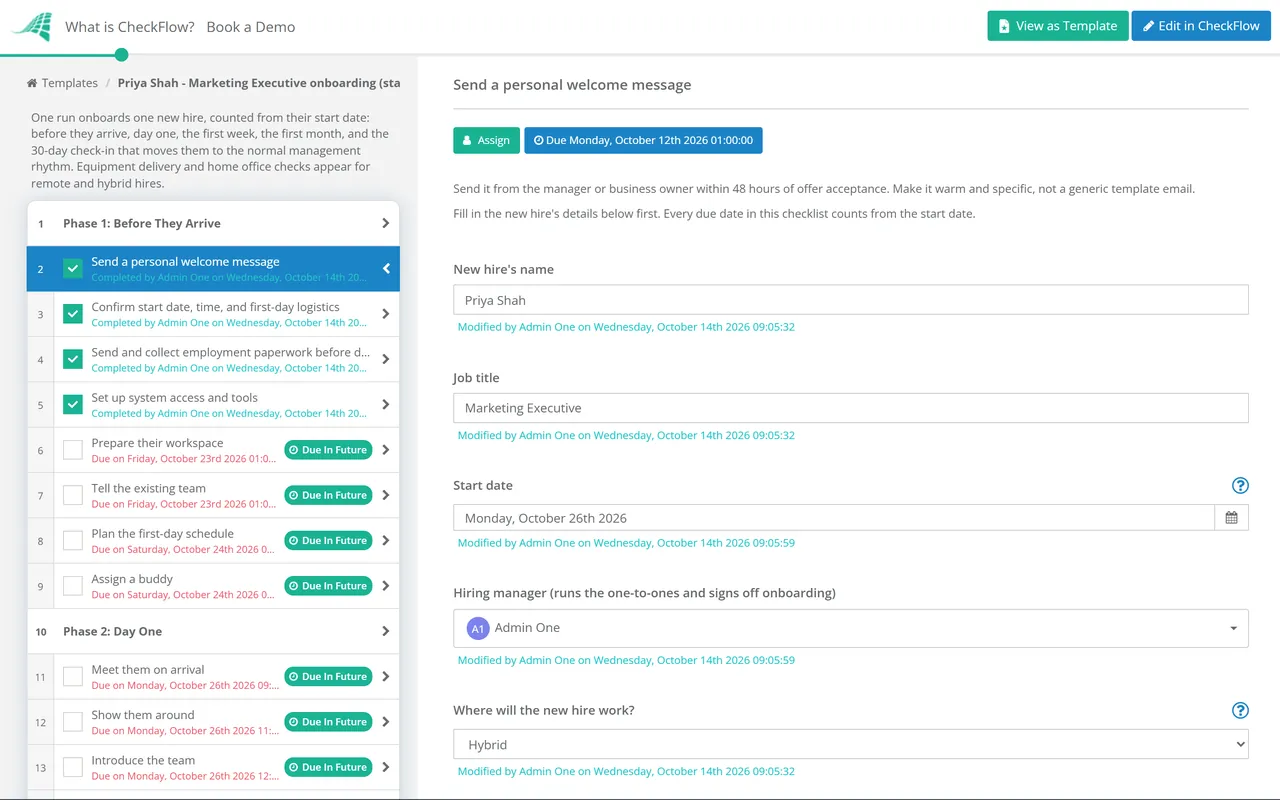
Phase 1: Before They Arrive

The quality of someone’s first day is entirely determined by what happens before it. Five minutes of preparation prevents fifty minutes of first-day chaos.

  • Send a personal welcome message — from the manager or business owner within 48 hours of offer acceptance; warm and specific, not a generic template email
  • Confirm start date, time, and first-day logistics — where to go, who to ask for, what to bring, and what the first day looks like
  • Send and collect employment paperwork before day one — contract, tax forms, bank details, emergency contact; do not make day one a paperwork exercise
  • Set up system access and tools — email account, any software they need from day one, and any hardware ordered and ready
  • Prepare their workspace — desk, equipment, and anything they need to start; for remote hires, confirm equipment delivery and home office setup
  • Tell the existing team — let colleagues know who is joining, when, and in what role; ask them to make the new hire feel welcome
  • Plan the first-day schedule — a clear, structured agenda for day one shared with the new hire before they arrive
  • Assign a buddy — a colleague who will be the new hire’s informal guide for the first few weeks; brief them on their role
Phase 2

Phase 2: Day One

The goal of day one is simple: the new hire should leave at the end of the day feeling genuinely welcomed and glad they said yes.

  • Meet them on arrival — be available in person or on a call when they arrive; do not leave them waiting or uncertain where to go
  • Show them around — the workspace, key facilities, how things work day-to-day; for remote hires, a virtual tour of the team’s tools and meeting rhythm
  • Introduce the team — direct colleagues first, then key people across the business they will work with; names, roles, and how they connect
  • Confirm everything works — all system access, all tools, all logins; fix any access issues on day one, not later in the week
  • Manager one-to-one — a conversation between the manager and new hire on day one; role overview, immediate priorities, how the manager likes to work, and what happens next
  • Cover the basics — key policies, how to book leave, how expenses work, who to contact for different types of questions; the practical information they need to function confidently
  • Lunch or coffee with the team — informal, social connection on day one makes a measurable difference to first-day experience
  • End-of-day check-in — a brief conversation: how was the day, any questions, what happens tomorrow; five minutes that signals genuine care
Phase 3

Phase 3: The First Week

  • Complete any outstanding paperwork — confirm all pre-employment documents are collected and payroll is set up correctly
  • Role orientation — the manager walks through the team’s work, current projects, processes, and priorities; the new hire understands what they are joining
  • Set first-month goals — two or three specific things the new hire should achieve or understand by the end of their first month
  • Introduce key stakeholders — anyone the new hire will work with beyond the immediate team; a brief introduction is better than a cold first contact
  • Complete any required compliance training — health and safety, data protection, or any sector-specific mandatory training
  • Give them real work — something meaningful they can contribute to in the first week; early contribution builds confidence faster than any orientation session
  • Set up regular one-to-ones — weekly in the first month; calendar invites sent in the first week; regular check-ins prevent small issues becoming bigger ones
  • End-of-week check-in — manager asks how the week went, what questions came up, and whether anything needs adjusting
Phase 4

Phase 4: The First Month

  • Keep one-to-ones weekly — at least for the first month; a mix of practical updates and genuine wellbeing check-ins
  • Check on buddy relationship — is the new hire using the buddy connection? Is it working well?
  • Address any questions or concerns promptly — new hires often hold back questions in the first weeks; proactively invite them
  • Introduce the performance review process — how reviews happen, when, and how the new hire will know if they are on track
  • Confirm all access and tools are working — any remaining setup issues resolved; new hire is not being held back by missing resources
  • Note what is working and what is not — informal feedback from the new hire about the onboarding experience so far; use it to improve for the next hire
  • Confirm the new hire feels part of the team — do they feel welcomed? Are they connecting with colleagues? Address any isolation concerns proactively
Phase 5

Phase 5: 30-Day Check-In & Establishing the Relationship

  • Conduct the 30-day check-in — a slightly more structured conversation than the weekly one-to-ones: how is the role going, how does it compare to expectations, what support is needed
  • Review first-month goals — what was achieved, what is in progress, what needs adjusting
  • Ask directly: is there anything about the onboarding experience that could have been better? This feedback improves your process for the next hire
  • Confirm the new hire understands their role and what success looks like — clarity at 30 days significantly predicts 12-month retention
  • Agree on what the next 60 days look like — what goals, what development, what growing independence is expected
  • Transition to normal cadence — confirm what ongoing communication, check-ins, and support look like beyond month one
  • Mark onboarding as complete — the new hire is settled, supported, and has what they need to do their job well
  • Ask for feedback on the process — what could have made their onboarding better? Use this to update the checklist before the next hire
  • Update the checklist for next time — any steps that were missing, any that were unnecessary; keep the process improving
  • Archive the onboarding record — a complete log of tasks completed for this hire retained for HR and compliance purposes

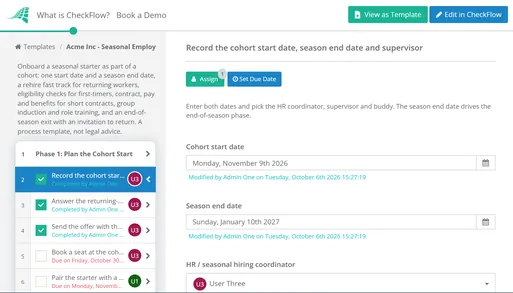
This checklist is available as a free, runnable template in CheckFlow — simple enough for a first-time manager, consistent enough for a growing team, and adaptable for every new hire.

Use This Template Free

Who Uses This Template

The simple employee onboarding template works for any business that hires people. Here are the contexts where it is most commonly used.

Small businesses and startups

A first-time manager or founder who has just made their third, fourth, or fifth hire and wants a consistent process without building an HR function. The checklist ensures nothing important is forgotten regardless of how busy the business is when the new hire joins.

Growing teams without a dedicated HR function

A team lead or department manager who handles onboarding alongside their main role. The checklist is light enough to run without specialist support and consistent enough to give every new hire the same quality of start.

Remote-first and distributed teams

Teams where the new hire and their manager are in different locations — or different time zones — and the informal onboarding that happens naturally in an office needs to be replaced with a deliberate, structured process.

Businesses formalising their process for the first time

Any business that has been onboarding informally and inconsistently, and wants to establish a simple, repeatable standard before the next hire. Start here, then add depth as your team and people function grow.

Seasonal or frequent hiring

Businesses that hire multiple people at once or on a regular cycle — seasonal staff, intake cohorts, or rapid growth phases. CheckFlow’s recurring checklist feature starts a fresh onboarding process for each new hire automatically.

Non-HR managers onboarding into their team

A line manager or team lead who owns the onboarding experience for their direct reports but is not an HR professional. The simple checklist gives them a framework without requiring HR expertise.

Why Run Employee Onboarding in CheckFlow?

1

The same great start for every person you hire

Without a checklist, onboarding quality varies with how busy the manager is and how much they remember to do. The first hire gets a thoughtful, thorough welcome. The fifth hire joins during a busy quarter and gets a laptop and a desk. CheckFlow runs the same process for every hire — the same welcome, the same day-one experience, the same first-month check-in — regardless of when they join or how stretched the team is.
2

Nothing falls through because someone forgot

The most common onboarding failure is not a bad first impression — it is no second impression. The email that was not sent at week two. The 30-day check-in that nobody scheduled. The system access that was never set up because IT was not in the loop. CheckFlow assigns every task to a named person with a due date and sends reminders before deadlines. The right things happen because the system makes sure they do.

3

Simple to start, easy to scale

The simple onboarding checklist runs today. As your team grows and your people processes mature, you can add phases, add tasks, and add depth — building from this foundation towards the full 30-60-90 day programme without switching tools or rebuilding from scratch. CheckFlow grows with your business. Start simple, build systematically.

The most time-consuming part of onboarding for small businesses is often the IT setup — creating accounts, assigning access, and making sure everything works from day one. CheckFlow’s IT Onboarding Checklist covers every technical setup step as a dedicated process for the IT side of any new hire. See the IT Onboarding Checklist →

For businesses hiring multiple people on a regular cycle — monthly, quarterly, or seasonally — CheckFlow’s recurring checklist feature starts a fresh onboarding process for each new hire automatically. The same great start, every time, without manual setup. Learn more about recurring checklists in CheckFlow →

Frequently Asked Questions

What should a simple employee onboarding checklist include?

+

A simple employee onboarding checklist should cover five core phases. Before they arrive: welcome communication, employment paperwork, system and tool setup, workspace preparation, team communication, and buddy assignment. Day one: personal welcome, workspace orientation, team introductions, technology confirmation, manager one-to-one, key policy overview, and end-of-day check-in. First week: role orientation, first-month goal-setting, key stakeholder introductions, compliance training, first real work assignment, and weekly one-to-one setup. First month: regular check-ins, buddy relationship monitoring, and performance process introduction. 30-day check-in: structured review, goal assessment, onboarding feedback, and transition to normal cadence. The checklist should be complete enough to be effective and simple enough to be run consistently for every hire.

Does a small business really need a formal onboarding process?

+

Yes — and the smaller the business, the more impact a poor onboarding has. In a 5-person team, one person leaving after three months because they felt unsupported represents a 20% turnover event. The cost of rehiring, re-onboarding, and the lost productivity during the gap is significant relative to the size of the business. The good news is that a formal onboarding process for a small business does not need to be complex — it needs to be consistent. A simple checklist that ensures every new hire gets a genuine welcome, understands their role, has the tools they need, and hears from their manager regularly in the first month is enough to produce measurably better outcomes than informal, ad hoc onboarding.

How long does a simple onboarding process take to complete?

+

The active onboarding period for a simple process runs to approximately 30 days — with meaningful manager contact concentrated in the first week and a formal check-in at the 30-day mark. The pre-arrival preparation typically takes 30–60 minutes of manager or admin time spread over the period between offer acceptance and start date. Day one takes a half day of the manager’s time when done well. Weekly one-to-ones through the first month typically run 30 minutes each. The total manager time investment for a well-run simple onboarding is approximately four to six hours spread over 30 days — a fraction of the cost of replacing a hire who leaves due to a poor start.

What is the difference between the simple onboarding template and the full employee onboarding checklist?

+

The simple employee onboarding template covers the essentials — five phases, a focused set of tasks per phase, designed for small businesses and managers without a dedicated HR function. The full employee onboarding checklist is the comprehensive 30-60-90 day programme — six phases with structured milestone reviews at 30, 60, and 90 days, goal-setting frameworks, multi-stakeholder coordination across HR, IT, and the hiring manager, and deeper integration with performance management. The simple template is the right starting point for any business formalising onboarding for the first time. The full template is the right framework for organisations with a dedicated people function, structured performance management processes, or complex multi-team onboarding requirements.

How do I make onboarding consistent when I am the only person running it?

+

The answer is a checklist that runs itself. When the tasks are defined, assigned, and scheduled in a system that sends reminders before deadlines, the right things happen regardless of how busy you are or how many other priorities are competing for your attention. The failure mode for solo onboarding managers is not bad intentions — it is the 30-day check-in that slips to week six because two urgent client projects arrived. CheckFlow’s checklist assigns every task to a due date and sends a reminder before it is due. You do not have to remember to check in; you receive a prompt that tells you it is time.

Is CheckFlow free to use for this template?

+

You can start a free 14-day trial with no credit card required, giving you full access to all features including this template. The Business plan is $10 per user per month after the trial. Full details at checkflow.io/pricing.

Give Every New Hire the Same Great Start

Free trial — no credit card required.