Real Estate Agent Onboarding Checklist Template

A new agent starts on Monday. Nobody checked the licence, the commission split was agreed in a text message, the CRM login does not work, and a listing appointment is booked before anyone has explained how the brokerage runs a deal.

Last reviewed: October 2026

This free real estate agent onboarding checklist is for managing brokers, branch managers and the people who onboard agents at brokerages and estate agencies. One run covers one new agent, from the licence check and the signed agreement to their first listing or buyer client and a 90-day review. It covers the commission split and fees, the brokerage’s compliance set-up, email, CRM, MLS or portal and e-signature access, brand materials, training on your transaction process and on fair housing or equality law, a mentor and shadowing, and a written business plan. The managing broker or branch manager signs the agent off before they work with clients alone. Answers on the first task add the US or UK compliance tasks, a contractor or employee note and, for experienced agents, a task to agree what they bring from their last firm. For the first meetings with buyers and sellers, use the Real Estate Client Onboarding Checklist.

One Onboarding, Different Rules in the US and the UK

A new agent can be fully licensed and still not ready to work for you. They need your agreement signed, your systems and forms, your way of running a deal, and training on the rules that apply to every client conversation. Most of that is the brokerage’s own process. Some of it is law, and the law depends on where the agent works.

This checklist covers the agent joining your firm. The first meetings with a buyer or seller are in the Real Estate Client Onboarding Checklist, and one deal from listing to close is in the Real Estate Transaction Checklist.

United States

Licensed by the state, working under a broker

Licence: issued by each state’s real estate regulator. In California, for example, a salesperson without a responsible broker may not do licensed work.

Federal rules in the training: the Fair Housing Act, RESPA section 8 on referral fees and the FCC do-not-call rules.

Your choice, not law: MLS and association membership.

United Kingdom

No licence to start, a regulated agency

Licence: none. The Estate Agents Act 1979 power to set standards of competence (section 22) is not in force.

Duties on the agency: HMRC registration for money laundering supervision and an approved redress scheme for residential work.

In the training: anti-money laundering, fee information, personal interest disclosure, misleading descriptions, equality and marketing calls.

Another country

Map the local rules first

Licence: whatever the local regulator requires, if anything.

In the template: a task to record the local rules on licensing, discrimination, money laundering, advertising and marketing calls, which the training tasks then use.

Same process: agreement, systems, mentor, sign-off and check-ins.

What the Real Estate Agent Onboarding Checklist Covers

Seven phases take one new agent from the signed agreement to their first listing or deal and a 90-day review. Three answers on the first task decide what appears: the country brings in the US or UK compliance tasks, the way the agent joins adds a contractor or employee note to the agreement, and an experienced agent gets a task to agree what they bring from their last firm. Nothing after the managing broker’s sign-off can be completed until it is given.

  1. Phase 1 — Two weeks before

    Phase 1: Licence, References & Agreement

    7 tasks

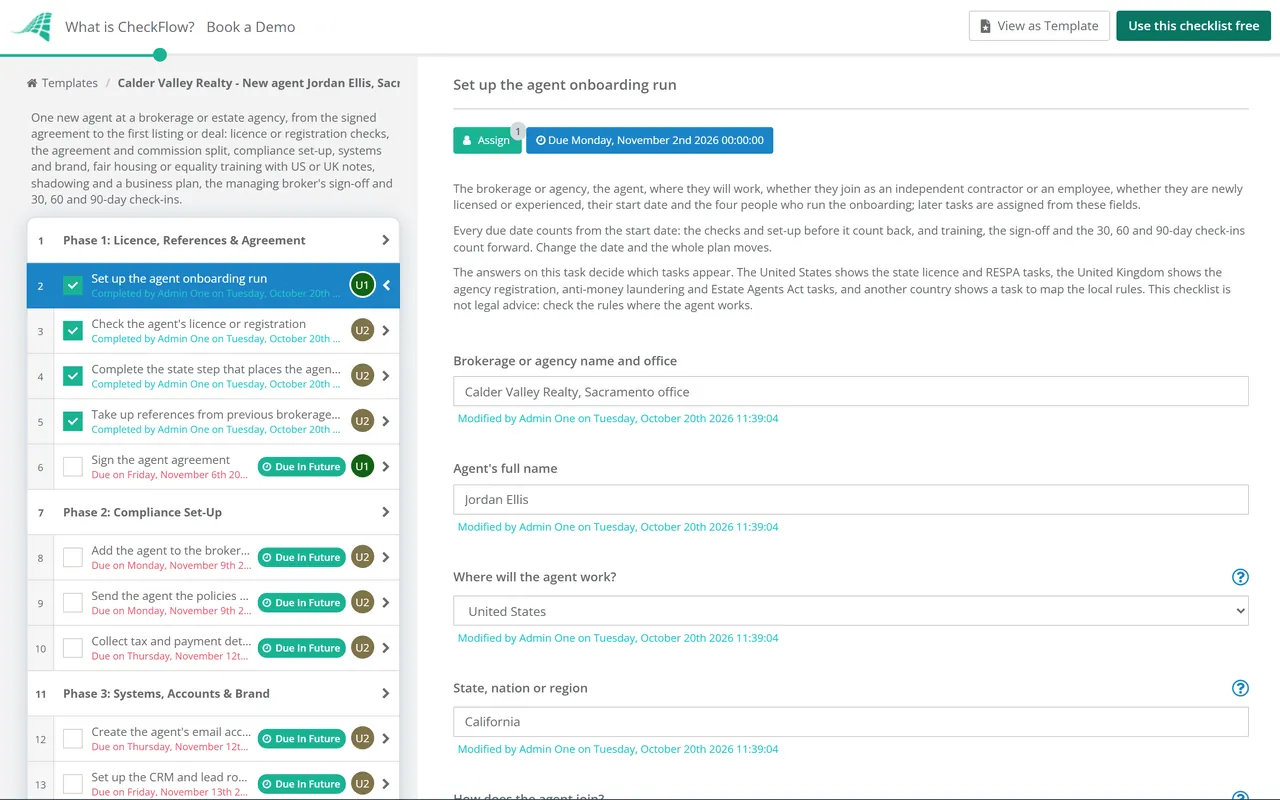
    The first task sets every due date and decides what appears: where the agent will work, how they join and whether they are new to the job. Nothing else starts until the licence or registration check is done and the agreement is signed.

    • Set up the agent onboarding run — the brokerage or agency, the agent, where they will work, whether they join as an independent contractor or an employee, whether they are newly licensed or experienced, their start date and the four people who run the onboarding; later tasks are assigned from these fields
    • Check the agent’s licence or registration — the licence number, type, status and expiry date on the regulator’s public lookup, and any disciplinary history, before the agent does any work for you
    • Complete the state step that places the agent under your broker — US only: the affiliation, transfer or sponsorship your state requires before a salesperson can do licensed work for your brokerage
    • Ask about prohibition orders and past complaints — UK only: a signed declaration that the agent is not banned from estate agency work, and any complaints or redress scheme decisions about their past work
    • Take up references from previous brokerages or agencies — the dates they worked there, the work they did and any complaints, with your normal background checks if your policy uses them
    • Agree what the agent brings from their last firm — experienced agents only: their own contacts, and a clear list of the listings, pending deals and leads that stay with the previous firm under its agreement
    • Sign the agent agreement — independent contractor or employee, the commission split and any cap, the fees the agent pays, who pays for marketing, and who keeps leads, listings and client files if the agent leaves
  2. Phase 2 — The week before

    Phase 2: Compliance Set-Up

    5 tasks

    Some duties sit with the brokerage or agency rather than the agent, and they must cover the agent before their first day. The policy manual goes out now so it can be signed in the first week.

    • Confirm the agency’s registrations cover the new agent — UK only: the agency’s registration with HMRC for money laundering supervision, or with its professional body supervisor, and its membership of an approved redress scheme, with the agent’s office on both
    • Map the local rules for agents where you work — another country only: any licence or registration, anti-discrimination law, anti-money laundering duties, consumer protection rules for property advertising and rules on marketing calls
    • Add the agent to the brokerage’s insurance and records — errors and omissions or professional indemnity cover, the agent roster, and any franchise or network the brokerage belongs to
    • Send the agent the policies and procedures manual — office rules, advertising and brand rules, data protection, complaints handling and escrow or client money rules, to read before the first week and sign in Phase 4
    • Collect tax and payment details for commission — the tax forms your country uses for a contractor or an employee, bank details for commission payments and an emergency contact
  3. Phase 3 — Before day one

    Phase 3: Systems, Accounts & Brand

    6 tasks

    Have every login working before the start date, so the first week goes on training and shadowing, not on passwords.

    • Create the agent’s email account and add them to the directory — a brokerage email address, the shared calendar, the phone system and the internal chat, with multi-factor sign-in
    • Set up the CRM and lead routing — the agent’s CRM account, their pipeline stages and the rules that route brokerage leads to them, importing only contacts they are allowed to bring
    • Arrange MLS or property portal access — in the US, MLS access through the local MLS and any association your brokerage requires; in the UK and elsewhere, the agency’s listing software and portal accounts
    • Give the agent e-signature and transaction file access — the e-signature account, the brokerage’s approved forms and the transaction management system where every deal file is kept
    • Order business cards, signs and brand materials — business cards, name riders or board slips, email signature and listing presentation templates, showing the brokerage name as your brand guidelines and any local advertising rules require
    • Publish the agent’s profile on the brokerage website — photo, short biography, contact details and the areas they cover, checked by the compliance contact before it goes live
  4. Phase 4 — Week one

    Phase 4: Training & Compliance

    8 tasks

    The agent learns how your brokerage runs a deal and the rules they must follow before they meet a client alone. The jurisdiction on the first task decides which training tasks and notes appear.

    • Welcome the agent and introduce the mentor — a tour of the office and systems, the team, the mentor, the schedule for the first two weeks and how often the mentor and agent will meet
    • Walk the agent through the brokerage’s transaction process — from the listing appointment or buyer consultation to closing or completion: the forms, the file, the deadlines, who checks what and who to ask
    • Train the agent on fair housing and equality law — no discrimination in who they show homes to, what they say, how they advertise or what they tell people about availability, with examples from your own market
    • Train the agent on referral fees and kickbacks under RESPA — US only: no fee, kickback or thing of value for referring settlement service business on a federally related mortgage loan, and no share of a charge for work not done
    • Train the agent on anti-money laundering — UK only: the money laundering law that applies to the agency, who the nominated officer is, the agency’s customer due diligence procedure and how to spot and report suspicious activity
    • Train the agent on their duties to clients under the Estate Agents Act — UK only: fee information before a client signs, disclosing any personal interest before negotiating, and property descriptions that do not mislead
    • Train the agent on the rules for prospecting calls — who they may call, at what times, and how to check the do-not-call lists before any cold call
    • Get the policies manual and training signed — the agent signs that they have read the manual, and the compliance contact records every training session with its date and who gave it
  5. Phase 5 — Weeks one and two

    Phase 5: Mentor, Shadowing & Business Plan

    4 tasks

    The agent watches the mentor do the work, then does it under watch. By the end of the phase they have a written plan for where their first clients will come from.

    • Shadow a listing appointment or valuation — the agent attends one of the mentor’s listing appointments, then they go through the pricing, the presentation and the paperwork together
    • Shadow a buyer consultation and a showing or viewing — the agent attends a buyer meeting and a showing or viewing with the mentor, including how the buyer agreement or terms are explained
    • Rehearse a listing presentation with the mentor — new agents only: a full practice presentation to the mentor, with feedback on the pricing, the marketing plan and how the fees are explained
    • Write the agent’s business plan and lead sources — goals for the first 90 days, where leads will come from, the time and money each takes, and how each source follows the training rules
  6. Phase 6 — End of week two

    Phase 6: Sign-Off to Work With Clients Alone

    3 tasks

    The managing broker or branch manager decides whether the agent can work with clients on their own. Nothing after this decision can be completed until it is recorded.

    • Confirm everything needed to work alone is in place — the licence or registration check, the signed agreement, the systems, the training record and the shadowing, ticked off by the mentor with the agent
    • Managing broker signs the agent off to work with clients alone — the managing broker or branch manager reviews the file and the mentor’s recommendation; nothing after this can be completed until the decision is recorded
    • Announce the agent to the office and their sphere — an internal announcement, a social post and a note to the agent’s own contacts, using the approved brand materials
  7. Phase 7 — First 90 days

    Phase 7: First Listing or Deal & 30/60/90-Day Check-Ins

    4 tasks

    The mentor stays close until the first listing or buyer client is signed, then the check-ins measure the agent against their own business plan.

    • Review the agent’s first listing or buyer agreement — the mentor checks the paperwork before it goes to the client, then they agree what the agent will do differently next time
    • Hold the 30-day check-in — activity against the business plan, the pipeline, anything the agent is stuck on and the next month’s focus
    • Hold the 60-day check-in — the same measures, the first deals in progress and whether the lead sources in the plan are working
    • Hold the 90-day review and close the onboarding — the managing broker or branch manager reviews the 90 days with the agent and the mentor, ends or extends mentoring and sets the licence renewal and training dates

What a New Agent Must Know, US and UK Side by Side

The training tasks show only the notes for the country you choose on the first task. This table puts the two side by side. Every entry comes from the regulation, statute or regulator page named in it, read in October 2026.

Topic United States United Kingdom
Licence to work as an agentIssued by the state real estate regulator; check type, status and expiry on its public lookupNone under the Estate Agents Act 1979: the section 22 power to set standards of competence is prospective, not in force
Who the agent works underA responsible or supervising broker, as the state requires (in California a salesperson without one may not do licensed work)The agency; the lead enforcement authority can ban an unfit person from estate agency work (section 3)
DiscriminationFair Housing Act: race, color, religion, sex, handicap, familial status and national origin, including steering and advertising (24 CFR 100.50 to 100.80)A ground for a prohibition order (section 3(1)(b)); the Equality Act 2010 applies in England, Wales and Scotland
Referral fees and kickbacksRESPA section 8: none for settlement service referrals on federally related mortgage loans; cooperative brokerage splits allowed (12 CFR 1024.14)Not covered by this template
Money launderingNot covered by this templateAgency registered with HMRC or a professional body supervisor; agents trained and a written record kept (Money Laundering Regulations 2017, regulations 7, 8 and 24)
ComplaintsBrokerage and state processApproved redress scheme for residential estate agency work, a duty on the business rather than employees (section 23A, Redress Scheme Order 2008)
Prospecting callsNo telephone solicitations before 8 a.m. or after 9 p.m., or to numbers on the national do-not-call registry (47 CFR 64.1200(c))No unsolicited marketing calls to numbers on the regulation 26 register or to people who objected; show a number (PECR regulation 21)
Contractor or employeeA licensed agent paid on output under a written contract is self-employed for federal tax purposes (IRS statutory nonemployee)Set by the agreement and employment law; a self-employed sub-agent may need its own HMRC registration

Scotland and Northern Ireland. The Estate Agents Act 1979 and the Money Laundering Regulations apply across the UK, but some rules differ. The Equality Act 2010 does not extend to Northern Ireland. Check the rules where the agent works before you rely on the UK notes.

Lettings. This template covers agents who sell. If the agent will also let property, add the letting rules where you work.

Why Run Real Estate Agent Onboarding in CheckFlow?

1

No client work before the broker says so

The managing broker or branch manager’s sign-off is assigned to them, and the checklist halts there: the announcement, the first listing review and the check-ins cannot be completed until the decision is recorded. See how approvals that halt a checklist work.

2

Only the rules for where the agent works

Three answers on the first task decide what appears: the US licence and RESPA tasks or the UK registration, anti-money laundering and Estate Agents Act tasks, a contractor or employee note on the agreement, and a task for experienced agents to agree what they bring. Change any of it with conditional rules.

3

One start date, every deadline

The checks and set-up count back from the start date and training, sign-off and the 30, 60 and 90-day check-ins count forward. The Reports Grid shows every agent being onboarded and what is still open, and licence renewals and refresher training can run as a recurring checklist.

CheckFlow does not check licences or decide whether an agent is ready, and this template is not legal advice. It runs the same onboarding for every agent, with a record of who did what and when.

This template covers one agent joining your firm. Once they have clients, the Real Estate Client Onboarding Checklist covers the first meetings, the Open House Checklist runs an open house and the Real Estate Transaction Checklist runs the deal. Staff who are not agents start with the Employee Onboarding Checklist. See how brokerages use CheckFlow on the real estate industry page.

AI generator

Didn’t find what you need? Describe it.

Describe the process in a sentence and the AI checklist generator drafts the phases and tasks for you.

Frequently Asked Questions

What should a real estate agent onboarding checklist include?

A licence or registration check, the signed agent agreement with the commission split and fees, the brokerage’s own compliance set-up, every system the agent needs (email, CRM, MLS or portals, e-signature and the transaction file), brand materials and a website profile. Then training on your transaction process and the rules that apply where the agent works, a mentor and shadowing, a written business plan, the managing broker’s sign-off before the agent works with clients alone, and check-ins at 30, 60 and 90 days.

Do new real estate agents need a licence?

In the US, yes. Licensing is by state, through each state’s real estate regulator, so check the rules of the state where the agent works. In California, for example, the Department of Real Estate says a salesperson without a responsible broker may not do work that needs a licence. In the UK there is no licence to start: the Estate Agents Act 1979 lets the government set minimum standards of competence (section 22), but that section has not been brought into force.

Is a real estate agent an employee or an independent contractor?

Either, depending on the agreement. For US federal tax, the IRS treats a licensed real estate agent as self-employed if substantially all of their pay is directly related to sales or other output rather than hours worked, and they work under a written contract saying they will not be treated as an employee for federal tax purposes. State rules can use different tests. In the UK, a self-employed sub-agent may need its own HMRC registration for money laundering supervision.

What fair housing training should a new agent get?

In the US, the Fair Housing Act bans discrimination in selling or renting a dwelling because of race, color, religion, sex, handicap, familial status or national origin. Training should cover steering buyers towards or away from neighbourhoods, advertising, posts and photographs that show a preference, and giving false information about availability (24 CFR 100.50 to 100.80). In the UK, discrimination in estate agency work is a ground for banning a person from the work (Estate Agents Act 1979, section 3).

Can a new agent pay or accept referral fees?

In the US, RESPA section 8 bans giving or accepting any fee, kickback or thing of value for referring settlement service business on a federally related mortgage loan, and splitting a charge for work not done (12 CFR 1024.14). A thing of value includes gifts, trips and paid expenses. Splits under cooperative brokerage and referral arrangements between real estate agents and brokers acting as brokers are allowed, but the exemption does not cover arrangements with mortgage brokers.

Do UK estate agents need anti-money laundering training?

Yes. Estate agents are covered by the Money Laundering Regulations 2017. Regulation 24 requires the agency to make relevant employees, and agents it uses, aware of the law, to train them regularly in how to recognise and deal with suspicious activity, and to keep a written record. HMRC’s guidance adds that staff must know who the nominated officer is. The agency itself must be registered with HMRC, or supervised by a professional body, before it does any estate agency work.

How long does it take to onboard a new real estate agent?

This template starts two weeks before the start date with the licence check and the agreement, has the systems ready before day one, and puts training and shadowing in the first two weeks. The managing broker’s sign-off is due two weeks after the start date, and the check-ins run at 30, 60 and 90 days. Change the offsets once in the template if your brokerage moves faster or slower.

Is CheckFlow free for this template?

14-day free trial, no card required. The Business plan is $10 per user per month after the trial. Full details at checkflow.io/pricing.

Every New Agent Signed Off Before Their First Client

Free trial — no credit card required.

14-day free trial, no credit cardFull refund in your first 30 daysUS hosting, EU on request