A sale has a dozen people working on it and nobody in charge of the whole timeline. That job falls to the agent or the transaction coordinator, usually without a system.
Printed from checkflow.io/templates/property-management/real-estate-transaction-checklist
Between the listing appointment and the day the keys change hands, a residential sale passes through the seller, the buyer, two agents, a lender, an appraiser or surveyor, an inspector, a title company or two conveyancers, and sometimes a chain of other sales. Each controls one piece. This free real estate transaction checklist is for listing agents, buyer’s agents, estate agents and transaction coordinators who need to keep the whole file moving. It covers opening the file, the listing or buyer representation, offer to agreed sale, then contract to close in the US or sale agreed to completion in England and Wales, and a post-close review with broker sign-off. Two questions at the start show only the phases for your side and your country.
The Agent’s File, From Listing to Close
This template follows the transaction from the agent’s desk. It starts before there is a contract, with the paperwork that lets you act for a client at all: a listing agreement or terms of business for a seller, a written buyer agreement in the US for a buyer. It ends after closing, when the commission is paid and the managing broker has reviewed the file. In between, the agent’s job is less about doing each step than making sure someone does it on time.
The contract stage itself, with its contingencies, surveys and title review worked through in detail for buyers and sellers, is covered by the Purchase and Sales Agreement Checklist. Use that one when you are a party to the deal. Use this one when you are running the deal for a client, especially if you are coordinating several at once.
The work on the two sides is different enough to need its own phase each. A listing agent is responsible for what the market is told about the property; a buyer’s agent is responsible for what the buyer agreed to before they set foot in it.
Representing the seller
Get the listing right
Listing agreement or terms of business signed before marketing
Seller disclosures, lead paint disclosure for older US homes, material information in the UK
Marketing the seller has checked for accuracy
Every offer passed on, in writing, until the deal is binding
Representing the buyer
Get the buyer ready
Written buyer agreement before the first US tour, with compensation stated
Finance confirmed before viewings, not after the offer
Disclosures and property information read before offering
An offer strategy agreed in writing: price, conditions and timing
What the Real Estate Transaction Checklist Covers
Seven phases run from opening the file to the broker’s review. Phase 2 appears only when you represent the seller and Phase 3 only when you represent the buyer. Phase 5 appears for US transactions and Phase 6 for sales in England and Wales, and the country-specific tasks in Phases 2 and 3 follow the same answer.
1
Scope
Phase 1: Open the File
5 tasks
Answer the two scope questions first. They decide which side and which country’s phases this transaction shows.
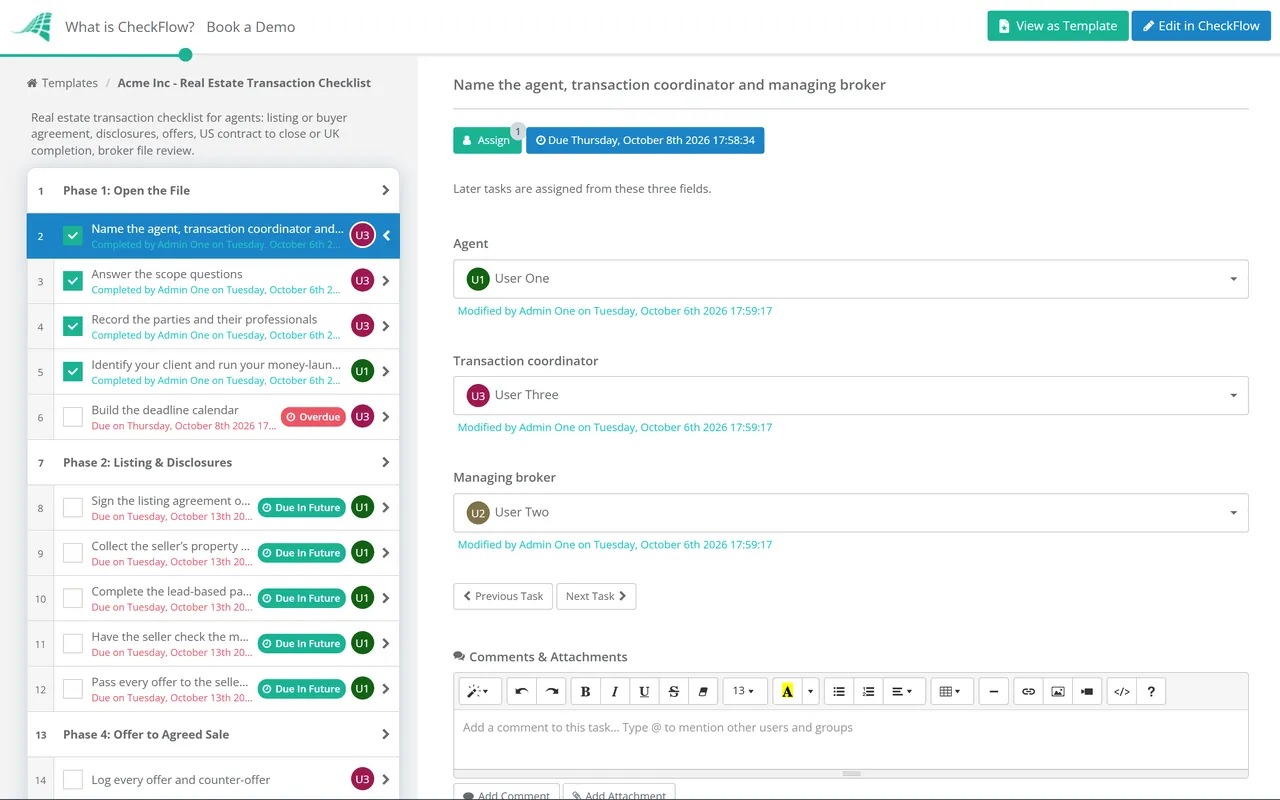
Name the agent, transaction coordinator and managing broker — later tasks are assigned from these three fields
Answer the scope questions — are you representing the seller or the buyer, and is the property in the US or in England and Wales
Record the parties and their professionals — client, other agent, lender, title company or conveyancers, with contact details
Identify your client and run your money-laundering checks — UK estate agents must verify buyers and sellers
Build the deadline calendar — every contractual and legal date, each with a named owner
2
Seller
Phase 2: Listing & Disclosures
6 tasks
Shown only when you represent the seller.
Sign the listing agreement or terms of business — fees and services in writing before marketing starts
Collect the seller’s property disclosures — on your state’s form in the US, or a property questionnaire in the UK
Complete the lead-based paint disclosure for pre-1978 US homes — pamphlet, warning statement and any known reports
Gather the material information for UK listings — tenure, council tax, charges, utilities and anything else a buyer needs to decide
Have the seller check the marketing — photos, floor plan and description, before anything is published
Pass every offer to the seller in writing — with the date, amount and conditions of each
3
Buyer
Phase 3: Buyer Representation & Search
5 tasks
Shown only when you represent the buyer.
Sign a written buyer agreement before the first US tour — including the amount or rate of your compensation
Confirm the buyer’s finance — mortgage approval in principle, proof of deposit and source of funds
Arrange and record each viewing — date, property and the buyer’s feedback
Review the property information before any offer — disclosures, listing details and comparable sales
Agree the offer strategy with the buyer — price, conditions, deposit and timescale, confirmed in writing
4
Agree
Phase 4: Offer to Agreed Sale
5 tasks
Log every offer and counter-offer — who made it, when, and what the other side answered
Circulate the accepted terms — the signed contract in the US, or a memorandum of sale to both conveyancers in the UK
Check the agreed terms against your client’s instructions — price, inclusions, dates and conditions
Load every agreed deadline into the calendar — and assign each one to the person who has to meet it
Introduce the professionals to each other — lender, surveyor or appraiser, title company or conveyancers
5
US
Phase 5: US Contract to Close
6 tasks
Shown only for US transactions.
Confirm the earnest money is deposited — attach the escrow receipt before the contract deadline passes
Track inspection, appraisal and financing contingencies — each removal or extension in writing, before its deadline
Follow the title work — commitment, liens, payoffs and any association documents
Confirm the buyer has the Closing Disclosure — at least three business days before closing
Warn both clients about wire fraud — and tell them to confirm wiring instructions by phone on a known number
Schedule the final walk-through and closing — with keys, codes and utilities arranged for the handover
6
UK
Phase 6: Sale Agreed to Completion
5 tasks
Shown only for sales in England and Wales.
Chase searches, enquiries and the mortgage offer — with both conveyancers, on a fixed day each week
Manage the survey outcome — and any renegotiation, passing revised offers to the seller in writing
Track every link in the chain — the status of each sale above and below yours
Confirm exchange and the completion date — neither side is bound until contracts are exchanged
Release keys only on confirmation of completion — from the seller’s conveyancer, not the buyer
7
Close
Phase 7: Post-Close & File Review
5 tasks
Confirm the commission is received — and matches the agreement
Hand over tenancy documents if the property is let — agreements, deposit details and inspection reports go to the buyer
Send the client a closing pack — final statement, key documents and what happens next
Complete the compliance file — agreements, disclosures, ID checks and correspondence, kept for the period your rules require
Managing broker approval of the transaction file — required before the file is closed
Rules That Shape the Transaction File in the US and UK
Most of what goes into a transaction file is set by the contract and by your brokerage’s own policies. A few items are set by regulation or by industry rules that changed recently, and these are the ones that cause trouble when they are missed. The table lists the main examples by stage. State law in the US adds its own disclosure forms and licence rules, so add those to the template for each state you work in.
Stage
United States
United Kingdom
Acting for a client
Since 17 August 2024, under the NAR settlement practice changes, an MLS participant working with a buyer needs a written agreement before touring a home, in person or by live virtual tour
Estate agents must give clients written details of their terms, including fees, before taking instructions
Compensation
Offers of compensation to buyer brokers are no longer allowed on the MLS. The buyer agreement must state an objectively ascertainable amount or rate, not a range or “whatever the seller offers”
Fees are agreed with the instructing client in the terms of business
Property information
For housing built before 1978: the “Protect Your Family From Lead in Your Home” pamphlet, a Lead Warning Statement, known reports, and 10 days for the buyer to test unless both parties agree otherwise in writing
Material information: under the Digital Markets, Competition and Consumers Act 2024, in force since 6 April 2025, leaving out information the average buyer needs to make a decision can be a misleading omission. The National Trading Standards guidance that listed it was withdrawn in 2025, and the government plans replacement non-statutory guidance. Until then, price, tenure, council tax, service charges, utilities, broadband, parking, building safety, rights and easements, and flood risk are a sensible baseline
Offers
Set by state licence law and brokerage policy
Agents must pass on offers to the seller promptly and in writing, up to exchange of contracts
Mortgage disclosures
Loan Estimate within three business days of application; Closing Disclosure received at least three business days before consummation, with a new three-day wait if the APR becomes inaccurate, the loan product changes or a prepayment penalty is added
Set by the lender; the buyer’s conveyancer confirms the mortgage offer is in place before exchange, when the buyer becomes committed
After closing
Sellers and agents keep the lead disclosure documents for at least three years from the sale
In England, the buyer’s Stamp Duty Land Tax is paid within 14 days of completion and the buyer is registered at HM Land Registry
Money-laundering checks in the UK. Estate agency businesses are supervised for anti-money laundering by HMRC and must carry out customer due diligence on both the buyer and the seller of a property, even where only the seller instructed them. Checks on the buyer must be completed before a binding contract is entered into. Record what you checked and when, and keep it with the transaction file, because HMRC compliance checks review those records.
Wire fraud in the US. The FBI describes real estate wire fraud as criminals getting into a transaction’s email and sending a buyer altered payment instructions just as closing funds are due, often posing as the agent or title company. Its advice is to verify any change to payment instructions in person or by phone with someone you already know. A warning task with a fixed date, a few days before closing, means every client hears it before the funds move.
Why Run Real Estate Transactions in CheckFlow?
1
Every deal at a glance
A transaction coordinator running a dozen files sees each one’s progress and overdue tasks on one dashboard, instead of keeping the deadlines in a spreadsheet and their head. Contingency, exchange and closing dates sit on the tasks they belong to.
2
Only the steps this deal needs
Two answers at the start decide the rest. A US buyer-side file never shows listing or exchange tasks, and a UK sale never shows earnest money, so agents work from one template without wading through steps that do not apply.
3
A file the broker can sign off
Agreements, disclosures and ID checks are attached to the tasks that required them, and the file closes only after the managing broker’s approval. The completion history shows who did what and when if a regulator or client asks.
Describe the process in a sentence and the AI checklist generator drafts the phases and tasks for you.
Frequently Asked Questions
What does a real estate transaction checklist cover?
Everything the agent or transaction coordinator must do or chase from the listing agreement or buyer agreement to the closed file: disclosures and marketing, offers, the accepted contract or memorandum of sale, earnest money, inspections, appraisal, financing, title or searches, the final walk-through, closing or completion, commission and the broker’s file review.
Do US buyers have to sign an agreement before touring a home?
If they are working with an agent who is an MLS participant, yes. Since 17 August 2024, under the practice changes that followed the NAR settlement, the agent must have a written agreement with the buyer before touring a home, including live virtual tours. The agreement must state the amount or rate of the agent’s compensation, and the agent cannot receive more than that from any source.
When does the buyer receive the Closing Disclosure?
For most US mortgages, the lender must make sure the buyer receives it at least three business days before consummation, which is usually closing day. A corrected disclosure restarts the three-day wait if the APR becomes inaccurate, the loan product changes or a prepayment penalty is added. Other changes can be disclosed at or before closing.
What is material information in a UK property listing?
Information a buyer or tenant needs to decide whether to view or proceed, which agents must not leave out of a listing. Since 6 April 2025 the duty has come from the unfair commercial practices rules in the Digital Markets, Competition and Consumers Act 2024, which replaced the Consumer Protection from Unfair Trading Regulations 2008; the CMA can now enforce them directly, alongside Trading Standards. The National Trading Standards guidance that grouped material information into Parts A, B and C was withdrawn in 2025 because it was written for the old regulations. In June 2026 the government said it will publish non-statutory guidance explaining what the 2024 Act requires; until it does, there is no official list. Price or rent, tenure, council tax band, service charges and ground rent, utilities, broadband, parking, building safety, rights and easements, flood risk and planning are a sensible baseline.
Do UK estate agents have to check the buyer’s identity?
Yes. Under the money laundering regulations, HMRC treats both the buyer and the seller as the estate agent’s customers, so the agent must identify and verify both. Due diligence on the buyer must be complete before a binding contract is entered into, which in England and Wales means before exchange.
Is CheckFlow free for this template?
14-day free trial, no card required. The Business plan is $10 per user per month after the trial. Full details at checkflow.io/pricing.
Run Every Deal From Listing to Close on One Timeline