Real Estate Client Onboarding Checklist Template

A structured onboarding process for buyer and seller clients — from first meeting to closing, with nothing left to chance or memory.

Buying or selling a home is the largest financial transaction most people ever make — and one of the most emotionally loaded. How a real estate agent manages the first few weeks of a new client relationship sets the tone for everything that follows: whether the client trusts your judgement, whether they feel informed and in control, and whether they refer you when it is over. A consistent, structured onboarding process — one that asks the right questions, collects the right documents, sets realistic expectations, and keeps communication proactive — is the difference between a client who becomes an advocate and one who quietly switches agents after a frustrating start. This free real estate client onboarding checklist covers both tracks: buyer client onboarding and seller client onboarding — from initial consultation and representation agreements through to closing and post-completion follow-up.

Use This Template Free See Live Example
No Credit Card Required

Buyer and Seller Onboarding Are Two Different Processes — Both Need a Checklist

Most real estate client onboarding templates treat buyers and sellers as variations of the same process. They are not. A buyer client needs to be pre-qualified, educated on market conditions, guided through property search criteria, and managed through the emotional journey of finding the right property at the right price in a market that may not cooperate. A seller client needs a clear-eyed pricing strategy, a pre-listing preparation plan, a marketing launch process, and an agent who manages viewings, feedback, and offers with consistent communication throughout.

The checklist below addresses both tracks separately — because running the same process for a buyer and a seller does not serve either client well. Both tracks share the same structural discipline: a defined sequence of tasks, assigned to the right person, with nothing dependent on the agent’s memory or the client’s initiative.

What the Real Estate Client Onboarding Checklist Covers

This checklist covers two tracks — buyer client onboarding and seller client onboarding. Both share the same initial phases (initial consultation and representation agreement) before diverging into their distinct processes.

Track A Buyer Client Onboarding
Phase A1

Track A — Buyer Initial Consultation

The initial consultation is where expectations are set and the working relationship is established. Done well, it builds confidence. Done poorly, it creates doubt the agent spends months trying to overcome.

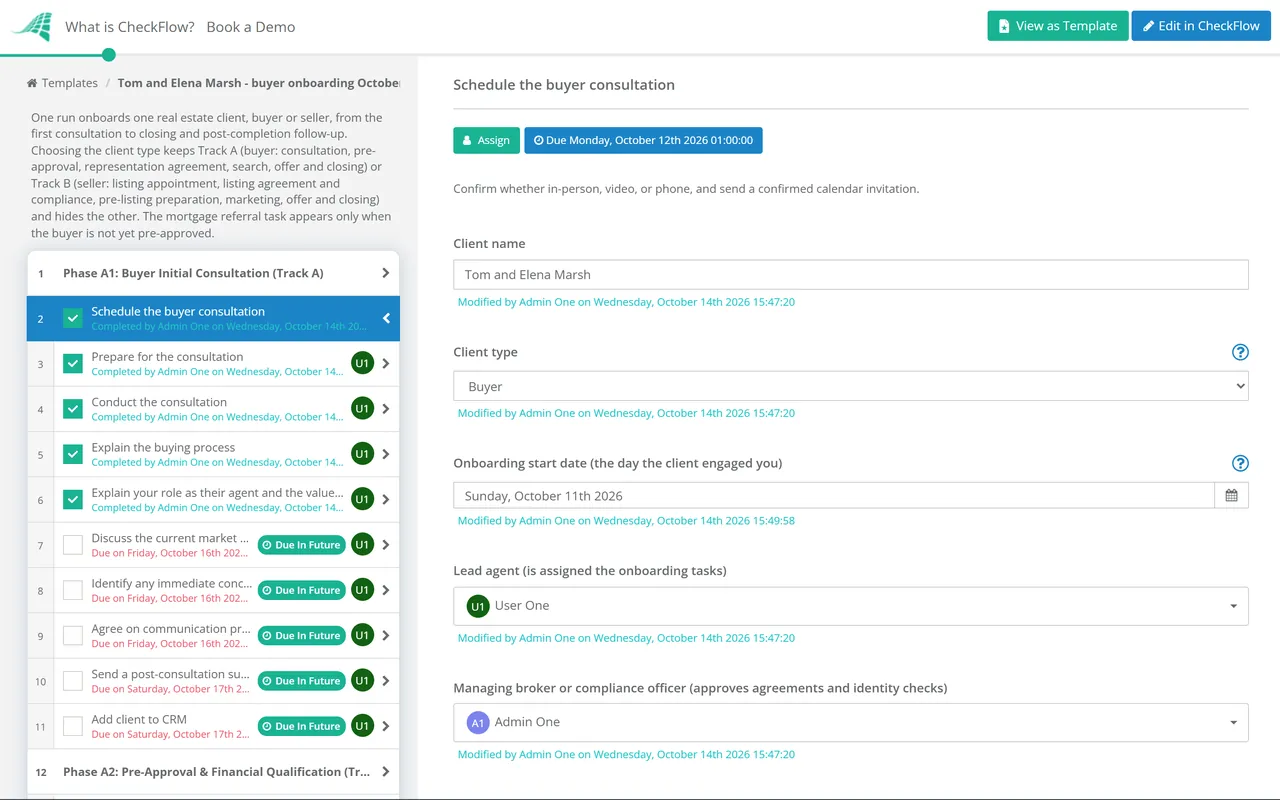
  • Schedule the buyer consultation — confirm whether in-person, video, or phone, and send a confirmed calendar invitation
  • Prepare for the consultation — review any information already known about the buyer’s situation and needs
  • Conduct the consultation — cover the buyer’s goals, timeline, preferred locations, property requirements, and any constraints
  • Explain the buying process — from property search through to completion, in plain terms appropriate to the buyer’s experience level
  • Explain your role as their agent and the value you provide — set clear expectations about how you will communicate, how often, and through which channels
  • Discuss the current market conditions relevant to their search — price trends, inventory levels, typical competition, and realistic timelines
  • Identify any immediate concerns or misconceptions the buyer has — address them directly rather than letting them fester
  • Agree on communication preferences — frequency, preferred channels, and how they want to receive property recommendations
  • Send a post-consultation summary — confirm agreed next steps, what you need from them, and what you will do next
  • Add client to CRM — record all relevant details, preferences, and notes from the consultation
Phase A2

Track A — Pre-Approval & Financial Qualification

  • Confirm the buyer’s financial position — whether pre-approved, pre-qualified, or cash buyer
  • If not pre-approved — provide referrals to mortgage brokers or lenders and set clear expectation that pre-approval is required before active property search begins
  • Confirm pre-approval letter has been received — review approved amount, loan type, and any conditions
  • Confirm the buyer understands the total cost of purchasing — deposit, legal fees, survey costs, stamp duty / transfer taxes, and moving costs
  • Confirm proof of funds or deposit evidence is available — required for offer submission in most markets
  • Collect identification documents for AML / KYC compliance where required — confirm identity verification is completed and documented
  • Confirm the buyer’s timeline — is there a chain dependency (sale of existing property), lease expiry, or other deadline driving urgency?
  • Discuss the buyer’s appetite for competitive markets — confirm they understand what is required to compete in a fast-moving market if applicable
  • Document financial qualification details in the client record
  • Confirm readiness to proceed with active property search
Phase A3

Track A — Buyer Representation Agreement

Following the August 2024 NAR settlement, buyer representation agreements are required before showing properties in most US markets. Confirm your jurisdiction’s current requirements and your brokerage’s policy.

  • Present the buyer representation agreement — explain the terms clearly, including the agent’s duties, compensation structure, exclusivity, and duration
  • Allow time for the buyer to review the agreement — do not pressure for immediate signature; explain the value and answer questions
  • Obtain signed buyer representation agreement before proceeding to property showings
  • Present required agency disclosure documents — confirm the buyer understands your fiduciary or agency duties to them
  • Confirm the agreement terms are recorded in the client file — including compensation structure, duration, and any agreed exclusions
  • Brief the buyer on their obligations under the agreement — particularly around contacting listing agents directly or attending open houses without representation
  • File all signed documents in the client record
Phase A4

Track A — Property Search & Viewings

  • Document detailed property search criteria — location preferences, property type, size, bedrooms, key features, and any non-negotiables
  • Set up MLS or portal property alerts — confirm the buyer is receiving relevant listings and the alert criteria are calibrated correctly
  • Establish a viewing process — confirm how quickly the buyer can respond to new listings, preferred viewing times, and decision-making process within their household
  • Conduct property viewings — confirm all parties who need to be present for a decision can attend
  • Collect structured feedback after each viewing — what did they like, what did not work, and how did it compare to their criteria?
  • Refine search criteria based on viewing feedback — adjust portal alerts if the criteria evolve
  • Manage expectations throughout the search — proactive communication when the market is competitive or inventory is low
  • Keep the buyer updated on market activity relevant to their search — comparable sales, price reductions, and new listings in their area
  • Track the buyer’s engagement level — proactively re-engage if activity or response time drops
  • Document all viewings and feedback in the client record
Phase A5

Track A — Offer, Negotiation & Under Contract

  • Prepare a comparative market analysis (CMA) for any property the buyer wishes to offer on — confirm the buyer understands market value before submitting an offer
  • Discuss offer strategy — price, terms, contingencies, deposit amount, and completion timeline
  • Prepare and submit the offer — confirm all required documentation is included
  • Communicate offer outcome — accepted, rejected, or counter-offer — promptly and clearly
  • Manage counter-offer negotiations — document all terms discussed and agreed
  • Confirm acceptance in writing — obtain signed purchase agreement from all parties
  • Brief the buyer on next steps under contract — survey/inspection, mortgage application progression, legal process, and key dates
  • Instruct legal / conveyancing team — confirm solicitor or attorney details and introduce to the process
  • Coordinate survey or home inspection — schedule promptly and review results with the buyer
  • Monitor mortgage progression and flag any issues that could affect the timeline
Phase A6

Track A — Closing & Post-Completion

  • Conduct pre-closing walkthrough with the buyer — confirm the property’s condition matches the purchase agreement
  • Confirm closing date, time, and logistics — brief the buyer on what to bring and what to expect
  • Coordinate with legal team, lender, and seller’s agent to ensure all documentation is in order for closing
  • Attend closing — or confirm a trusted colleague will represent if unavailable
  • Hand over keys — congratulate the buyer and mark the milestone appropriately
  • Send a post-closing gift or personal note — a small gesture that creates a lasting impression
  • Send a 30-day check-in — confirm the buyer is settled and address any post-completion questions
  • Request a review or testimonial — a recent, specific review from a completed transaction is your most powerful marketing asset
  • Ask for referrals — do so directly and specifically after a successful completion
  • Archive the client file and update CRM — set a reminder for an annual check-in
Track B Seller Client Onboarding
Phase B1

Track B — Seller Initial Consultation & Listing Appointment

The listing appointment is a competitive pitch as much as a consultation — the seller may be meeting multiple agents. Preparation, market knowledge, and a clear marketing plan are what differentiate a winning presentation.

  • Research the property before the listing appointment — review sold comparables, current market conditions, and any available history on the property
  • Prepare a comparative market analysis (CMA) — honest pricing assessment with supporting evidence
  • Prepare the listing presentation — marketing plan, fee structure, your track record, and proposed timeline
  • Conduct the listing appointment — present the CMA, discuss pricing strategy, and outline the full marketing plan
  • Manage pricing expectations honestly — do not inflate the suggested price to win the listing at the expense of a longer, harder sale
  • Explain your role and agency duties — fiduciary obligation to the seller and what that means in practice
  • Present the listing agreement terms — fee structure, duration, exclusivity, and marketing commitments
  • Address the seller’s questions and concerns — including timeline, viewings, and what happens if the property does not sell quickly
  • Confirm the seller’s timeline and any constraints — are they in a chain? Do they have a move-out deadline?
  • Send a post-meeting summary confirming agreed next steps
Phase B2

Track B — Listing Agreement & Compliance Documentation

  • Obtain signed listing agreement — confirm all terms are clear and agreed before proceeding
  • Present required agency disclosure documents — confirm seller understands the agent’s duties and any dual agency implications
  • Collect identification documents for AML / KYC compliance where required — confirm identity verification is completed and documented
  • Confirm ownership and legal authority to sell — confirm all legal owners are party to the listing agreement
  • Collect the property’s legal documentation — title deeds, mortgage details, service charge records (for leasehold), and planning permissions
  • Prepare property disclosure documentation — confirm the seller has disclosed all known material defects as required by applicable law
  • Confirm homeowners association details where applicable — HOA fees, rules, and any outstanding assessments
  • File all signed documents in the client record — retain for required period
Phase B3

Track B — Pre-Listing Preparation

  • Walk through the property with the seller — identify recommended repairs, decluttering, staging, and presentation improvements before photography
  • Provide a written pre-listing preparation list — specific, prioritised recommendations with clear guidance on which items will have the most impact on presentation and price
  • Confirm which repairs or improvements the seller will undertake — and set a realistic timeline before photography is scheduled
  • Arrange professional photography — confirm date, time, and what needs to be ready before the photographer arrives
  • Arrange floorplan, virtual tour, or video where applicable — confirm these are included in the marketing plan
  • Arrange an Energy Performance Certificate (EPC) or equivalent energy disclosure where required by law
  • Confirm the listing description is accurate, compelling, and reviewed by the seller before going live
  • Confirm the asking price is agreed and reflects current market conditions — revisit if conditions have changed since the listing appointment
  • Set up the property in the MLS, portals, and internal systems
  • Confirm the launch date and marketing plan with the seller
Phase B4

Track B — Marketing Launch & Viewings

  • Launch the listing on all agreed platforms — MLS, portals (Rightmove, Zillow, Zoopla, etc.), social media, and agent website
  • Notify the seller that the property is live — share the listing links and confirm how it looks across platforms
  • Establish viewing procedures — accompanied or unaccompanied showings, notice requirements, and any restrictions the seller needs to be aware of
  • Confirm the seller’s availability for viewings — and brief them on how to prepare the property before each viewing
  • Collect feedback after every viewing — report to the seller regularly and honestly
  • Monitor enquiry and viewing volumes — if activity is low, discuss pricing or marketing adjustments proactively
  • Manage any price reduction conversations with evidence — CMA update and comparable market data, not anecdote
  • Keep the seller updated at a regular cadence — do not wait for them to chase you for a status update
  • Manage open house events where applicable — confirm logistics, safety procedures, and follow-up process with all attendees
Phase B5

Track B — Offer, Negotiation & Under Contract

  • Present all offers to the seller promptly — with a clear explanation of terms, conditions, and any concerns
  • Advise the seller on the relative merits of each offer — not just price but buyer qualification, chain position, and conditions
  • Negotiate on the seller’s behalf — document all counter-offers and responses in writing
  • Confirm the accepted offer in writing — obtain acknowledgement from both parties
  • Carry out buyer qualification checks — confirm the buyer is financially qualified and their chain position is clear
  • Instruct the seller’s legal or conveyancing team — confirm all necessary documentation is being prepared
  • Brief the seller on the under-contract process — survey or inspection, legal process, key milestones, and expected timeline
  • Manage the survey or home inspection outcome — advise the seller on any renegotiation requests calmly and with evidence
  • Monitor mortgage and legal progress on the buyer side — flag any delays to the seller proactively
Phase B6

Track B — Closing & Post-Completion

  • Confirm closing date and logistics — brief the seller on what to expect, when to vacate, and what to leave behind
  • Coordinate with all parties — legal teams, buyer’s agent, and lenders — to confirm all documentation is in order
  • Attend closing or confirm representation
  • Confirm final meter readings, key handover, and any agreed chattels or inclusions are in place
  • Confirm commission and fees have been paid and receipted correctly
  • Send a post-completion personal note — mark the milestone for the seller
  • Request a review or testimonial — directly and specifically
  • Ask for referrals — your best source of future business is a recently satisfied client
  • Archive the client file — retain all documentation for the required period
  • Set a 12-month CRM reminder — for market update outreach and relationship maintenance

Both checklists are available as free, runnable templates in CheckFlow — with tasks assigned to agents and shared directly with clients where appropriate, phase order enforced so compliance steps cannot be skipped, and a complete record for every transaction.

Use This Template Free

The 2024 NAR Settlement — What Changed for Buyer Representation

Note: The August 2024 NAR settlement introduced significant changes to buyer agent compensation and representation agreements. Requirements vary by state and brokerage policy. Confirm your jurisdiction’s current requirements before implementing.

In August 2024, the National Association of Realtors (NAR) reached a landmark settlement that fundamentally changed how buyer agent compensation works in US real estate transactions. The two most significant changes for buyer agents are that written buyer representation agreements are now required before showing properties in most markets, and compensation offers can no longer be communicated through MLS databases — buyers and their agents must negotiate compensation directly.

What Changed

Buyer representation agreements required before showings

Obtaining a signed buyer representation agreement is now a mandatory step in the onboarding process — before any property viewings are conducted. The agreement must clearly state the agent’s compensation terms. This step must be reflected in any buyer onboarding checklist and cannot be skipped or deferred.

What Changed

MLS compensation offers eliminated

Agents must have a direct conversation with buyer clients about compensation at the outset of the relationship — not after they have already seen properties. This makes the consultation and representation agreement phase more commercially important than ever, and requires agents to be clear and confident in communicating their value before the client is committed.

CheckFlow’s enforced task order ensures the buyer representation agreement cannot be bypassed — property search tasks are locked until the representation agreement phase is marked complete.

Why Run Real Estate Client Onboarding in CheckFlow?

1

The same professional process for every client

Real estate agents juggle multiple transactions simultaneously — buyers searching for months, sellers managing viewings, deals under contract, and new listings launching. Without a structured checklist, the quality of each client’s experience depends on how busy the agent is that week. CheckFlow gives every client — buyer or seller — the same thorough, structured process. Nothing is forgotten because the agent is managing six other transactions.


2

Share tasks directly with clients

Buyers need to arrange pre-approval, gather identification documents, and confirm their search criteria. Sellers need to complete property disclosures, prepare the property for photography, and provide legal documentation. CheckFlow lets you assign these client-facing tasks directly via a shared checklist link — with each task clearly described, assigned by name, and visible to the agent the moment it is completed. No more chasing clients for documents by email.

3

Manage multiple transactions at once

An agent with ten active clients needs to know — right now — which buyers are under contract, which sellers have a viewing tomorrow, and which transactions have overdue compliance steps. CheckFlow’s grid-based dashboard shows every active client and transaction in one view — which phase each is in, what is overdue, and where to focus today. No more reconstructing the status of each client from memory or email history.

Real estate agents managing multiple transactions simultaneously use the same structured approach as MSPs managing multiple client environments — many active processes at once, each in a different phase, each requiring a different next action. CheckFlow’s grid dashboard is built for exactly this kind of multi-client visibility. See how CheckFlow handles multi-client process management →

Frequently Asked Questions

What should a real estate client onboarding checklist include?

+

A comprehensive real estate client onboarding checklist needs to cover two separate tracks — buyer onboarding and seller onboarding — because the processes are fundamentally different. Buyer onboarding covers: initial consultation and needs assessment, pre-approval and financial qualification, the buyer representation agreement (now required before showings in most US markets following the 2024 NAR settlement), property search setup, viewings, offer and negotiation, under-contract management, and closing. Seller onboarding covers: listing appointment and CMA presentation, listing agreement and compliance documentation, pre-listing preparation, marketing launch and viewings management, offer and negotiation, under-contract management, and closing. Both tracks should embed compliance steps — agency disclosure, representation agreements, and AML checks where required — as enforced, non-skippable steps.

What changed for buyer agents after the 2024 NAR settlement?

+

The August 2024 NAR settlement introduced two major changes for buyer agents in the US. First, written buyer representation agreements must be in place before agents can show properties to buyers — compensation terms must be clearly stated in the agreement. Second, buyer agent compensation offers can no longer be communicated through MLS listings — buyers and their agents must negotiate compensation directly with sellers and their agents as part of the transaction. These changes make the buyer consultation and representation agreement phase more commercially important than ever — agents must be able to clearly communicate their value and confirm compensation before the client is committed.

What documents does a real estate agent need to collect from a buyer client?

+

Before an active property search begins, agents typically need from buyer clients: a mortgage pre-approval letter (or proof of cash funds for cash buyers), government-issued photo identification for KYC compliance where applicable, proof of deposit or source of funds where required, and a signed buyer representation agreement. During the offer and under-contract phase, additional documents include the signed purchase agreement, mortgage application confirmation, and any survey or inspection reports. The exact requirements vary by jurisdiction and transaction type.

How do I manage a real estate seller client who wants to overprice their property?

+

Pricing conversations are one of the most common challenges in seller onboarding — and one of the most important to handle at the outset. The most effective approach is to present the CMA before the listing appointment rather than at it — so the seller has seen the market evidence before they are in the room with you. Be honest about the likely outcome of overpricing: longer time on market, price reductions, and the stigma that attaches to a property that has been sitting. Agree on an initial price range that reflects the market, set a clear review trigger (for example, if there are no offers within 30 days), and document the conversation in the client file. A structured onboarding checklist that includes a pricing expectations task forces this conversation to happen at the right time — before the listing goes live.

How do you handle AML requirements in real estate onboarding?

+

Anti-Money Laundering requirements in real estate are significant and growing — particularly for high-value transactions. Requirements vary by jurisdiction: in the UK, estate agents are directly regulated under the Money Laundering Regulations and must conduct KYC verification, source of funds checks, and politically exposed persons screening. In the US, FinCEN has introduced geographic targeting orders requiring title companies to report cash transactions above defined thresholds in specified markets. Real estate agents in many markets are required to collect and verify identification documents from all parties to a transaction and retain records for defined periods. A structured onboarding checklist with an embedded compliance phase ensures AML steps are completed for every transaction — not selectively.

Is CheckFlow free to use for this template?

+

You can start a free 14-day trial with no credit card required, giving you full access to all features including this template. The Business plan is $10 per user per month after the trial. Full details at checkflow.io/pricing.

Start Running Consistent Client Onboarding for Every Transaction

Free trial — no credit card required.