Bringing someone into a role
Paperwork: offer, contract, payroll and benefits.
Support: a line manager and often a buddy.
The work: the job itself, ramping up over three months.
Ends with: a probation or 90-day review.
An internship is a short placement built around learning, and it should be onboarded that way. This free internship onboarding checklist starts with a recorded decision on pay, then handles the school or university paperwork for credit-bearing placements, written learning objectives, a named mentor with time set aside, and one real project with a deliverable. It closes with a midpoint review, a final review, and a decision on a graduate offer, a reference, or both. It suits summer internships, year-long industrial placements and graduate intern intakes, and it is written for HR, hiring managers and mentors. For a permanent hire, use the Employee Onboarding Checklist instead. For a large intake of temporary staff ahead of a busy period, the Seasonal Employee Onboarding Checklist is built for speed and rehires.
An employee is hired to do a job, and onboarding brings them up to speed in it. An intern is there, at least partly, to learn, and several of the employer’s obligations follow from that. In the US, an unpaid internship at a for-profit business is only lawful when the intern, rather than the business, is the main beneficiary. In the UK, an intern who does real work is usually a worker and is owed the minimum wage. So the learning plan is not a nice extra. For an unpaid placement, the learning objectives and the school’s involvement are part of what supports the decision not to pay.
The other difference is the ending. Employee onboarding finishes with a 90-day review and an open-ended future. An internship has a fixed end date, and the most useful work happens in its last two weeks: a structured final review, a decision on whether to make a graduate or return offer, and a reference written while the detail is still fresh. A placement that simply stops on its last day throws away most of what both sides found out.
Paperwork: offer, contract, payroll and benefits.
Support: a line manager and often a buddy.
The work: the job itself, ramping up over three months.
Ends with: a probation or 90-day review.
Paperwork: a recorded pay decision, then either worker paperwork or the school’s placement agreement.
Support: a named mentor with diary time set aside.
The work: learning objectives and one real project with a deliverable.
Ends with: a final review, an offer decision and a reference.
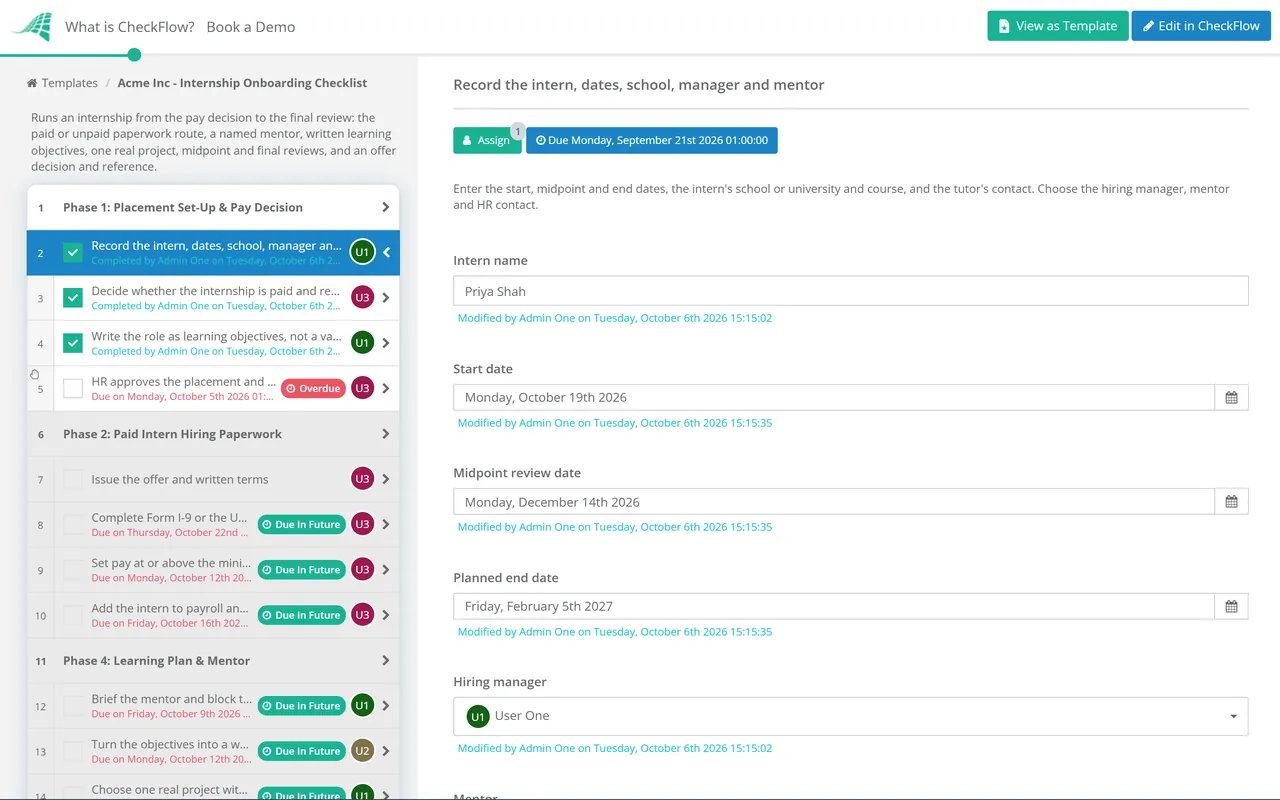
Seven phases run from the placement decision to the final review. Phase 2 or Phase 3 appears, depending on whether the internship is paid.
Shown only when the internship is paid. A paid intern is an employee or worker, so the normal hiring rules apply in full.
Shown only when the internship is unpaid or for academic credit. A process step, not legal advice: it makes sure the basis for not paying is checked and written down.
Due dates count back from the start date recorded in Phase 1.
Due on the midpoint date set in Phase 1.
Due dates count back from the planned end date, so the offer decision is made while the intern is still on site.
The word “intern” has no special legal status in either country. What matters is what the person actually does, who benefits and, in the UK, whether they are a worker. The table sets out the main situations and what to keep on file for each. It supports the pay decision in Phase 1. It is not legal advice, and a written agreement calling someone a volunteer does not change the answer if the facts point the other way.
| Situation | Pay rule | Record to keep |
|---|---|---|
| US, for-profit employer | Unpaid only if the intern is the “primary beneficiary” under the Department of Labor’s seven-factor test; otherwise minimum wage and overtime apply under the FLSA | The factors weighed, the link to the intern’s education and the written no-pay understanding |
| US, public sector or non-profit charity | Unpaid internships are generally permissible where the intern volunteers without expecting pay | The volunteer arrangement and confirmation that no pay is expected |
| UK, intern doing work as a worker | National Minimum Wage or National Living Wage for their age, including where they have been promised future work | Pay records, hours worked and the written statement |
| UK, required course placement | No minimum wage if the placement is a required part of a UK further or higher education course and lasts no more than a year | The course requirement, usually shown in the placement agreement |
| UK, work shadowing only | No minimum wage, provided the intern observes and does no work | What the intern did day to day, so the shadowing stays genuine |
| UK, voluntary worker for a charity | No minimum wage for unpaid work for a charity or voluntary organisation, apart from basic expenses | Expenses paid, so no other benefit could look like pay |
| UK, pupil on school work experience | No minimum wage for a pupil below school leaving age on a work experience placement | The school’s placement paperwork and the young person’s risk assessment |
The US test weighs seven factors: a clear understanding that there is no pay, training similar to what an educational setting would give, a tie to formal coursework or credit, a schedule that fits the academic calendar, a duration limited to the useful learning period, work that complements rather than replaces paid staff, and no promise of a job at the end. No single factor decides it. For paid UK interns, the hourly rates from April 2026 are £12.71 at 21 and over, £10.85 at 18 to 20 and £8.00 under 18. Paid US interns are owed the federal, state or local minimum wage, whichever is highest.
This area is moving in the UK. In its February 2026 response to a call for evidence, the government stopped short of a new ban on unpaid internships and said it would expand the minimum wage guidance and step up enforcement through the Fair Work Agency, without ruling out legislation later. Review Phase 3 when the guidance changes. The sources to check are the Department of Labor’s Fact Sheet #71, GOV.UK’s guidance on intern rights and the current minimum wage rates.
One answer on the first task, “Is the internship paid?”, decides which phase appears. A paid intern gets the offer, Form I-9 or right to work check and payroll. An unpaid one gets the placement agreement and a recorded basis for not paying. Two more answers add the under-18 and visa checks only when they apply.
The mentor is chosen from a Members picker on the first task, and every mentor task is assigned to them automatically. The start, midpoint and end dates set the due dates for the learning plan, both reviews and the offer decision, so nothing slips into the intern’s final afternoon.
The pay decision and its reasons, HR’s approval, the signed placement agreement, the review notes and the reference sit on one checklist with names and timestamps. If a pay question or a reference request arrives a year later, the answer is already written down.
Interns, permanent hires, contractors and seasonal staff each need a different start. CheckFlow’s onboarding software runs each from its own template, with conditional phases, approvals and handoffs between HR, the hiring manager and the mentor.
Converting an intern to a graduate hire? Their first months in the permanent role still need a plan. The 90-day onboarding plan guide shows how to build one around what the internship already covered.
Describe the process in a sentence and the AI checklist generator drafts the phases and tasks for you.
A recorded decision on pay, the paperwork that follows from it, three to five written learning objectives, a named mentor with time set aside, one real project with a deliverable, a first-week induction, a midpoint review and a final review. It should end with a decision on a graduate or return offer and a written reference. Where the intern is under 18 or an international student, it should also cover the risk assessment and the visa conditions.
Often, yes. In the US, an intern at a for-profit business must be paid unless they are the primary beneficiary of the arrangement under the Department of Labor’s seven-factor test. In the UK, an intern who is a worker is owed the minimum wage, with narrow exceptions: a required placement of up to a year on a UK further or higher education course, pure work shadowing, voluntary work for a charity, and school-age work experience. If the position is unclear, paying at least the minimum wage removes the risk.
A paid US intern is an employee, so Form I-9 applies on the usual timetable: Section 1 by the first day and Section 2 within three business days. USCIS says unpaid interns generally do not need one unless they receive something of value in return for their work. In the UK, check a paid intern’s right to work before they start, as you would for any hire. For international students, also confirm that their visa allows the placement.
They keep the learning plan on track. That means a short daily check-in during the first week and a weekly one-to-one after that, introductions to the people the intern needs, honest feedback on the project, and input to both reviews. The mentor should usually be someone other than the line manager, and their time has to be planned. A mentor who is never given the hours to do it becomes a name on a form.
With a project presentation, a final review against the objectives set at the start, and a clear decision on a graduate or return offer, made before the intern leaves rather than weeks later. Write the reference straight away, while the mentor still remembers the detail, complete any assessment the school requires, then remove access and collect equipment. Asking the intern for feedback on the programme improves the next intake.
14-day free trial, no card required. The Business plan is $10 per user per month after the trial. Full details at checkflow.io/pricing.
14-day free trial, no credit cardFull refund in your first 30 daysUS hosting, EU on request