Data Governance Programme Checklist Template

Three systems hold three versions of the same customer, and nobody can say whose job it is to decide which one is right.

Last reviewed: November 2026

Printed from checkflow.io/templates/compliance/data-governance-programme-checklist

This free data governance checklist is for heads of data, data governance leads and the executives who sponsor them, setting up a data governance programme or refreshing it once a year. One run is one cycle for one organisation, counted from the programme start date. It agrees the scope, goals and measures with an executive sponsor, sets up a council, and names an owner for each data domain and the stewards who look after the data day to day. It identifies the critical data elements, writes the policy and standards, builds the business glossary and data catalogue, and sets quality rules, targets and baseline scores with an issue log. It links the programme to your classification scheme, record of processing and retention schedule, then the sponsor decides, the programme launches and the first review checks the scores. It follows two free sources, the NSW Government Data Governance Toolkit and the UK Government Data Quality Framework, and does not by itself meet any law or standard.

A Data Governance Checklist for the Whole Programme

Data governance decides who is accountable for an organisation’s data and how it is defined, kept and used. A programme gives that a shape: an executive sponsor, a council that takes decisions, an owner for each data domain, stewards who look after the data day to day, policies and standards, a business glossary and a data catalogue, and data quality rules with targets and scores. This checklist sets one up, or refreshes it once a year, and ends with the sponsor’s decision and a review after launch.

It links to your privacy, security and records work rather than repeating it. The classification scheme, its labels and handling rules are reviewed in the Data Classification Review Checklist; the Article 30 record is built in the Record of Processing Activities (ROPA) Checklist; the disposal cycle runs in the Data Retention & Disposal Review Checklist; and a check of GDPR compliance as a whole is the GDPR Compliance Audit Checklist.

This checklist

Owners, quality and the council

Covers: scope and goals, the council, owners and stewards, critical data elements, policies and standards, the glossary and catalogue, quality rules, scores and issues, the privacy and retention links, the sponsor’s approval, launch and the first review.

Planned around: the programme start date, about six months to the first review after launch.

Output: an approved programme with named owners and stewards, baseline quality scores and an issue log.


Labels and handling

The classification scheme

Covers: whether the scheme still fits, label sampling, handling rules, regulated data, DLP and access, in the Data Classification Review Checklist. Phase 7 here checks that every critical data element carries a level from it.

Planned around: the periodic review of the scheme.

Output: a reviewed scheme and its handling rules.

The privacy record

The record of processing

Covers: the Article 30 record of what each team does with personal data, in the Record of Processing Activities (ROPA) Checklist. When the programme covers personal data, Phase 7 here cross-checks the catalogue with it.

Planned around: the first build and each annual review.

Output: an approved record of processing.

What the Data Governance Programme Checklist Covers

Nine phases take one programme from the start date to the first review after launch, about six months later. The first task asks whether this is a first programme or an annual refresh, and whether the programme covers personal data: a refresh adds a review of last year, and personal data adds three tasks in Phase 7. In Phase 6, a count of elements below their target above zero adds a remediation task for the data owner, and high-priority issues add an escalation task. The sponsor’s decision is the gate: nothing after it can be completed until the sponsor completes it, Not approved shows a rework task above it, and Approved with conditions adds a task to meet them.

  1. Phase 1

    Phase 1: Set Up the Programme

    4 tasks

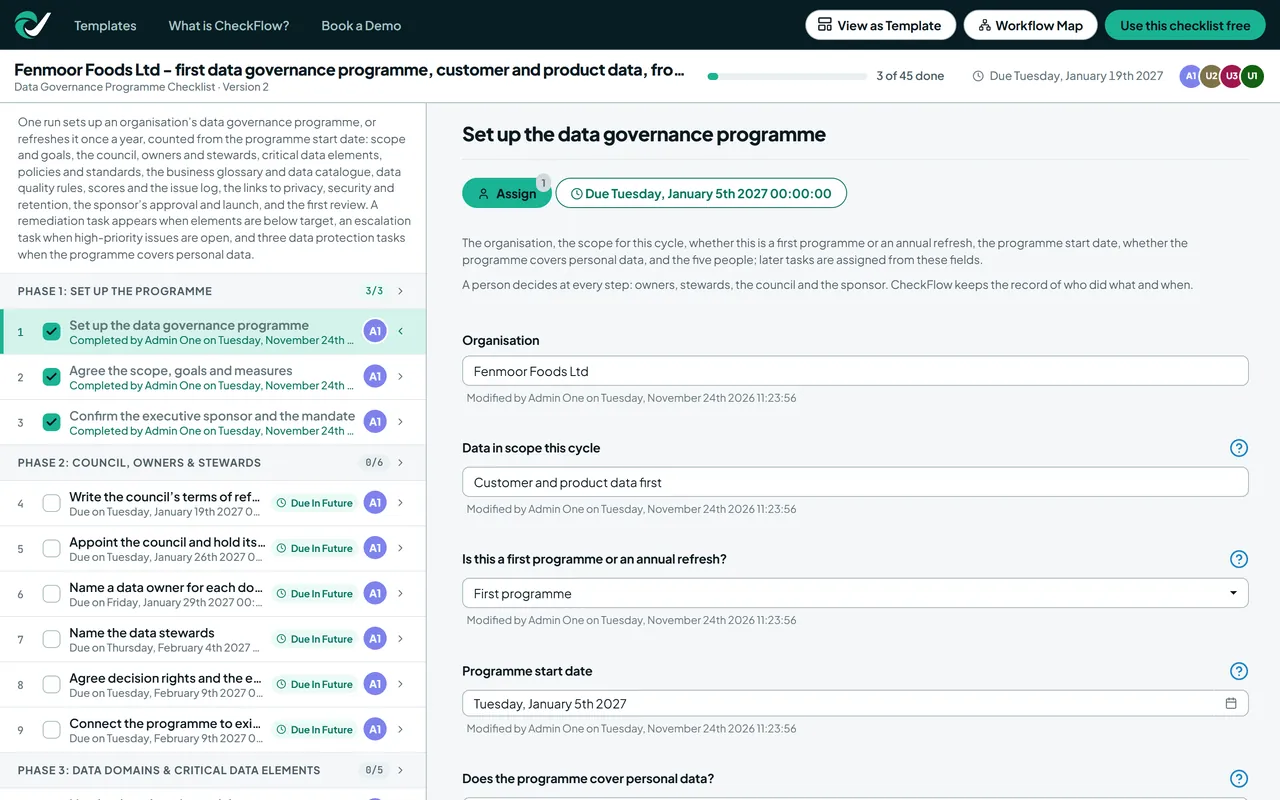
    Start on the programme start date: every due date counts from it in working days, and the run takes about six months. The first task names the five people and asks whether this is a first programme or an annual refresh, and whether the programme covers personal data; each answer adds the tasks it needs.

    • Set up the data governance programme — the organisation, the scope for this cycle, whether this is a first programme or an annual refresh, the programme start date, whether the programme covers personal data, and the five people; later tasks are assigned from these fields
    • Review last year’s programme and its results — the last cycle’s goals and measures, data quality scores against targets, issues still open, owners and stewards who have moved on, and what the sponsor asked for at the last review
    • Agree the scope, goals and measures — the business problems the programme is to solve, the domains in scope this cycle and what is out of scope, and three to five measures that will show progress, such as quality scores for critical data elements and open issues
    • Confirm the executive sponsor and the mandate — the sponsor’s agreement to sponsor the programme, the authority it has to set policies and name owners, the budget and people’s time for this cycle, and how the sponsor wants to be kept informed
  2. Phase 2

    Phase 2: Council, Owners & Stewards

    6 tasks

    The council, the owners and the stewards are named before any policy is written, so every later decision has someone accountable for it. The roles follow the functions the NSW toolkit describes; use the titles your organisation already uses.

    • Write the council’s terms of reference — purpose, members, chair, quorum, how often it meets, the decisions it takes and the ones it escalates to the sponsor, and how it reports
    • Appoint the council and hold its first meeting — members from each business area in scope plus IT, information security, data protection and records, the meeting calendar for the year, and the first meeting’s decisions recorded
    • Name a data owner for each domain — one senior person accountable for each domain in scope, who approves its definitions, quality targets and access rules, with their agreement recorded
    • Name the data stewards — the people who look after each domain’s data day to day (definitions, quality rules, issues and access requests) and the time their managers agree they can give
    • Agree decision rights and the escalation route — who decides what (owners, stewards, the council, the sponsor), the route for an issue that crosses domains or needs money, and how a dispute over a definition is settled
    • Connect the programme to existing roles — how the data protection lead, information security, records management, internal audit and IT system owners work with the council, so no job is done twice
  3. Phase 3

    Phase 3: Data Domains & Critical Data Elements

    5 tasks

    The domains and the critical data elements decide where the programme spends its effort. This template treats a critical data element as a data item whose errors would most affect customers, decisions, reporting or legal duties; the UK Government Data Quality Framework asks you to prioritise the data that is most critical.

    • List the data domains and the systems that hold them — each domain in scope, the systems where its data is created and kept, the systems that copy it, and its owner from Phase 2
    • Identify the critical data elements — the data items in each domain whose errors would most affect customers, decisions, reporting or legal duties; these get definitions, quality rules, targets and scores first
    • Record each element’s definition, owner and source — a plain business definition, the owner, the system of record, the format and allowed values, and who uses it, in a register the stewards keep
    • Trace where each element comes from and goes — the path from the system where it is created to the reports, interfaces and partners that use it, and the points where it is changed or copied, kept at a level the stewards can maintain
    • Agree the critical data element list with the council — the council confirms the list, each element’s owner and which elements are measured first; later changes to the list go through the council
  4. Phase 4

    Phase 4: Policies & Standards

    6 tasks

    One data governance policy says who decides what; short standards say how. Point to the policies you already have rather than repeating them.

    • Review the policies you already have — information security, data protection, records and retention, acceptable use and any data or information policy, noting gaps, overlaps and owners, so the new policy points to them rather than repeating them
    • Draft the data governance policy — purpose and scope, principles, the roles and their duties, decision rights, how policies and standards are approved and reviewed, and how compliance is checked
    • Write the data quality standard — the quality dimensions you measure, how rules are written and scored, how targets are set and approved, how often scores are reported, and what happens when an element falls below its target
    • Set the data access and sharing standard — who approves access to each domain, how requests are made and recorded, how data is shared inside and outside the organisation, and the handling rules for each classification level
    • Write the data issue and escalation procedure — how anyone reports a data issue, how stewards triage it and find its root cause, the priorities and target times your programme sets, and when an issue goes to the owner, the council or the sponsor
    • Set the rules for reference and master data — which system holds the master record for customers, products and other shared entities, who may create or change one, how duplicates are found and merged, and the code lists everyone uses
  5. Phase 5

    Phase 5: Business Glossary & Data Catalogue

    5 tasks

    The glossary says what the words mean; the catalogue says what data you hold, where and who owns it. Both start with the critical data elements and grow from there.

    • Set up the business glossary — where it lives, the template for a term (name, definition, owner, related terms, examples), who may propose and approve a term, and how changes are recorded
    • Agree definitions for the critical data element terms — each term behind a critical data element defined once and approved by its owner, with conflicting local definitions settled through the council
    • Record the data assets in the data catalogue — each system, data set and report in scope, its owner and steward, what it holds, its classification and where its documentation is, in a catalogue or register of data assets
    • Agree the minimum metadata for each asset — the fields every catalogue entry must have, who keeps them current, and how a new system or data set is added before it goes live
    • Make the glossary and catalogue available to staff — where staff find them, how they ask for a new term or report a wrong entry, and a short note to the teams that use the critical data elements most
  6. Phase 6

    Phase 6: Data Quality Rules, Scores & Issues

    8 tasks

    Each critical data element gets rules, a target and a baseline score. The number of elements below target decides whether a remediation task appears, and the number of high-priority issues decides whether an escalation task appears.

    • Write the data quality rules for each element — for each critical data element, the dimensions that matter, a rule you can test, how it is measured and how often
    • Set a target for each element — the score each element must reach, as a percentage, agreed by its owner, with the reason for any target below 100 per cent
    • Set up the data issue log — one log for the whole programme: the issue, the element and system, who reported it, priority, owner, root cause, the fix and its target date, and its status
    • Measure the baseline scores — each element’s score against its rules, recorded beside its target, and the number of elements below target
    • Log the issues the baseline found — every failure behind a score below target, and any issue staff already knew about, in the issue log with an owner and a priority
    • Plan the remediation for elements below target — for each element below its target: the cause, the fix, its owner and the date it is due, approved by the data owner
    • Escalate the high-priority issues to the council — each high-priority issue, its impact, its owner and the decision needed, on the council’s next agenda or sooner if the procedure says so
    • Report the baseline to the council — scores against targets, elements below target and their remediation, open issues, and what the council needs to decide
  7. Phase 7

    Phase 7: Privacy, Security & Retention Links

    5 tasks

    Data governance does not replace the privacy, security and records work you already do; it links to it. Three tasks here appear only when the programme covers personal data.

    • Check each element’s classification and handling — every critical data element and catalogue entry carries a level from your classification scheme, and the access standard’s handling rules match it
    • Cross-check the catalogue with the record of processing — each data asset that holds personal data appears in your Article 30 record of processing activities with the same owner, systems and retention, and gaps go to the data protection lead
    • Link each data asset to its retention rule — the retention period and disposal method for each asset from your retention schedule, and assets with no rule passed to records management
    • Build data protection checks into the change process — a step in the change and project process that asks whether a new system, or a new use of a critical data element, needs a data protection impact assessment, so the council hears of it early
    • Record how the programme shows accountability — the policies, roles, records and reports that help you demonstrate compliance with the data protection principles, filed where the data protection lead can produce them
  8. Phase 8

    Phase 8: Programme Approval & Launch

    7 tasks

    The data governance lead prepares the pack and the executive sponsor decides. Nothing after the decision can be completed until the sponsor completes it. Not approved shows a rework task above the decision, which stays open; Approved with conditions adds a task to meet them.

    • Prepare the programme pack for approval — the terms of reference, owners and stewards, the critical data element list, the policy and standards, the glossary and catalogue, the baseline scores and remediation, and the plan for the first year
    • Rework the pack after the sponsor’s decision — what the sponsor asked to change, the changes made and the date the revised pack went back; then the sponsor changes the decision on the next task and completes it
    • Approve the data governance programme — Approved, Approved with conditions or Not approved, with the reasons; complete this task with the decision
    • Meet the sponsor’s conditions — each condition met, with its evidence, and confirmed with the sponsor before the policy is published
    • Publish the policy, the roles and the council’s terms — the approved documents in your policy library, owners and stewards told in writing, and the roles added to job descriptions or objectives where your HR process allows
    • Train the owners and stewards — what each role does, the glossary, the catalogue, the quality rules and the issue log, with attendance recorded
    • Brief all staff on the programme — why it exists, how to find a definition, how to report a data issue and who to ask, through your usual channels and induction
  9. Phase 9

    Phase 9: Operate, Measure & Review

    4 tasks

    The first review after launch checks the scores, the issues and the goals agreed in Phase 1. The run ends by setting the annual refresh, which is a new run of this checklist.

    • Track the issue log and remediation actions — each open issue and remediation action against its due date, with any slipping action taken to its owner and the council
    • Hold the first council review after launch — scores against targets for each element, elements below target, issues opened and closed, and the measures agreed in Phase 1
    • Review progress against the programme’s goals — each goal and measure from Phase 1, what has changed for the business problems the programme set out to solve, and what to change next cycle
    • Set the annual review and close this run — the date the next annual refresh starts (a new run of this checklist with Annual refresh chosen), the council calendar, and this run’s records filed together

Roles, Quality Dimensions and Sources

This checklist follows two free sources and names the paid ones, so you can map it to whichever your organisation uses. The NSW toolkit describes roles by what they do rather than by title; the table shows where each sits here.

Function in the NSW toolkitAlso calledDuties the toolkit lists (in part)Where it sits in this checklist
Accountable ExecutiveData Sponsor or Data OwnerApproves policies, budgets and significant changes; makes sure data assets are documented in a data catalogue or registerThe executive sponsor, who approves the programme in Phase 8
Responsible ExecutiveData CustodianResponsible for a specified data asset by delegation; documents assets, identifies their security classification and sets the standards for themThe data owner for each domain, named in Phase 2
Operational Data ManagerSometimes Data StewardDay-to-day management of the data asset, metadata and business rules, and feedback on data quality issuesThe data stewards, named in Phase 2, who keep the register, rules and issue log
Data Creator and Data UserSupplier (Data Creator); none given for Data UserRecord data to agreed standards; report errors to the operational data manager or responsible executiveAll staff, briefed in Phase 8 on how to report a data issue

The six data quality dimensions

The UK Government Data Quality Framework uses six core dimensions, as defined by DAMA UK, and says the list is not prescriptive. The example rules are this template’s, for a food business’s product data.

DimensionWhat it describes (UK Government Data Quality Framework)Example rule for product data
CompletenessThe degree to which records are presentEvery live product has its allergen fields filled in
UniquenessThe degree to which there is no duplication in recordsOne product record per product code
ConsistencyThe degree to which values do not contradict other values for the same entityThe pack size matches in the product master and the ordering system
TimelinessThe degree to which data reflects the period it represents and is up to dateA recipe change reaches the product record before the new label is printed
ValidityThe degree to which data is in the range and format expectedBarcodes have the expected number of digits and a correct check digit
AccuracyThe degree to which data matches realityA sample of product records matches the specification sheets

Sources and where they show

SourceWhat it isStatus (read 24 November 2026)Where it shows here
NSW Government Data Governance ToolkitFree guidance from Data.NSW: a four-tier model (strategy and planning, structures and roles, organisational enablers, data management functions), functional roles and a checklist and templateVersion 1.3, 5 June 2024; not mandatory for NSW agenciesPhases 1, 2 and 5; the roles table above
UK Government Data Quality FrameworkFree guidance for central government with five principles, the data lifecycle and six data quality dimensionsPublished 3 December 2020; its authors say many of its approaches apply beyond central governmentThe data quality standard, rules, scores and training
UK GDPR and EU GDPR, Articles 5(2) and 24Accountability: the controller is responsible for, and able to demonstrate, compliance with the principles, with appropriate measures reviewed where necessaryIn force; Article 24(3) of the UK GDPR was amended by the Data (Use and Access) Act 2025 from 20 August 2025Phase 7, when the programme covers personal data
ICO data protection audit framework (the ICO is in law the Information Commission since 30 September 2026)The ICO’s nine toolkits for assessing compliance; it suggests starting with the Accountability toolkit (formerly the Accountability framework)The ICO says it is under review after the Data (Use and Access) Act 2025Phase 7, the accountability record
DAMA-DMBOK (DAMA International)The Data Management Body of KnowledgeSecond edition, a 2.0 revision launched in 2024 and a 3.0 project started in 2025; paid, so named here onlyNot drawn on here
DCAM (EDM Council)A data management capability assessment modelVersion 3 is current; paid, so named here onlyNot drawn on here
ISO 8000 series, data qualityInternational standards on data quality and master data; ISO 8000-1:2022 is the overviewPaid, so named here onlyNot drawn on here

Read on 24 November 2026: the NSW Data Governance Toolkit and its version 1.3 PDF; The Government Data Quality Framework on GOV.UK; Articles 5 and 24 of the UK GDPR on legislation.gov.uk, and the text of the EU GDPR as adopted; the ICO’s data protection audit framework; and the DAMA International, EDM Council and ISO pages. This checklist does not decide whether a law is met; your data protection and legal advisers do.

Why Run Your Data Governance Programme in CheckFlow?

1

No programme goes live before the sponsor decides

The approval is assigned to the executive sponsor alone, and the checklist halts there: publishing the policy, training and the first review cannot be completed until the sponsor completes it. Not approved shows a rework task, and Approved with conditions adds a task to meet them. See how approvals that halt a checklist work.

2

A score below target starts the fix

The baseline asks for the number of critical data elements below their target. Above zero adds a remediation plan for the data owner, with a cause, a fix, an owner and a due date for each element. High-priority issues in the log add a task to escalate them to the council.

3

Every task has a named person

Name the data governance lead, the sponsor, the first data owner, the lead steward and the data protection lead on the first task, and every task is assigned from those fields and dated from the start date. The Reports Grid lists every cycle with its answers, so next year’s refresh starts from this year’s scores.

CheckFlow runs the programme’s work: who does what and by when, the registers, the scores, the decision and the record. It does not profile data, run data quality rules or host a data catalogue; your systems and people do. Start each annual refresh on a recurring schedule so none is missed.

Review labels and handling with the Data Classification Review Checklist, keep the Record of Processing Activities (ROPA) Checklist current, run disposal with the Data Retention & Disposal Review Checklist and assess new processing with the Data Protection Impact Assessment (DPIA) Checklist.

AI generator

Didn’t find what you need? Describe it.

Describe the process in a sentence and the AI checklist generator drafts the phases and tasks for you.

Frequently Asked Questions

What is a data governance programme?

It is how an organisation decides who is accountable for its data and how that data is defined, kept and used: a sponsor and a council that take decisions, an owner for each data domain, stewards who look after the data day to day, policies and standards, a glossary and catalogue, and quality rules with targets. The NSW Government’s toolkit describes four tiers: strategy and planning, structures and roles, organisational enablers, and data management functions.

What should a data governance checklist include?

The scope and goals, an executive sponsor, a council with terms of reference, an owner for each domain and named stewards, the critical data elements, a policy and the standards under it, a business glossary and a data catalogue, data quality rules with targets and scores, an issue log with an escalation route, the links to privacy, security and retention, training, and a review date. This template covers each of them in nine phases.

What is the difference between a data owner and a data steward?

In this template the data owner is the senior person accountable for a domain, who approves its definitions, quality targets and access rules. The steward looks after the data day to day: definitions, rules, issues and access requests. The NSW toolkit names roles by function: its accountable executive, often called the data sponsor or data owner, is this template’s sponsor; the owner of one domain here is closer to its responsible executive, often called the data custodian; and its operational data manager is sometimes called the data steward.

What is a critical data element?

This template uses the term for the data items whose errors would most affect customers, decisions, reporting or legal duties, such as a delivery address or a product’s allergen information. They get definitions, owners, quality rules, targets and scores first, and more are added each cycle. The UK Government Data Quality Framework makes the same point in general terms: research your users’ needs and prioritise efforts on the data which is most critical.

How do you measure data quality?

Write rules for each critical data element and score the share of records that pass them, against a target its owner sets. The UK Government Data Quality Framework uses six dimensions, as defined by DAMA UK: completeness, uniqueness, consistency, timeliness, validity and accuracy, and says the list may vary with your data and users. Its worked example scores uniqueness as 500 unique records out of 501, which is 99.8%.

What does a data governance council do?

It takes the decisions no single owner can: the critical data element list, definitions two domains dispute, priorities for fixing issues, and the policies and standards before they go to the sponsor. The NSW toolkit suggests a cross-functional executive-level body with strategic oversight, plus working groups for specific issues such as data quality, and notes that some organisations give the role to a governance group that already exists.

How does data governance support UK GDPR accountability?

Article 5(2) of the UK GDPR and the EU GDPR makes the controller responsible for, and able to demonstrate compliance with, the data protection principles, which include accuracy. Article 24 asks for appropriate measures to ensure and demonstrate compliance. Named owners, quality rules, an issue log and records of decisions can form part of that evidence. They do not replace your record of processing, DPIAs or retention schedule, which this template links to.

Which data governance frameworks does this checklist use?

It follows two free sources: the NSW Government Data Governance Toolkit and the UK Government Data Quality Framework. It names three paid ones without reproducing them: DAMA International’s DAMA-DMBOK, the EDM Council’s DCAM and the ISO 8000 series of data quality standards. Its tasks use common terms such as owner, steward, glossary, catalogue and quality rule, so a team that follows another framework can record its own steps in the task fields.

How long does it take to set up a data governance programme?

This template plans about six months for one cycle: the council, owners and stewards in the first five weeks, then the critical data elements, policies, glossary and quality baseline by about week 18, the sponsor’s approval in about week 20 and the first review after launch in about week 25. That is this template’s timetable, not a rule. The due dates are fixed offsets from the start date, so move individual dates if your plan differs.

Is CheckFlow free for this template?

14-day free trial, no card required. The Business plan is $10 per user per month after the trial. Full details at checkflow.io/pricing.

Every Critical Data Element With an Owner and a Score

Free trial — no credit card required.

14-day free trial, no credit cardFull refund in your first 30 daysUS hosting, EU on request