Record of Processing Activities (ROPA) Checklist Template

A record of processing activities goes out of date the first time a team adds a tool, a supplier or a purpose without telling the person who keeps it. This checklist rebuilds the record from what each team does, then has it approved.

Last reviewed: October 2026

This free ROPA template takes one organisation’s record of processing activities under Article 30 of the UK GDPR or the EU GDPR from scope to an approved, published record. It is for DPOs, privacy leads and compliance teams, the first time a record is built and at each annual review. The record owner sets the scope and checks the under-250 exemption, then a questionnaire and interviews collect what each team does with personal data. The controller fields Article 30(1) lists come next, and the processor record when the organisation also processes data for clients. Special category data, transfers outside the UK or EEA, and links to the privacy notice, DPIAs and contracts follow. Each gap gets an owner and a fix. The DPO or privacy lead approves the record before it is published, and the next review is set. Choose UK GDPR, EU GDPR or both on the first task and the matching notes appear. Test the wider programme with the GDPR Compliance Audit Checklist.

Building the Record, Not Auditing the Programme

Article 30 of the UK GDPR and the EU GDPR requires each controller, and each processor, to keep a written record of its processing activities and to make it available to the regulator on request. The record is often called a ROPA. Privacy notices, DPIAs, retention schedules and processor contracts each describe part of what it records, so it is the map the rest of your privacy work can link to.

This checklist builds or reviews one organisation’s record. It does not audit the whole GDPR programme, assess one high-risk project, review one supplier’s contract or delete data past its retention period; other checklists do those, and this one links to their results. It is a working checklist, not legal advice.

This checklist

One organisation’s Article 30 record

Covers: scope and the exemption check, interviews with each team, the controller and processor fields, special category data, transfers, links, gaps and the DPO’s approval.

When: the first time, then each year and after a big change.

Output: an approved record, published to the people who keep it, with a next review date.
The yearly audit

The GDPR Compliance Audit Checklist

Covers: whether the whole programme works, from lawful basis and rights requests to processors, transfers, breaches and DPIAs. It checks that a record exists and matches what the organisation does.

Use it: once a year, after the record is up to date. GDPR Compliance Audit Checklist.

What the ROPA Checklist Covers

Eight phases take one organisation from scope to an approved record of processing activities. The type of run, the law that applies, the organisation’s roles and its headcount are set on the first task. Fewer than 250 employees, a first record or a review, processing for other organisations, special category data, transfers outside the UK or EEA and gaps found each add their own tasks. The DPO’s approval is the gate: publishing and the next review wait until it is done.

  1. Phase 1

    Phase 1: Scope, Roles & Exemption

    6 tasks

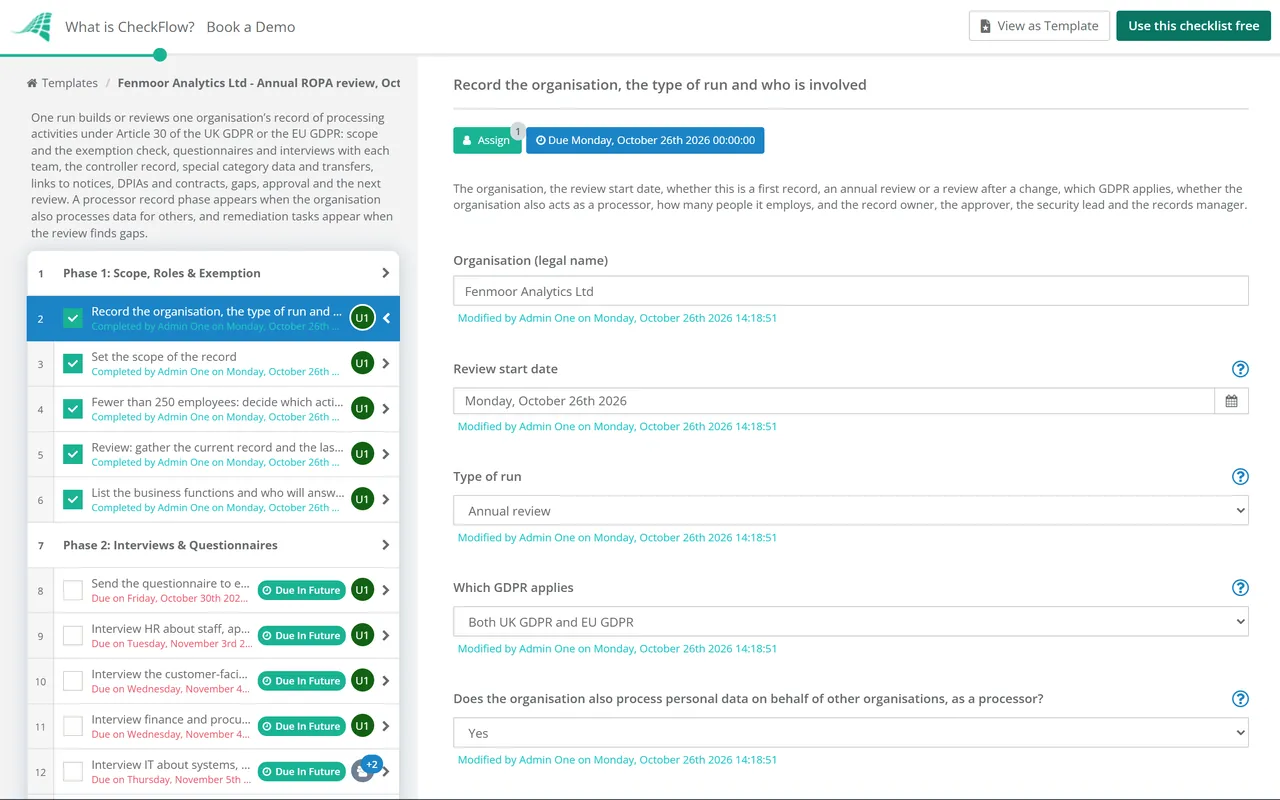
    The record owner starts the run on the day the review begins. Task 1 sets the type of run, the law that applies, the organisation’s roles and the people involved. Every due date counts in working days from the review start date.

    • Record the organisation, the type of run and who is involved — the organisation, the review start date, whether this is a first record, an annual review or a review after a change, which GDPR applies, whether the organisation also acts as a processor, how many people it employs, and the record owner, the approver, the security lead and the records manager
    • Set the scope of the record — the legal entities, business functions, sites and systems the record covers; Article 30(1) puts the duty on each controller, so name every legal entity that decides why and how personal data is used
    • Fewer than 250 employees: decide which activities must still be recorded — Article 30(5) says the duty does not apply to an organisation employing fewer than 250 persons unless the processing is likely to result in a risk to people’s rights and freedoms, is not occasional, or includes special category or criminal offence data; the ICO reads this as recording every activity that meets any one of the three
    • First record: choose the format and structure of the record — a spreadsheet, the ICO’s templates for controllers and processors, or a privacy tool, kept in writing (electronic form counts) and built broad to narrow: business function, then purpose, people, data, recipients and retention, with meaningful links between them
    • Review: gather the current record and the last review’s open actions — the approved record with its version and date, the changes teams have reported since, and any actions left open at the last review
    • List the business functions and who will answer for each — every team that uses personal data, such as HR, sales, marketing, customer service, finance, IT and legal, with one person who answers the questionnaire and comes to the interview
  2. Phase 2

    Phase 2: Interviews & Questionnaires

    8 tasks

    The ICO suggests a questionnaire to every area that handles personal data, meetings with key business functions and a review of policies, contracts and agreements. Record what each team says before writing anything into the record.

    • Send the questionnaire to each business function — the plain questions the ICO suggests: why do you use personal data, who do you hold information about, what do you hold about them, who do you share it with, how long do you keep it and how do you keep it safe; this template adds which systems hold it and whether any of it leaves the UK or EEA
    • Interview HR about staff, applicant and former staff data — recruitment, employment records, payroll, absence and health, pensions, training, monitoring and leavers, including health data and any equal opportunities data on ethnic origin, religion, sexual orientation or disability, which is special category data
    • Interview the customer-facing teams — sales, marketing and customer service: customer and prospect records, marketing lists and consents, call recordings, website and app data, and any profiling or segmentation
    • Interview finance and procurement — payments, invoicing, credit checks, supplier contacts, expenses, and any data passed to banks, auditors or tax authorities
    • Interview IT about systems, data locations and security — the systems and cloud services that hold each team’s data, where they are hosted and supported from, backups, access controls, encryption and logging; the security lead uses the answers to describe the measures in Phase 3
    • Interview legal and compliance about sharing, contracts and consents — data sharing agreements, processor contracts, joint controller arrangements, consent records, DPIAs and the breach log
    • Review policies, procedures, contracts and agreements — privacy notices, data protection, retention and security policies, system procedures, processor contracts and data sharing agreements, compared with what the teams said they actually do
    • Review: compare the answers with the current record — each activity in the current record marked unchanged, changed or stopped, and every new activity the teams described that the record lacks
  3. Phase 3

    Phase 3: The Controller Record

    8 tasks

    Article 30(1) lists what a controller’s record must contain. The ICO asks for a granular record with meaningful links: each purpose tied to its people, data, recipients and retention period, not separate lists.

    • Record the organisation’s details, joint controllers, representative and DPO — the name and contact details of the organisation and, where they apply, of any joint controller, the representative and the data protection officer (Article 30(1)(a))
    • List each processing activity and its purpose — every purpose for which the organisation uses personal data, grouped by business function, such as staff administration, customer orders or marketing (Article 30(1)(b))
    • Describe the people and the personal data for each activity — the categories of data subjects, such as employees, customers or suppliers, and the categories of personal data held about each, linked to the purpose they serve (Article 30(1)(c))
    • Record the recipients for each activity — the categories of recipients the data has been or will be disclosed to, such as processors, other controllers and public authorities, including recipients in other countries (Article 30(1)(d))
    • Record the retention period for each category of data — where possible, the envisaged time limits for erasure of each category of data, taken from the retention schedule (Article 30(1)(f)); check any period a team gave against the schedule
    • Describe the security measures — where possible, a general description of the technical and organisational measures under Article 32(1), such as encryption, access controls, backups and staff training (Article 30(1)(g))
    • Add the lawful basis and the other privacy notice details — not required by Article 30, but the ICO suggests keeping them with the record: the lawful basis, any legitimate interests, the rights that apply, any automated decision-making including profiling, and the source of the data
    • Record where each activity’s data is held — the systems, paper files and processors that hold it, which the ICO suggests recording so the data can be found quickly, for example when someone asks for a copy of their data
  4. Phase 4

    Phase 4: The Processor Record

    5 tasks

    Applies only when task 1 says the organisation also processes personal data on behalf of other organisations. Article 30(2) asks for a separate, shorter record of that processing.

    • Processor: list each controller and its contact details — the name and contact details of each controller the organisation acts for, any controller’s or processor’s representative, and the data protection officer (Article 30(2)(a))
    • Processor: record the categories of processing for each controller — what the organisation does with the data for each controller, such as hosting, payroll processing, analytics or sending email (Article 30(2)(b))
    • Processor: record transfers made for each controller — where applicable, each third country or international organisation the data goes to for that controller, and the documented safeguards for any transfer under the second subparagraph of Article 49(1) (Article 30(2)(c))
    • Processor: describe the security measures for this processing — where possible, a general description of the Article 32(1) measures that protect each controller’s data (Article 30(2)(d))
    • Processor: link each controller’s contract — the contract or other legal act with each controller that Article 28(3) requires, linked from the record so the controller’s instructions can be checked against the processing recorded
  5. Phase 5

    Phase 5: Special Category Data & Transfers

    8 tasks

    Two checks across every activity. Special category or criminal offence data adds the conditions to record, and data leaving the UK or EEA adds the transfer details. Each answer shows its own tasks.

    • Check each activity for special category and criminal offence data — data revealing racial or ethnic origin, political opinions, religious or philosophical beliefs or trade union membership, genetic data, biometric data used to identify someone, health data, and data about sex life or sexual orientation (Article 9(1)), and data about criminal convictions and offences (Article 10)
    • Special category: record the conditions relied on for each activity — for each activity, the Article 9(2) condition for special category data, or how processing of criminal offence data is authorised under Article 10, alongside the Article 6 lawful basis
    • Special category (UK): add the details Schedule 1 of the DPA 2018 requires — where the organisation relies on a Schedule 1 condition that needs an appropriate policy document, the record must say which condition is relied on, how the processing satisfies Article 6, and whether the data is retained and erased in line with the policy document, with the reasons if it is not (Schedule 1 paragraph 41)
    • Special category (UK): check the appropriate policy document — it explains the procedures for complying with the Article 5 principles and the retention and erasure policies for this data (paragraph 39), is reviewed and updated from time to time, and is kept until 6 months after the processing stops (paragraph 40)
    • Find out which activities send data outside the UK or EEA — any activity whose data is sent to, or can be reached from, a country outside the UK under the UK GDPR or outside the EEA under the EU GDPR, including hosting, support access and processors abroad
    • Transfers: name each country or international organisation — for each activity, the third country or international organisation the data goes to and the recipient there, as Article 30(1)(e) asks
    • Transfers: record the transfer mechanism for each destination — adequacy, or the safeguard used, such as standard clauses or binding corporate rules, with the transfer risk assessment where one is needed; the ICO suggests documenting the transfer mechanism safeguards in the record
    • Transfers: document any exceptional transfers — a transfer under the second subparagraph of Article 49(1), which is not repetitive, concerns a limited number of people and serves compelling legitimate interests, needs its assessment and suitable safeguards documented in the record (Article 49(6)), and the regulator must be informed of it
  6. Phase 6

    Phase 6: Links to Notices, DPIAs & Contracts

    5 tasks

    The ICO suggests documenting, or linking to, the records that show compliance elsewhere. With the links in place, a change to one activity is easier to trace to its notice, DPIA and contracts.

    • Compare the record with the privacy notice — every purpose, recipient, retention period and transfer in the record is described in the privacy notices given under Articles 13 and 14, and the notices describe nothing the record lacks
    • Link each high-risk activity to its DPIA — the DPIA report for each activity likely to result in a high risk to people (Article 35), or a flag that one is needed; the ICO suggests using the record to flag DPIAs and track their progress
    • Link processor contracts and data sharing agreements — each processor in the record linked to its Article 28 contract, and each disclosure to another controller linked to its data sharing agreement
    • Link the consent records where consent is the lawful basis — for each activity that relies on consent, a link to where each consent is recorded and how it was given, rather than copying consents into the record
    • Mark personal data breaches against the activities they affected — each breach in the breach log marked against the activity it affected and linked to its documentation, which the ICO suggests so patterns and areas of concern show up
  7. Phase 7

    Phase 7: Gaps & Fixes

    4 tasks

    List every gap the review found. When there are gaps, the record’s own gaps are fixed before approval, and the fixes that sit elsewhere get an owner and a date.

    • Decide whether the record has gaps — activities missing from the record, fields left blank, retention periods or transfers not known, links missing, and entries that no longer match what the teams do
    • Gaps: give each gap an owner, a fix and a date — every gap in one list, with what will fix it, who owns the fix and when it is due
    • Gaps: fix the gaps in the record itself — missing activities, purposes, recipients, retention periods, transfers or security descriptions added and checked with the team concerned before the record goes for approval
    • Gaps: raise the fixes that sit outside the record — a missing DPIA, processor contract, privacy notice update, retention period or transfer safeguard, each raised with its owner and tracked after approval
  8. Phase 8

    Phase 8: Approval, Publication & Next Review

    7 tasks

    The DPO or privacy lead approves the record before it is published to the people who keep it. The approval is the gate: publishing, briefing the teams and setting the next review wait until it is done.

    • Prepare the record and a summary for approval — the updated record, what changed since the last version, the gaps found and fixed, any still open, and anything the approver must decide
    • DPO or privacy lead approves the record — the record and the summary read, open gaps accepted or sent back, and the decision recorded; if the record is not ready, record what must change and leave this task open, because nothing after it can be completed until it is done
    • Publish the approved record to the people who keep it — the approved version saved in its agreed place with its version number and date, changed only by the record owner, and shared with the teams who report changes
    • Tell each team which changes they must report — a new system, supplier, purpose, kind of data, transfer or retention period reported to the record owner before it starts, so the record stays current between reviews
    • Gaps: track the remaining fixes to closure — each fix outside the record followed up by its due date, and the record updated as each one closes
    • Keep the record ready to show the regulator — Article 30(4) says the record is made available to the regulator on request, so know where it is, who can produce it and in what form
    • Set the next review date — a full review a year after this one, which is this template’s choice, and an update sooner after a change such as a new system, an acquisition or a new purpose; the ICO asks for regular reviews so the record reflects current processing

What Article 30 Asks For, and Where the UK and EU Differ

What a record must hold

Article 30 reads the same in the UK GDPR and the EU GDPR, apart from who can ask to see the record. A controller’s record asks for more than a processor’s.

What the record holdsController record (Article 30(1))Processor record (Article 30(2))
WhoName and contact details of the controller and, where they apply, any joint controller, the representative and the data protection officerName and contact details of the processor, each controller it acts for, any controller’s or processor’s representative, and the data protection officer
What forThe purposes of the processingThe categories of processing carried out for each controller
People and dataThe categories of data subjects and of personal dataNot required
RecipientsThe categories of recipients, including recipients in other countriesNot required
TransfersWhere applicable, each third country or international organisation, and the safeguards for exceptional transfers under Article 49(1)The same
RetentionWhere possible, the time limits for erasure of each category of dataNot required
SecurityWhere possible, a general description of the Article 32(1) measuresThe same
FormIn writing, including electronic form, and made available to the regulator on requestThe same

UK GDPR and EU GDPR: where the record differs

The notes on the representative, special category, transfer and regulator tasks follow the law you choose on the first task.

PointUK GDPREU GDPR
Who can ask for the recordThe Information Commission, which replaced the Information Commissioner on 30 September 2026 (Article 30(4))The supervisory authority (Article 30(4))
Small organisationsFewer than 250 employees are exempt unless the processing is likely to result in a risk, is not occasional, or includes special category or criminal offence data (Article 30(5))The same wording today; the Omnibus IV proposal would widen it (below)
Representative named in the recordA UK representative, for an organisation outside the UK caught by Article 3(2), unless Article 27(2) appliesAn EU representative, for an organisation outside the EU caught by Article 3(2), unless Article 27(2) applies
Special category dataWhere a Schedule 1 condition of the Data Protection Act 2018 needs an appropriate policy document, the record adds the condition, how Article 6 is met and whether the retention and erasure policy is followed (paragraph 41)No such addition in the GDPR itself; member states may add conditions for genetic, biometric and health data (Article 9(4)), so check the law where you rely on one
Transfer mechanismsUK adequacy regulations (regulations under Article 45A), or safeguards such as the IDTA, the Addendum or UK binding corporate rulesCommission adequacy decisions, or Article 46 safeguards such as standard data protection clauses or binding corporate rules
Exceptional transfersAssessment and safeguards documented in the record; the Information Commission informed (Article 49)Assessment and safeguards documented in the record; the supervisory authority informed (Article 49)

What changed recently. The Data (Use and Access) Act 2025 left the content of Article 30 as it was. Its one change to the article, in force from 30 September 2026, is that the record is made available to the Information Commission, which replaced the Information Commissioner. The ICO says its documentation guidance is under review because of the Act. In the EU, the Omnibus IV proposal of 21 May 2025 (procedure 2025/0130(COD)) would exempt organisations with fewer than 750 employees, the Commission’s figure, unless the processing is likely to result in a high risk; the European Parliament’s committee report proposed 1,000. The text agreed in negotiations (document A 004146 of 29 June 2026), approved in the Parliament’s committee on 2 July 2026, would set the threshold at 1,000 employees and keep the duty only for a specific activity that is likely to result in a high risk, or that is a core activity requiring a data protection officer. It is still a proposal, not law: the procedure file says it awaits the Parliament’s first-reading position, with an indicative plenary date of 23 November 2026. Until a change is adopted and in force, the 250-employee rule applies.

Sources. UK GDPR Article 30, Article 27 and Article 49 on legislation.gov.uk (latest revised version), and the EU GDPR Article 30 as adopted. The Data Protection Act 2018 Schedule 1 paragraphs 39, 40 and 41. The ICO’s guidance on documentation and its brief guide to international transfers. The European Parliament’s procedure file for Omnibus IV and the text agreed in negotiations. ICO guidance is guidance, not law.

Why Run Your ROPA Review in CheckFlow?

1

Each team asked, each part owned

Choose the record owner, the approver, the security lead and the records manager on the first task, and each task is assigned to the person who should do it. Every due date counts in working days from the review start date, and overdue alerts go to the people assigned.

2

Only the tasks this organisation needs

Fewer than 250 employees, a first record or a review, processing for other organisations, special category data, transfers outside the UK or EEA and gaps found each add the tasks that deal with them. The law chosen on the first task shows the UK or EU notes.

3

Approved before it is published

The DPO’s approval is a gate: publishing the record, briefing the teams and setting the next review cannot be ticked off until it is done. Interview notes, the record and the policy document are uploaded to the tasks they belong to, and the Reports Grid lists each review with its answers, with filters and export. See how approval steps work.

This template runs the review, not the record itself: keep the record in your spreadsheet, the ICO’s template or your privacy tool, and attach each approved version to the run. CheckFlow tracks who answered for each team, which part of the record is complete, what gaps were found and who approved which version. Analytics shows open and overdue reviews, and recurring checklists start next year’s review on time.

Test the whole programme each year with the GDPR Compliance Audit Checklist. When the review flags a gap, run the Data Protection Impact Assessment (DPIA) Checklist for a high-risk activity, the Data Processing Agreement (DPA) Review Checklist for a supplier without a proper contract, or the Data Retention & Disposal Review Checklist for data kept too long. The record also helps you find a person’s data when you answer an access request with the DSAR Response Checklist.

AI generator

Didn’t find what you need? Describe it.

Describe the process in a sentence and the AI checklist generator drafts the phases and tasks for you.

Frequently Asked Questions

What is a record of processing activities (ROPA)?

It is the written record Article 30 of the UK GDPR and the EU GDPR asks each controller and processor to keep of the processing under its responsibility. It can be electronic. A controller’s record covers who it is, why it uses personal data, whose data and what kind, who receives it, transfers abroad, retention periods and security measures. The regulator can ask to see it. ROPA is a common short name, not a legal term.

What must a controller’s record include?

Article 30(1) lists seven things: the name and contact details of the controller and, where they apply, any joint controller, the representative and the data protection officer; the purposes; the categories of data subjects and of personal data; the categories of recipients; transfers to other countries, with safeguards for exceptional transfers; where possible, retention periods; and, where possible, a general description of the security measures.

What must a processor’s record include?

Article 30(2) asks a processor to record the name and contact details of the processor and of each controller it acts for, any representative and the data protection officer, the categories of processing carried out for each controller, any transfers to other countries with the safeguards for exceptional transfers, and, where possible, a general description of the security measures. This checklist adds that record as Phase 4 when an organisation is both.

Do organisations with fewer than 250 employees need a ROPA?

For some processing. The ICO calls the exemption limited: Article 30(5) exempts them unless the processing is likely to result in a risk to people’s rights and freedoms, is not occasional, or includes special category or criminal offence data. The ICO reads that as recording each activity that meets any one of the three, such as regular payroll or HR processing, and calls recording everything good practice. An EU proposal would widen the exemption, but it is not law yet.

Is there an official ROPA template?

The ICO publishes two basic documentation templates, one for controllers and one for processors, and says using them is not mandatory. The record can be a spreadsheet or a privacy tool, as long as it is in writing and granular: each purpose linked to its people, data, recipients and retention. This checklist runs the work of building or reviewing the record and keeps the evidence of who did what.

How often should a ROPA be reviewed?

Article 30 sets no interval. The ICO says the record must reflect current processing, so treat it as a living document and review it regularly. This template’s choice is a full review once a year, with teams reporting new systems, suppliers, purposes and transfers as they happen. Run it again after a big change, such as an acquisition or a new product that uses personal data.

What extra does the record need for special category data in the UK?

Where you rely on a condition in Schedule 1 of the Data Protection Act 2018 that needs an appropriate policy document, paragraph 41 says the record must also show which condition you rely on, how the processing satisfies Article 6, and whether you retain and erase the data in line with the policy document, with the reasons if not. The policy document is kept until 6 months after that processing stops.

Did the Data (Use and Access) Act 2025 change Article 30?

Not what the record contains. Since 30 September 2026 the record is made available on request to the Information Commission, which replaced the Information Commissioner. The ICO says its documentation guidance is under review because of the Act, so check it for updates. In the EU, the Omnibus IV proposal to widen the small-organisation exemption had not been adopted when this page was reviewed in October 2026.

Who should approve the ROPA?

The law does not say who approves it inside an organisation. This checklist makes the DPO or privacy lead the gate, because they can judge whether the record is complete and accurate, and leaves the record owner to keep it up to date. The security lead describes the security measures and the records manager the retention periods, so each part has an owner.

Is CheckFlow free for this template?

14-day free trial, no card required. The Business plan is $10 per user per month after the trial. Full details at checkflow.io/pricing.

Keep Your Record of Processing Activities True

Free trial — no credit card required.

14-day free trial, no credit cardFull refund in your first 30 daysUS hosting, EU on request