AI Impact Assessment Checklist Template

The model passed its accuracy tests, but nobody wrote down who it affects, who can overrule it, or when it should be looked at again.

Last reviewed: November 2026

Printed from checkflow.io/templates/compliance/ai-impact-assessment-checklist

This free AI impact assessment checklist is for AI system owners, product and service owners, risk, compliance and data protection teams who must judge an AI system’s effect on people before it is used. One run is one system in one use, planned back from the deployment date, before first use or after a significant change. It records the purpose, the intended use and the process the system sits in, identifies the people affected and hears from them, records the data, the model and its limits, and tests it. It assesses fairness, safety, privacy, rights, transparency and wider effects in one impact register, then designs human oversight, the responses to each impact, the notices, a pause plan and monitoring. An independent reviewer checks it and a named approver decides whether to deploy. A DPIA runs alongside when the system processes personal data, and a phase for the EU AI Act’s fundamental rights impact assessment appears for the deployers Article 27 names. It is framework-neutral, and following it does not by itself meet any law or standard.

An AI Impact Assessment That Ends in a Decision

An AI impact assessment looks at how one AI system, in one use, could affect the people it touches: the people its output is about, the staff who use it, groups who could be treated differently, and society more widely. It is done before the system is first used and again when it changes, and it ends in a decision by a named person on whether to deploy, with the measures and monitoring that decision depends on. ISO/IEC 42005:2025, the international standard for AI system impact assessment, gives guidance on how organisations assess the effects of AI systems on individuals, groups and society; it is a paid standard and this checklist does not reproduce it.

This checklist runs one assessment. Running an AI management system is the ISO 42001 AI Management System Checklist; a programme for the EU AI Act as a whole is the EU AI Act Compliance Checklist; buying and configuring an AI tool for staff is the AI Tool Rollout & Governance Checklist; and the personal data side of a project is the Data Protection Impact Assessment (DPIA) Checklist, which this one calls on when the system processes personal data. To audit AI already in use, the AI audit checklist generator builds a checklist for it.

This checklist

One system, one use, one decision

Covers: the purpose and intended use, the people affected and their views, data, model and testing, the impacts, human oversight, mitigations, monitoring, an independent review, the deployment decision and the first review in use.

Planned around: the planned deployment date, from about ten working weeks before it to about five weeks after.

Output: a signed-off assessment with an impact register, measures with owners, review triggers and a recorded decision.
The management system

ISO/IEC 42001 across the organisation

Covers: the AI policy, roles, risk criteria, the Statement of Applicability, internal audit and management review, in the ISO 42001 AI Management System Checklist. Its impact assessment card asks for one assessment per system; each one can run here.

Planned around: the management system’s year and its certification audits.

Output: a working AI management system.

The law

The EU AI Act programme

Covers: the AI inventory, roles, risk classification, AI literacy, transparency and the provider, deployer and general-purpose AI duties, in the EU AI Act Compliance Checklist. Its Phase 5 decides whether a fundamental rights impact assessment is needed; when it is, Phase 7 here carries it out for the system.

Planned around: the Act’s application dates.

Output: a classified inventory and a compliance plan.

What the AI Impact Assessment Checklist Covers

Nine phases take one AI system from setting up the assessment, about ten working weeks before the planned deployment date, to the first review about a month after it. The first task asks whether this is a first assessment and whether the system processes personal data: a reassessment adds a review of the last one, and personal data adds the DPIA screening, the DPIA and its outcome. A task in Phase 1 asks whether Article 27 of the EU AI Act applies, which shows Phase 7, or adds a task to get advice. The approver’s decision is the gate: nothing after it can be completed until the approver completes it, Approved with conditions adds a task to meet them, and Not approved shows a rework task and hides Phase 9.

  1. Phase 1

    Phase 1: Set Up the Assessment

    6 tasks

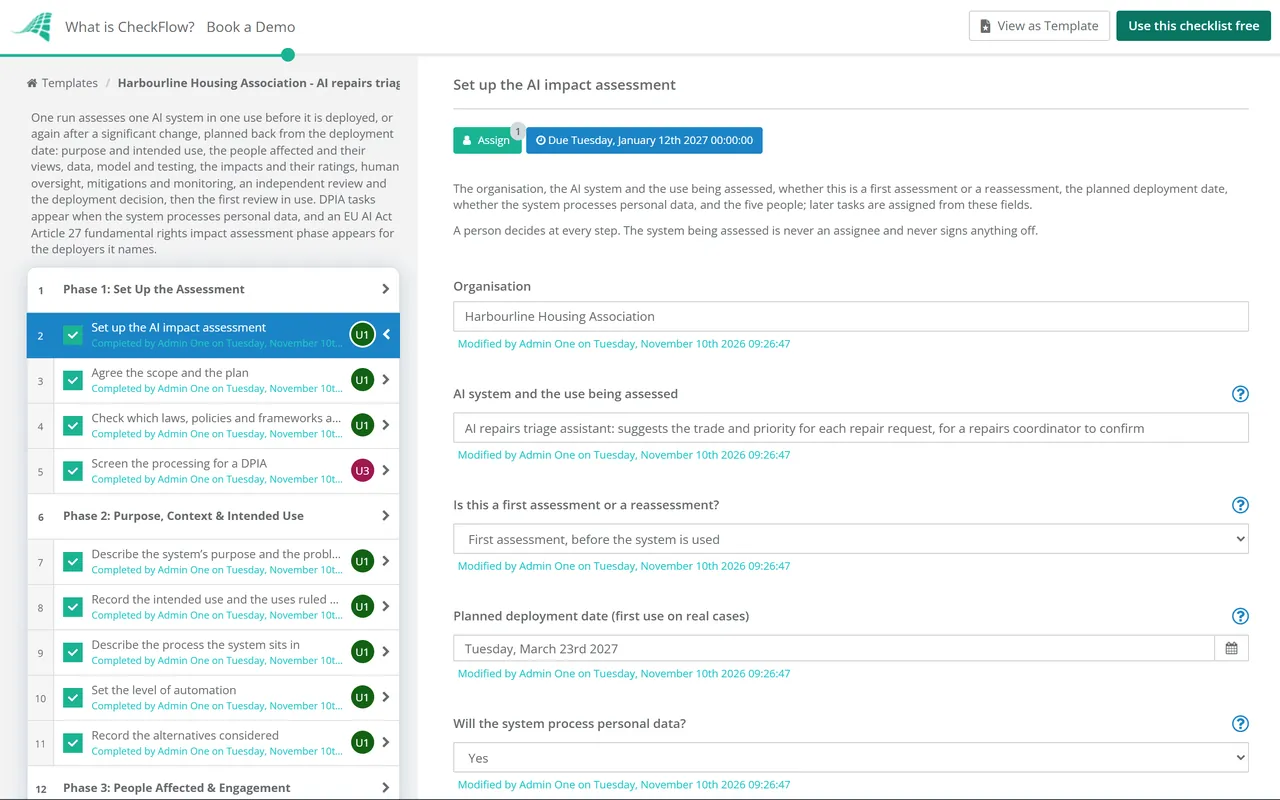
    Start about ten working weeks before the planned deployment date, the day the system is first used on real cases: every due date counts from it in working days. The first task names the five people and asks whether this is a first assessment, and whether the system processes personal data; each answer adds the tasks it needs. A later task asks whether Article 27 of the EU AI Act applies.

    • Set up the AI impact assessment — the organisation, the AI system and the use being assessed, whether this is a first assessment or a reassessment, the planned deployment date, whether the system processes personal data, and the five people; later tasks are assigned from these fields
    • Review the last assessment and what has changed — the last assessment and its decision, conditions still open, incidents, complaints and monitoring results since, and what has changed in the model, the data, the use or the people affected
    • Agree the scope and the plan — what is in and out of scope, the timetable back from the deployment date, who will be consulted, and where the evidence for each task is kept
    • Check which laws, policies and frameworks apply — your AI policy and risk appetite, data protection law, whether the EU AI Act applies to this use and whether its Article 27 asks for a fundamental rights impact assessment (FRIA), sector rules, and any framework you follow, such as ISO/IEC 42001 or the NIST AI RMF
    • Screen the processing for a DPIA — whether the processing is likely to result in a high risk to people’s rights and freedoms, using the regulator’s list of processing that needs a DPIA; if you decide a DPIA is not needed, record how you decided
    • Get advice on whether Article 27 applies — ask your legal or compliance adviser whether the system is high-risk under Annex III, whether your organisation is a deployer that Article 27 names, and from when it would apply. Record the advice and who gave it here, complete this task, then add the advice to the laws and frameworks answer on the task above and change the Article 27 answer there: changing that answer hides this task
  2. Phase 2

    Phase 2: Purpose, Context & Intended Use

    5 tasks

    The AI system owner writes down what the system is for and how it will be used, before anyone judges its effects. The NIST AI Risk Management Framework starts in the same place: its MAP 1.1 asks for intended purposes, uses and settings to be understood and documented.

    • Describe the system’s purpose and the problem it solves — what the system does, the task or decision it supports, why AI is being used for it, and the benefits expected, for whom
    • Record the intended use and the uses ruled out — the intended users, where and when it will be used, the uses it must not be put to, and the misuse you can foresee
    • Describe the process the system sits in — the steps before and after it, who acts on its output, how often it will be used and for how long, and what the process looked like without it
    • Set the level of automation — whether the system suggests, drafts, ranks or decides; whether a person checks every output before it takes effect; and which outcomes could have a significant effect on someone
    • Record the alternatives considered — the process without AI, a simpler model or rules, a narrower use, and why this option was chosen
  3. Phase 3

    Phase 3: People Affected & Engagement

    4 tasks

    Identify everyone the system could affect, including people who never use it, and hear from them or their representatives before the impacts are judged. The route for complaints and challenges is set up here so it exists before the first case.

    • Identify the people and groups affected — the users, the people the output is about, groups who could be affected differently (for example by age, disability, language or where they live), and staff whose work changes
    • Plan how the people affected will be heard — who will be asked (users, staff, the people the output is about or their representatives), how, in what accessible formats, and by when
    • Hold the engagement and record what was said — what people said, the concerns raised, what will change because of them, and what will not, with the reason
    • Set up the route to question or challenge an outcome — how someone affected can ask how an outcome was reached, ask a person to look again, or complain, and who answers and how fast
  4. Phase 4

    Phase 4: Data, Model & Testing

    6 tasks

    The technical lead records where the data and the model come from and what the system cannot do, then tests it for the people identified in Phase 3. Where the system processes personal data, the DPIA runs alongside.

    • Record the data sources and where they came from — the data used to train, fine-tune or ground the system and the data it will see in use: the source, the owner, the licence or legal basis, its quality, and how well it represents the people affected
    • Record the model and its supplier — the model and version, the supplier, the supplier’s documentation and instructions for use, what the supplier tested, and what the contract says about your data and changes to the model
    • Document what the system cannot do — known limits, conditions where it performs poorly, languages or inputs it does not handle, and how its output should be read and checked by people
    • Agree the tests before use — accuracy overall and for each group in Phase 3, bias, how it handles unusual inputs, security and misuse tests, and the result each test must reach before deployment
    • Run the DPIA alongside this assessment — the DPIA for the personal data the system processes, run with your DPIA process; record its reference and the risks it found that this assessment should carry
    • Run the tests and record the results — each test, the result for each group, whether it met the agreed result, and what will be done about any that did not
  5. Phase 5

    Phase 5: Assess the Impacts

    7 tasks

    Judge the system’s effects on individuals, groups and society, harmful and beneficial, from the evidence in Phases 2 to 4. Each impact goes into one register with its likelihood, severity and owner, which Phase 6 works from.

    • Assess fairness and discrimination — whether outcomes differ between groups, whether any input stands in for a protected characteristic, and the equality duties that apply to your organisation
    • Assess safety and what happens when it is wrong — the errors the system can make, what each would mean for the person affected, the worst credible case, and how quickly an error would be noticed
    • Assess privacy — what the system learns or infers about people, whether it uses more data than it needs, and how long inputs and outputs are kept
    • Assess the effect on people’s rights and access to services — whether the system could affect someone’s access to a service, money, work or housing, their ability to understand and challenge an outcome, or other rights
    • Assess transparency and explanation — whether people know AI is used, whether staff can explain an outcome in plain words, and what records show how an outcome was reached
    • Assess wider effects on staff, society and the environment — changes to jobs and skills, dependence on one supplier, the energy and computing the system uses, and effects on groups beyond the people it serves
    • Rate each impact in the impact register — every impact found in this phase, harmful or beneficial, with the group affected, its likelihood and severity, a rating and an owner
  6. Phase 6

    Phase 6: Oversight, Mitigations & Monitoring

    7 tasks

    Decide how people will oversee the system, what reduces each significant impact, what people are told, how the system is paused, and what is watched once it is live. What is left after all of that is the residual impact the approver accepts or not.

    • Design the human oversight — who checks the system’s output and when, how they overrule it, the training they need, and how you guard against people accepting its output without checking
    • Agree a response for each significant impact — for each impact rated medium or high: avoid, reduce, transfer or accept it, the measure, its owner and its date
    • Write what people will be told — the notice to the people affected that AI is used and how to question an outcome, and the guidance for staff who use the system
    • Plan how to pause or switch off the system — who can pause it, what would make them do so, how work carries on without it, and how the people affected are told
    • Set the monitoring measures and review triggers — what is measured in use (accuracy, results by group, overrides, complaints, incidents), how often, who looks, and the events that trigger a reassessment
    • Bring the DPIA outcome into the decision — the DPIA signed off, its measures included in Phase 6, and, if it shows a residual high risk you cannot sufficiently reduce, prior consultation with the data protection regulator before the processing starts
    • Record the residual impacts — what remains after the measures, who carries it, and why it is acceptable or not, for the approver to decide on
  7. Phase 7

    Phase 7: EU AI Act Fundamental Rights Impact Assessment

    4 tasks

    Applies only when the answer on Check which laws, policies and frameworks apply is Yes. Article 27 of the EU AI Act asks the deployers it names to assess the impact on fundamental rights before first using a high-risk AI system, and to notify the market surveillance authority of the results.

    • Complete the six FRIA elements in Article 27(1) — the deployer’s processes, the period and frequency of use, the people and groups likely to be affected, the specific risks of harm (using the provider’s information under Article 13), the human oversight measures, and the measures if risks materialise, including internal governance and complaints
    • Cross-refer the DPIA where it already covers an element — where a DPIA already meets one of the FRIA obligations, include cross-references to the relevant sections of the DPIA or the relevant parts of it, rather than writing them twice
    • Fill in the AI Office’s FRIA questionnaire template — check whether the AI Office has published the questionnaire template Article 27(5) asks it to develop, and if so fill it in from the FRIA
    • Notify the market surveillance authority of the results — send the results to the market surveillance authority, with the filled-out template, and record the date; Article 46(1) cases may be exempt
  8. Phase 8

    Phase 8: Review & Deployment Decision

    4 tasks

    Someone who did not build or buy the system reviews the assessment, and the approver decides. The decision halts the checklist: nothing after it can be completed until the approver completes it. Approved with conditions adds a task to meet them before first use; Not approved shows a rework task and hides Phase 9.

    • Review the assessment independently — whether every impact is evidenced, the ratings are reasonable, the measures match the impacts and nothing in Phases 1 to 7 is missing; write each point for the owner to answer
    • Answer the reviewer’s points — each point answered or the assessment changed, confirmed with the reviewer
    • Rework the assessment or stop the project — what the approver asked for, the changes made or the decision to stop, and a new deployment date if the system goes ahead
    • Decide whether to deploy the system — Approved, Approved with conditions or Not approved, with the reasons and the residual impacts accepted; complete this task with the decision
  9. Phase 9

    Phase 9: Deployment, Monitoring & Review

    5 tasks

    After an approval, the owner meets any conditions, tells people, files the assessment and checks the first weeks of use. The first review about a month after deployment compares what happened with what was assessed and sets the next review.

    • Meet the approver’s conditions before first use — each condition met, with its evidence, confirmed with the approver
    • Brief staff, publish the notices and file the assessment — staff trained on the oversight and the pause plan, the notice live where the people affected will see it, and the assessment filed in your AI register or inventory
    • Check the first two weeks of use — the monitoring measures against the assessment, overrides, complaints and incidents, and anything that needs action now
    • Hold the first review after deployment — results by group, overrides, complaints, incidents and the impact register compared with what was assessed; update the register and act on anything new
    • Set the next review and close this run — the date of the next periodic review, the owner of the monitoring, and the assessment and its evidence filed together

Where the Frameworks and Article 27 Fit

Several sources describe impact assessment for AI. This checklist follows the free ones and names the paid ones, so you can map it to whichever your organisation uses.

SourceWhat it isStatus (read 10 November 2026)Where it shows in this checklist
ISO/IEC 42005:2025, AI system impact assessmentInternational guidance for organisations assessing how AI systems and their foreseeable applications may affect individuals, groups or societyPublished May 2025, first edition; paid, so named here onlyThe whole checklist is one assessment of one system
ISO/IEC 42001:2023, AI management systemsRequirements for establishing, implementing, maintaining and continually improving an AI management systemPublished December 2023, first edition; paid, so named here onlyEach run gives the management system one system’s assessment; the ISO 42001 AI Management System Checklist covers the rest
NIST AI Risk Management Framework 1.0 and its PlaybookVoluntary US framework, released 26 January 2023, with four functions: Govern, Map, Measure and ManageNIST says it is being revised as part of the White House AI Action PlanMAP 1.1 in Phase 2, MAP 5.1 in Phase 5, MANAGE 1.3 and 2.4 in Phase 6, MANAGE 1.1 at the decision, MANAGE 4.1 in Phases 6 and 9
EU AI Act (Regulation (EU) 2024/1689), Article 27A fundamental rights impact assessment before first use, for the deployers of high-risk systems that Article 27 namesApplies from 2 December 2027 for Annex III systems (Article 113, as amended by Regulation (EU) 2026/1744, in force since 27 July 2026)Phase 7, shown when the answer in Phase 1 is Yes
UK GDPR and GDPR, Articles 35 and 36A DPIA before processing that is likely to result in a high risk, and prior consultation when a high risk remainsIn force; the EU’s data Digital Omnibus (COM(2025) 837) would change parts of the GDPR but is still a proposalThe DPIA tasks in Phases 1, 4 and 6, shown when the system processes personal data
ICO, Guidance on AI and data protectionThe UK regulator’s guidance on applying data protection law to AIUnder review after the Data (Use and Access) Act 2025, as the ICO’s page saysThe DPIA screening in Phase 1
Microsoft Responsible AI Impact Assessment TemplateOne published example of an impact assessment form, released by Microsoft in June 2022Not drawn on hereNot used

The fundamental rights impact assessment in Article 27

Article 27 applies to deployers of high-risk AI systems listed in Annex III (except critical infrastructure) that are bodies governed by public law or private entities providing public services, and to deployers of systems that assess the creditworthiness of natural persons or set their credit score (except systems used to detect financial fraud), or assess risk and set prices for natural persons in life and health insurance (Annex III, points 5(b) and (c)). For a high-risk system placed on the market or put into service before 2 December 2027, Article 111(2) as amended applies the Act only if its design changes significantly from that date, but providers and deployers of high-risk systems intended for use by public authorities must comply by 2 August 2030.

Article 27What it asks of the deployerWhere in this checklist
27(1)(a)A description of the deployer’s processes in which the system will be used in line with its intended purposeDescribe the process the system sits in (Phase 2)
27(1)(b)The period of time within which, and how often, the system is intended to be usedDescribe the process the system sits in (Phase 2)
27(1)(c)The categories of people and groups likely to be affected in the specific contextIdentify the people and groups affected (Phase 3)
27(1)(d)The specific risks of harm to those people, taking into account the provider’s information under Article 13Phases 4 and 5, with the supplier’s documentation
27(1)(e)The human oversight measures, according to the instructions for useDesign the human oversight (Phase 6)
27(1)(f)The measures if those risks materialise, including internal governance and complaint mechanismsPhase 6 and the challenge route in Phase 3
27(2)Applies to first use; may rely on earlier FRIAs or the provider’s impact assessments in similar cases; update when an element changesReassessments, from the first task
27(3)Notify the market surveillance authority of the results, with the filled-out templateNotify the market surveillance authority (Phase 7)
27(4)Where a DPIA already meets an obligation, the FRIA may cross-refer to it or include its relevant partsCross-refer the DPIA (Phase 7)
27(5)The AI Office develops a questionnaire templateFill in the AI Office’s template (Phase 7)

Read on 10 November 2026: Article 27 and Articles 111 and 113 on EUR-Lex with the amendments in Regulation (EU) 2026/1744 (published 24 July 2026); the NIST AI RMF page; the ICO’s guidance on AI and data protection; the ISO pages for 42005 and 42001. This checklist does not decide whether your system is high-risk or whether a law is met; your legal and data protection advisers do.

Why Run AI Impact Assessments in CheckFlow?

1

No deployment before a person decides

The deployment decision is assigned to the approver alone, and the checklist halts there: briefing staff, publishing the notices and the reviews in use cannot be completed until the approver completes it. Approved with conditions adds the task to meet them, and Not approved shows a rework task. See how approvals that halt a checklist work.

2

Only the assessments this system needs

Personal data adds the DPIA screening, the DPIA and its outcome. A Yes on Article 27 adds the fundamental rights impact assessment and the notification to the authority, and Not sure adds a task to get advice. A reassessment starts from the last assessment and what has changed.

3

People assigned, never the AI

Name the system owner, the technical lead, the data protection lead, the independent reviewer and the approver on the first task, and every task is assigned from those fields and dated from the deployment date. The system being assessed is never an assignee. The Reports Grid lists every assessment with its answers, so the next review starts from the last.

CheckFlow runs the assessment: who does what and by when, the registers, the review, the decision and the record. It does not test models, decide whether a system is high-risk or judge whether an impact is acceptable; your people and advisers do. Start each periodic review on a recurring schedule so none is missed.

Keep the AI policy and the inventory in the ISO 42001 AI Management System Checklist, classify each system with the EU AI Act Compliance Checklist, record the processing in the Record of Processing Activities (ROPA) Checklist, and assess the technology risks with the IT Risk Assessment Checklist.

AI generator

Didn’t find what you need? Describe it.

Describe the process in a sentence and the AI checklist generator drafts the phases and tasks for you.

Frequently Asked Questions

What is an AI impact assessment?

It is a documented look at how one AI system, in one use, could affect individuals, groups and society, harmful and beneficial, before it is used and when it changes. It records the purpose and intended use, the people affected, the data and model, the impacts and their ratings, human oversight, the measures and the monitoring, and ends in a decision by a named person. ISO/IEC 42005:2025 is the international guidance on it.

When should you carry out an AI impact assessment?

Before the system is first used on real cases, and again whenever a review trigger is met: a new model or version, new data, a new use or new users, new groups affected, a serious incident or a pattern of complaints, or a change in the law or your AI policy. This template also sets a periodic review date at the end of each run, so a system nobody changes is still looked at again.

How is an AI impact assessment different from a DPIA?

A DPIA is required by UK GDPR and GDPR Article 35 for processing of personal data likely to result in a high risk, and looks at people’s rights and freedoms through that processing. An AI impact assessment looks at the system’s wider effects, including fairness, safety, access to services and the environment, with or without personal data. Where the system processes personal data, this template runs the DPIA alongside and carries its risks into the register.

Who has to carry out a fundamental rights impact assessment?

Under Article 27 of the EU AI Act: deployers of high-risk AI systems listed in Annex III, except critical infrastructure, that are bodies governed by public law or private entities providing public services, and deployers of systems that assess the creditworthiness of natural persons or set their credit score (except systems used to detect financial fraud), or assess risk and set prices for natural persons in life and health insurance. It applies from 2 December 2027 for Annex III systems.

What does ISO/IEC 42005 cover?

ISO/IEC 42005:2025 gives guidance for organisations conducting AI system impact assessments: how AI systems and their foreseeable applications may affect individuals, groups or society, identified, evaluated and documented across the system’s life cycle. It was published in May 2025 and is a paid standard, so this checklist names it without reproducing it. It sits beside ISO/IEC 42001, which sets the requirements for an AI management system.

Is an algorithmic impact assessment the same thing?

Both names describe an assessment of how an automated system affects people before and during its use. This template uses “AI impact assessment”, close to the title of ISO/IEC 42005, “AI system impact assessment”, and works for any system that suggests, ranks or decides, whether it uses machine learning, a large language model or fixed rules. Check whether a law or a funder that applies to you asks for a particular form.

Who should review and sign off an AI impact assessment?

This template uses two people besides the system owner: an independent reviewer who did not build or buy the system checks the evidence and the ratings, and an approver, for example the executive accountable for the service, decides whether it is deployed. The NIST AI RMF’s MANAGE 1.1 asks for a determination of whether deployment should proceed. A person decides; the system being assessed never signs anything off.

Do you need to involve the people affected?

No law named here requires it in every case. The GDPR and UK GDPR ask the controller to seek the views of the people affected or their representatives, where appropriate, when it carries out a DPIA (Article 35(9)), and hearing from them brings out impacts the team cannot see. The NIST AI RMF asks for outside feedback to be considered (GOVERN 5.1) and for a way to report problems and appeal outcomes (MEASURE 3.3). This template plans the engagement and sets up the challenge route in Phase 3.

Is CheckFlow free for this template?

14-day free trial, no card required. The Business plan is $10 per user per month after the trial. Full details at checkflow.io/pricing.

Every AI System Assessed Before It Reaches People

Free trial — no credit card required.

14-day free trial, no credit cardFull refund in your first 30 daysUS hosting, EU on request