Call Centre Agent Onboarding Checklist Template

A new agent’s mistakes happen on a recorded line, in front of a customer, often while a card number is being read out. Classroom slides and a script do not prepare anyone for that, and a protected first period on live calls does.

This free call centre agent onboarding checklist is for contact-centre managers, trainers and team leaders bringing on voice agents for inbound, outbound or blended queues, in an office or at home. It moves each agent from telephony and CRM practice to the recording and security rules, then through side-by-side listening and a nesting period with floor support, and finishes with QA calibration and schedule adherence. Two phases appear only when they apply: card payments by phone, and the rules for outbound calling. For agents who work email, chat and in-app messages rather than the phone, use the Customer Support Agent Onboarding Checklist. For contracts, payroll and HR paperwork, pair it with the Employee Onboarding Checklist.

Use This Template Free See Live Example
No Credit Card Required

Last reviewed: October 2026

From Classroom to Production in Four Stages

Most contact centres train in the same order: classroom, listening, supported live calls, then the full queue. Where onboarding goes wrong is the handover between those stages. An agent leaves the classroom on a fixed date whether or not they can transfer a call, or ends nesting because the rota needs them, not because their QA scores show they are ready. Compliance training gets a slide and a signature, and the first time anyone checks whether the agent pauses a recording during a payment is when a QA analyst hears a card number on playback.

This checklist turns each handover into a decision with a named owner. Calls stay off the agent’s phone until a compliance lead approves them, and the trainer, not the calendar, decides when nesting ends. The team leader signs the agent into full production once the first QA evaluations are in. Every approval is recorded, so a client audit or an internal review can see who made each call and when.

Classroom

Systems and rules

  • Softphone, CRM and call flow
  • Recording and security checks
  • Payments and outbound rules
Side-by-side

Listening on live calls

  • Sits with an experienced agent
  • Notes how calls are handled
  • Asks questions between calls
Nesting

Supported live calls

  • Simpler call types first
  • Floor support on hand
  • Daily call reviews
Production

The full queue

  • Normal QA sampling
  • Schedule adherence counts
  • Regular coaching

What the Call Centre Agent Onboarding Checklist Covers

Seven phases take an agent from their first login to full production. The card payment and outbound phases stay hidden unless the agent’s queue needs them.

Phase 1

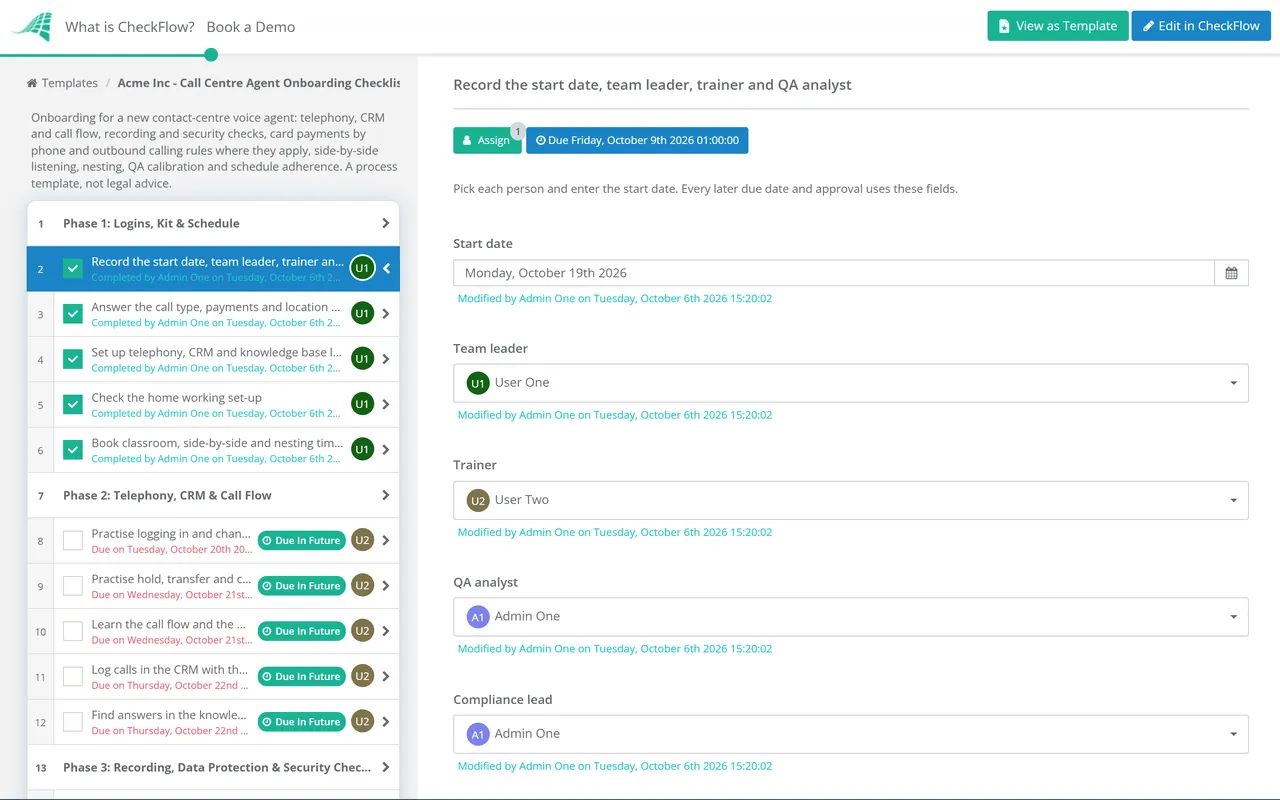
Phase 1: Logins, Kit & Schedule

  • Record the start date, team leader, trainer and QA analyst — every later due date runs from the start date
  • Answer the call type, payments and location questions — inbound, outbound or blended; card payments by phone or not; office or home
  • Set up telephony, CRM and knowledge base logins — agent ID on the phone system and dialler, the right CRM role, and a tested headset
  • Check the home working set-up — shown for home agents: a private room, a wired connection, no paper at the desk and a screen nobody else can see
  • Book classroom, side-by-side and nesting time in the schedule — so workforce planning does not count the agent as available too early
Phase 2

Phase 2: Telephony, CRM & Call Flow

  • Practise logging in and changing agent states — available, after-call work, break and training, and why the wrong state leaves callers waiting
  • Practise hold, transfer and conference on test calls — tell the caller before holding, and brief the receiving agent on a warm transfer
  • Learn the call flow and the mandatory script lines — which words are fixed, such as security and legal statements, and where the agent can speak naturally
  • Log calls in the CRM with the right disposition codes — notes another agent could pick up without calling the customer back
  • Find answers in the knowledge base during role-play calls
Phase 3

Phase 3: Recording, Data Protection & Security Checks

Finished before the agent takes a live call. It closes with the compliance lead’s sign-off, and nothing after it opens until that is given.

  • Explain how calls are recorded and what callers are told — the recording message, why calls are kept, and what to say if a caller objects
  • Run the caller security check before discussing an account — ask, never prompt, and know what a third party may be told
  • Recognise requests that must be routed — complaints, requests for personal data, and signs that a caller may be vulnerable
  • Complete the compliance assessment — a short test on recording, security and data handling
  • Compliance lead approves the agent for live calls
Phase 4 — If Taking Card Payments

Phase 4: Card Payments by Phone

Shown only when the agent will take card payments. Process steps, not a PCI DSS assessment.

  • Walk through the secure payment procedure — keypad entry with tone masking, or pausing the recording, whichever your system uses
  • Practise a payment in the training environment — confirm the recording stops or the tones are masked before the number is given
  • Confirm card details are never written or typed into notes — not on paper, in the CRM, in chat or in email
  • Report a recording that captured card details — to the team leader the same day, as a security incident
  • Sign the card handling acknowledgement
Phase 5 — If Outbound or Blended

Phase 5: Outbound Calling Rules

Shown for outbound and blended agents. A process step, not legal advice: check the rules for each country you call.

  • Explain the do-not-call lists and how numbers are screened — the National Do Not Call Registry in the US, TPS and CTPS in the UK, and your own suppression list
  • Practise recording a do-not-call request during a call — logged before the call ends, never left for later
  • Deliver the opening identification on every call — agent name, company and purpose, with a number that can be called back
  • Check calling hours against the customer’s time zone — in the US, 8 a.m. to 9 p.m. at the called person’s location
  • Explain abandoned and silent calls and the agent’s part — staying ready in available state so dialled calls connect at once
Phase 6

Phase 6: Side-by-Side & Nesting

Nesting ends on the trainer’s approval, not on a fixed date.

  • Complete side-by-side listening with an experienced agent — across the call types the agent will take
  • Take the first live calls with a coach listening in — the coach can step in, and debriefs after each call
  • Work nesting shifts with floor support on hand — simpler call types first, with a raised-hand route for home agents
  • Review recorded calls with the trainer each nesting day
  • Trainer approves the agent to leave nesting
Phase 7

Phase 7: QA Calibration & Schedule Adherence

  • Walk through the QA scorecard and automatic fails — what is scored, how it is weighted and which errors fail a call outright
  • Score a recorded call alongside the QA analyst — compare scores line by line until the agent reads the form the same way
  • Explain schedule adherence and how the schedule is built — breaks, after-call work, shift swaps and who to tell when something runs over
  • Hold the first QA evaluations and coaching session — scores and agreed actions recorded on the checklist
  • Team leader signs the agent off for full production

Phone Rules Every New Agent Should Know: US and UK

Agents do not need to know the regulations by section number. They do need to know what each rule asks of them on a call, because they are the ones saying the words and pressing the buttons. This summary is a starting point for the training content, not legal advice. Your compliance team should confirm the rules for every state and country you call or serve.

Topic United States United Kingdom
Recording callsFederal law allows recording with one party’s consent, but some states, including California and Florida, require the consent of everyone on the call, so a recording notice at the start is the safe defaultA business recording its calls must make all reasonable efforts to tell callers they may be recorded, and data protection law expects people to be told why
Card numbers on recordingsThe same in both: PCI DSS forbids keeping the card security code after a payment is authorised, including in audio files. The PCI Security Standards Council says to stop it being recorded wherever possible
Do-not-call listsThe National Do Not Call Registry plus a company list. Anyone involved in telemarketing must be trained in how the list is usedMarketing calls must be screened against the TPS and Corporate TPS, and against your own list of people who have objected
A request to stop callingHonoured within a reasonable time of no more than ten business days, and kept for five yearsAdded to the suppression list, not deleted, so the number is never called again by mistake
Who is callingThe agent’s name, the company the call is for, and a phone number or address; telemarketers must also state the purpose of the call promptlyThe organisation’s name and a phone number shown to the person called, which they can ring back
Abandoned callsA call counts as abandoned if no agent is connected within two seconds of the greeting; the safe harbour allows no more than 3% of answered calls per campaign over 30 daysOfcom sets no permitted rate. Its policy expects a short information message within two seconds, a returnable number, and no repeat call within 72 hours unless a live agent is guaranteed

Some of this is moving. The FCC’s rules on how people revoke consent to calls and texts have changed since 2025, with parts delayed. Ofcom dropped the 3% figure from its UK policy in 2016, saying it had never been a safe harbour, so treat any abandoned call as a problem. The ICO is reviewing its marketing guidance after the Data (Use and Access) Act 2025. Check the sources directly: the FTC Telemarketing Sales Rule, the FCC telemarketing rules, Ofcom’s persistent misuse policy, the ICO guidance on live marketing calls and the PCI SSC answer on call recordings.

Why Run Call Centre Onboarding in CheckFlow?

1

The queue decides the training

Three answers on the first phase shape the checklist. An outbound or blended agent gets the calling rules, an agent who takes payments gets the card procedure, and a home agent gets the workspace check. An inbound agent who never takes a card sees none of it.
2

No live calls before sign-off

The compliance lead’s approval halts the checklist until it is given, and nesting ends on the trainer’s approval. The team leader, trainer and QA analyst are picked once on the first task, so each approval and review lands with the right person.

3

A training record clients can audit

The signed card handling acknowledgement, the assessment result, the calibration scores and the coaching notes sit on one checklist, each task stamped with who completed it and when. When an outsourcing client asks how agents were trained, you can show them.

Training classes start every few weeks in most contact centres. CheckFlow’s onboarding software runs one checklist per agent with due dates from each start date, and reports show who is still in nesting and who is waiting for sign-off.

Running a home-based team? Remote employee onboarding in CheckFlow covers equipment shipping and remote check-ins alongside this checklist. Once agents are in production, the Call Center Sales QA Checklist takes over for ongoing call scoring on sales queues.

Frequently Asked Questions

What is nesting in a call centre?

+

Nesting is the period between classroom training and the full queue, when a new agent takes real calls with extra support around them. Usually that means simpler call types, a trainer or team leader on the floor to answer questions straight away, more calls reviewed than usual, and a short debrief each day. Measures such as handle time are watched for trends rather than held against the agent. Nesting should end when the agent meets agreed quality criteria, not after a set number of days.

Do we have to tell callers that calls are recorded?

+

In the UK, a business that records calls must make all reasonable efforts to tell callers that calls may be recorded, and data protection law expects you to explain why. In the US, federal law needs only one party’s consent, but some states require everyone on the call to agree, so most contact centres play a notice on every call. Agents should know what the message says and how to answer a caller who asks about it or objects.

Can agents take card payments on a recorded line?

+

Yes, as long as the card security code does not end up in the recording. PCI DSS forbids storing it after the payment is authorised, and the PCI Security Standards Council treats an audio file as storage. Common methods are tone masking, where the customer keys the number and the agent hears flat tones, and pausing the recording while the details are given. Agents must also never write the number down or type it into notes.

What outbound calling rules should new agents learn?

+

The ones they control on a call: say who they are and who they are calling for, record a request to stop calling before the call ends, and never call a number they have been told is suppressed. US agents also need to respect calling hours of 8 a.m. to 9 p.m. in the called person’s time zone. Screening against do-not-call lists and dialler settings are usually handled centrally, but agents should understand both so they can spot when something looks wrong.

How is this different from the customer support agent checklist?

+

Voice work is what this one covers: telephony, scripts, recording notices, card payments by phone, outbound rules, and nesting on live calls. The Customer Support Agent Onboarding Checklist is for written, mostly asynchronous support by email, chat and in-app messages, where the agent learns the product hands-on, writes knowledge base articles and escalates bugs to engineering. If your agents do both, run this one and add the written-channel tasks to it.

Is CheckFlow free for this template?

+

14-day free trial, no card required. The Business plan is $10 per user per month after the trial. Full details at checkflow.io/pricing.

Every Agent Ready Before the Phone Rings

Free trial — no credit card required.